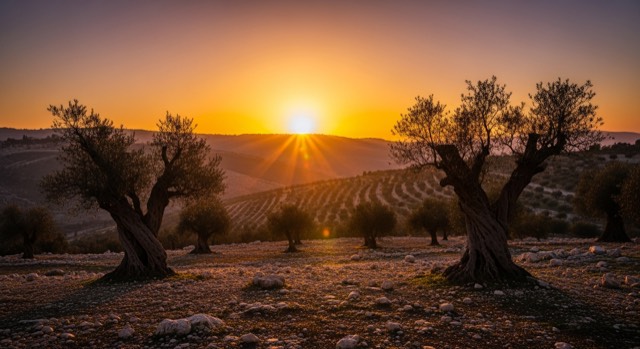
A Covenant Etched in Dust and Stars
It’s late. The house is quiet, but your mind isn't. The blue light of a screen paints shadows on the wall as headlines scroll past, each one a fresh wave of violence and confusion from a tiny sliver of land thousands of miles away. You see the anger, the rubble, the weeping mothers, and a question burns in the stillness of your heart: Why? Why this place, this people? It feels like the world’s most stubborn storm, a conflict that rages from generation to generation, and we whisper into the darkness, 'God, why do you protect Israel?' The question isn't political; it's deeply spiritual, a plea to understand the heart of a God whose ways so often feel shrouded in a painful mystery.
And then we come to the Lord's own words, spoken not from a throne of comfort but on the road to a cross. Jesus looks at his disciples, his friends, and he doesn't promise them ease. He promises them fire. 'Now the brother shall betray the brother to death, and the father the son; and children shall rise up against their parents, and shall cause them to be put to death.' He tells them, with a devastating clarity, 'And ye shall be hated of all men for my name’s sake.' This is not a portrait of a pampered people, shielded from all harm. It's a promise of endurance through the very worst of human depravity, a promise that salvation is found not in avoiding the trial, but in holding fast through the long, dark night until the dawn.
So what is God’s protection then? It’s not a bubble of invincibility. It’s not an escape from history. Look closer at what Christ says. He speaks of an affliction so profound, a time of trouble 'such as was not from the beginning of the creation which God created unto this time, neither shall be.' It is a horror that would consume everything. But then, the pivot. The entire Bible hinges on these 'buts' from God. 'And except that the Lord had shortened those days, no flesh should be saved: but for the elect’s sake, whom he hath chosen, he shortened the days.' There it is. Protection isn't the absence of the storm; it is God's hand on the storm's leash, preserving His chosen people not *from* the fire, but *through* it for His own unshakeable purposes.
And except that the Lord had shortened those days, no flesh should be saved: but for the elect’s sake, whom he hath chosen, he shortened the days.— Mark 13:20, KJV
The Elect's Sake
We try so hard to make sense of it all with our own tools. We draw maps, sign treaties, build armies, and engage in endless, circular arguments, believing that if we just find the right political formula, we can solve this ancient wound. But human effort is a dam made of sand against this tidal wave of prophecy. Every worldly attempt to bring a lasting peace or a final solution fails because it cannot grasp the spiritual dimension of this conflict. Men are trying to fix a foundation when the argument is about the Architect's original blueprint. Self-reliance, political maneuvering, military might—they are all utterly powerless before a promise God made to Abraham under a canopy of stars, a promise He intends to keep no matter what empires rise and fall.
And here's the beautiful, staggering truth that changes everything. God's faithfulness to Israel is the bedrock of His faithfulness to you. If God could break His covenant with them, what hope would your faith have? His preservation of that people is the ultimate demonstration of His character: He does not forget His promises. The finished work of Christ on the cross was not a plan B; it was the crescendo of the song He began singing with Abraham. God's protection of Israel through the ages isn't about their merit, their righteousness, or their performance—and thank God, because neither is His grace toward us. It is all, from start to finish, about His name, His glory, and the integrity of His Word.
When Jesus speaks of the 'elect's sake,' He is speaking of His chosen, a term deeply rooted in the story of Israel. He is talking about a remnant, a people preserved according to a covenant of grace. This isn't about ethnic superiority; it's about prophetic necessity. From this people came the patriarchs, the prophets, the Scriptures, and ultimately, the Messiah Himself. God’s purpose required their preservation. So when you see that 'abomination of desolation, spoken of by Daniel the prophet, standing where it ought not,' you are seeing a signpost in God's grand, redemptive timeline. It is a terrible sign, but it is a sign nonetheless that God is still sovereign over history, moving all the pieces toward their final, intended conclusion.
But when ye shall see the abomination of desolation, spoken of by Daniel the prophet, standing where it ought not... then let them that be in Judea flee to the mountains:— Mark 13:14, KJV
Pray Your Flight is Not in Winter
This grand, cosmic drama touches down right in the middle of your living room, right in the quiet anxieties of your own heart. Jesus's warning, 'And pray ye that your flight be not in the winter,' is so startlingly practical. He's not just talking about eschatology; He’s talking about real life, about shivering children and impossible choices. He cares about the details. And it shows us that trusting God’s sovereign plan doesn't mean we become stoic and unfeeling. It means we learn to pray with a new urgency, not just for the 'what' but for the 'how.' We learn to ask for mercy in the midst of the trial, for strength when our own gives out, for the grace to flee to the mountain of His presence when the world demands we stay and fight its losing battles.
So let this truth settle over you. Stop trying to fix the world with your worry. Stop trying to untangle the knots of prophecy with your own intellect. Rest. Rest in the God who keeps His promises. If He is sovereign enough to shorten the days of the greatest tribulation the world will ever know for the sake of His elect, don't you think He is sovereign over the crisis in your own life? Your protection, like theirs, might not mean avoiding the pain. It might mean being held *in* the pain, preserved for a purpose you cannot yet see, sustained by a grace that is more than sufficient for the affliction of this present hour. You don't have to understand the whole map; you just have to trust the Guide.
Walking in this grace day by day means we read the news differently. We see the conflicts of the world not as random chaos but as the groaning of a creation awaiting its redemption. It means we pray for Israel not with a political agenda, but with a deep, biblical understanding that we are praying for the integrity of God's own Word to be upheld. It means when our own lives are shaken, when a brother betrays a brother in our own family, when we are misunderstood for our faith, we don't despair. We remember that we are part of a story much bigger than our own, a story of endurance, a story that ends not in tragedy, but in the triumphant return of the King.
And pray ye that your flight be not in the winter. For in those days shall be affliction, such as was not from the beginning of the creation which God created unto this time, neither shall be.— Mark 13:18-19, KJV
He That Shall Endure
The solid ground beneath our feet is this: God made a promise. It was an unconditional covenant of grace, and He will see it through. The entire witness of Scripture, from Genesis to Revelation, testifies to a God who chooses, who calls, who preserves, and who redeems for His own name's sake. His protection of Israel is not a sentimental favoritism but a display of His covenant-keeping power for all the world to see. It is the historical anchor that keeps our personal faith from drifting into mere feeling or philosophy. He is faithful in the big story, so we can trust Him with our small one. That is the rock we build our house on, and the gates of hell shall not prevail against it.
So be careful. Be so careful not to fall back into the trap of measuring God's faithfulness by the world's standards of peace and prosperity. If you do, you will be constantly confused and disappointed. The world sees chaos; faith sees a covenant being fulfilled. The world sees a political problem; faith sees a prophetic promise. Don't let the noise of the temporary drown out the whisper of the eternal. God's protection is real, but it is a fierce, refining, preserving protection that has an end goal in mind: not our immediate comfort, but His ultimate glory and the salvation of His chosen people.
And ye shall be hated of all men for my name’s sake: but he that shall endure unto the end, the same shall be saved.— Mark 13:13, KJV
Let your heart find its rest here tonight. The God who watches over Israel, who shortens the days of affliction for the sake of the elect, is the very same God who holds your life in His hands. His eye is on the sparrow, and His heart is bound by covenant to His children. The storms will come, the winds will blow, and the nights will grow dark. But the promise holds. He who began this good work will be faithful to complete it. Trust Him. Trust His timing. Trust His methods. For He is preserving you, right now, not just from something, but for someone—for the day you see your Savior face to face.