There is a voice that many of us carry — a voice that sounds like memory but functions like a prison. It speaks in the language of old failures, old sins, old wounds. It says: you know who you used to be. Don't forget. Don't get too comfortable thinking you've changed. And for some of us, we have believed that voice so long that we've stopped noticing we carry it. We just walk lighter in some rooms and heavier in others, and we never quite ask ourselves why.
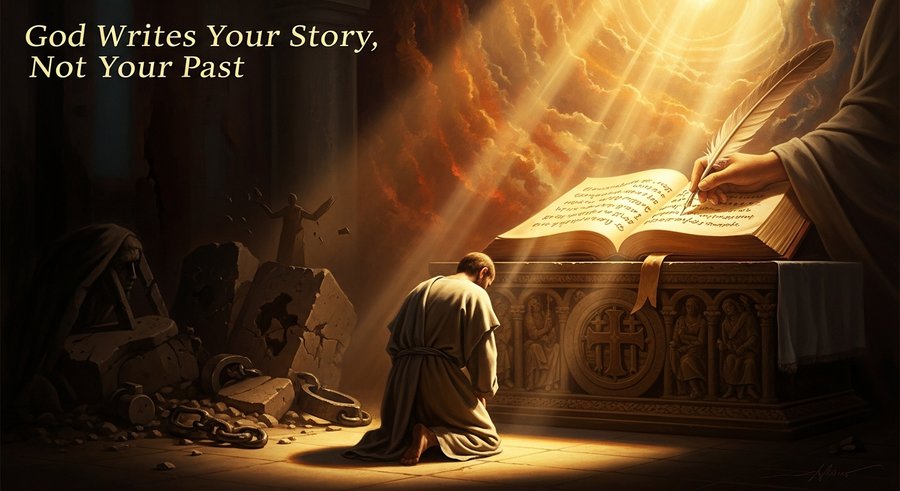
I want you to consider this: who gets to write your story? Because if your past holds the pen, the answer was decided years ago. But if God gets the pen — and He does, if you will let Him — then the most important pages have not been written yet.
"Therefore, if anyone is in Christ, he is a new creation; old things have passed away; behold, all things have become new."— 2 Corinthians 5:17 (KJV)
There is a voice that many of us carry — a voice that sounds like memory but functions like a prison. It speaks in the language of old failures, old sins, old wounds. It says: you know who you used to be. Don't forget. D...
- God Specializes in People With a History: Trusting God's Word through life's deepest trials and seasons of waiting.
- Your Worst Moment Is Not Your Defining Moment: Trusting God's Word through life's deepest trials and seasons of waiting.
- Stop Introducing Yourself By Your Old Name: Trusting God's Word through life's deepest trials and seasons of waiting.
God Specializes in People With a History
Look at the lineage in Matthew chapter one — the genealogy of Jesus Christ, the Son of God. It is a roll call of people who had no business being in that list by human standards. Rahab, the prostitute of Jericho. Tamar, who did what she had to do in desperation. Bathsheba, introduced to Scripture through the wound of David's sin. Ruth, a foreign woman from Moab, a nation that was supposed to be Israel's enemy. Jacob, who deceived his father. Judah, who wasn't exactly a model of righteousness.
These men and women are in the bloodline of Jesus. Not despite their stories, but with their stories. God did not redact their histories before including them in the most sacred narrative in human history. He wove their stories into it — not to glorify the failures, but to show us what redemption actually looks like when God is writing.
He did not give them new pasts. He gave them new futures. And there is a critical difference between those two things. You don't need a past that was clean. You need a God who is sovereign enough to repurpose the broken parts.
"For I am not ashamed of the gospel of Christ, for it is the power of God to salvation for everyone who believes."— Romans 1:16 (KJV)
Your Worst Moment Is Not Your Defining Moment
Think about someone in Scripture who had a defining moment that was not their worst one. Peter denied Jesus three times — three times in one night, with cursing, with the firelight on his face, with his voice loud and frightened. And yet, within weeks, he was standing in Jerusalem and 3,000 people came to Christ through his preaching. Not someone else — Peter. The same voice that said "I don't know the man" said "Repent and be baptized, every one of you."
What changed? Jesus did not pretend the denial never happened. He met Peter by the sea, and He asked him three times — once for every denial — do you love me? He didn't erase the failure. He redeemed it. He returned to the exact number and made it into something else. The past didn't disappear: it was transformed into a foundation of grace deep enough to build a ministry on.
That is what God does. He does not hand you a blank page and pretend you never wrote on the first one. He takes the page that is already written — the one with the mistakes and the mess and the crossed-out places — and He writes something new starting right from here. From this moment. From today.
"See, I am doing a new thing! Now it springs up; do you not perceive it? I am making a way in the wilderness and streams in the wasteland."— Isaiah 43:19 (NIV)
Stop Introducing Yourself By Your Old Name
When Jacob wrestled with God through the night and demanded a blessing, God asked him: What is your name? He answered: Jacob. That was the name that meant "supplanter" — deceiver, heel-grabber, the one who manipulated his way through life. God then changed his name: Israel. Prince of God. And with the new name came a new walk — literally. Jacob left that encounter with a limp, but also a blessing. Every step he took for the rest of his life was marked by that night. But he was no longer Jacob.
Some of us are still walking around telling people we are Jacob. Still introducing ourselves by the name the enemy gave us, the name the past assigned, the name fear whispered in our worst season. But God has already spoken a different name over you. You just have to stop answering to the old one.
Today, let this be your declaration: God is the author of my story. My past has a chapter in this book, but God has the pen from here forward. And every chapter He writes ends the same way — in redemption, in purpose, in the irreversible victory of a man who went to a cross and came back with the keys to death and hell in His hand.
He is writing. Trust the Author.
"Being confident of this very thing, that He who has begun a good work in you will complete it until the day of Jesus Christ."— Philippians 1:6 (KJV)