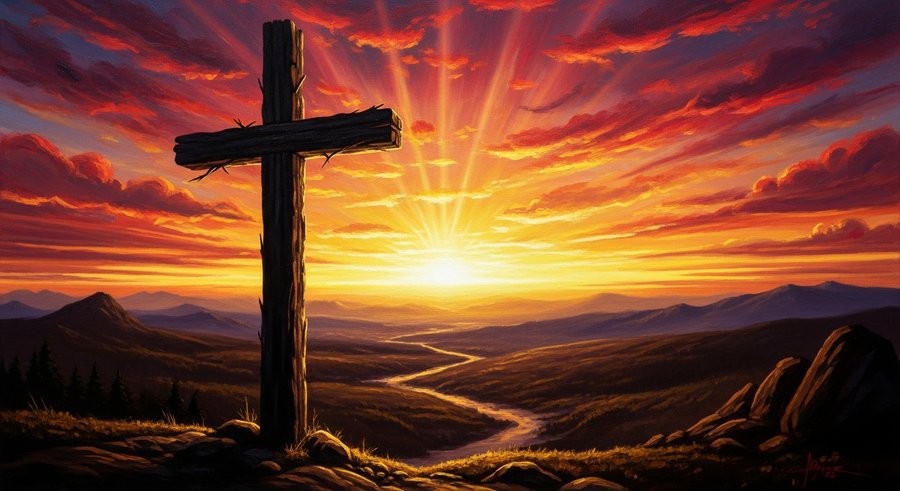
The cross of Christ is not a quiet relic of the ancient past—it is the living anchor of eternal hope and reconciliation. At Golgotha, Jesus willingly bore the full penalty of human rebellion, substituting His righteousness for our sin. Because He died and rose again, salvation is not earned through human effort, but received freely by grace through faith in Him (Romans 5:8).
The Interruption We All Needed
The cross. For many of us, the image is so familiar it has lost its shock. We see it on necklaces, on church steeples, tattooed on skin. It has become a sanitized symbol, a quiet piece of religious art. But the real cross, the one that stood on Golgotha’s hill, was anything but quiet.
It was a brutal, bloody instrument of state-sponsored terror. It was scandalous. It was designed to humiliate, to scream failure, to be the final, full stop on a man’s life and movement. And for the followers of Jesus, it felt like exactly that: a catastrophic end to the greatest story they had ever known.
They had been on the ultimate 'come up.' They had seen Jesus heal the sick, feed the thousands, and teach with an authority that left the religious elite sputtering. They were following a King, and they expected a coronation. What they got was a crucifixion. What they witnessed was their hope, their Rabbi, their Messiah, being mocked and murdered between two common criminals. The very people He came to save stood by and challenged Him, their words dripping with scorn.
They couldn't see it then, but this horrifying interruption was the whole point. This was not Plan B. This was the plan from before the foundation of the world. Humanity, lost in its own pride and rebellion, needed an interruption. Our frantic efforts to save ourselves, to be good enough, to build our own towers to heaven—it all needed to be brought to a halt.
The cross was God’s divine interruption. It was the moment He stepped into our failure and absorbed it completely. The mockery of the crowd was, in a dark and twisted way, proclaiming the gospel without even knowing it. Jesus couldn't save Himself *because* He was saving others. He stayed on that cross not because He was powerless, but because His power was being demonstrated in a way the world had never seen and could never comprehend: through sacrificial love.
He saved others; himself he cannot save. If he be the King of Israel, let him now come down from the cross, and we will believe him.— Matthew 27:42, KJV
The Great Exchange on Golgotha's Hill
So, what really happened on that cross? It was more than wood, nails, and flesh. It was a spiritual transaction of cosmic significance. It was the place where the perfect Son of God became sin for us. Every lie you’ve ever told, every selfish act, every hidden shame, every broken piece of your past—it was all placed upon Him. The cross is where God’s perfect justice and His unfathomable mercy kissed. The price for sin had to be paid, and on the cross, it was—paid in full.
This is the heart of the answer to the question, 'why Jesus died?' He died because God’s love for you is relentless. It’s a love that doesn't wait for you to get your act together. It’s a love that meets you in the middle of your mess. The Apostle Paul framed it with breathtaking clarity in his letter to the Romans. He doesn't say Christ died for us when we were deserving or when we finally figured it all out. He says something far more scandalous, far more gracious.
This is the beautiful, terrible truth of the cross. ” (Matthew 27:46). This wasn't a moment of doubt. It was the cry of the Sin-Bearer. For the first and only time in all eternity, the Son experienced the separation from the Father that our sin deserved.
He took our hell so that we could receive His heaven. He took our condemnation so we could receive His righteousness. He was forsaken so you would never have to be. Your debt, your shame, your regrets—they were all nailed to those beams. On the cross, your slate was wiped clean, not because you earned it, but because He paid for it.
But God commendeth his love toward us, in that, while we were yet sinners, Christ died for us.— Romans 5:8, KJV
It's Not Just His Cross, It's Yours Too
The message of the cross doesn't end with us looking back at a historical event in grateful admiration. It extends an invitation into our present reality. The cross that saves us is also the cross that defines us. Jesus was crystal clear about this. He looked a rich young man in the eyes—a man who had everything the world says is valuable—and He loved him enough to tell him the truth. He told him that to truly live, he had to die.
This call is not for the super-spiritual; it is for every single person who wants to follow Jesus. To 'take up the cross' is a daily decision. It is the surrender of our will to His. It is choosing to die to our pride, our ambition, our need to be right, and our addiction to comfort.
It is laying down the illusion that we are in control. It means surrendering our own 'come up' story and allowing God to write a better one—His story, through us. It's a hard saying, and like that rich young man, our first instinct is often to walk away grieved.
But here is the grace in it: Jesus knows we can't do this on our own. When the disciples were astonished, asking who could possibly be saved, Jesus gave them the only answer that matters: “With men it is impossible, but not with God: for with God all things are possible” (Mark 10:27). The same power that held Jesus to the cross—the power of self-giving love—is the power that enables you to carry yours.
The cross is not a burden meant to crush you; it is a yoke that connects you to the strength of Christ Himself. It is where you exchange your weakness for His power, your striving for His peace, your life for His.
Then Jesus beholding him loved him, and said unto him, One thing thou lackest: go thy way, sell whatsoever thou hast, and give to the poor, and thou shalt have treasure in heaven: and come, take up the cross, and follow me.— Mark 10:21, KJV
The cross still changes everything because it was not the end of the story. The darkness of that Friday was shattered by the light of Sunday morning. The resurrection proves that the payment was accepted, death was defeated, and the love of God is more powerful than any grave.
The cross is not a symbol of a tragic hero, but the throne of a victorious King. It stands today as God's eternal declaration over your life: you are loved, you are forgiven, you are redeemed. It is the place where your broken story becomes a beautiful testimony of His unending grace.