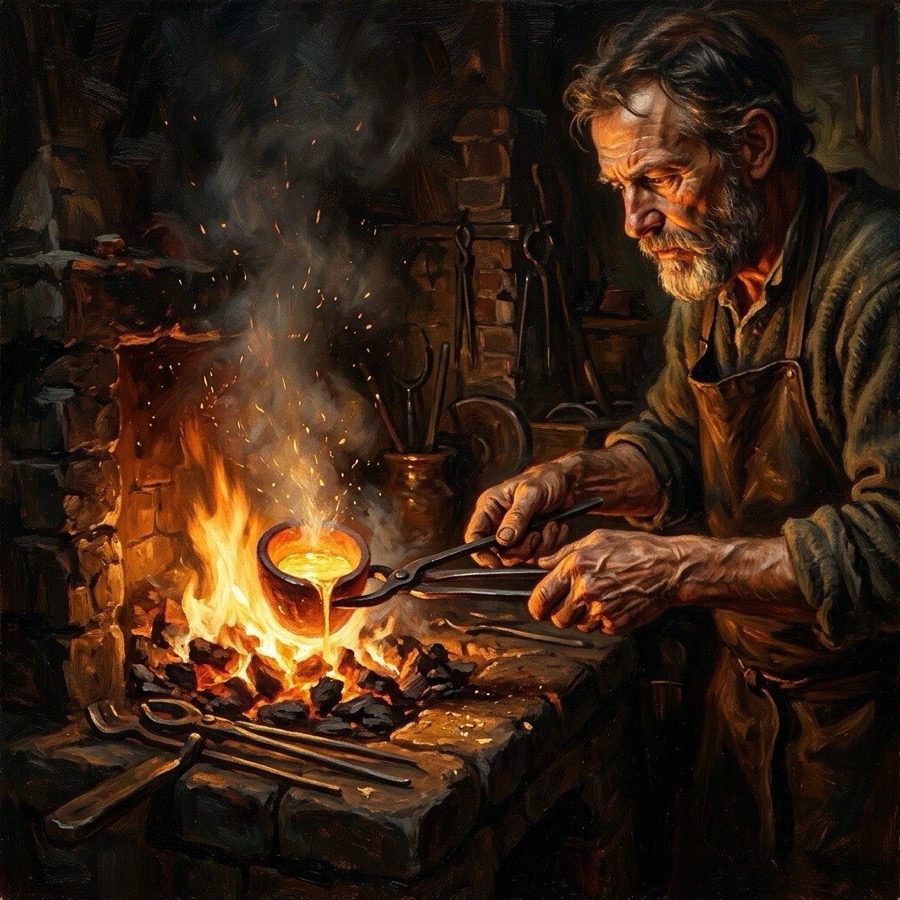
The enemy of our souls is a master of timing. When you are walking through a season of intense difficulty, dry wilderness, or heavy trial, he rarely attacks with a single front. Instead, he waits until you are weary, and then he whispers a devastating lie directly into your spiritual ear: "God is angry with you. This hardship is proof of His displeasure. You are being punished."
He wants you to believe that the adversity you face is a divine payment for past failures, a debt you cannot name, or evidence that the Father has withdrawn His love. This is a cruel, calculated deception. By framing your trial as punitive wrath, the enemy seeks to inject shame into your suffering.
If you believe God is punishing you, you will shrink back from His presence in fear rather than running to His throne of grace for help. You will feel condemned to suffer alone, waiting out a sentence you cannot change.
But this is not the testimony of Holy Scripture. For the born-again believer, who is securely held in a living relationship with Jesus Christ, our trials are never judicial punishments. They are divine processes. God is not destroying you; He is refining you.
The enemy of our souls is a master of timing. When you are walking through a season of intense difficulty, dry wilderness, or heavy trial, he rarely attacks with a single front. Instead, he waits until you are weary, and...
- The Great Divide: Trusting God's Word through life's deepest trials and seasons of waiting.
- The Refiner Sits at the Furnace: Trusting God's Word through life's deepest trials and seasons of waiting.
- The Apostolic Perspective on the Fire: Trusting God's Word through life's deepest trials and seasons of waiting.
The Great Divide: Condemnation vs. Chastisement
To understand why this season is process and not punishment, we must first establish a foundational, orthodox truth regarding our standing before God. If you have been born again by the grace of God through faith in the finished work of Jesus Christ, your sins—past, present, and future—have been fully paid for at Calvary. The wrath of God that we deserved was entirely poured out upon our Savior.
Therefore, the Apostle Paul writes with absolute, unwavering certainty in the Epistle to the Romans:
"There is therefore now no condemnation to them which are in Christ Jesus, who walk not after the flesh, but after the Spirit."— Romans 8:1
If there is "no condemnation" for those in Christ Jesus, then God cannot and will not punish a believer in a judicial sense. To punish a believer for sin would be to demand a double payment for a debt that Christ already paid in full. God’s justice would forbid it, and His grace prevents it.
However, we must distinguish between judicial punishment and parental chastisement. Punishment is meted out by a judge upon a criminal to satisfy the law; chastisement is administered by a loving Father to train and mature His child. The writer of Hebrews explains this vital distinction:
"For whom the Lord loveth he chasteneth, and scourgeth every son whom he receiveth."— Hebrews 12:6
Chastisement is not proof of God's rejection; it is the ultimate proof of your adoption. It is a relational process designed to correct our steps, deepen our dependence, and produce the peaceable fruit of righteousness. When the heat is turned up, it is not because God is trying to burn you up, but because He is burning away the dross that hinders your walk with Him.
The Refiner Sits at the Furnace
The Old Testament prophet Malachi provides us with one of the most beautiful and comforting metaphors of this divine process. He writes of the coming Messiah’s work in the lives of His people:
"And he shall sit as a refiner and purifier of silver: and he shall purify the sons of Levi, and purge them as gold and silver, that they may offer unto the LORD an offering in righteousness."— Malachi 3:3
Consider the precision of this imagery. An ancient metallurgical refiner did not simply throw precious metal into a raging fire and walk away. He did not abandon the crucible to the elements. Instead, the scripture says, "he shall sit." The refiner sits directly before the furnace, fully engaged, watching the process with intense, uninterrupted focus.
The refiner knows that if the heat is too low, the impurities—the dross—will never separate from the silver. But he also knows that if the heat is too high, or if the metal remains in the fire for even a moment too long, the silver itself will be damaged and lose its value. He regulates the temperature with absolute mastery. He is present in every second of the trial.
How does the refiner know when the process is complete? Historically, the silversmith knew the dross was fully purged when he could look down into the molten metal and see his own face perfectly reflected on the surface. This is exactly what God is doing in your life.
He has not abandoned you to the fire. He is sitting at the furnace, watching over you, adjusting the heat, and waiting patiently until the image of His Son, Jesus Christ, is clearly reflected in your character, your faith, and your life.
The Apostolic Perspective on the Fire
The Apostle Peter, who knew firsthand the pain of failure and the restoring grace of Christ, wrote to believers who were scattered and suffering under intense trials. He did not offer them shallow platitudes, but anchored them in the eternal purpose of their suffering:
"Wherein ye greatly rejoice, though now for a season, if need be, ye are in heaviness through manifold temptations: That the trial of your faith, being much more precious than of gold that perisheth, though it be tried with fire, might be found unto praise and honour and glory at the appearing of Jesus Christ:"— 1 Peter 1:6-7
Notice the deliberate language Peter uses under the inspiration of the Holy Ghost. First, he notes that these trials are "for a season." Your current struggle is not your permanent destination. The furnace has an expiration date. God has measured the duration of this trial, and it will not last one second longer than is necessary to accomplish His divine purpose.
Second, Peter includes the phrase "if need be." There is a divine necessity behind your trial. God does not waste pain. If you are in the fire, it is because there is something precious in your faith that must be brought to light—something that comfort and ease could never produce. The "trial of your faith" is of far greater value than perishable gold because it yields eternal dividends: praise, honor, and glory at the appearing of our Lord Jesus Christ.
The Work of Patience and Wholeness
When we are in the midst of a difficult season, our natural, fleshly response is to cry out, "Why is this happening to me?" or "How can I escape this?" But the scriptures invite us to ask a higher, more spiritually mature question: "What is God producing in me through this?"
The Apostle James instructs us on how to yield to this divine process rather than fighting against it:
"But let patience have her perfect work, that ye may be perfect and entire, wanting nothing."— James 1:4
In the King James Bible, the word "perfect" does not imply sinless perfection, but rather spiritual maturity, completeness, and full growth. The word "entire" means whole, with no vital part missing.
The fire of testing does not rob you of anything of true spiritual value. Instead, it consumes the wood, hay, and stubble of self-reliance, pride, and worldly security. It leaves you "wanting nothing"—fully satisfied in Christ, deeply rooted in His grace, and unshakable in your faith. The very areas where you feel the most pressure are the areas where God is building a supernatural resilience that will serve you for the rest of your earthly calling.
You Are in His Hands
Dear believer, do not listen to the accusations of the enemy. Your current trial is not a sign that God has forgotten you, nor is it a punishment for your past. If you are in Christ, you are fully accepted, deeply loved, and eternally secure.
This season is a process of preparation. God is expanding your capacity to hold His blessings, deepening your prayer life, and teaching you to walk by faith and not by sight. He is pruning the branches of your life not to kill them, but so that they may bring forth more fruit (John 15:2).
Trust the hand of the Refiner. He has not looked away from you for a single moment. He is right there in the midst of the fire with you, and He knows exactly when to open the door. You will come out of this furnace not smelling of smoke, but shining like pure gold.
— Grace — Faith Companion