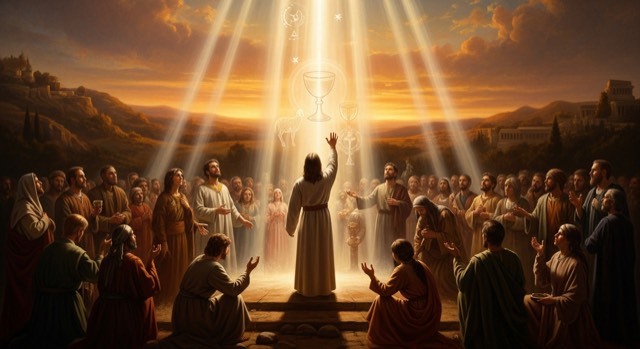
It’s three in the morning. The house is quiet, the world outside is still, but your soul is loud. There’s a deep, persistent ache that logic can't soothe and sleep can't silence, a profound spiritual hunger for something...
- The Murmur of an Empty Heart: Trusting God's Word through life's deepest trials and seasons of waiting.
- The Well Is Deep, But Grace Is Deeper: Trusting God's Word through life's deepest trials and seasons of waiting.
- Living at the Covenant Table: Trusting God's Word through life's deepest trials and seasons of waiting.
The Murmur of an Empty Heart
It’s three in the morning. The house is quiet, the world outside is still, but your soul is loud. There’s a deep, persistent ache that logic can't soothe and sleep can't silence, a profound spiritual hunger for something more than you currently possess. You've tried filling it with work, with relationships, with hobbies, with religion, but it's like eating stale bread that leaves you emptier than before. This is the murmur of the human heart, the same ancient complaint that echoes through the ages, the one that asks in the darkness if there is truly a bread that can satisfy, a water that can quench this relentless thirst. You feel the grit of your own insufficiency, the deep knowing that all your efforts to draw life from the world's wells have left you with nothing but a frayed rope and an empty bucket.
This is precisely where we find the crowd in the sixth chapter of John's gospel, their bellies full of yesterday's miracle but their spirits grumbling with dissatisfaction. Jesus has just declared, “I am the bread which came down from heaven,” and the sound of their murmuring fills the air. Listen to their complaint: “Is not this Jesus, the son of Joseph, whose father and mother we know? how is it then that he saith, I came down from heaven?” They were stuck on the crust, unable to see the substance. They saw a carpenter, a neighbor, a man of flesh and bone, and their familiarity blinded them to the divine reality standing right before them, offering them the very life of God. Their skepticism is our skepticism; we often look at the claims of Christ through the narrow lens of our own experience, judging the eternal by the temporal and missing the feast for a crumb of doubt.
And here is where the entire story of our redemption pivots. Jesus doesn't offer them a better argument or a more detailed five-step plan for spiritual fulfillment; He offers them a new covenant, a radical reorientation of everything they thought they knew about God. The old way, the manna in the wilderness, was a provision for the body that ultimately ended in death; as Jesus reminds them, “Your fathers did eat manna in the wilderness, and are dead.” But this new bread, this life He offers, is eternal. It’s a transaction sealed not with promises we have to keep, but with blood He was about to shed. The writer to the Hebrews makes it plain: “without shedding of blood is no remission.” This wasn't just a new meal plan; it was a new testament, a new will, making us heirs of a promise that could only be activated by His death.
Verily, verily, I say unto you, He that believeth on me hath everlasting life. I am that bread of life.— John 6:47-48, KJV
The Well Is Deep, But Grace Is Deeper
Think of that woman at the well in Samaria, a perfect picture of our own self-reliant striving. She comes in the heat of the day, a pariah carrying the heavy waterpot of her past, performing a task of sheer survival. She represents our best religious and personal efforts: we dig our little wells of morality, of good works, of self-improvement, and we return to them day after day, hoping to draw up enough to satisfy our thirst. But the well is always deep, and our strength is always small. Her response to Jesus is so telling, so human: “Sir, thou hast nothing to draw with, and the well is deep.” She, like the crowd in John 6, could only see the physical problem, the logistical impossibility. She was focused on the mechanics of getting water, completely missing the man who was offering to become the wellspring of life within her.
Jesus’s answer shatters her world of performance and effort. He doesn't offer her a better bucket or a longer rope. He doesn't offer to improve her system. He offers to obliterate it entirely. “Whosoever drinketh of this water shall thirst again,” He says, exposing the futility of all our striving. Then comes the glorious, unmerited gift: “But whosoever drinketh of the water that I shall give him shall never thirst; but the water that I shall give him shall be in him a well of water springing up into everlasting life.” This is the covenant of grace. It is not a reward for our digging, but a free-flowing fountain installed in the core of our being by the Spirit of God, purchased and guaranteed by the blood of Christ. The guilt isn't just covered; it's gone. The debt isn't just deferred; it's stamped 'Paid in Full' with the crimson ink of Calvary.
This is why Jesus’s words in John 6 are so critical to our peace. He states plainly, “No man can come to me, except the Father which hath sent me draw him.” Your salvation, your connection to God, was never initiated by your own cleverness, your own searching, or your own goodness. You were drawn. Pulled from the mire. Rescued. This truth destroys our pride and establishes our security on the bedrock of God's sovereign choice, not our fickle commitment. The covenant isn't a partnership between two equal parties; it's a testament from a loving Father to his lost children, a one-sided promise from the God who cannot lie, and the inheritance is guaranteed by the Son who cannot fail. He promises, “and I will raise him up at the last day.” He will finish what He started.
This is the bread which cometh down from heaven, that a man may eat thereof, and not die.— John 6:50, KJV
Living at the Covenant Table
So what does this look like when the kids are screaming and you're late for work? It looks like a quiet revolution in your soul. In a moment of intense frustration with a spouse or a coworker, the old self, the one still trying to draw from Jacob’s well, rises up to demand its rights, to prove its point, to win the argument. That old self is desperately trying to establish its own righteousness. But the one who lives by the blood covenant has been given a righteousness that can't be earned and can't be tarnished. You don't have to fight for your place because your place has been permanently secured at the Father's table. This truth allows you to absorb an offense without retaliating, to offer a word of grace when you want to give a piece of your mind, because you are no longer living out of your own depleted account but from the infinite, overflowing resources of Christ's life in you.
So please, my friend, hear me on this. Stop trying to fix yourself. Stop trying to make yourself worthy of the love He has already freely given you. Lay down the tools you've been using to dig your own wells; they are broken. You can't make yourself less thirsty. You can only come, thirsty, to the one who is Living Water. You can't make yourself less hungry. You can only come, starving, to the one who is the Bread of Life. Rest in the finished work of your Savior. His arms are not crossed, waiting for you to get your act together. They are open, bearing the scars that purchased your peace, inviting you to come and dine. This is not a call to try harder, but to trust deeper.
To walk in this grace day by day means you fundamentally change your response to failure. When you stumble, and you will, the covenant means you don't run away from God in shame but run to Him for mercy, knowing the blood has already spoken a better word over you than your sin ever could. It means your identity is no longer a fluctuating stock price based on your daily performance but a fixed, eternal inheritance sealed in heaven. It is a moment-by-moment dependence, a conscious choice to stop drinking from the muddy puddles of self-effort and to draw instead from the deep, clear, artesian well of His Spirit within. It is learning to live loved, not for what you do, but for whose you are.
Every man therefore that hath heard, and hath learned of the Father, cometh unto me.— John 6:45, KJV
Sealed and Secure
The promises of Jesus are not gentle suggestions; they are declarations of eternal fact, spoken with the authority of the Godhead. He doesn't say, “He that believeth on me might have a good chance at everlasting life.” He thunders with divine finality, “Verily, verily, I say unto you, He that believeth on me hath everlasting life.” The verb is present tense. It is a current possession, a legal reality for you right now, not a far-off hope you might attain if you behave. This is the unshakeable ground of our faith. The blood covenant means that your standing with God is based entirely on the unbreakable promise of God, guaranteed by the perfect sacrifice of His Son. Your feelings will lie to you, your circumstances will change, but His covenant word stands forever.
So be on guard against the subtle whisper that tries to pull you back to the wilderness, back to the drudgery of gathering your own manna. It is the voice of religion, and it always seeks to add a condition to the unconditional grace of God. It says, “Christ’s blood is sufficient, but you must also…” That little conjunction is the clinking of a chain. To add any human work to the finished work of the cross is to insult its infinite power and sufficiency. The blood was not a down payment. It was payment in full. You are not on probation. You are a son, a daughter, an heir. Stand fast therefore in the liberty wherewith Christ hath made us free, and be not entangled again with the yoke of bondage.
No man can come to me, except the Father which hath sent me draw him: and I will raise him up at the last day.— John 6:44, KJV
Therefore, come to His table today not as a stranger or a guest who has to earn his keep, but as a beloved child returning home. The blood covenant means your name is written on a place card that can never be removed. It means you belong. You are wanted. You are secure. This isn't a hope built on the sand of your own resolve but on the solid rock of His righteousness. Let this truth sink deep into your bones and quiet your striving soul. The battle is over, the victory is won, the price is paid, and your life is hidden with Christ in God, sealed forever by a promise signed in blood.