More Than a Missing Body
There's a quiet hollowness that can settle in on an Easter Monday. The good dishes are washed and put away, the family has driven home, and the leftover ham sits in the cold silence of the refrigerator. After the glorious hymns and the bright pastels, the ordinary world rushes back in with its familiar weight, its nagging anxieties, and its unanswered questions. It's in that quiet letdown that the true test of our faith begins, because if the resurrection is only a one-day spectacle, a historical pageant we observe once a year, then it has no real power to speak into the deafening quiet of a Tuesday afternoon. We celebrate the empty tomb, but then we go right back to living as though death still has the final say, as if the stone was never really rolled away for good.
The disciples knew that desolation intimately. They weren't suffering from a post-holiday letdown; they were shattered by a post-execution terror, huddled behind locked doors while the world they knew dissolved into failure and fear. They had heard Jesus lament over the city that rejected Him, His voice thick with a sorrow that saw the coming storm. He looked at the heart of their religion and said, 'Behold, your house is left unto you desolate.' That's exactly how it felt in the silence of that Saturday. Desolate. Every hope they had was nailed to a cross and sealed in a tomb, and the promises of God Himself seemed to echo in an empty, abandoned house.
And here's the thing. The resurrection is not a simple repair job on a bad weekend; it is God's definitive, world-altering answer to that very desolation. The Apostle Paul doesn't treat it like a sweet story to make us feel better; he handles it like a structural engineer examining the foundation of a skyscraper, declaring with brutal honesty that if this one beam is faulty, the entire structure is a catastrophic failure. If Christ is not raised, our preaching is a lie, our faith is a fantasy, and worst of all, we are still trapped, utterly and hopelessly, in our sins. The resurrection isn't the epilogue to the story of Jesus; it is the explosive event that gives the entire story its meaning, filling every desolate corner of our lives with a light that cannot be extinguished.
And if Christ be not raised, your faith is vain; ye are yet in your sins.— 1 Corinthians 15:17, KJV
When Your House Is Left Desolate
We spend so much of our lives trying to furnish that desolate house on our own. We hang new curtains of self-improvement, lay down fresh carpets of religious observance, and arrange the furniture of good works, hoping that if we just make it look respectable enough, no one will notice the rot in the foundation. This is the very trap Jesus condemned with fire in His eyes, calling the religious experts of his day 'whited sepulchres, which indeed appear beautiful outward, but are within full of dead men's bones, and of all uncleanness.' Our attempts to fix ourselves, to manage our sin, to earn God's favor through sheer effort, are nothing more than painting a tomb. It might look clean for a little while, but it's still a house of the dead, because it is built on the flimsy, failing power of our own strength.
But the resurrection is God's public declaration that the debt is paid in full and the deed to the house is now in His name. The cross was the place of payment, where the unthinkable price for our sin was settled by the blood of the Lamb, but the empty tomb is the divine receipt. It is God the Father's thunderous 'Amen' to the Son's cry of 'It is finished.' That shame that shadows you, that guilt that whispers your name in the dark, that persistent feeling of not being good enough—it was all buried with Him in that borrowed tomb. But here is the miracle: it stayed there. He walked out into the garden dawn leaving it all behind, and because you are in Him, you walk out free and clear, no longer defined by your failures but by His victory.
Think of the heartbreak in His voice in Matthew 23: 'how often would I have gathered thy children together, even as a hen gathereth her chickens under her wings, and ye would not!' This is not the voice of an angry judge, but of a loving father whose children refuse to come inside during a storm. Their refusal, their stiff-necked insistence on their own way, is what left their house desolate. The resurrection, then, is the ultimate gathering. It is God, in His scandalous grace, not just unlocking the door for the children who ran away, but demolishing the old, ruined house and building an entirely new one, with His risen Son as the chief cornerstone, a place where we are not just forgiven guests but living stones built into a home that can never be shaken.
O Jerusalem, Jerusalem, thou that killest the prophets, and stonest them which are sent unto thee, how often would I have gathered thy children together, even as a hen gathereth her chickens under her wings, and ye would not!— Matthew 23:37, KJV
The Unprofitable Servant's Freedom
This all sounds wonderful on a Sunday morning, but it has to live on a frantic Wednesday evening when you've just lost your temper with your spouse and the weight of the world feels like it's crushing your chest. This is where the reality of the resurrection meets the road of our messy lives. It means that in that moment of searing personal failure, your acceptance before God has not shifted one inch. It means you can stop the frantic cycle of shame and self-justification, and simply breathe in the reality that His perfect record is counted as yours. Living in resurrection power isn't about achieving a state of sinless perfection; it's about getting up from the mud of your own failure, not by your own strength, but by clinging to the finished work of the One who has already conquered sin and death for you.
I need you to hear this. Please, lean in and listen. You can stop trying so hard to impress God. Jesus gives us the most freeing, counter-intuitive job description in all of Scripture when he tells the parable of the servant. After you've done everything you were commanded to do, after you've given it your absolute best, He instructs you to say, 'We are unprofitable servants: we have done that which was our duty to do.' This isn't a put-down; it's a liberation. If even our most faithful obedience doesn't put God in our debt, then we are finally free from the exhausting burden of performance. We can stop trying to build a resume for heaven and simply serve the King out of sheer, grateful love, knowing our place at His table was secured not by our work for Him, but by His work for us.
Walking in this resurrection grace day by day means we can finally afford to be honest about our weakness. We don't have to wear masks or pretend we have it all together, because our identity is no longer rooted in our performance but in His perfection. This truth fundamentally changes how we interact with everyone around us. When Jesus speaks of forgiving your brother seven times in a day, as he does in Luke 17, it sounds impossible until you realize it's flowing from a heart that understands it has been forgiven an infinite, unpayable debt. The resurrection power of Christ doesn't just save our souls for eternity; it re-calibrates our relationships, our reactions, and our responses in the here and now, enabling us to offer grace because we are living in it.
So likewise ye, when ye shall have done all those things which are commanded you, say, We are unprofitable servants: we have done that which was our duty to do.— Luke 17:10, KJV
Standing on Solid Ground
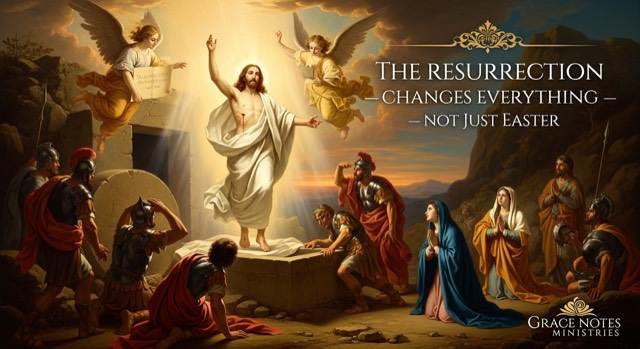
The resurrection of Jesus Christ is not a beautiful idea, a comforting metaphor, or a spiritual philosophy. It is a brute fact of history. It is the unshakable bedrock upon which every single promise of God rests. Without it, the forgiveness of sins is a hopeful wish, the promise of eternal life is a fairy tale, and the presence of the Holy Spirit is a psychological delusion. Paul staked everything on this historical reality, and so must we. The angel at the tomb didn't offer a theory; he stated a fact: 'He is not here: for he is risen, as he said.' Because that is true, everything else is true. Our faith has substance, our hope has certainty, and our lives have a purpose that death itself cannot touch. This is the solid ground for your feet when all other ground is sinking sand.
The most profound tragedy for a child of God is to live as if the resurrection never happened. It is to receive the pardon and then willingly crawl back into the prison cell of fear and guilt. It is to be adopted by the King and yet live like an orphan, scrounging for scraps of approval and trying to earn a love that has already been lavished upon us. When we choose to live by our own religious efforts, our own moral scorekeeping, we are choosing to inhabit a desolate house of our own making. We ignore the open door of the Father's palace to sit in the ruins of our own self-righteousness, forgetting the very power that blasted the door of the tomb off its hinges and declared us free forever.
For I say unto you, Ye shall not see me henceforth, till ye shall say, Blessed is he that cometh in the name of the Lord.— Matthew 23:39, KJV
So don't relegate the resurrection to a single Sunday in the spring. Let it be the resounding reality that defines your every waking moment. It is the power of God available to you now, the promise that this broken world is not the final chapter, and the person of Jesus Christ, alive and reigning, who walks with you through every valley. Because He is risen, your past is redeemed, your present is secure, and your future is gloriously certain. This isn't just a truth for Easter. It is the truth that changes everything, today and for all eternity. He is alive, and because He lives, you can truly live too.