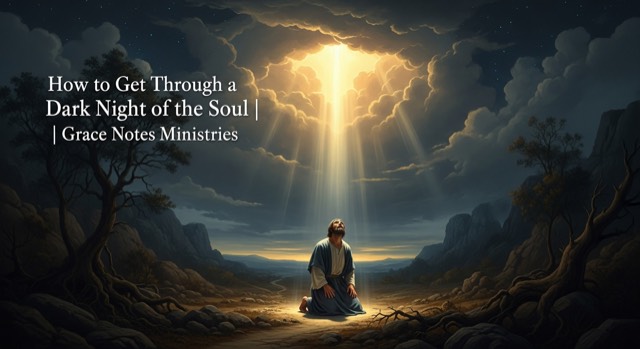
Lover and Friend Hast Thou Put Far From Me
It's three in the morning, and the ceiling is your whole world. Every crack and shadow seems to mock the silence, a profound and heavy silence that feels like the very absence of God. You've prayed, you've pleaded, you've quoted every promise you ever memorized, but the words fall like dead things to the floor. This isn't just a bad mood or a tough week; this is a spiritual blackout, a soul-level cold that no blanket can warm. The psalmist called it being laid 'in the lowest pit, in darkness, in the deeps.' You know exactly what he means. It's the terrifying suspicion that you've been forgotten, cut off from His hand, left alone in an endless night where your cries for help are swallowed by the void.
And here's the thing about that pit: it feels personal, like a judgment you can't quite name. You scour your memory for the secret sin, the unconfessed fault that must have caused this divine departure, this cosmic shunning. But often, there's nothing. There's just the ache. The writer of Psalm 88 offers no explanation for his suffering, only a raw catalog of his grief and the overwhelming sense of God’s wrath upon him. This brutal honesty is a strange kind of comfort, because it validates our own experience. A dark night of the soul isn't always a punishment for a specific failing; sometimes, it is a profound and painful mystery, a season where faith is stripped of all its sensory props and forced to survive on bare truth alone.
But it is in that barren landscape, where feelings have fled and hope has grown thin, that a single, indestructible truth must become our shelter. Before the foundation of the world, a promise was spoken that echoes into our deepest darkness. A virgin would bring forth a son, and 'they shall call his name Emmanuel, which being interpreted is, God with us.' That name, Emmanuel, wasn't just a birth announcement; it was a battle cry against the very darkness you feel right now. His other name, JESUS, was given for a specific reason: 'for he shall save his people from their sins.' This salvation isn't merely a future rescue from hell, but a present reality of His companionship in the hells we walk through on earth. He is with you in the pit, even when He is silent.
Lover and friend hast thou put far from me, and mine acquaintance into darkness.— Psalm 88:18, KJV
The Prison of Your Expectations
We build these invisible prisons, don't we? Prisons of expectation. We're taught, or we assume, that a life with Christ is a straight line of spiritual progress, a steady climb from glory to glory where we feel more blessed and joyful each day. So when the darkness descends, when the joy evaporates and the prayers feel empty, our first assumption is that we've done something wrong. We fall back on the grim calculus of religious performance, trying to fix the problem ourselves. We'll pray harder, read more chapters, serve more hours, fast more often, desperately trying to manipulate the spiritual levers to make God's presence return. But this frantic self-reliance is a house of cards, and the long, slow gale of a true dark night will inevitably bring it all crashing down.
And in the rubble of our own efforts, Jesus points to a different economy entirely. He watches the religious and the rich pour their clanging coins into the treasury, giving easily from their abundance, their surplus. Then He sees her. A poor widow, anonymous and destitute, approaches with two mites, a farthing, the smallest of coins. She gives 'all that she had, even all her living.' And Christ stops everything, gathers his disciples, and says, 'Verily I say unto you, That this poor widow hath cast more in, than all they which have cast into the treasury.' In your dark night, you feel you have nothing left to give but your pain, your confusion, your microscopic grain of faith. You bring Him your spiritual bankruptcy, and He declares it a greater offering than all the world's manufactured piety.
Let that sink in. Now, look again at Psalm 88. It stands alone in the entire Psalter, a gaping wound in the songbook of Israel. It is the only psalm that ends without a final turn to hope, without a concluding note of praise. It ends with the slam of a door: 'Lover and friend hast thou put far from me, and mine acquaintance into darkness.' Why would God include such a bleak, unresolved cry in His holy Word? Because He is not afraid of your reality. He put this prayer in the book to authorize it, to tell you that this desperate, honest cry is a valid prayer. The very existence of Psalm 88 in the canon of Scripture is the hope. It is God's own permission slip for you to be brutally honest with Him, assuring you that He will not turn away from your anguish, even when you can't see His face.
Verily I say unto you, That this poor widow hath cast more in, than all they which have cast into the treasury: For all they did cast in of their abundance; but she of her want did cast in all that she had, even all her living.— Mark 12:43-44, KJV
What to Do When You Can't Do Anything
So how does this truth breathe in the suffocating air of a Tuesday afternoon when the darkness is just as thick as it was at 3am? It's not about trying to feel something you don't. It's about a stubborn, gut-level decision to stand on what is written, not what is felt. It looks like whispering 'Emmanuel' while you're washing the dishes, your mind a storm of doubt. It sounds like calling a trusted brother and saying, 'I'm in the pit today, but I'm holding on.' It's the simple, mechanical act of opening your Bible, even when the pages feel cold and the words seem to mock you, because John tells us exactly why they were given: 'But these are written, that ye might believe that Jesus is the Christ, the Son of God; and that believing ye might have life through his name.' Life is not a feeling. Life is a Person, and you have Him.
Please, friend, hear me on this: stop trying to fix yourself. You are trying to perform spiritual surgery on yourself in the dark with a butter knife, and it's only making things worse. The immense pressure you feel to 'get better' is a lie from the pit of hell, designed to convince you that your standing with God depends on your spiritual performance. It does not. It depends entirely on the finished work of Jesus Christ. Your only job right now is to rest in that work. Let the waves of anxiety and fear come, but know your anchor holds fast to the bedrock of Calvary. Jesus didn't say, 'Clean yourself up and then I'll draw near.' He came to be with us, the broken and the despairing, precisely where we are. He is holding you; your weak, trembling grip is not the issue.
To walk in this grace means you must fundamentally redefine what you call 'victory.' For a season, victory may not be the triumphant return of joy or the sudden lifting of the fog. Victory is making it through another twenty-four hours without giving up. Victory is offering your two mites of trust when you feel spiritually bankrupt. Victory is choosing to believe the objective truth of Scripture over the subjective tyranny of your emotions. It's a quiet, un-celebrated faithfulness that no one else sees. It's the long obedience of just putting one foot in front of the other, trusting that the God who spoke light into darkness is still at work, even when the darkness is all you know.
But these are written, that ye might believe that Jesus is the Christ, the Son of God; and that believing ye might have life through his name.— John 20:31, KJV
The Unshakeable Word in the Shaking World
Your emotions are powerful, and your experience of darkness is painfully real, but they are not the ultimate reality. The bedrock truth of the universe is the character of God and the promises He has made, promises sealed by the blood of His own Son. In the tenth chapter of John, the Jews picked up stones to kill Jesus because He dared to say, 'I and my Father are one.' They couldn't silence that truth then, and your dark night cannot silence it now. Your depression does not get the final word. Your anxiety does not get the final word. Your grief does not get the final word. The Word gets the final word. And that Word became flesh and was named Emmanuel, 'God with us.' That is not a hopeful suggestion. It is an unshakeable, eternal fact.
As light begins to seep back in, as it eventually will, the temptation will be to scurry away from this place of utter dependence. The urge will be to return to the old prison of religious performance, to build up your walls of spiritual disciplines so you never feel that vulnerable again. Please, don't do it. That road only leads back to exhaustion and the same old despair, because it is built on the sinking sand of your own effort. Those disciplines, when they become chains of guilt and performance, are just another form of bondage. Stay in that open, vulnerable place of total reliance on Him. The dark night is a terrible classroom, but it is there we learn the most important lesson of all: He is our only light, and He is more than enough.
Behold, a virgin shall be with child, and shall bring forth a son, and they shall call his name Emmanuel, which being interpreted is, God with us.— Matthew 1:23, KJV
This dark passage is not a detour from your walk with God; for many of us, it is the path itself. It is not a sign of His displeasure but a severe invitation into a faith that is no longer propped up by happy feelings or favorable circumstances. It is an invitation to a faith that can scream the words of Psalm 88 into the silence, knowing that the One who listens is Emmanuel, the God who is with us. He is the Man of Sorrows who had His own Gethsemane, who cried out from His own cross, 'My God, my God, why hast thou forsaken me?' He endured the ultimate darkness so that you would never, in the final analysis, be alone in yours. Cling to what is written. Life is not a feeling you must generate, but a Person you already have. The morning is coming, because the Morning Star has already risen.