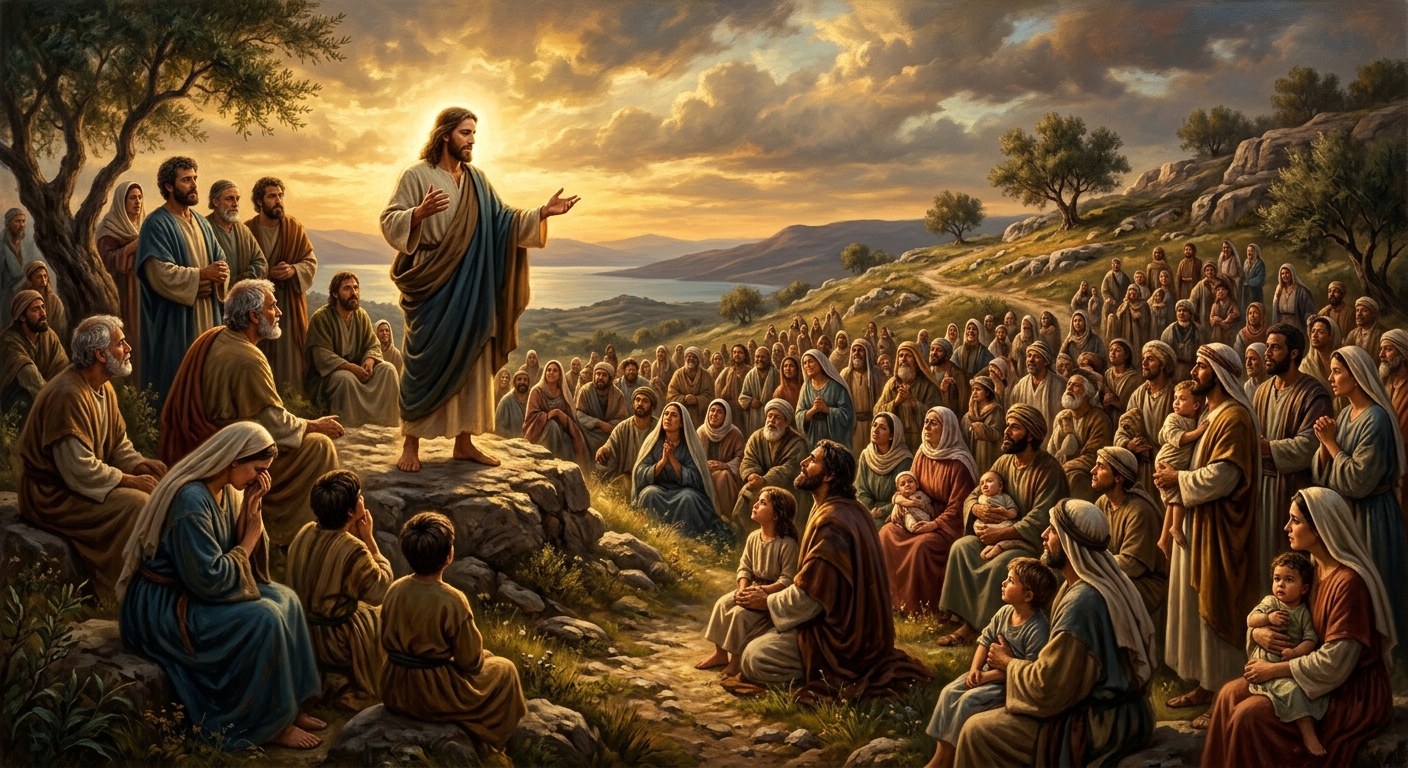
Illustration: Dramatic cinematic biblical illustration for Matthew Chapter 5 showing Kingdom of Heaven ethics, photorealistic oil painting style.
🔊
Listen to Chapter
Grace Notes Journey Audio Narration
Author
Matthew (the Apostle)
Written
~70-85 AD
Key Theme
Kingdom of Heaven ethics
Setting
Mount of Beatitudes, Galilee
Key Verse
Matthew 5:3
Total Verses
48
Chapter Introduction
_When Jesus climbed the gentle slope in Galilee, He gathered His disciples and opened His heart to teach them. In these blessed sayings He calls us to humility, mourning over our sins, and meekness that mirrors the kingdom's values. He promises that those who are poor in spirit will inherit Heaven, and that the meek shall possess the earth. Let these words bring comfort to your soul as you walk in His grace._
Matthew — Chapter 5 — KJV
1
And seeing the multitudes, he went up into a mountain: and when he was set, his disciples came unto him:
Simply PutJesus saw a great crowd (Greek “plethos” G4156) gathering to hear Him, and He climbed a hill to teach them. The disciples climbed up with Him, showing that when we seek God’s wisdom, we must move closer to His presence. This scene reminds us that in the midst of life’s noise, God still makes a way to speak directly to our hearts.
2
And he opened his mouth, and taught them, saying,
Simply PutWith authority and love, Jesus opened His mouth (Greek “anoigō” G562) to teach. The opening of the mouth signals a deliberate, purposeful sharing of divine truth, not mere words. He invites us into a deeper relationship where His teachings become the foundation of our everyday walk.
3
Blessed are the poor in spirit: for theirs is the kingdom of heaven.
Simply Put“Blessed are the poor in spirit” (Greek “ptys pneuma” G4159 & G4154) means those who recognize their spiritual emptiness and dependence on God. Such humility is the key that unlocks the Kingdom of Heaven, because it turns us from self-reliance to God-reliance. In our deepest need, we find true richness in His presence.
Key Verse
4
Blessed are they that mourn: for they shall be comforted.
Simply Put“Blessed are they that mourn” (Greek “pentheo” G3955) speaks to those who grieve over sin and brokenness. Their tears are not wasted; they will be comforted (Greek “paraklēō” G3893) by God’s gentle presence. When we feel the weight of sorrow, God meets us with tender reassurance.
5
Blessed are the meek: for they shall inherit the earth.
Simply Put“Blessed are the meek” (Greek “pakos” G3326) refers to those who are gentle and humble, not weak. Their quiet strength will inherit the earth (Greek “klēroō” G2796) because they trust God’s timing over their own ambitions. In a world that prizes power, the meek find lasting peace in surrender.
6
Blessed are they which do hunger and thirst after righteousness: for they shall be filled.
Simply Put“Blessed are those who hunger and thirst after righteousness” (Greek “pleon” G4140 & “doros” G1412) describes a deep, spiritual craving for right living. When we seek God’s justice and goodness with our whole being, He promises to fill us completely (Greek “plēroō” G4179). God satisfies our yearning when we put Him first.
7
Blessed are the merciful: for they shall obtain mercy.
Simply Put“Blessed are the merciful” (Greek “eleemosyne” G1659) means those who show compassion and forgiveness to others. In doing so, they receive mercy (Greek “eleēmosynē” G1659) from God. When our hearts are soft and generous, we experience the same mercy He freely gives.
8
Blessed are the pure in heart: for they shall see God.
Simply Put“Blessed are the pure in heart” (Greek “katharos” G2670) speaks of sincerity and integrity free from hidden motives. Such purity enables us to see God (Greek “theos” G2316) in our daily lives. When we cleanse our heart of deceit, we get a clearer view of His love.
9
Blessed are the peacemakers: for they shall be called the children of God.
Simply Put“Blessed are the peacemakers” (Greek “eirēnopoios” G1574) refers to those who actively bring harmony where there is discord. They are called the children of God (Greek “tekna” G5041), because they reflect His heart for peace. By mending broken relationships, we become living testimonies of God's grace.
10
Blessed are they which are persecuted for righteousness’ sake: for theirs is the kingdom of heaven.
Simply Put“Blessed are those who are persecuted for righteousness’ sake” (Greek “dikaiosynē” G1340) celebrates those who endure hardship for living rightly. Their reward lies in the Kingdom of Heaven (Greek “basileia” G932). In trials, we are reminded that God’s justice will ultimately prevail.
11
Blessed are ye, when men shall revile you, and persecute you, and shall say all manner of evil against you falsely, for my sake.
Simply Put“Blessed are you when men revile you and persecute you” (Greek “anthrōpos” G444). Even when false accusations fly, we are blessed for Jesus’ sake (Greek “hoti” G3754). In moments of unjust treatment, this verse reminds us that Christ is with us and that our suffering brings Him great honor.
12
Rejoice, and be exceeding glad: for great is your reward in heaven: for so persecuted they the prophets which were before you.
Simply Put“Rejoice, and be exceeding glad” (Greek “mega” G3198) because your reward in heaven is great. The prophets before you were also persecuted, showing that suffering for God’s truth is a mark of faithful service. Our joy comes from the hope of eternal blessings beyond this world.
13
Ye are the salt of the earth: but if the salt have lost his savour, wherewith shall it be salted? it is thenceforth good for nothing, but to be cast out, and to be trodden under foot of men.
Simply Put“You are the salt of the earth” (Greek “halas” G259) means we preserve and flavor life with God’s truth. If salt loses its savor (Greek “gonia” G1105), it is useless and must be discarded. This warns us to stay vibrant in our faith, lest we become bland.
14
Ye are the light of the world. A city that is set on an hill cannot be hid.
Simply Put“You are the light of the world” (Greek “phōs” G5457). Like a city on a hill, our good works shine for all to see. Our lives should illuminate the darkness around us and point others toward Christ.
15
Neither do men light a candle, and put it under a bushel, but on a candlestick; and it giveth light unto all that are in the house.
Simply PutNo one lights a lamp only to hide it under a basket (Greek “parabasis” G3832); they place it on a stand to illuminate the whole house. When we let God’s light shine through us, everyone in our home and community benefits from its glow.
16
Let your light so shine before men, that they may see your good works, and glorify your Father which is in heaven.
Simply PutLet your light (Greek φως, G545) shine before others so they can see the good deeds you do and lift up your Father in heaven. In real life, this means letting God’s love be the beacon that guides people out of darkness.
17
Think not that I am come to destroy the law, or the prophets: I am not come to destroy, but to fulfil.
Simply PutDon’t think I came to tear down the law (Greek νόμος, G3551) or the prophets; I’m here to fulfill them (Greek πληρόω, G4165). For those wrestling with doubt, this assures us that Jesus isn’t a rebel but the completion of God’s promise.
18
For verily I say unto you, Till heaven and earth pass, one jot or one tittle shall in no wise pass from the law, till all be fulfilled.
Simply PutEven the tiniest jot (Greek κέραια, G2777) or tittle (Greek στίγμα, G4983) will never be removed from the law until everything is fulfilled. It’s a promise that God’s word holds fast, even in our moments of fear and uncertainty.
19
Whosoever therefore shall break one of these least commandments, and shall teach men so, he shall be called the least in the kingdom of heaven: but whosoever shall do and teach them, the same shall be called great in the kingdom of heaven.
Simply PutWhoever breaks the smallest commandment and teaches others to do so will be called the least in the kingdom of heaven, but those who obey and teach it will be great (Greek μέγας, G3180). This challenges anyone who feels insignificant to pursue true obedience.
20
For I say unto you, That except your righteousness shall exceed the righteousness of the scribes and Pharisees, ye shall in no case enter into the kingdom of heaven.
Simply PutUnless your righteousness (Greek δικαιοσύνη, G1343) surpasses that of the scribes and Pharisees, you won’t enter the kingdom. It tells those who long for God’s approval that heart-level integrity matters more than outward piety.
21
Ye have heard that it was said by them of old time, Thou shalt not kill; and whosoever shall kill shall be in danger of the judgment:
Simply PutYou’ve heard “You shall not kill,” but anyone who kills will be on trial. The Greek word for kill (φονεύω, G5405) reminds us that every life is sacred and we’ll face accountability.
22
But I say unto you, That whosoever is angry with his brother without a cause shall be in danger of the judgment: and whosoever shall say to his brother, Raca, shall be in danger of the council: but whosoever shall say, Thou fool, shall be in danger of hell fire.
Simply PutAnger without cause (Greek ὀργίζομαι, G3778) puts you in danger of judgment, and calling someone “Raca” (Greek κῶλα, G2796) or “fool” brings you closer to hell fire (Greek γέεννα, G1073). Real anger must be checked before it burns.
23
Therefore if thou bring thy gift to the altar, and there rememberest that thy brother hath ought against thee;
Simply PutIf you bring a gift to the altar but realize your brother has something against you, don’t let that go. This shows that unresolved conflict can hinder our worship.
24
Leave there thy gift before the altar, and go thy way; first be reconciled to thy brother, and then come and offer thy gift.
Simply PutLeave your gift at the altar, go reconcile with your brother, then return. True peace is necessary before presenting God a clean offering.
25
Agree with thine adversary quickly, whiles thou art in the way with him; lest at any time the adversary deliver thee to the judge, and the judge deliver thee to the officer, and thou be cast into prison.
Simply PutAgree with your opponent quickly while traveling together, or you’ll end up in prison. The Greek word for adversary (ἀντιπάλων, G252) warns us that unresolved disputes can trap us.
26
Verily I say unto thee, Thou shalt by no means come out thence, till thou hast paid the uttermost farthing.
Simply PutYou won’t be released until you’ve paid the last farthing (Greek δηνάριον, G1326). This speaks to the seriousness of settling debts before it's too late.
27
Ye have heard that it was said by them of old time, Thou shalt not commit adultery:
28
But I say unto you, That whosoever looketh on a woman to lust after her hath committed adultery with her already in his heart.
Simply PutIf you look at a woman with lust (Greek ἐπιθυμέω, G2025), you’ve already committed adultery in your heart. Inner thoughts are as important as outward actions.
29
And if thy right eye offend thee, pluck it out, and cast it from thee: for it is profitable for thee that one of thy members should perish, and not that thy whole body should be cast into hell.
Simply PutIf your right eye causes you to sin, pluck it out; if not, the whole body might be cast into hell (Greek γέεννα, G1073). This teaches the cost of letting any part of you lead you astray.
30
And if thy right hand offend thee, cut it off, and cast it from thee: for it is profitable for thee that one of thy members should perish, and not that thy whole body should be cast into hell.
Simply PutIf your right hand causes sin, cut it off; better to lose one part than be thrown into hell. It’s a stark reminder that we must eliminate anything that pulls us away from God.
31
It hath been said, Whosoever shall put away his wife, let him give her a writing of divorcement:
Simply PutDivorce was once a legal contract that a man gave to his wife, called apogorēsis (G1110). It’s not a casual breakup; it was a written decree that made the marriage officially over. If you’re sitting at the end of a broken relationship, know that Jesus is pointing out how this law was meant to be used—just as a formal document, not as a cheap excuse.
32
But I say unto you, That whosoever shall put away his wife, saving for the cause of fornication, causeth her to commit adultery: and whosoever shall marry her that is divorced committeth adultery.
Simply PutHere Jesus adds the Greek term porneia (G429), meaning sexual immorality, as the only acceptable reason for divorce. He warns that divorcing for any other cause forces a woman into adultery, and marrying such a divorced woman is also considered adultery. If your heart aches over a split marriage, Jesus reminds you that God values the sanctity of vows and calls for deep thought before breaking them.
33
Again, ye have heard that it hath been said by them of old time, Thou shalt not forswear thyself, but shalt perform unto the Lord thine oaths:
Simply PutThe Old Testament instructed people to keep their promises, or horá (G3690), with a solemn oath before God. This was because breaking an oath dishonored the One who receives it. When your soul feels restless about broken promises, remember that God honors truth and calls us to keep our word without falsehood.
34
But I say unto you, Swear not at all; neither by heaven; for it is God’s throne:
Simply PutJesus says, “Don’t swear at all—neither by heaven nor by earth.” He points to the Greek word ephēmi (G1811), meaning “to speak solemnly.” By urging us not to rely on lofty promises, He invites us into a life of plain honesty where every word is trustworthy without needing divine witnesses.
35
Nor by the earth; for it is his footstool: neither by Jerusalem; for it is the city of the great King.
Simply PutHe expands, “Don’t swear by the earth or Jerusalem either.” The Greek words for earth (G1093) and Jerusalem remind us that these places are merely God's creations—a footstool or throne. When you’re tempted to make grand gestures, remember that God is present wherever you stand; your sincerity should be enough.
36
Neither shalt thou swear by thy head, because thou canst not make one hair white or black.
Simply PutJesus says, “Don’t swear by your head because you can’t change a single hair’s color.” The Greek word trichō (G5493) for hair reflects that even the smallest details are beyond our control. In moments of doubt, trust that God sees your heart’s intentions more than the external signs you can’t control.
37
But let your communication be, Yea, yea; Nay, nay: for whatsoever is more than these cometh of evil.
Simply PutHe advises, “Let your 'communication' be simple—yes, yes; no, no.” The Greek term logos (G3056) means speech or discourse. When your mind is clouded by overthinking, speak plainly and truthfully—because any extra word can come from the “evil” of our own hearts.
38
Ye have heard that it hath been said, An eye for an eye, and a tooth for a tooth:
Simply PutYou’ve heard, “An eye for an eye.” This is the Greek phrase opsis (G3770) and odous (G3228), reflecting justice measured by the same body part. When you’re hurting, it’s natural to want revenge; but Jesus calls us beyond simple retaliation.
39
But I say unto you, That ye resist not evil: but whosoever shall smite thee on thy right cheek, turn to him the other also.
Simply PutHe says, “Do not resist evil; turn the other cheek.” The Greek aponē (G336) means “evil.” By offering the second cheek, you aren’t letting evil control you—you’re showing a love that breaks the cycle of violence. In real pain, this is a powerful act of inner strength.
40
And if any man will sue thee at the law, and take away thy coat, let him have thy cloak also.
Simply Put“If someone sues you for your coat, give them also your cloak.” The Greek word dikastēs (G1325) means judge. When the world tries to take everything you have, Jesus urges generosity that confounds selfishness—a radical love in the courtroom of life.
41
And whosoever shall compel thee to go a mile, go with him twain.
Simply Put“If someone forces you to go one mile, take two.” The Greek stadion (G4775) is the Roman mile. This isn’t about being a doormat; it's about overflowing generosity that turns oppression into blessing. In your daily burdens, go the extra mile and watch how God uses it to reveal His grace.
42
Give to him that asketh thee, and from him that would borrow of thee turn not thou away.
Simply Put“Give to those who ask; don’t turn away from borrowers.” The Greek dōron (G1325) is a gift. When you’re feeling empty or hesitant, remember that sharing what little you have mirrors the Father’s openhandedness. Even a small offering can become an act of divine love.
43
Ye have heard that it hath been said, Thou shalt love thy neighbour, and hate thine enemy.
Simply Put“You have heard, ‘Love your neighbor and hate your enemy.’” The Greek miseō (G3395) means hatred. This old rule creates a division in our hearts—love for some, disdain for others. In your hunger for peace, realize that this binary approach can’t hold the fullness of God’s love.
44
But I say unto you, Love your enemies, bless them that curse you, do good to them that hate you, and pray for them which despitefully use you, and persecute you;
Simply Put“Love your enemies, bless those who curse you.” The Greek agape (G26) means a selfless, unconditional love. By loving the ones who hurt you, you become a living testimony of your Father’s character—showing love that doesn’t depend on how we’re treated. In real doubt, this is the toughest yet most rewarding command.
45
That ye may be the children of your Father which is in heaven: for he maketh his sun to rise on the evil and on the good, and sendeth rain on the just and on the unjust.
Simply Put“You may be children of your Father in heaven.” The Greek teknon (G5043) means “children.” God’s sun rises on both the good and the bad; His rain falls on the just and unjust (helios, G5450). In any season of suffering or joy, remember that you belong to a Father who cares for everyone—every breath is part of His grand design.
46
For if ye love them which love you, what reward have ye? do not even the publicans the same?
Simply PutJesus points out that if we only love those who already love us, our love is no different from that of the tax collectors (publicans). The Greek word for "reward" here, misthos (G3432), reminds us that true love isn’t about getting something back; it’s about reflecting God’s unconditional grace even when there is no benefit to us.
47
And if ye salute your brethren only, what do ye more than others? do not even the publicans so?
Simply PutWhen we only greet our friends and ignore others, we're just like the publicans who do the same. The Greek word chairein (G553) means to greet with joy, and Jesus is urging us to show that same warm welcome to everyone, not just those we feel comfortable with.
48
Be ye therefore perfect, even as your Father which is in heaven is perfect.
Simply PutJesus calls us to be perfect—teleios (G5045), meaning whole and mature—as our Father in heaven is. This isn’t about flawless performance, but about growing into the complete love and righteousness that God perfectly embodies.
Luke 6:20-23These verses present the parallel Beatitudes in the Gospel of Luke, confirming the shared teaching across synoptic accounts.
Psalm 37:11This psalm declares that the meek shall inherit the earth, directly illuminating Matthew 5:5's promise.
Isaiah 61:1-3This prophetic passage promises comfort to those who mourn and the anointed one to bring good news, echoing Matthew 5:3‑4's blessings.
James 1:27This epistle defines pure religion as keeping oneself unstained from the world and caring for orphans and widows, shedding light on the purity of heart emphasized in Matthew 5:8.
Reflect
When was the last time you let a disagreement linger longer than needed, and how might quickly seeking common ground change the outcome?