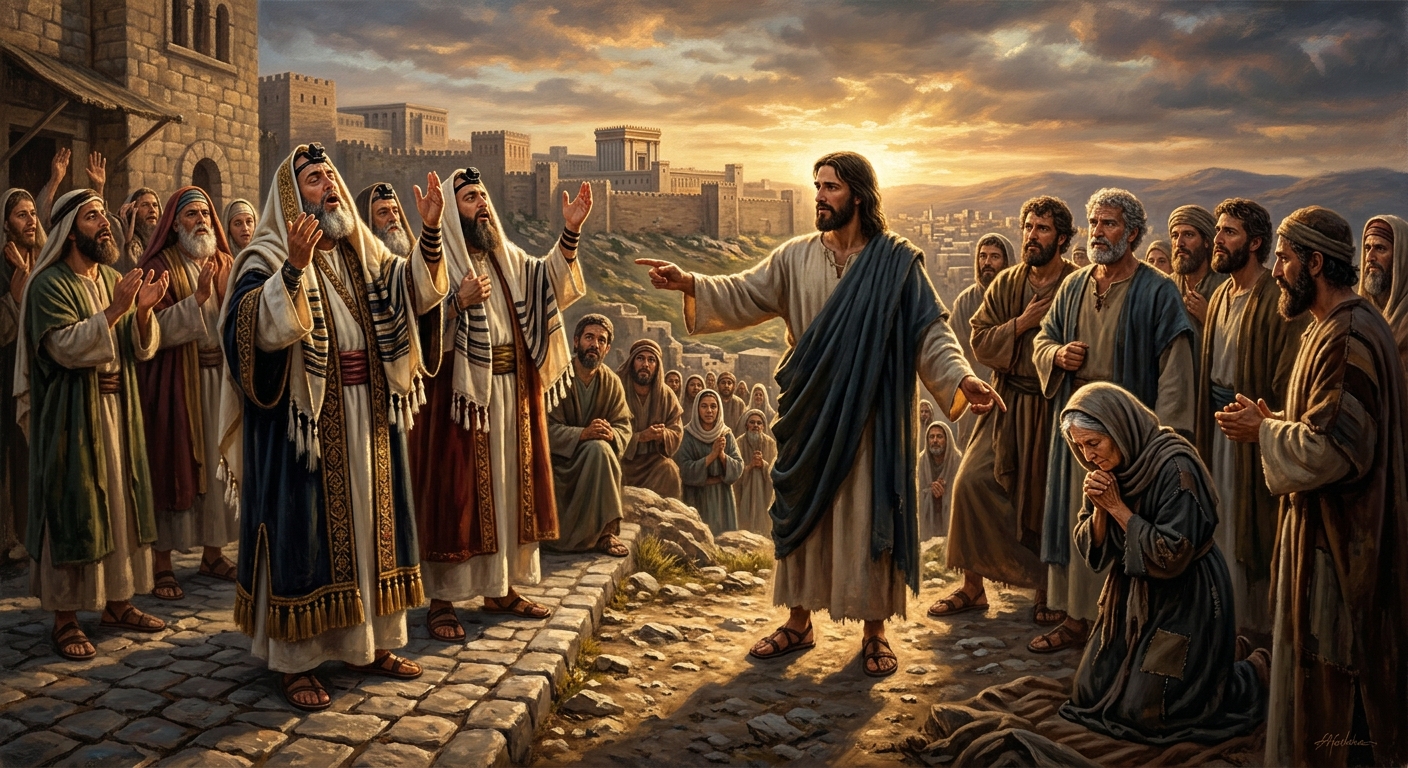
Illustration: Dramatic cinematic biblical illustration for Matthew Chapter 6 showing Authentic devotion over external show, photorealistic oil painting style.
🔊
Listen to Chapter
Grace Notes Journey Audio Narration
Author
Matthew the Apostle
Written
~70-80 AD
Key Theme
Authentic devotion over external show
Setting
Jerusalem - early Christian community
Key Verse
Matthew 6:33
Total Verses
34
Chapter Introduction
*Dear friend, Jesus invites us into a deeper rhythm of worship—one that is whispered in the quiet of our hearts, not shouted on the rooftops. He reminds us that the Father sees what we do in secret and rewards us with a love that is richer than any applause. When we give, pray, and fast, let our motives be pure, seeking His kingdom above all else. In this gentle guidance, we find the peace of being truly known and loved by God.*
Matthew — Chapter 6 — KJV
1
Take heed that ye do not your alms before men, to be seen of them: otherwise ye have no reward of your Father which is in heaven.
Simply PutThe Greek word for alms, eleemosynē (G1657), means a compassionate giving that flows from the heart. Jesus warns us not to give just so people can clap their hands or nod approvingly, because the true reward comes from Father in heaven—not from our own applause.
2
Therefore when thou doest thine alms, do not sound a trumpet before thee, as the hypocrites do in the synagogues and in the streets, that they may have glory of men. Verily I say unto you, They have their reward.
Simply PutHe calls out the hypocrites who set their trumpets (salpinx, G465) to blare before they give, seeking the spotlight. Their reward is simply the praise of men; but when we give quietly, our reward comes from God Himself.
3
But when thou doest alms, let not thy left hand know what thy right hand doeth:
Simply PutWhen you help someone in need, don’t make a big deal of it—let your left hand not tell what your right hand is doing. This isn’t about secrecy for its own sake, but about humility and letting God see the pure motive behind your generosity.
4
That thine alms may be in secret: and thy Father which seeth in secret himself shall reward thee openly.
Simply PutThe Greek word for secret, kryptos (G2776), means hidden from human eyes. When you give in private, the Father who sees all will reward you openly—He knows your heart and makes His love visible to the world.
5
And when thou prayest, thou shalt not be as the hypocrites are: for they love to pray standing in the synagogues and in the corners of the streets, that they may be seen of men. Verily I say unto you, They have their reward.
Simply PutSome people love to pray in grand synagogues or on street corners just so others can see them bow. Their reward is the approval of men; but if you pray from a place of sincere need, God rewards you in ways that truly matter.
6
But thou, when thou prayest, enter into thy closet, and when thou hast shut thy door, pray to thy Father which is in secret; and thy Father which seeth in secret shall reward thee openly.
Simply PutJesus says to go into your closet (kryptē, G2776) and shut the door before you pray. It isn’t about being secretive; it’s about coming to God alone, where He can hear the honest whispers of your heart and respond with open love.
7
But when ye pray, use not vain repetitions, as the heathen do: for they think that they shall be heard for their much speaking.
Simply Put"Vain repetitions" (battologia, G923) refer to empty phrases spoken just for the sake of speaking. The heathen (ethnos, G2090) thought that long speeches would impress God; He knows the exact needs of your soul before you even ask.
8
Be not ye therefore like unto them: for your Father knoweth what things ye have need of, before ye ask him.
Simply PutYour Father knows what you truly need (anankē, G303) before you speak. You don’t have to impress Him with a long prayer or fancy words—He is already aware of the weight you carry.
9
After this manner therefore pray ye: Our Father which art in heaven, Hallowed be thy name.
Simply PutThe Greek word hallowed (hagiazō, G26) means to make holy. To pray "Our Father in heaven, hallowed be Thy name" is a simple declaration that God’s Name is sacred and deserves reverence, not our own cleverness.
10
Thy kingdom come. Thy will be done in earth, as it is in heaven.
Simply PutThe kingdom (basileia, G933) isn’t just a distant realm; it’s God's rule in our hearts and lives. When we pray "Thy will be done on earth as it is in heaven," we’re asking God to bring His perfect order into our messy world.
11
Give us this day our daily bread.
Simply PutThe phrase "daily bread" (epiousios, G1908) literally means bread for the coming day. It’s a humble request that God provide just enough to sustain us each day, reminding us of our dependence on Him.
12
And forgive us our debts, as we forgive our debtors.
Simply PutThe Greek word for debt (opheilēma, G5305) signifies a moral obligation. As we ask God to forgive our debts, we must also be ready to release the debts of others—because forgiveness is a two-way street.
13
And lead us not into temptation, but deliver us from evil: For thine is the kingdom, and the power, and the glory, for ever. Amen.
Simply PutTemptation (peirasmos, G3988) is a test of faith; it’s not God leading us into sin but giving us challenges to grow. We ask Him to deliver (sōtēriāzō, G4976) us from the evil that seeks to trap us.
14
For if ye forgive men their trespasses, your heavenly Father will also forgive you:
Simply PutTo forgive (aphēmi, G563) means to let go of the debt entirely. If we truly release others from their sins, our Heavenly Father will also let go of ours.
15
But if ye forgive not men their trespasses, neither will your Father forgive your trespasses.
Simply PutIf we hold onto unforgiveness, we block God's grace from flowing back to us. The promise is clear: our forgiveness of others opens the door for God's forgiveness in our own lives.
16
Moreover when ye fast, be not, as the hypocrites, of a sad countenance: for they disfigure their faces, that they may appear unto men to fast. Verily I say unto you, They have their reward.
Simply PutDon’t fast just to look pious like the hypocrites (Greek hypocharis, G528) who make a sad face to show off. Their only reward is the applause of other people, not from God.
17
But thou, when thou fastest, anoint thine head, and wash thy face;
Simply PutWhen you fast, wash your face and anoint your head. The Greek words for “wash” (pluno, G4058) and “anoint” (chriso, G5541) remind us that our devotion is a personal cleansing, not a public performance.
18
That thou appear not unto men to fast, but unto thy Father which is in secret: and thy Father, which seeth in secret, shall reward thee openly.
Simply PutFast in secret before the Father who sees what’s hidden, and He will reward you openly. The Greek “secret” (kryptos, G2819) and “openly” (dēma, G1202) show a contrast between hidden devotion and public acknowledgment.
19
Lay not up for yourselves treasures upon earth, where moth and rust doth corrupt, and where thieves break through and steal:
Simply PutDon’t store up earthly treasures that moth and rust will eat away, and thieves can steal. The Greek word for “treasures” (thēsauros, G2361) points to anything you think is your security but can be lost.
20
But lay up for yourselves treasures in heaven, where neither moth nor rust doth corrupt, and where thieves do not break through nor steal:
Simply PutInstead, store up heavenly treasures that moth and rust cannot corrupt, and thieves cannot steal. “Heaven” (ouranos, G3772) is a realm beyond decay where God’s promises hold forever.
21
For where your treasure is, there will your heart be also.
Simply PutWhere your treasure lies, there your heart will be. “Treasure” (thēsauros) and “heart” (kardia, G2588) together tell us that what we value most shapes the core of who we are.
22
The light of the body is the eye: if therefore thine eye be single, thy whole body shall be full of light.
Simply PutYour eye is the lamp of your body. If it’s single (heis, G1525), your whole being will be full of light. The Greek “light” (phos, G5457) represents clarity and vision for a life aligned with God.
23
But if thine eye be evil, thy whole body shall be full of darkness. If therefore the light that is in thee be darkness, how great is that darkness!
Simply PutBut if your eye is evil (ponēros, G4205), your whole body will be filled with darkness. When the inner light is actually darkness (skotos, G4640), that darkness becomes overwhelming.
24
No man can serve two masters: for either he will hate the one, and love the other; or else he will hold to the one, and despise the other. Ye cannot serve God and mammon.
Simply PutNo one can serve two masters; you’ll end up loving one and hating the other. “Master” (kyrios, G2962) versus “mammon” (G3138) – you can’t split your heart between God and money.
25
Therefore I say unto you, Take no thought for your life, what ye shall eat, or what ye shall drink; nor yet for your body, what ye shall put on. Is not the life more than meat, and the body than raiment?
Simply PutDon’t worry about what you’ll eat or wear. “Thought” (merimna, G3322) is anxiety, but your life (zoē, G2222) and body are far more important than food and clothing.
26
Behold the fowls of the air: for they sow not, neither do they reap, nor gather into barns; yet your heavenly Father feedeth them. Are ye not much better than they?
Simply PutLook at the birds of the air; they don’t sow or reap, yet their heavenly Father feeds them. You are far more valuable to Him than these simple creatures.
27
Which of you by taking thought can add one cubit unto his stature?
Simply PutWhich of you can add a cubit (pēchys, G4208) to his height by worrying? Worrying doesn’t change the size of your body or soul.
28
And why take ye thought for raiment? Consider the lilies of the field, how they grow; they toil not, neither do they spin:
Simply PutWhy worry about clothing? Look at the lilies—they grow without labor or spinning. They focus entirely on what God provides.
29
And yet I say unto you, That even Solomon in all his glory was not arrayed like one of these.
Simply PutEven Solomon in all his splendor wasn’t dressed like one of these lilies. The grandeur of the greatest king pales beside God’s natural beauty.
30
Wherefore, if God so clothe the grass of the field, which to day is, and to morrow is cast into the oven, shall he not much more clothe you, O ye of little faith?
Simply PutIf God clothes today’s grass, which tomorrow is burned in a furnace, how much more will He clothe you? This is a call to trust God’s care over your “little faith” (pistis, G4102).
31
Therefore take no thought, saying, What shall we eat? or, What shall we drink? or, Wherewithal shall we be clothed?
Simply PutThe Greek word here, merimnao (G3320), means to be anxious or worried. Jesus is telling us to drop that heavy weight, even when the stomach and wardrobe feel empty.
32
(For after all these things do the Gentiles seek:) for your heavenly Father knoweth that ye have need of all these things.
Simply Put"Gentiles" (Greek ethne) refers to those who chase after material comforts without trusting a higher power. Our Heavenly Father knows we are hungry, thirsty, and need clothing—He is already aware of our needs.
33
But seek ye first the kingdom of God, and his righteousness; and all these things shall be added unto you.
Simply PutThe verb "seek" (Greek zeteo, G2212) invites us to actively pursue God's reign and moral uprightness. When we put that first, He promises to provide the rest of our needs like bread and clothing.
34
Take therefore no thought for the morrow: for the morrow shall take thought for the things of itself. Sufficient unto the day is the evil thereof.
Simply PutThis proverb reminds us that each day has its own challenges. Instead of fretting about tomorrow, we should focus on today’s troubles and trust that God will handle the next day.
Luke 12:3-7This passage echoes Matthew 6:8’s promise that the Father knows our needs before we ask, emphasizing divine omniscience over human display.
Luke 18:9-14The parable of the Pharisee and the tax collector illustrates the humility in prayer that Matthew 6:5‑7 warns against hypocritical, ostentatious worship.
Isaiah 58:6-10Isaiah’s description of true fasting, which includes loosening the bonds of wickedness and sharing food with the hungry, illuminates Matthew 6:16‑18’s call for secret, sincere fasting.
James 2:14-17James’ teaching that faith without works is dead reinforces Matthew 6:1‑4’s instruction that almsgiving must be genuine and not merely for human approval.
Reflect
When you set aside time for fasting or prayer, do you notice a desire to share it on social media or with friends for encouragement, and how might you imagine keeping those moments as a private conversation between you and God?