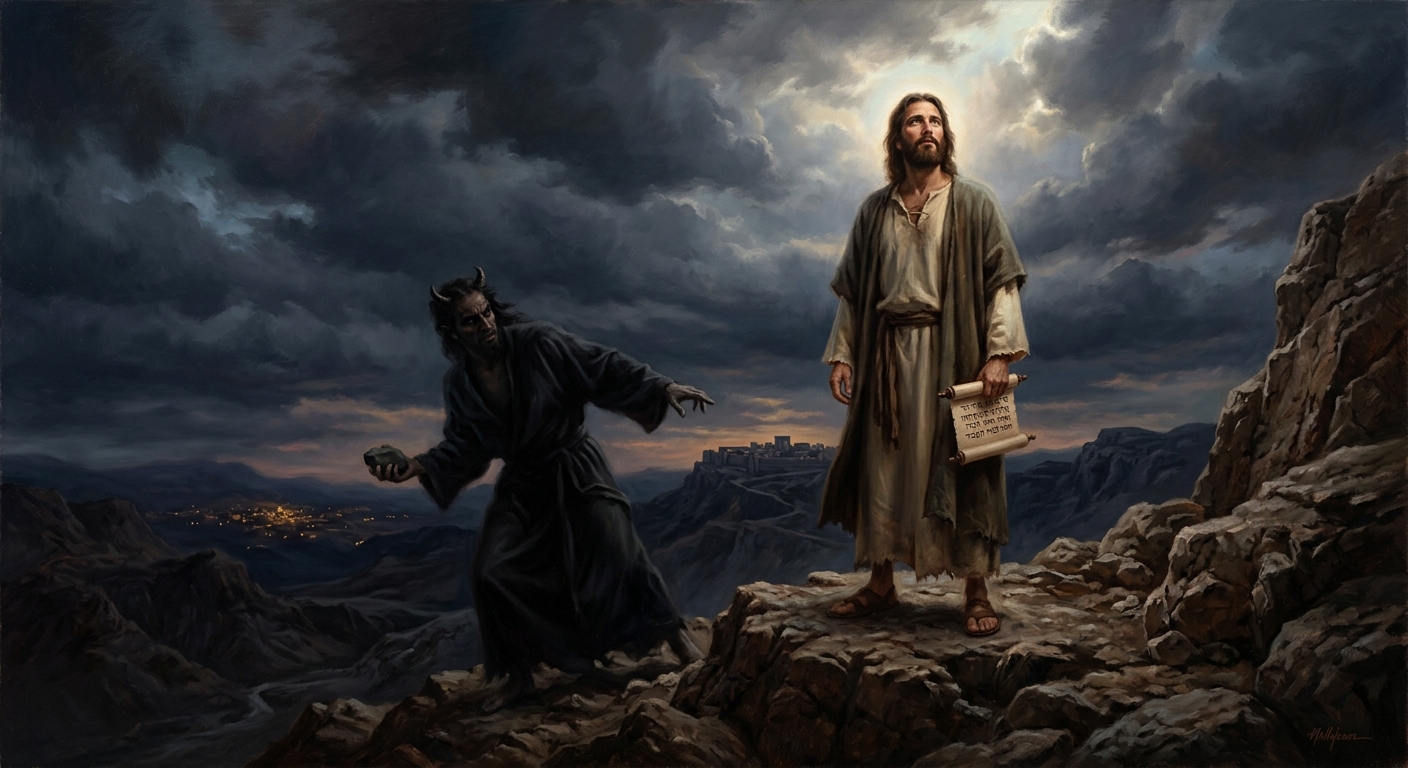
Illustration: Dramatic cinematic biblical illustration for Matthew Chapter 4 showing Victory over temptation through obedience, photorealistic oil painting style.
🔊
Listen to Chapter
Grace Notes Journey Audio Narration
Author
Matthew the Apostle
Written
~80-85 AD
Key Theme
Victory over temptation through obedience
Setting
Judean Wilderness
Key Verse
Matthew 4:4
Total Verses
25
Chapter Introduction
*In the quiet hush of the desert, our Savior steps forward to meet the One Who knows Him most intimately. The Spirit guides Him into this solitude, not as a test of weakness but as an arena for grace to be displayed. As He fasts and feels hunger, we are reminded that our deepest cravings are not merely for food but for the living Word of God. In each temptation, He offers us a firm anchor: Scripture is our shield, and reliance on the Father is our sustenance.*
Matthew — Chapter 4 — KJV
1
Then was Jesus led up of the Spirit into the wilderness to be tempted of the devil.
Simply PutThe Spirit (Greek, pneuma G4151) leads Jesus into the wilderness (eremia G1648), a barren place where He must confront loneliness and temptation. It’s not random wanderings; it’s God’s purposeful preparation for the battle ahead.
2
And when he had fasted forty days and forty nights, he was afterward an hungred.
Simply PutAfter fasting (Greek, nesiō G3526) for forty days and nights—just as Israel did in the desert—Jesus feels real hunger (Greek, peinaō G4009). He experiences the same physical weakness we feel when we’re weary and waiting on God.
3
And when the tempter came to him, he said, If thou be the Son of God, command that these stones be made bread.
Simply PutThe devil (Greek, diabolos G1229) tempts with a simple question and the promise of bread (Greek, artos G805). He challenges Jesus to prove His identity by turning a spiritual need into a physical one.
4
But he answered and said, It is written, Man shall not live by bread alone, but by every word that proceedeth out of the mouth of God.
Simply PutJesus replies with Scripture, saying man (Greek, anthropos G3619) does not live by bread alone but by every word spoken by God (Greek, logos G3056). It reminds us that true life comes from God’s promises, not just material needs.
5
Then the devil taketh him up into the holy city, and setteth him on a pinnacle of the temple,
Simply PutThe devil transports Jesus to the holy city (Greek, hagios G40), setting Him on a temple pinnacle. He wants to test Jesus by pushing Him toward a spectacular display of power and faith.
6
And saith unto him, If thou be the Son of God, cast thyself down: for it is written, He shall give his angels charge concerning thee: and in their hands they shall bear thee up, lest at any time thou dash thy foot against a stone.
Simply PutHe tempts Jesus to jump, citing angels (Greek, angelos G32) who would “bear up” (Greek, anabaino G458) Him. The devil twists Scripture to make it sound like a safety net for prideful leaps.
7
Jesus said unto him, It is written again, Thou shalt not tempt the Lord thy God.
Simply PutJesus counters with Scripture again, warning against testing (Greek, peirazō G3987) God. He teaches that it’s wrong to put God on trial or demand miracles for personal gain.
8
Again, the devil taketh him up into an exceeding high mountain, and sheweth him all the kingdoms of the world, and the glory of them;
Simply PutThe devil shows all the world’s kingdoms and glory from an exceedingly high mountain (Greek, ophis G545). He offers a shortcut to power if Jesus will worship him instead of God.
9
And saith unto him, All these things will I give thee, if thou wilt fall down and worship me.
Simply PutThe devil promises everything—wealth, authority, glory—if Jesus simply bows down. It’s the classic bargain: sacrifice worship for worldly gain.
10
Then saith Jesus unto him, Get thee hence, Satan: for it is written, Thou shalt worship the Lord thy God, and him only shalt thou serve.
Simply PutJesus rejects the deal, commanding Satan to leave (Greek, satana). He reaffirms that we should worship God alone and serve only Him.
11
Then the devil leaveth him, and, behold, angels came and ministered unto him.
Simply PutAs soon as the devil departs, angels (Greek, angelos G32) come to minister and care for Jesus. It shows that after trials, God sends His helpers to refresh our spirit.
12
Now when Jesus had heard that John was cast into prison, he departed into Galilee;
Simply PutHearing of John’s imprisonment (Greek, exagō G1921), Jesus moves to Galilee. He leaves the familiar Nazareth behind, stepping into a new season of ministry.
13
And leaving Nazareth, he came and dwelt in Capernaum, which is upon the sea coast, in the borders of Zabulon and Nephthalim:
Simply PutHe settles in Capernaum on the Sea of Galilee, near Zabulon and Nephthalim. This location fulfills prophecy—Jesus is now in the heart of a region that will be key to His mission.
14
That it might be fulfilled which was spoken by Esaias the prophet, saying,
Simply PutThe passage notes that the prophecy of Isaiah (Greek, Esaias G2192) is being fulfilled. It confirms Jesus as the promised Messiah who brings light to a dark world.
15
The land of Zabulon, and the land of Nephthalim, by the way of the sea, beyond Jordan, Galilee of the Gentiles;
Simply PutThe land of Zabulon and Nephthalim, beyond the Jordan—Galilee of the Gentiles—is highlighted. It points to Jesus’ purpose: to bring salvation not just to Jews but to all nations.
16
The people which sat in darkness saw great light; and to them which sat in the region and shadow of death light is sprung up.
Simply PutThose living in spiritual darkness—people who felt lost and hopeless—saw a great light burst forth. The Greek word for "light" (phōs, G5457) carries the idea of clarity and direction. For anyone in deep sorrow or despair, this verse promises that God’s illumination can pierce even the darkest shadows of death. It says your night will end, and a new dawn is breaking.
17
From that time Jesus began to preach, and to say, Repent: for the kingdom of heaven is at hand.
Simply PutFrom that moment Jesus began to proclaim “Repent,” a call to turn away from the old ways (the Greek word metanoeō, G3300 means a change of mind and heart). He warned that the kingdom of heaven (basileia tou ouranou, G932) was near—like a wave about to crash onto the shore. For anyone burdened by sin or longing for a fresh start, this is an invitation to leave behind old habits and step into the reality of God’s reign.
18
And Jesus, walking by the sea of Galilee, saw two brethren, Simon called Peter, and Andrew his brother, casting a net into the sea: for they were fishers.
Simply PutAs Jesus walked along the Sea of Galilee, He saw Simon (Peter) and Andrew casting a net—simple fishermen. The Greek word for “net” (koptō, G2830) symbolizes gathering. For those who feel ordinary or unimportant, this reminds us that God can use even the most humble jobs as a platform for His great purpose.
19
And he saith unto them, Follow me, and I will make you fishers of men.
Simply PutHe said to them, “Follow me,” using the Greek term akoloutheō (G259), which means to walk beside and learn. He promised to make them “fishers of men,” turning their trade into a spiritual harvest. If you’re searching for meaning, this verse tells you that following Jesus transforms your daily life into a mission of love and outreach.
20
And they straightway left their nets, and followed him.
Simply PutThey left their nets immediately—right away, with no hesitation. The Greek word euthys (G2191) conveys prompt obedience. This shows that when the heart is touched by God’s call, old securities can be dropped without looking back.
21
And going on from thence, he saw other two brethren, James the son of Zebedee, and John his brother, in a ship with Zebedee their father, mending their nets; and he called them.
Simply PutMoving on, Jesus saw James and John fixing their nets in a boat with their father Zebedee. “Mending” (koptō, G2830) signifies preparation and readiness. When He called them, it was an invitation to join a larger work beyond their family business.
22
And they immediately left the ship and their father, and followed him.
Simply PutThey too left the boat and father immediately, showing decisive faith. Their willingness to abandon familiar comforts for an unknown future illustrates how true discipleship requires trust and sacrifice.
23
And Jesus went about all Galilee, teaching in their synagogues, and preaching the gospel of the kingdom, and healing all manner of sickness and all manner of disease among the people.
Simply PutJesus traveled throughout Galilee, teaching in synagogues—places of worship—and preaching the gospel (euaggelion tēs basileias, G2097+G932) of God’s kingdom. He also healed every kind of sickness and disease, showing that the arrival of God's reign brings both spiritual instruction and physical restoration.
24
And his fame went throughout all Syria: and they brought unto him all sick people that were taken with divers diseases and torments, and those which were possessed with devils, and those which were lunatick, and those that had the palsy; and he healed them.
Simply PutHis fame spread through Syria, drawing crowds of the sick—those tormented by disease, demonic oppression, madness, or palsy. Jesus healed them all, demonstrating that God’s compassion meets the deepest pains and brokenness of humanity.
25
And there followed him great multitudes of people from Galilee, and from Decapolis, and from Jerusalem, and from Judaea, and from beyond Jordan.
Simply PutGreat multitudes from Galilee, Decapolis, Jerusalem, Judea, and beyond the Jordan followed Him. This shows that the message of hope, healing, and kingdom power resonated far beyond a single region—reaching anyone who hungered for relief and meaning.
Considering how Jesus left Nazareth and chose to dwell in Capernaum, what step or new setting are you feeling drawn toward today that might help you grow into the role you're meant to play?