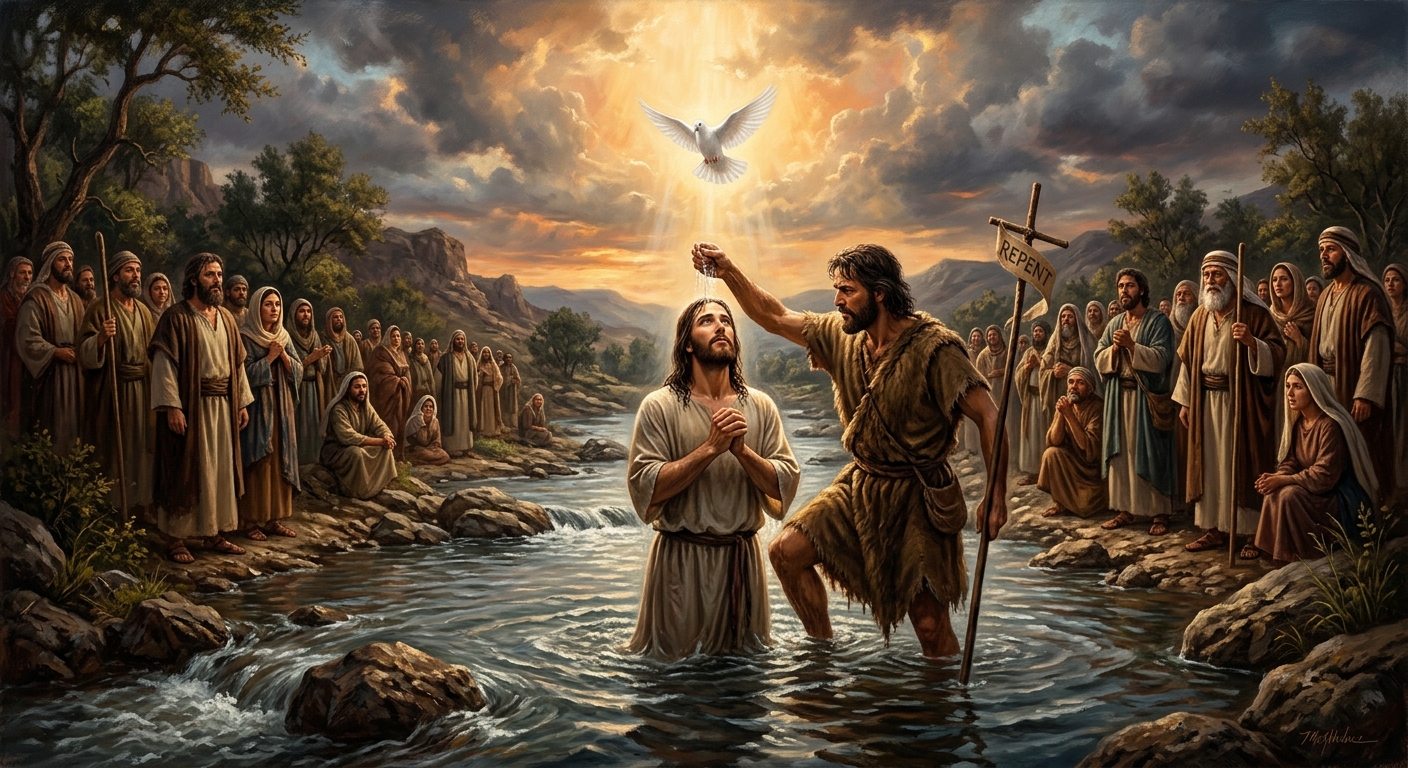
Illustration: Dramatic cinematic biblical illustration for Matthew Chapter 3 showing Repentance and Baptism of the Messiah, photorealistic oil painting style.
🔊
Listen to Chapter
Grace Notes Journey Audio Narration
Author
Matthew (Levi)
Written
~85 AD
Key Theme
Repentance and Baptism of the Messiah
Setting
Judean Wilderness – Jordan River
Key Verse
Matthew 3:17
Total Verses
17
Chapter Introduction
_In the quiet of the wilderness, God's voice whispers a call to return. John, clothed in humble camel hair, stands as the bridge between old promises and new hope. He invites us to turn away from our sins, for the Kingdom of Heaven is drawing near. As we hear this invitation, may our hearts be stirred to seek the grace that flows from the waters of baptism._
Matthew — Chapter 3 — KJV
1
In those days came John the Baptist, preaching in the wilderness of Judaea,
Simply PutJohn the Baptist appears in “the wilderness” (Greek erēmos, G1791), a place of solitude and testing. He’s not just a preacher; he’s a beacon in the desert, calling us out of our comfort zones to hear God’s voice.
2
And saying, Repent ye: for the kingdom of heaven is at hand.
Simply PutThe word “repent” (Greek metanoia, G3327) means a deep change of mind and heart. John tells us that the “kingdom of heaven is at hand”—God’s reign is about to break into our lives, and we must turn inwardly before it does.
3
For this is he that was spoken of by the prophet Esaias, saying, The voice of one crying in the wilderness, Prepare ye the way of the Lord, make his paths straight.
Simply PutThe Greek word “voice” (phōnē, G5349) evokes a cry that pierces the silence of the desert. John is fulfilling Isaiah’s prophecy, urging us to “prepare the way” and straighten our paths so we’re ready for the Lord’s arrival.
4
And the same John had his raiment of camel’s hair, and a leathern girdle about his loins; and his meat was locusts and wild honey.
Simply PutJohn’s “raiment of camel’s hair” and diet of “locusts and wild honey” reflect his simplicity and dedication to God’s call. He lives with the bare essentials, showing that true devotion isn’t about fancy clothes but a heart set on God alone.
5
Then went out to him Jerusalem, and all Judaea, and all the region round about Jordan,
Simply PutPeople from “Jerusalem, all Judaea, and the region around Jordan” flock to John. Their journey shows that when God’s message rings out, it draws everyone—whether near or far—to seek His truth.
6
And were baptized of him in Jordan, confessing their sins.
Simply Put“Baptized” (Greek baptizō, G908) in the Jordan signifies a public declaration of cleansing. As they confess their sins, each person is symbolically washing away the past and stepping into a fresh start before God.
7
But when he saw many of the Pharisees and Sadducees come to his baptism, he said unto them, O generation of vipers, who hath warned you to flee from the wrath to come?
Simply PutJohn calls the Pharisees and Sadducees “a generation of vipers,” using the Greek word ophis (G4333) to describe their deceitful nature. He warns them that merely outward rituals won’t save them from the coming “wrath”—true repentance is needed.
8
Bring forth therefore fruits meet for repentance:
Simply PutThe call to “bring forth fruits meet for repentance” (Greek karpos kataphron, G2585 + G2682) urges visible change. It’s not enough to say we’re sorry; our lives must produce the good actions that prove a transformed heart.
9
And think not to say within yourselves, We have Abraham to our father: for I say unto you, that God is able of these stones to raise up children unto Abraham.
Simply PutJohn warns against relying on “Abraham as father,” saying God can raise children from “stones” (Greek lithos, G2992). This shows that God’s power isn’t limited to lineage; He can give new life from the most unlikely places.
10
And now also the axe is laid unto the root of the trees: therefore every tree which bringeth not forth good fruit is hewn down, and cast into the fire.
Simply PutThe “axe” (Greek pelekys, G3995) laid at the root of the trees signals impending judgment. Those that don’t bear good fruit will be cut down and thrown into fire—an urgent reminder to live a life that honors God.
11
I indeed baptize you with water unto repentance: but he that cometh after me is mightier than I, whose shoes I am not worthy to bear: he shall baptize you with the Holy Ghost, and with fire:
Simply PutWhile John baptizes with water, he points to the One “mightier” who will baptize with the “Holy Ghost” (Greek pneuma hagion, G4151) and fire. This means the Holy Spirit will ignite a deep, lasting transformation within us.
12
Whose fan is in his hand, and he will throughly purge his floor, and gather his wheat into the garner; but he will burn up the chaff with unquenchable fire.
Simply PutThe image of “the fan” (Greek krithé, G2913) in his hand shows the process of separating wheat from chaff. The Holy Spirit will gather believers for God’s harvest but burn away the worthless, ensuring purity in His kingdom.
13
Then cometh Jesus from Galilee to Jordan unto John, to be baptized of him.
Simply PutJesus comes from Galilee to the Jordan, seeking John’s baptism. It shows that even the Son of God humbly submits to a cleansing rite, modeling for us the importance of preparation before ministry.
14
But John forbad him, saying, I have need to be baptized of thee, and comest thou to me?
Simply PutJohn “forbids” (Greek aphistēmi, G559) Jesus from baptizing Him, feeling unworthy. This humility reminds us that the greatest among us must recognize our dependence on Christ’s grace.
15
And Jesus answering said unto him, Suffer it to be so now: for thus it becometh us to fulfil all righteousness. Then he suffered him.
Simply PutJesus says, “Suffer it to be so,” affirming the necessity of fulfilling all righteousness. He obeys God’s plan, showing us that true obedience sometimes means stepping into uncomfortable but essential places.
16
And Jesus, when he was baptized, went up straightway out of the water: and, lo, the heavens were opened unto him, and he saw the Spirit of God descending like a dove, and lighting upon him:
Simply PutAs Jesus came up from the water, the heavens opened and He saw the Spirit of God (pneuma, G4151) descending like a dove. The Greek word pneuma conveys the breath of life that fills and sustains us; it shows that God’s presence is on Him, empowering Him for the work ahead. The dove (nēnē, G3522) is a tender symbol of peace and purity, reminding the hurting that God's Spirit brings gentle comfort even after we step into deep waters.
17
And lo a voice from heaven, saying, This is my beloved Son, in whom I am well pleased.
Simply PutA voice from heaven declared, "This is my beloved Son (agapētos, G26), in whom I am well pleased." The word agapētos tells us that the Father’s love for Jesus is deep and personal, not just a title. The term well pleased (eudokimos, G2121) means that Jesus perfectly fulfills the Father’s purpose—an assurance to those in doubt that He is the one who can truly meet their deepest hunger and lead them into wholeness.
Isaiah 40:3This verse directly fulfills Matthew 3:3, identifying John the Baptist as the prophetic voice preparing the way of the Lord in the wilderness.
Mark 1:4-5This passage parallels Matthew 3, describing John’s preaching of repentance and baptism in the wilderness, confirming the synoptic harmony.
Luke 3:2-6This account mirrors Matthew 3’s description of John’s ministry, emphasizing the geographic setting and the call for repentance among all Judea.
John 1:6-8These verses illuminate John the Baptist’s role as a witness to Christ, underscoring his purpose of preparing people for the coming Messiah.
Reflect
Do you ever rely on your family or cultural heritage as the basis of who you are, or do you trust that God can shape new purpose from the ordinary stones in your life?