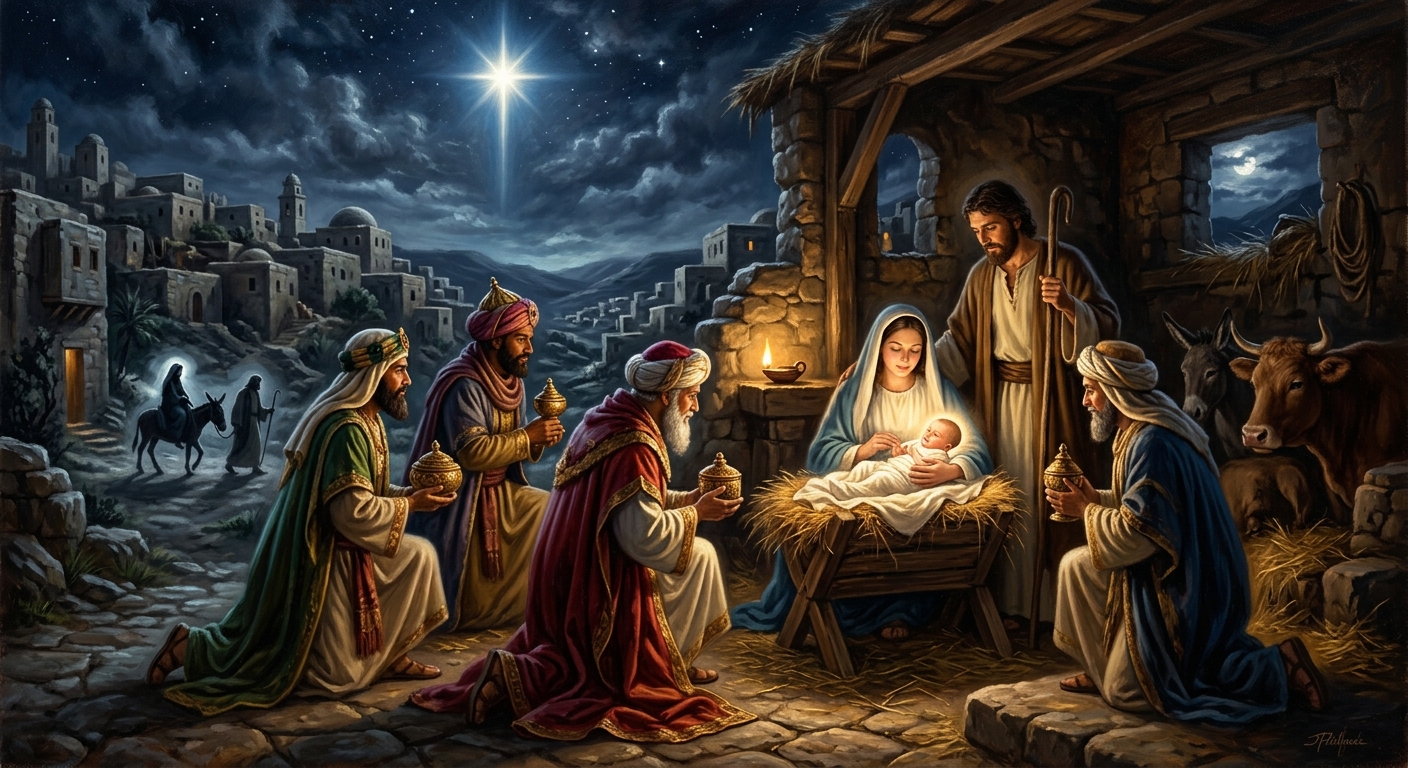
Illustration: Dramatic cinematic biblical illustration for Matthew Chapter 2 showing Fulfillment of Messianic Prophecy, photorealistic oil painting style.
🔊
Listen to Chapter
Grace Notes Journey Audio Narration
Author
Matthew, the Apostle
Written
~85 AD
Key Theme
Fulfillment of Messianic Prophecy
Setting
Bethlehem, Judea; early first century
Key Verse
Matthew 2:6
Total Verses
22
Chapter Introduction
As we walk through the night with the Magi, we feel the gentle pull of God's promise toward a humble cradle. In that quiet Bethlehem, divine grace entered history, shining brighter than any royal palace. The journey reminds us that true worship follows a star of faith, even when the world is troubled. May this chapter stir our hearts to seek and adore the King who came for all peoples.
Matthew — Chapter 2 — KJV
1
Now when Jesus was born in Bethlehem of Judaea in the days of Herod the king, behold, there came wise men from the east to Jerusalem,
Simply PutWhen Jesus entered the world in Bethlehem, during Herod's reign, some wise men from far-off lands found their way to the bustling city of Jerusalem. The Greek word for "born" (gennēō, G1110) means more than a simple birth—it signifies the beginning of something that would change history forever.
2
Saying, Where is he that is born King of the Jews? for we have seen his star in the east, and are come to worship him.
Simply PutThese travelers asked, "Where is the one who has been born King of the Jews?" The words "King" (basileus, G932) and "Jews" (Ioudaios, G2455) point to a ruler promised long ago. Their sight of the star in the east and their desire to worship show that they were longing for a hope they could see shining in the heavens.
3
When Herod the king had heard these things, he was troubled, and all Jerusalem with him.
Simply PutWhen Herod heard this news, he felt uneasy; Jerusalem itself seemed to tremble with worry. The Greek word "troubled" (emetheos, G1688) captures that restless feeling—like a father who hears of his child's future and is suddenly filled with fear.
4
And when he had gathered all the chief priests and scribes of the people together, he demanded of them where Christ should be born.
Simply PutHerod gathered the chief priests and scribes, those who knew God's Scriptures, and asked them where the Messiah (Christ) should be born. "Christ" comes from the Greek word christos (G5547), meaning "anointed one," a title that points to God's promised rescue.
5
And they said unto him, In Bethlehem of Judaea: for thus it is written by the prophet,
Simply PutThe teachers answered, "In Bethlehem of Judea," quoting the prophet Micah. This shows that God's plan was already written down, just as a promise kept over generations provides comfort to someone who feels forgotten.
6
And thou Bethlehem, in the land of Juda, art not the least among the princes of Juda: for out of thee shall come a Governor, that shall rule my people Israel.
Simply PutThey reminded Herod that although Bethlehem is a humble town, it would produce a ruler who would guide Israel. The Greek word "Governor" (archegos, G747) also carries the sense of a shepherd—someone who cares for and feeds his people.
7
Then Herod, when he had privily called the wise men, enquired of them diligently what time the star appeared.
Simply PutHerod secretly called the wise men, eager to learn exactly when the star first appeared. He wanted to track the timeline of this heavenly sign, showing his desire to control the unfolding story.
8
And he sent them to Bethlehem, and said, Go and search diligently for the young child; and when ye have found him, bring me word again, that I may come and worship him also.
Simply PutHe sent them to Bethlehem, urging them to diligently search for the child and to return with news so he could also worship him. "Diligently" (spoudazo, G5583) means putting in careful effort and attention—like a parent searching through a crowded market for their lost baby.
9
When they had heard the king, they departed; and, lo, the star, which they saw in the east, went before them, till it came and stood over where the young child was.
Simply PutThe wise men left, following the star that rose in the east and led them straight to where the child lay. The Greek word for "star" (aster, G191) often signals a guiding light—much like how a lighthouse guides ships safely home through dark waters.
10
When they saw the star, they rejoiced with exceeding great joy.
Simply PutUpon seeing the star, they were filled with overwhelming joy. This "great joy" (chara, G2580) is a deep happiness that comes from finding something precious after a long search.
11
And when they were come into the house, they saw the young child with Mary his mother, and fell down, and worshipped him: and when they had opened their treasures, they presented unto him gifts; gold, and frankincense, and myrrh.
Simply PutWhen they entered the house and saw the child with Mary, they fell down to worship him. They offered gifts—gold, frankincense, and myrrh—each symbolizing royalty, prayer, and sacrifice, just as a grateful heart brings offerings to God.
12
And being warned of God in a dream that they should not return to Herod, they departed into their own country another way.
Simply PutAfter receiving God's warning in a dream, they left for their own country by another route. This "dream" (oneiro, G3685) was a divine safeguard—a reminder that God watches over those who walk in faith.
13
And when they were departed, behold, the angel of the Lord appeareth to Joseph in a dream, saying, Arise, and take the young child and his mother, and flee into Egypt, and be thou there until I bring thee word: for Herod will seek the young child to destroy him.
Simply PutAn angel appeared to Joseph in a dream, saying, "Rise, take the child and his mother, and flee to Egypt." The word "flee" (phlego, G5401) indicates urgent escape—much like running away from a storm to find shelter.
14
When he arose, he took the young child and his mother by night, and departed into Egypt:
Simply PutBy night, Joseph took Mary and the child and traveled to Egypt. Their nighttime journey shows quiet trust in God's protection during uncertain times.
VER
15
And was there until the death of Herod: that it might be fulfilled which was spoken of the Lord by the prophet, saying, Out of Egypt have I called my son.
Simply PutThey stayed there until Herod died, fulfilling the prophecy that God had spoken long ago. This shows how God's words (the prophet's promise) are trustworthy, providing hope that even in danger, a divine plan is at work.
16
Then Herod, when he saw that he was mocked of the wise men, was exceeding wroth, and sent forth, and slew all the children that were in Bethlehem, and in all the coasts thereof, from two years old and under, according to the time which he had diligently enquired of the wise men.
17
Then was fulfilled that which was spoken by Jeremy the prophet, saying,
Simply PutThis verse tells us that God’s promises never fail. The Greek word “fulfilled” (G566) means to bring something completely into reality, just as He promised through Jeremiah. Even when life feels chaotic and uncertain, you can trust that the divine story is already being written out.
18
In Rama was there a voice heard, lamentation, and weeping, and great mourning, Rachel weeping for her children, and would not be comforted, because they are not.
Simply PutHere we hear a haunting cry of loss. The Greek term “lamentation” (G2815) paints a picture of deep, aching weeping—Rachel’s grief for her children. If you’re carrying the weight of sorrow, this verse reminds you that God sees every tear and honors your pain.
19
But when Herod was dead, behold, an angel of the Lord appeareth in a dream to Joseph in Egypt,
Simply PutAn angel appears to Joseph in a dream. The Greek word “angelos” (G32) is a messenger sent directly by the Lord, and “appeareth” (G531) conveys that this was a vivid, real encounter. When you feel alone in the night, remember that divine guidance can come when you least expect it.
20
Saying, Arise, and take the young child and his mother, and go into the land of Israel: for they are dead which sought the young child’s life.
Simply PutThe angel tells Joseph to rise and take his family back to Israel. “Arise” (G1110) is a call to action, and the phrase “they are dead which sought the child’s life” (G562) shows that those who intended harm have been removed. In moments of fear, God provides a path forward and removes the obstacles.
21
And he arose, and took the young child and his mother, and came into the land of Israel.
Simply PutJoseph obeys—he takes his child and mother home. This verse shows that obedience brings safety, even after danger passes. When you’re called to step out of uncertainty, trust that God will guide your steps.
22
But when he heard that Archelaus did reign in Judaea in the room of his father Herod, he was afraid to go thither: notwithstanding, being warned of God in a dream, he turned aside into the parts of Galilee:
Simply PutJoseph learns that Archelaus now reigns and feels fear (Greek “phobos,” G5310). Yet God warns him in a dream to go elsewhere. Even when new threats arise, the divine plan is flexible; God redirects you to places where He can protect and nurture.
23
And he came and dwelt in a city called Nazareth: that it might be fulfilled which was spoken by the prophets, He shall be called a Nazarene.
Simply PutJoseph settles in Nazareth, fulfilling the prophecy that “He shall be called a Nazarene.” Though the exact Old Testament phrase isn’t explicit, it points to humility and lowliness. If you feel overlooked or insignificant, this verse reminds you that God values the humble heart.
Micah 5:2This prophecy identifies Bethlehem as the birthplace of a ruler over Israel, directly fulfilling Herod’s inquiry in v5 about where Christ was to be born.
Numbers 24:17The verse predicts a star rising from Jacob, illuminating the Wise Men’s reference to “his star in the east” in v2.
Psalm 72:10-11These verses describe distant kings bringing gifts to the king, echoing the Wise Men’s presentation of gold, frankincense, and myrrh in v8.
Isaiah 60:1-3This passage speaks of the nations drawn to a divine light and bringing gifts, thematically resonating with the Wise Men’s journey from far lands to worship the newborn King in v1‑v2.
Reflect
When was a moment that felt like God or an inner voice warned you to take a different route, and how did trusting that guidance shape your journey?