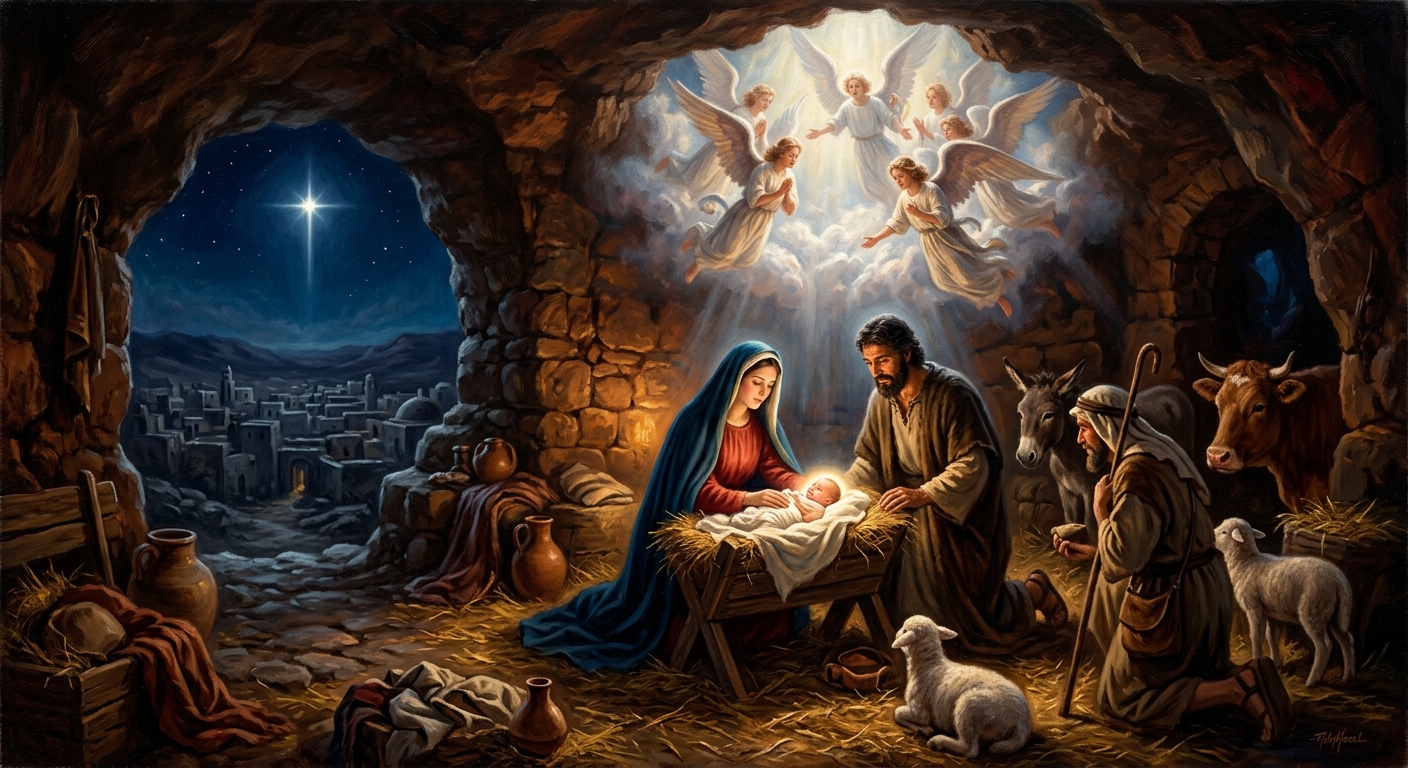
Illustration: Dramatic cinematic biblical illustration for Matthew Chapter 1 showing Fulfillment of Messianic Promise, photorealistic oil painting style.
🔊
Listen to Chapter
Grace Notes Journey Audio Narration
Author
Matthew the Apostle
Written
~80-85 AD
Key Theme
Fulfillment of Messianic Promise
Setting
First-century Judea, post-Temple
Key Verse
Matthew 1:1
Total Verses
25
Chapter Introduction
*Beloved child of God, this opening chapter invites you into the grand tapestry of divine grace. From Abraham to David and finally to Jesus, we see God's faithful hand weaving a story of redemption that spans generations. Each name is a thread in the fabric of God's covenant, reminding us that He never abandons His promises. As you read, may your heart be filled with awe at the wonder of Christ's arrival—our Savior and King.*
Matthew — Chapter 1 — KJV
1
The book of the generation of Jesus Christ, the son of David, the son of Abraham.
Simply PutThe opening line declares that this is the story of Jesus, the Christ—Greek has Χριστός (G5549), meaning "the anointed one"—and reminds us that He is both the son of David and the son of Abraham. This tells a hurting soul that Jesus stands in line with God's promises made to Israel long ago, bridging the old covenant to the new hope we crave today.
2
Abraham begat Isaac; and Isaac begat Jacob; and Jacob begat Judas and his brethren;
Simply PutAbraham begat Isaac; and Isaac begat Jacob; and Jacob begat Judah and his brothers. The word "begat" (Greek: ἐγέννησεν, G1075) means to bring forth into life. In moments of doubt, this reminds us that God’s promises flow through generations like a river; He can bring life even when we feel barren.
3
And Judas begat Phares and Zara of Thamar; and Phares begat Esrom; and Esrom begat Aram;
Simply PutAnd Judah begat Perez and Zerah by Tamar; and Perez begat Hezron; and Hezron begat Aram. The name "Tamar," meaning "date palm," symbolizes fruitfulness in unexpected places. For those hungry for purpose, this verse shows that God can turn broken situations into a lineage of blessing.
4
And Aram begat Aminadab; and Aminadab begat Naasson; and Naasson begat Salmon;
Simply PutAnd Aram begat Aminadab; and Aminadab begat Nahshon; and Nahshon begat Salmon. The name "Nahshon" means "courage." In real pain, we can see that God’s story includes brave ancestors who stepped out in faith—encouraging us to trust Him even when the path ahead looks uncertain.
5
And Salmon begat Booz of Rachab; and Booz begat Obed of Ruth; and Obed begat Jesse;
Simply PutAnd Salmon begat Boaz of Rahab; and Boaz begat Obed of Ruth; and Obed begat Jesse. Boaz (Greek: βόας, G938) means "swift," and Ruth's name reflects "friendship." Their union shows that God’s plan weaves together strangers from different walks of life, reminding us that His love is inclusive and redeeming.
6
And Jesse begat David the king; and David the king begat Solomon of her that had been the wife of Urias;
Simply PutAnd Jesse begat David the king; and David the king begat Solomon by the wife of Uriah. The Greek word for "king" (βασιλεύς, G911) denotes a ruler appointed by God. For the weary heart, this lineage signifies that even from flawed human stories, God raises a ruler who points us toward the true King—Jesus.
7
And Solomon begat Roboam; and Roboam begat Abia; and Abia begat Asa;
Simply PutAnd Solomon begat Rehoboam; and Rehoboam begat Abijah; and Abijah begat Asa. The name "Solomon" (Greek: Σολομών, G4675) means "peace." In the midst of turmoil, we can find hope that God's lineage continues toward a promised peace beyond earthly kingdoms.
8
And Asa begat Josaphat; and Josaphat begat Joram; and Joram begat Ozias;
Simply PutAnd Asa begat Jehoshaphat; and Jehoshaphat begat Joram; and Joram begat Uzziah. "Uzziah" means "my strength." This reminds us that, despite human frailty and political strife, God's promise persists—strengthening those who trust in Him.
9
And Ozias begat Joatham; and Joatham begat Achaz; and Achaz begat Ezekias;
Simply PutAnd Uzziah begat Jotham; and Jotham begat Ahaz; and Ahaz begat Hezekiah. "Hezekiah" (Greek: Ἑζεκίας, G2363) means "strengthening." In times of doubt, this verse tells us that God raises leaders who ultimately turn back to Him for the restoration of His people.
10
And Ezekias begat Manasses; and Manasses begat Amon; and Amon begat Josias;
Simply PutAnd Hezekiah begat Manasseh; and Manasseh begat Amon; and Amon begat Josiah. The name "Josiah" means "the Lord heals." For those in pain, this lineage points to a king who sought to restore true worship—signaling that God's healing is possible even after long periods of sin.
11
And Josias begat Jechonias and his brethren, about the time they were carried away to Babylon:
Simply PutAnd Josiah begat Jeconiah and his brothers, at the time they were carried away to Babylon. This verse marks the end of Israel's kingdom and the beginning of exile, reminding us that when we feel displaced, God’s story continues—His promises endure beyond any earthly captivity.
12
And after they were brought to Babylon, Jechonias begat Salathiel; and Salathiel begat Zorobabel;
Simply PutAnd after they were taken to Babylon, Jeconiah begat Shealtiel; and Shealtiel begat Zerubbabel. "Zerubbabel" (Greek: Ζεροῦβάλ, G2220) means "seed of Babylon." In real hunger for hope, this shows that God can bring life and purpose out of exile and displacement.
13
And Zorobabel begat Abiud; and Abiud begat Eliakim; and Eliakim begat Azor;
Simply PutAnd Zerubbabel begat Abiud; and Abiud begat Eliakim; and Eliakim begat Azor. The name "Azor" signifies help. For those seeking comfort, this lineage demonstrates that God’s providence guides each step toward the fulfillment of His promise.
14
And Azor begat Sadoc; and Sadoc begat Achim; and Achim begat Eliud;
Simply PutAnd Azor begat Zadok; and Zadok begat Achim; and Achim begat Eliud. "Zadok" is Greek for "righteous." This reminds us that God’s lineage includes those who stand firm in righteousness—encouraging believers to pursue holiness amid life's trials.
15
And Eliud begat Eleazar; and Eleazar begat Matthan; and Matthan begat Jacob;
Simply PutAnd Eliud begat Eleazar; and Eleazar begat Matthan; and Matthan begat Jacob. The name "Jacob" (Greek: Ἰακώβ, G2474) means "supplanter," indicating that God’s plan often unfolds in unexpected ways. In moments of doubt, this verse assures us that the lineage leading to Jesus is a testament to God’s sovereign hand guiding history toward redemption.
16
And Jacob begat Joseph the husband of Mary, of whom was born Jesus, who is called Christ.
Simply PutThis verse ties Jesus directly to the promises made to Abraham and David. The Greek word “Christ” (Strong’s #5547) means “the Anointed One,” showing that Jesus is the fulfillment of the Messianic hope.
17
So all the generations from Abraham to David are fourteen generations; and from David until the carrying away into Babylon are fourteen generations; and from the carrying away into Babylon unto Christ are fourteen generations.
Simply PutThe three sets of fourteen generations highlight God’s orderly plan and faithfulness across the ages. “Generations” (Greek γενεά, G1079) points to a divine timeline that assures us God never forgets His promises.
18
Now the birth of Jesus Christ was on this wise: When as his mother Mary was espoused to Joseph, before they came together, she was found with child of the Holy Ghost.
Simply PutMary’s pregnancy began before she and Joseph lived together, through the Holy Ghost (Greek Πνεῦμα Ἅγιον, G4151). This shows that Jesus’ birth was a supernatural work of God, not simply human chance.
19
Then Joseph her husband, being a just man, and not willing to make her a publick example, was minded to put her away privily.
Simply PutJoseph was a “just man” (Greek δικαίος, G1343), so he didn’t want to shame Mary publicly. His intention to “put her away privily” reflects his compassionate heart, even amid personal confusion.
20
But while he thought on these things, behold, the angel of the LORD appeared unto him in a dream, saying, Joseph, thou son of David, fear not to take unto thee Mary thy wife: for that which is conceived in her is of the Holy Ghost.
Simply PutWhile Joseph was wrestling with these thoughts, an angel of the Lord (Greek ἄγγελος, G32) appeared in a dream. The angel’s reassurance—“Fear not”—confirms that the child’s conception is by the Holy Spirit, marking Jesus as divine.
21
And she shall bring forth a son, and thou shalt call his name JESUS: for he shall save his people from their sins.
Simply PutThe name “Jesus” (Greek Ἰησοῦς, G2424) means “Savior.” This tells us that He will rescue His people from their sins, offering hope to anyone burdened by guilt or hopelessness.
22
Now all this was done, that it might be fulfilled which was spoken of the Lord by the prophet, saying,
Simply PutAll these events were orchestrated to fulfill the prophecy spoken by Isaiah. The Greek word “fulfilled” (πληρόω, G4155) means to bring something completely into being—showing God’s perfect timing.
23
Behold, a virgin shall be with child, and shall bring forth a son, and they shall call his name Emmanuel, which being interpreted is, God with us.
Simply PutIsaiah promised a virgin would bear a son called “Emmanuel,” meaning “God with us.” This reassures the weary that God is not distant; He has entered our world, sharing in our pain.
24
Then Joseph being raised from sleep did as the angel of the Lord had bidden him, and took unto him his wife:
Simply PutJoseph woke from his sleep and obeyed the angel’s command, taking Mary as his wife. His obedience demonstrates trust in God’s guidance during uncertain times.
25
And knew her not till she had brought forth her firstborn son: and he called his name JESUS.
Simply PutJoseph kept his marriage intimate until after Mary gave birth to her firstborn son, and he named Him Jesus. This underscores the divine nature of the birth—Jesus is the promised Savior, not just a family heir.
Genesis 12:1-3This passage records God's promise to Abram that he will become a great nation and that all families of the earth shall be blessed through his seed, which Matthew 1:1-2 identifies as fulfilled in the lineage leading to Jesus Christ.
Genesis 21:1-3The birth of Isaac to Abraham as promised by God provides the foundational link in Matthew 1:2's genealogy, confirming the divine continuity of the covenantal line.
Ruth 4:13-22The genealogy from Boaz and Ruth to David, detailed in these verses, directly mirrors Matthew 1:5-6's record of Salmon begat Boaz and Boaz begat Obed, underscoring the inclusion of Gentile women in the messianic lineage.
2 Samuel 7:12-13God's covenant with David that his throne will be established forever is realized in Matthew 1:6-16, where the genealogy culminates in Jesus Christ, the eternal King.
Reflect
When you read about Zorobabel and his descendants, what hopes or responsibilities do you feel for the legacy you're creating for your own family today?