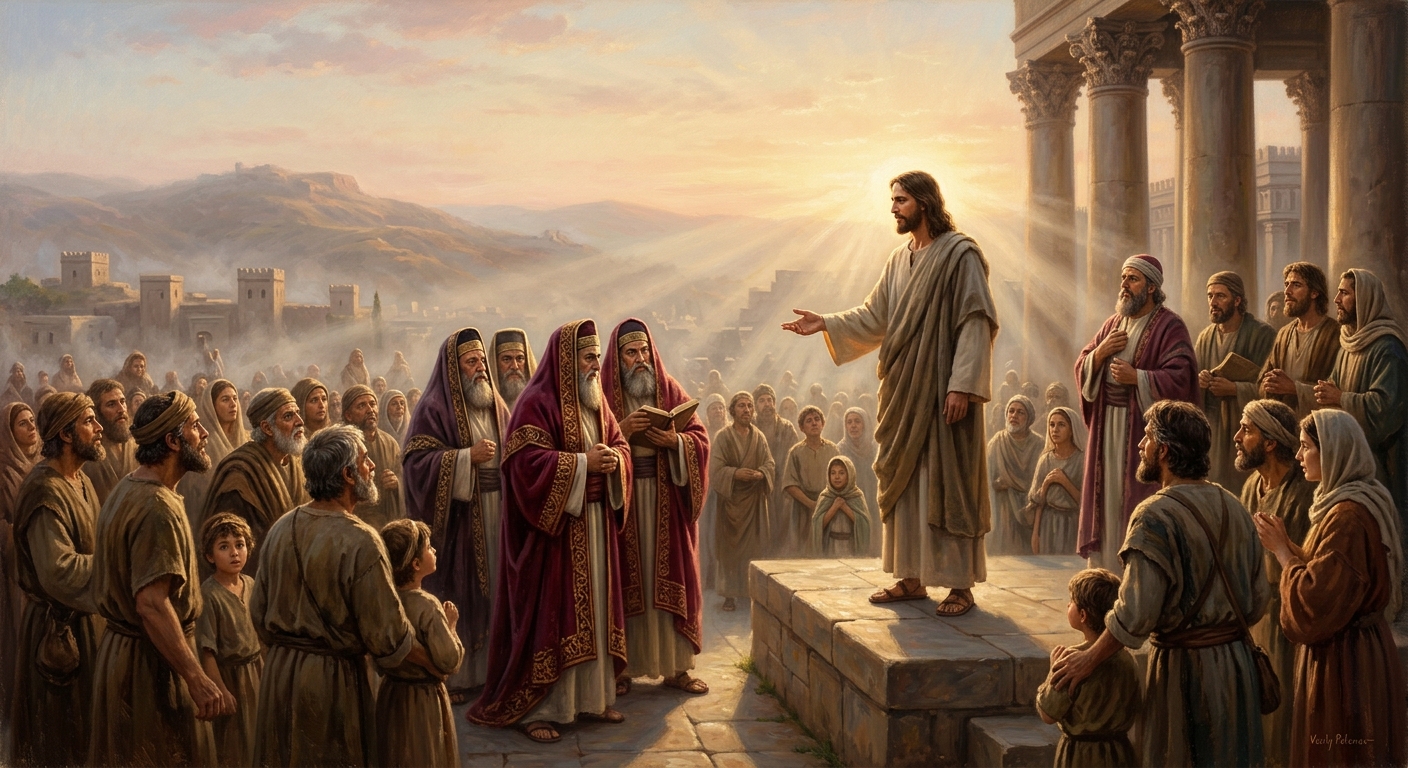
Illustration: A sweeping photorealistic oil painting captures a dramatic moment in ancient Jerusalem, where Jesus stands on a stone platform illuminated by radiant sunrise light that pierces the misty air, casting long shadows across the bustling crowd; the scene juxtaposes the opulent, gold-embroidered robes of solemn Pharisees whose stern faces mask hollow pride against the humble, weathered garments and earnest expressions of simple villagers, all set against a backdrop of towering temple columns and distant hills that
🔊
Listen to Chapter
Grace Notes Journey Audio Narration
Author
Matthew the Apostle
Written
~80 AD
Key Theme
True Righteousness vs Religious Hypocrisy
Setting
Jerusalem - Temple Mount
Key Verse
Matthew 23:12
Total Verses
39
Chapter Introduction
*Jesus' voice rises like a gentle rebuke from the hill, calling us to look beyond outward show and into the heart's posture. He warns that those who seek praise from men are like a mirror that reflects only vanity, while the humble find true honor in God's eyes. Let this be a reminder to lay down the heavy burdens we place on ourselves and others, seeking instead the lightness of grace. May our worship be a private communion with God rather than a performance for crowds.*
Matthew — Chapter 23 — KJV
1
Then spake Jesus to the multitude, and to his disciples,
Simply PutJesus turns to both the crowd gathered around Him and His own close followers. The Greek word *ochlos* (G2720) means a mass of people, showing that His warning is for all who hear Him, not just the elite.
2
Saying, The scribes and the Pharisees sit in Moses’ seat:
Simply PutHe points out that the scribes and Pharisees claim to sit in “Moses’ seat,” a place of authority. The Greek word *gabal* (G1014) means “chair,” implying they consider themselves the rightful interpreters of the Law.
3
All therefore whatsoever they bid you observe, that observe and do; but do not ye after their works: for they say, and do not.
Simply PutJesus tells them to obey everything the teachers say, but warns against merely copying their actions. The word *poieo* (G4180) means “to do,” and He’s saying that true obedience is heart‑action, not just empty gestures.
4
For they bind heavy burdens and grievous to be borne, and lay them on men’s shoulders; but they themselves will not move them with one of their fingers.
Simply PutThe teachers lay down heavy burdens for people to carry, yet they won’t lift even a finger to help. The Greek *bremma* (G1020) means “burden,” highlighting the crushing weight of their legalism that crushes the soul.
5
But all their works they do for to be seen of men: they make broad their phylacteries, and enlarge the borders of their garments,
Simply PutTheir deeds are just for show; they widen their headbands and hems to look impressive. *Phylacterion* (G5375) refers to the little boxes that hold Scripture, and they make them huge—just a flashy display without real devotion.
6
And love the uppermost rooms at feasts, and the chief seats in the synagogues,
Simply PutThey love the best seats at banquets and the highest places in the synagogue. This is a craving for status, not a love of God’s presence.
7
And greetings in the markets, and to be called of men, Rabbi, Rabbi.
Simply PutThey greet each other in the markets and chase after being called “Rabbi.” The title *rabbon* (H6783) means “my master,” and they seek the honor of being recognized by others.
8
But be not ye called Rabbi: for one is your Master, even Christ; and all ye are brethren.
Simply PutJesus says don’t let them call you “Rabbi” because He is the one Master. *Adelphos* (H140) means “brother,” reminding us that we’re all siblings under Christ’s lordship.
9
And call no man your father upon the earth: for one is your Father, which is in heaven.
Simply PutHe tells them not to call anyone “father” on earth, because there is only one Father—God in heaven. *Pater* (H3965) points to the ultimate source of our identity and relationship.
10
Neither be ye called masters: for one is your Master, even Christ.
Simply PutHe forbids them from calling themselves “masters,” since Christ is the only true Master. *Didaskalos* (H1325) means “teacher,” reminding us that we are students, not rulers.
11
But he that is greatest among you shall be your servant.
Simply PutThe greatest among them must be a servant. *Doulos* (H1690) means “slave or servant,” underscoring that greatness comes from serving others, not being served.
12
And whosoever shall exalt himself shall be abased; and he that shall humble himself shall be exalted.
Simply PutAnyone who lifts themselves up will be humbled; those who humble themselves will be lifted. The Greek *hyperephero* (H5279) means “to lift up,” and it flips the world’s idea of power on its head.
13
But woe unto you, scribes and Pharisees, hypocrites! for ye shut up the kingdom of heaven against men: for ye neither go in yourselves, neither suffer ye them that are entering to go in.
Simply PutHe warns that these leaders shut people out of the kingdom, refusing to enter themselves or let others in. *Hypokrites* (G534) means “an actor,” showing that their outward piety hides an inner blockage.
14
Woe unto you, scribes and Pharisees, hypocrites! for ye devour widows’ houses, and for a pretence make long prayer: therefore ye shall receive the greater damnation.
Simply PutThey devour widows’ houses and make long prayers for show. *Phagein* (G535) means “to eat,” highlighting how they consume others’ resources while putting on a pretended spiritual front.
15
Woe unto you, scribes and Pharisees, hypocrites! for ye compass sea and land to make one proselyte, and when he is made, ye make him twofold more the child of hell than yourselves.
16
Woe unto you, ye blind guides, which say, Whosoever shall swear by the temple, it is nothing; but whosoever shall swear by the gold of the temple, he is a debtor!
Simply PutJesus calls them "blind guides," pointing out that they claim swearing by the temple itself is meaningless, but swearing by its gold makes them a debtor (ὀφειλέτης). Their focus on glittering metal shows they value appearances over the true source of worship.
17
Ye fools and blind: for whether is greater, the gold, or the temple that sanctifieth the gold?
Simply PutHe asks, is it the gold that sanctifies (ἁγιάζω) the temple, or the temple that sets apart the gold? The answer is clear—the holy place gives meaning to the metal, not vice versa.
18
And, Whosoever shall swear by the altar, it is nothing; but whosoever sweareth by the gift that is upon it, he is guilty.
Simply PutThe scribes say swearing by the altar is empty, yet they swear by the gift (δῶρον) placed upon it and become a debtor. They miss that it's the offering, not the stone, that matters before God.
19
Ye fools and blind: for whether is greater, the gift, or the altar that sanctifieth the gift?
20
Whoso therefore shall swear by the altar, sweareth by it, and by all things thereon.
Simply PutIf anyone swears by the altar, they swear by it and everything on it. Their oath binds them to the whole system of rituals, not just a single symbol.
21
And whoso shall swear by the temple, sweareth by it, and by him that dwelleth therein.
Simply PutSwearing by the temple also means swearing by Him who dwells within. They think God lives in the building itself, missing that He resides beyond walls.
22
And he that shall swear by heaven, sweareth by the throne of God, and by him that sitteth thereon.
Simply PutSwearing by heaven is swearing by God's throne and Him who sits there. The heavenly realm points to the sovereign King, not just a distant sky.
23
Woe unto you, scribes and Pharisees, hypocrites! for ye pay tithe of mint and anise and cummin, and have omitted the weightier matters of the law, judgment, mercy, and faith: these ought ye to have done, and not to leave the other undone.
24
Ye blind guides, which strain at a gnat, and swallow a camel.
Simply PutYou strain at a gnat and swallow a camel. You're obsessing over tiny details while missing the massive reality before you.
25
Woe unto you, scribes and Pharisees, hypocrites! for ye make clean the outside of the cup and of the platter, but within they are full of extortion and excess.
26
Thou blind Pharisee, cleanse first that which is within the cup and platter, that the outside of them may be clean also.
Simply PutClean inside first, then the outside will also be clean. True holiness starts within the heart.
27
Woe unto you, scribes and Pharisees, hypocrites! for ye are like unto whited sepulchres, which indeed appear beautiful outward, but are within full of dead men’s bones, and of all uncleanness.
28
Even so ye also outwardly appear righteous unto men, but within ye are full of hypocrisy and iniquity.
Simply PutOutwardly you appear righteous, but inside you're full of hypocrisy and iniquity. Appearances deceive.
29
Woe unto you, scribes and Pharisees, hypocrites! because ye build the tombs of the prophets, and garnish the sepulchres of the righteous,
30
And say, If we had been in the days of our fathers, we would not have been partakers with them in the blood of the prophets.
Simply PutYou claim that if you had lived in your ancestors' days, you wouldn't have been partakers in the prophets' blood. It's an excuse for refusing to bear the cost of true devotion.
31
Wherefore ye be witnesses unto yourselves, that ye are the children of them which killed the prophets.
Simply PutYou’re saying, “Look here—you are the children of those who killed the prophets.” The Greek word for children (G5043) carries the weight of being born into a broken family. If you’re wrestling with doubt, this verse reminds you that the pain of generations is not yours to bear alone; God knows the weight of your ancestors’ sins and offers a fresh start.
32
Fill ye up then the measure of your fathers.
Simply Put“Fill up then the measure of your fathers.” The verb fill (G4160) means to add on, to become what your ancestors were. If you feel stuck in a cycle of failure, this is a call to break that pattern—don’t inherit their shortcomings, but fill the space with God’s righteousness instead.
33
Ye serpents, ye generation of vipers, how can ye escape the damnation of hell?
Simply Put“Ye serpents, ye generation of vipers, how can ye escape the damnation of hell?” The Greek words for serpents (G358) and vipers (G2199) paint a vivid picture of deceitful, venomous hearts. For the hungry soul, this is a stark warning: without true repentance, you’ll stay trapped in spiritual poison that leads to eternal loss.
34
Wherefore, behold, I send unto you prophets, and wise men, and scribes: and some of them ye shall kill and crucify; and some of them shall ye scourge in your synagogues, and persecute them from city to city:
Simply Put“I send unto you prophets, and wise men, and scribes… ye shall kill and crucify them.” The word crucify (G2603) rings with the pain of being nailed to a cross. If you’re feeling persecuted or unheard, Jesus is saying He’s already seen that. Even those who stand up for truth will be mistreated—yet your hope rests in Him, not in human approval.
35
That upon you may come all the righteous blood shed upon the earth, from the blood of righteous Abel unto the blood of Zacharias son of Barachias, whom ye slew between the temple and the altar.
Simply Put“From the blood of righteous Abel unto the blood of Zacharias…” The Greek name Abel (G77) stands for innocence, while Zacharias (G2275) represents prophetic suffering. If your heart aches over past injustices, know that God sees every tear shed from the first martyr to the last; He gathers all those tears into a tapestry of redemption.
36
Verily I say unto you, All these things shall come upon this generation.
Simply Put“Verily I say unto you, All these things shall come upon this generation.” The word truly (G71) underscores the certainty of Jesus’ warning. If you’re doubting whether God’s words matter today, this verse assures you that the consequences of ignoring Him are as real now as they were then.
37
O Jerusalem, Jerusalem, thou that killest the prophets, and stonest them which are sent unto thee, how often would I have gathered thy children together, even as a hen gathereth her chickens under her wings, and ye would not!
Simply Put“O Jerusalem, how often would I have gathered thy children together, even as a hen gathers her chickens under her wings.” The word wings (G4075) evokes the tender protection of a mother. If you’re longing for safety, this shows God’s desire to shelter you intimately—though humanity often refuses His loving embrace.
38
Behold, your house is left unto you desolate.
Simply Put“Behold, your house is left unto you desolate.” The term desolate (G1800) signifies abandonment and ruin. If you feel spiritually empty, this is a warning that neglecting God’s house leads to emptiness—but it also hints at the possibility of restoration if you turn back.
39
For I say unto you, Ye shall not see me henceforth, till ye shall say, Blessed is he that cometh in the name of the Lord.
Simply Put“Ye shall not see me henceforth, till ye shall say, Blessed is he that cometh in the name of the Lord.” The word blessed (G2073) points to divine approval. For the seeker, this verse emphasizes that true blessing comes not from personal merit but from recognizing and welcoming Christ as the promised Savior.
Luke 20:45This verse mirrors Matthew 23:5‑6 by highlighting the scribes' love for prominent seats at feasts and synagogues, underscoring their desire for outward prestige.
Mark 12:38It parallels Matthew 23:5‑6, describing how the scribes covet the chief places at feasts and seek honor, reinforcing their hypocrisy.
John 8:31Jesus' call to "continue in my word" directly contrasts the scribes' outward observance with genuine obedience, illuminating the theme of true discipleship versus mere ritual.
Isaiah 28:10This passage about the burdensome, repetitive law ("precept upon precept") echoes Matthew 23:4‑5's critique of the heavy yokes imposed by the scribes and Pharisees.
Reflect
When you make a promise or vow—whether to your family, at work, or about a personal goal—do the everyday actions you take (the "altar and everything on it") truly reflect that commitment, or are there parts of your life where you find yourself falling short?