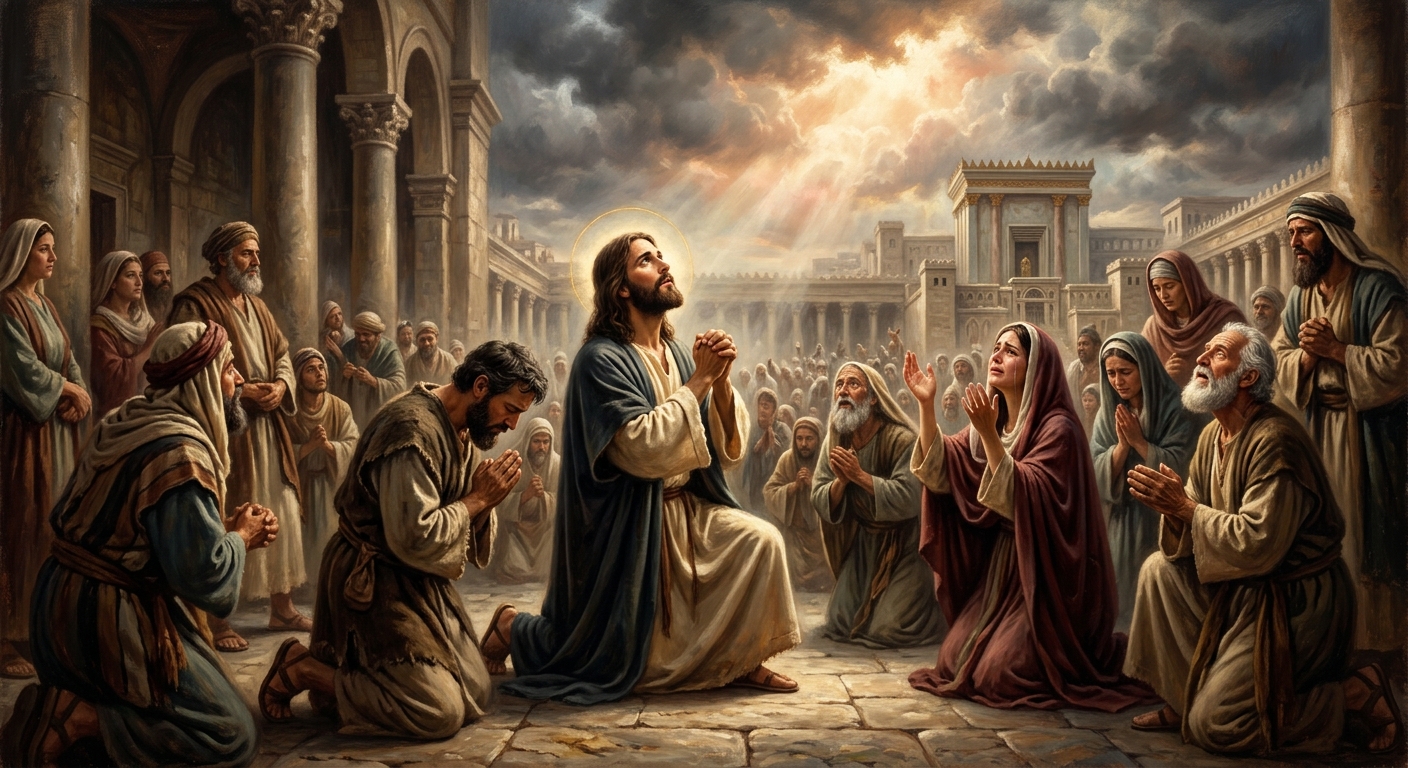
Illustration: Dramatic cinematic biblical illustration for Matthew Chapter 22 showing True Worship and Love of God, photorealistic oil painting style.
🔊
Listen to Chapter
Grace Notes Journey Audio Narration
Author
Matthew the Apostle
Written
~80 AD
Key Theme
True Worship and Love of God
Setting
Jerusalem - Temple Mount
Key Verse
Matthew 22:37
Total Verses
45
Chapter Introduction
*In this chapter, Jesus invites us to see the kingdom of heaven as a grand banquet, where every invitation is a call to love. He gently rebukes the empty hearts that ignore God's summons, and points us toward the heart of worship—loving God with our whole being. Through parables, He reveals that true discipleship is measured by the sincerity of our devotion. Let this passage stir your heart to offer a worship that honors God above all else.*
Matthew — Chapter 22 — KJV
1
And Jesus answered and spake unto them again by parables, and said,
2
The kingdom of heaven is like unto a certain king, which made a marriage for his son,
Simply PutThe kingdom of heaven (Greek: basileia, G932) is like a royal banquet—an extravagant wedding feast the king prepares for his beloved son. It’s not just an event; it’s a vivid picture of God’s reign, where He invites us into His deepest love and joy.
3
And sent forth his servants to call them that were bidden to the wedding: and they would not come.
Simply PutThe king sends his servants to call those who were invited (Greek: kaleō, G2589). Yet the guests ignore the summons. In our own lives, this shows how we can miss God’s call when we’re distracted or indifferent.
4
Again, he sent forth other servants, saying, Tell them which are bidden, Behold, I have prepared my dinner: my oxen and my fatlings are killed, and all things are ready: come unto the marriage.
Simply PutHe tells the servants, “My dinner is ready—my oxen and fatlings are slaughtered.” The feast is fully prepared, a promise of abundance. It reminds us that God’s provision is complete; He has already laid the table for our hearts.
5
But they made light of it, and went their ways, one to his farm, another to his merchandise:
6
And the remnant took his servants, and entreated them spitefully, and slew them.
Simply PutThe rest of the servants (those left behind) treat the messengers with contempt and kill them. Their cruelty reflects how some reject God’s grace and even fight against those who bring it.
7
But when the king heard thereof, he was wroth: and he sent forth his armies, and destroyed those murderers, and burned up their city.
8
Then saith he to his servants, The wedding is ready, but they which were bidden were not worthy.
Simply PutHe tells his servants, “The wedding is ready, but those who were invited were not worthy.” The invitation was given freely; the problem lay in the guests’ hearts. It reminds us that worthiness is not about status but of a humble, repentant spirit.
9
Go ye therefore into the highways, and as many as ye shall find, bid to the marriage.
Simply Put“Go into the highways,” he says—into the main roads (Greek: odos, G2315)—and invite as many as you find. God’s invitation extends beyond the elite to every corner of humanity, reaching those who were previously overlooked.
10
So those servants went out into the highways, and gathered together all as many as they found, both bad and good: and the wedding was furnished with guests.
Simply PutThe servants gather “both bad and good” (Greek: kakos, G381; agathos, G2580) and fill the banquet. The kingdom’s doors are open to all—no one is excluded based on past deeds, but everyone must respond.
11
And when the king came in to see the guests, he saw there a man which had not on a wedding garment:
Simply PutWhen the king inspects the guests, he sees a man without a wedding garment (Greek: chiton, G2545). It’s not the clothing itself but what it represents—a heart prepared to meet God.
12
And he saith unto him, Friend, how camest thou in hither not having a wedding garment? And he was speechless.
Simply PutThe king asks, “Friend, how did you come in without a wedding garment?” The man is speechless. His silence shows the weight of being unprepared for God’s presence.
13
Then said the king to the servants, Bind him hand and foot, and take him away, and cast him into outer darkness; there shall be weeping and gnashing of teeth.
Simply PutThe king commands, “Bind him hand and foot, cast him into outer darkness (Greek: skotos, G804).” There will be weeping and gnashing of teeth. This vivid picture warns that those who ignore God’s invitation will face eternal separation.
14
For many are called, but few are chosen.
Simply Put“Many are called, but few are chosen.” The Greek word for “chosen” (eklegō, G1905) implies a deliberate selection. It’s an invitation to be counted among the few who truly respond.
15
Then went the Pharisees, and took counsel how they might entangle him in his talk.
Simply PutThe Pharisees, feeling threatened, plot to trap Him. Their scheming reveals the danger of using religious questions for personal gain rather than seeking truth.
16
And they sent out unto him their disciples with the Herodians, saying, Master, we know that thou art true, and teachest the way of God in truth, neither carest thou for any man: for thou regardest not the person of men.
Simply PutThey send their disciples and the Herodians, saying, “Teacher, we know you speak truth (Greek: alētheia, G225), teaching the way of God without caring for anyone.” Their flattery masks a deeper attempt to undermine His authority.
17
Tell us therefore, What thinkest thou? Is it lawful to give tribute unto Caesar, or not?
Simply PutThe Greek word for “lawful” (G3559) means what is permitted by law or custom. The religious leaders are trying to trap Jesus—if He says yes, they can accuse Him of being a Roman collaborator; if He says no, they can charge Him with rebellion. In the midst of your own hardships or doubts, this reminds us to ask where our true loyalty belongs.
18
But Jesus perceived their wickedness, and said, Why tempt ye me, ye hypocrites?
Simply PutJesus “perceived” (G4621) the wickedness behind their question; He sees beyond their outward words to the heart’s intent. By calling them “hypocrites,” He exposes their double standards and shows that God knows the motives behind every attempt to test Him.
19
Shew me the tribute money. And they brought unto him a penny.
Simply PutThe “money” (Greek δηνάριον, G1350) was the small Roman coin used for taxes—a symbol of worldly authority. Bringing this to Jesus, they hoped He would either endorse or reject the empire’s rule; yet He turns it into a lesson about what truly belongs to us.
20
And he saith unto them, Whose is this image and superscription?
Simply PutThe “image” (Greek εἰκὼν, G1519) on the coin bore Caesar’s portrait and inscription, declaring his dominion. Jesus points out that this belongs to the ruler of the earth, setting the stage for a deeper truth about belonging to God.
21
They say unto him, Caesar’s. Then saith he unto them, Render therefore unto Caesar the things which are Caesar’s; and unto God the things that are God’s.
Simply PutTo “render” (Greek δότε, G1325) means to give back what is due. Jesus teaches us to fulfill our civic responsibilities while recognizing that everything else—our hearts, thoughts, and deeds—is owed to God alone.
22
When they had heard these words, they marvelled, and left him, and went their way.
23
The same day came to him the Sadducees, which say that there is no resurrection, and asked him,
Simply PutThe Sadducees, who deny the “resurrection” (Greek ἀνάστασις, G310), approach Him with a legal dilemma. Their denial of life after death reveals their limited view, and they seek to catch Him in a theological snare.
24
Saying, Master, Moses said, If a man die, having no children, his brother shall marry his wife, and raise up seed unto his brother.
Simply Put“Seed” (Greek σπέρμα, G4677) refers to offspring—the continuation of a family line. Their question about who will raise the seed in the afterlife highlights their misunderstanding of what resurrection truly means.
25
Now there were with us seven brethren: and the first, when he had married a wife, deceased, and, having no issue, left his wife unto his brother:
Simply Put“Issue” (Greek γενεά, G1070) refers to children or descendants. The fact that none of the brothers left any offspring makes their legal question impossible, pointing to a deeper spiritual reality.
26
Likewise the second also, and the third, unto the seventh.
Simply PutThe “seventh” (Greek ἑπτά, G2146) brother completes the pattern of levirate marriages. Their scenario creates a paradox that reveals they have missed the nature of eternal life.
27
And last of all the woman died also.
Simply PutWith “the woman died also,” the passage underscores that even in this earthly story, death ends the family line—yet resurrection transcends such endings.
28
Therefore in the resurrection whose wife shall she be of the seven? for they all had her.
Simply PutTheir question about “whose wife shall she be of the seven?” shows they “err” (Greek πλανῶσιν, G4013) by assuming marriage continues after resurrection. Their confusion exposes a lack of understanding about the power and nature of God’s kingdom.
29
Jesus answered and said unto them, Ye do err, not knowing the scriptures, nor the power of God.
Simply PutJesus rebukes them, saying they “err” (Greek πλανῶσιν, G4013) because they do not know the Scriptures or God’s power. He points out that true wisdom comes from grasping divine truth, not merely legal reasoning.
30
For in the resurrection they neither marry, nor are given in marriage, but are as the angels of God in heaven.
Simply PutHe explains that in the resurrection people “neither marry nor are given in marriage,” but are “as the angels of God” (Greek ἄγγελος, G32). This means we will exist as spiritual beings, fully devoted to God without earthly ties.
31
But as touching the resurrection of the dead, have ye not read that which was spoken unto you by God, saying,
Simply PutJesus reminds them that the “God spoke” (Greek εἶπεν, G808) about the resurrection long ago. By turning to Scripture, He shows that God's own words hold the key to understanding life after death.
32
I am the God of Abraham, and the God of Isaac, and the God of Jacob? God is not the God of the dead, but of the living.
Simply PutJesus tells them that the God who promised Abraham, Isaac and Jacob—'theos' (G2316)—is not a distant deity who lives only in the past. He is a living God, present and active for those who are alive today. If you feel abandoned or like your prayers have gone unheard, this verse reminds you that the same God who spoke to your forefathers is walking beside you now.
33
And when the multitude heard this, they were astonished at his doctrine.
Simply PutWhen the crowd heard this truth, they were 'astonished' (Greek entaxio, G1885)—their hearts were shaken by the depth of his teaching. It lit a fire in their souls, showing that Jesus' doctrine was more than rules; it touched the core of human longing. In your moments of doubt, let this astonishment remind you that divine wisdom can still surprise and renew.
34
But when the Pharisees had heard that he had put the Sadducees to silence, they were gathered together.
Simply PutSeeing that Jesus had silenced the Sadducees, the Pharisees 'gathered together' to regroup. The word for silence (hēge, G219) points to the crushing defeat they felt as their arguments fell flat. If you ever feel silenced by those who think they have the answers, remember that true wisdom can quiet even the loudest voices.
35
Then one of them, which was a lawyer, asked him a question, tempting him, and saying,
Simply Put'Master, what is the great commandment in the law?' He asks for the most important rule—'megas' (G3179) meaning supreme or chief. In a world full of rules, he craves the one that truly matters for his soul. If you feel lost among many do's and don'ts, this verse points you to the heart of what truly guides us.
36
Master, which is the great commandment in the law?
37
Jesus said unto him, Thou shalt love the Lord thy God with all thy heart, and with all thy soul, and with all thy mind.
Simply PutJesus answers that the first command is to love God with all your heart, soul and mind—'
38
This is the first and great commandment.
39
And the second is like unto it, Thou shalt love thy neighbour as thyself.
40
On these two commandments hang all the law and the prophets.
41
While the Pharisees were gathered together, Jesus asked them,
42
Saying, What think ye of Christ? whose son is he? They say unto him, The son of David.
43
He saith unto them, How then doth David in spirit call him Lord, saying,
44
The LORD said unto my Lord, Sit thou on my right hand, till I make thine enemies thy footstool?
45
If David then call him Lord, how is he his son?
46
And no man was able to answer him a word, neither durst any man from that day forth ask him any more questions.
Simply PutWhen Jesus asked a deep question about the Messiah's identity, no one could give even a single reply; they were too weak to dare answer again. The Greek word here, ἀποκριθῆναι (G657), simply means “to answer,” but it also carries the weight of being able to meet a divine challenge. This verse reminds us that sometimes, when we’re overwhelmed by life’s mysteries or God’s truths, it’s okay to stay silent and let the truth settle in our hearts. It shows that true humility often follows when we recognize our limits before the One who knows all things.
When someone close to you passes away without children, how have you responded—or might respond—to support their surviving spouse and help keep their memory alive?