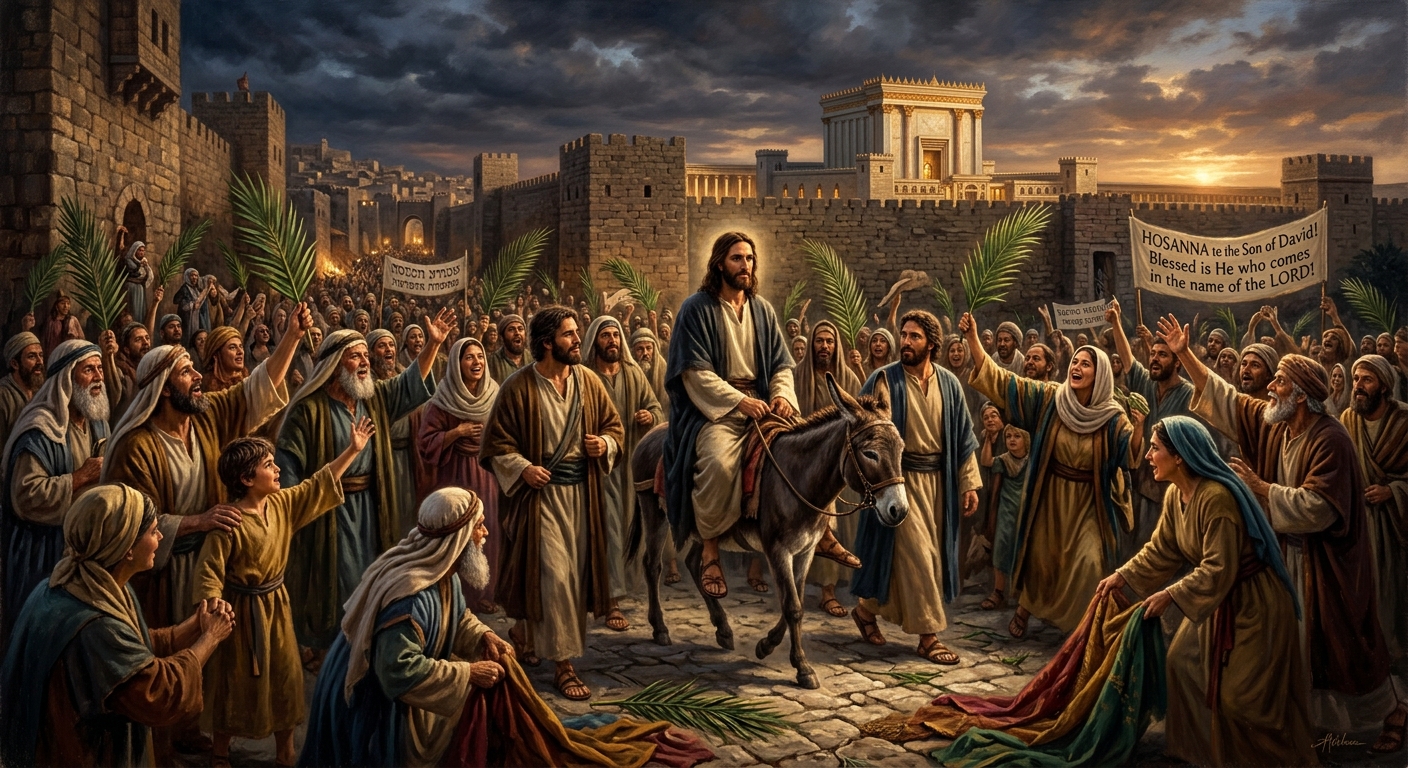
Illustration: Dramatic cinematic biblical illustration for Matthew Chapter 21 showing Messianic Fulfillment through Jesus, photorealistic oil painting style.
🔊
Listen to Chapter
Grace Notes Journey Audio Narration
Author
Matthew the Apostle
Written
~80 AD
Key Theme
Messianic Fulfillment through Jesus
Setting
Jerusalem - Triumphal Entry
Key Verse
Matthew 21:5
Total Verses
46
Chapter Introduction
*As we walk the dusty roads of Bethphage and Mount Olives, imagine the humble donkey waiting for its Master. Jesus rides in, not as a conquering warlord but as the promised King of peace, fulfilling ancient prophecy. The crowds shout "Hosanna," a heartfelt cry for salvation that still echoes in our hearts today. In this moment, the kingdom of God steps onto the stage of human history, inviting us to worship with awe and humility.*
Matthew — Chapter 21 — KJV
1
And when they drew nigh unto Jerusalem, and were come to Bethphage, unto the mount of Olives, then sent Jesus two disciples,
Simply PutJesus and his two closest friends are getting close to the holy city, specifically to Bethphage on the Mount of Olives. The Greek verb for “drew nigh” (G5044) means to approach with intention, showing that they were moving toward something significant—God’s plan about to unfold.
2
Saying unto them, Go into the village over against you, and straightway ye shall find an ass tied, and a colt with her: loose them, and bring them unto me.
Simply PutJesus tells them to go and fetch a donkey (Greek “ass,” G161) and her colt. He emphasizes that the Lord has a need for them, using the Greek word “exigēsis” (G2580), which conveys an urgent necessity. This shows that even humble, simple animals are vital for the divine purpose.
3
And if any man say ought unto you, ye shall say, The Lord hath need of them; and straightway he will send them.
Simply PutIf anyone objects, they’re to say “The Lord has need of them,” again using that word of urgent necessity (G2580). The implication is that God’s purposes trump any human hesitation; the need of God must be met without delay.
4
All this was done, that it might be fulfilled which was spoken by the prophet, saying,
Simply PutAll these actions were performed to fulfill (Greek “fulfill,” G1246) the prophecy of a prophet. The word carries the weight of completing God’s spoken promise, showing that history is moving according to divine design.
5
Tell ye the daughter of Sion, Behold, thy King cometh unto thee, meek, and sitting upon an ass, and a colt the foal of an ass.
Simply PutThe prophecy says the King comes meek (Greek “meek,” G332) and rides a donkey. Meekness here isn’t weakness—it’s humble confidence that trusts in God rather than relying on worldly power.
6
And the disciples went, and did as Jesus commanded them,
Simply PutThe disciples obey the command without question. Their obedience reflects how we are called to trust and act when God gives direction.
7
And brought the ass, and the colt, and put on them their clothes, and they set him thereon.
Simply PutThey bring the donkey and its colt, place their clothes on them, and set Jesus atop. This simple act of preparation signals that God’s entrance into the world is through humble means, not grand displays.
8
And a very great multitude spread their garments in the way; others cut down branches from the trees, and strawed them in the way.
Simply PutA crowd spreads their garments and branches on the road. The act of laying down cloaks shows reverence, like a warm welcome for someone who needs care and compassion.
9
And the multitudes that went before, and that followed, cried, saying, Hosanna to the son of David: Blessed is he that cometh in the name of the Lord; Hosanna in the highest.
Simply PutThe multitude shouts “Hosanna” to the Son of David. “Hosanna” is a Hebrew cry for salvation, meaning “save now.” They bless the One who comes in the name of the Lord, recognizing Him as the promised Messiah.
10
And when he was come into Jerusalem, all the city was moved, saying, Who is this?
Simply PutAs Jesus enters Jerusalem, the whole city is stirred with curiosity—“Who is this?” It reflects a deep longing for answers, a realization that something new has arrived.
11
And the multitude said, This is Jesus the prophet of Nazareth of Galilee.
Simply PutThe crowd identifies Him as “Jesus the prophet of Nazareth.” Their words show a recognition that He is more than a teacher; He embodies the prophetic voice of God.
12
And Jesus went into the temple of God, and cast out all them that sold and bought in the temple, and overthrew the tables of the moneychangers, and the seats of them that sold doves,
Simply PutJesus clears out the marketplace in the temple, overturning tables. He “casts out” (Greek “cast,” G2756) the sellers, showing that worship should be focused on God alone, not commercialized.
13
And said unto them, It is written, My house shall be called the house of prayer; but ye have made it a den of thieves.
Simply PutHe quotes Scripture: “My house shall be called a house of prayer,” but the people have turned it into a den of thieves. The Greek word for “prayer” (G1691) emphasizes heartfelt communion with God, while “den of thieves” points to greed corrupting worship.
14
And the blind and the lame came to him in the temple; and he healed them.
Simply PutThe blind and lame come to Him, and He heals them. In the temple He restores physical sight and mobility—a tangible sign that God’s power brings wholeness to those in need.
15
And when the chief priests and scribes saw the wonderful things that he did, and the children crying in the temple, and saying, Hosanna to the son of David; they were sore displeased,
Simply PutThe chief priests and scribes see the miracles and hear the children shouting “Hosanna” but they are sore displeased. Their displeasure shows that true worship can be met with resistance from those who cling to tradition and power.
16
And said unto him, Hearest thou what these say? And Jesus saith unto them, Yea; have ye never read, Out of the mouth of babes and sucklings thou hast perfected praise?
Simply PutJesus turns the priests' question back onto them, quoting the Psalms. The “babes” (paidion) and “sucklings” speak with pure hearts, their simple mouths offering the most sincere praise. For someone in pain, this reminds us that God values honest, childlike trust over polished words.
17
And he left them, and went out of the city into Bethany; and he lodged there.
Simply PutAfter confronting the priests, Jesus heads out of Jerusalem to Bethany and stays there. He seeks a place of rest amid the whirlwind of ministry, showing that even the Savior needed quiet moments to regroup.
18
Now in the morning as he returned into the city, he hungered.
Simply PutEarly the next morning, Jesus returns to Jerusalem feeling hungry. His physical hunger reflects his deep desire to fulfill God’s plan, reminding us that our own cravings can be a pathway back to seeking the Lord’s purpose for us.
19
And when he saw a fig tree in the way, he came to it, and found nothing thereon, but leaves only, and said unto it, Let no fruit grow on thee henceforward for ever. And presently the fig tree withered away.
Simply PutSeeing a fig tree, Jesus finds only leaves and declares it “cursed” (Greek sykomoros, G4988). He teaches that outward appearances—like leaves—can hide an empty heart. In our hunger, this calls us to bear fruit that truly satisfies the soul.
20
And when the disciples saw it, they marvelled, saying, How soon is the fig tree withered away!
Simply PutThe disciples watch in amazement as the fig tree wilts almost instantly. Their wonder shows how quickly God’s word can take effect when we truly trust, encouraging those in doubt to see the power of faith at work.
21
Jesus answered and said unto them, Verily I say unto you, If ye have faith, and doubt not, ye shall not only do this which is done to the fig tree, but also if ye shall say unto this mountain, Be thou removed, and be thou cast into the sea; it shall be done.
Simply PutJesus says that if we have unwavering faith (Greek pistis, G4100), we can not only command a fig tree but also move mountains (Greek oros). This isn’t about magic; it’s about trusting God fully, even when the world seems impossible.
22
And all things, whatsoever ye shall ask in prayer, believing, ye shall receive.
Simply PutHe promises that every prayer asked in belief will be received. When we hunger for God’s presence, this assures us that sincere faith opens the door to His abundant provision.
23
And when he was come into the temple, the chief priests and the elders of the people came unto him as he was teaching, and said, By what authority doest thou these things? and who gave thee this authority?
Simply PutThe chief priests confront Jesus, demanding to know his authority. Their question reflects a deeper fear of losing control over what the people hear.
24
And Jesus answered and said unto them, I also will ask you one thing, which if ye tell me, I in like wise will tell you by what authority I do these things.
Simply PutJesus counters with one question, showing that true authority comes from answering divine mysteries. He invites them to trust Him rather than just challenge Him.
25
The baptism of John, whence was it? from heaven, or of men? And they reasoned with themselves, saying, If we shall say, From heaven; he will say unto us, Why did ye not then believe him?
Simply PutHe asks whether John’s baptism came from heaven or men. Their struggle reveals a reluctance to admit that God works beyond human plans.
26
But if we shall say, Of men; we fear the people; for all hold John as a prophet.
Simply PutIf they say “men,” they fear the crowd’s loyalty to John. Their answer shows how often we let public opinion dictate our spiritual convictions.
27
And they answered Jesus, and said, We cannot tell. And he said unto them, Neither tell I you by what authority I do these things.
Simply PutUnable to answer, they claim ignorance, and Jesus says He won’t reveal His authority either. This teaches that when we hide from truth, the gospel’s power remains mysterious to us.
28
But what think ye? A certain man had two sons; and he came to the first, and said, Son, go work to day in my vineyard.
Simply PutJesus tells a parable of a man and his two sons working in the vineyard. The “certain” (Greek kathemenos, G2590) man represents God’s call to all of us.
29
He answered and said, I will not: but afterward he repented, and went.
Simply PutThe first son initially refuses but later repents (Greek metanoia, G3327), meaning a heartfelt change of direction. His story reminds us that it’s never too late to turn back and act.
30
And he came to the second, and said likewise. And he answered and said, I go, sir: and went not.
Simply PutThe second son eagerly promises to go but never does. Jesus points out that empty words without action are meaningless, urging us to align our promises with genuine deeds.
31
Whether of them twain did the will of his father? They say unto him, The first. Jesus saith unto them, Verily I say unto you, That the publicans and the harlots go into the kingdom of God before you.
Simply PutJesus asks, "Which of the two did the will of his father?" The key word here is "kingdom" (KJV), from the Greek basileia (G932), meaning a sovereign realm. He tells his listeners that even those despised by society—tax collectors and harlots—will enter God's kingdom before they do, because the kingdom belongs to those who humbly receive it.
32
For John came unto you in the way of righteousness, and ye believed him not: but the publicans and the harlots believed him: and ye, when ye had seen it, repented not afterward, that ye might believe him.
Simply PutThe Greek word for "repented" is metanoeō (G3319), meaning a change of heart and mind. Jesus points out that John the Baptist brought righteousness, yet they rejected him; meanwhile, the lowly did not because they saw the truth of God's love. Their failure to repent shows they're missing the very reason to believe.
33
Hear another parable: There was a certain householder, which planted a vineyard, and hedged it round about, and digged a winepress in it, and built a tower, and let it out to husbandmen, and went into a far country:
Simply PutThe key word is "vineyard," Greek ampelon (G258), symbolizing God's people. The owner of the vineyard prepares it—he hedges, digs a press, builds a tower—to produce fruit. He then rents it to husbandmen and goes away, trusting them with what God has entrusted.
34
And when the time of the fruit drew near, he sent his servants to the husbandmen, that they might receive the fruits of it.
Simply Put"Time of the fruit" uses the Greek word khronos (G5620), meaning a set season. When that season approaches, the owner sends servants to collect what was promised. The expectation is simple: give back what you received.
35
And the husbandmen took his servants, and beat one, and killed another, and stoned another.
Simply PutThe husbandmen's cruelty is shown in the Greek words beat (pēnō, G4016), kill (phagein, G5312), and stone (sphōra, G4775). Their violent rejection of the servants reflects a deeper spiritual rebellion against God's messengers.
36
Again, he sent other servants more than the first: and they did unto them likewise.
Simply PutThe owner sends "other servants" again, Greek palin (G3821), meaning repeatedly. Yet the husbandmen repeat the same violent treatment, showing their stubbornness and lack of gratitude.
37
But last of all he sent unto them his son, saying, They will reverence my son.
Simply PutHe finally sends his "son," trusting they will honor him ("reverence"—phileō, G5365, literally "to love"). The assumption is that the heir will be respected and valued.
38
But when the husbandmen saw the son, they said among themselves, This is the heir; come, let us kill him, and let us seize on his inheritance.
Simply PutThe husbandmen plot to kill him, seeing the "inheritance" (klēros, G2825) as theirs. Their greed blinds them to the true purpose of the inheritance: to bear fruit for the owner.
39
And they caught him, and cast him out of the vineyard, and slew him.
Simply PutThey "caught" (koptō, G2770), cast out, and "slew" the son. The tragedy is that they destroy what was most valuable to them—God's own Son.
40
When the lord therefore of the vineyard cometh, what will he do unto those husbandmen?
Simply PutWhen the "lord of the vineyard" (kurios, G2962) returns, He will take decisive action. This is a warning that God will not tolerate abuse of His gifts.
41
They say unto him, He will miserably destroy those wicked men, and will let out his vineyard unto other husbandmen, which shall render him the fruits in their seasons.
Simply PutThe answer given is that He "will miserably destroy" (apollumi, G618) the wicked and give the vineyard to faithful workers. It’s a promise that those who betray God will be removed, while others will inherit.
42
Jesus saith unto them, Did ye never read in the scriptures, The stone which the builders rejected, the same is become the head of the corner: this is the Lord’s doing, and it is marvellous in our eyes?
Simply PutJesus cites the scripture about "the stone which the builders rejected" (lithos, G2985). This stone becomes the cornerstone—a solid foundation—showing that what was scorned can become the most vital part of God's plan.
43
Therefore say I unto you, The kingdom of God shall be taken from you, and given to a nation bringing forth the fruits thereof.
Simply PutHe warns that "the kingdom of God shall be taken from you" (basileia, G932) and given to a nation that bears fruit. The warning is clear: spiritual responsibility carries real consequences.
44
And whosoever shall fall on this stone shall be broken: but on whomsoever it shall fall, it will grind him to powder.
Simply PutWhoever "falls on this stone" will be broken, but it also grinds them to powder. The stone represents both judgment and the transformative power that refines those who accept it.
45
And when the chief priests and Pharisees had heard his parables, they perceived that he spake of them.
Simply PutThe chief priests and Pharisees "perceived" (katalambanō, G2591) that Jesus was speaking about them through his parables. Their realization is that the story is a mirror reflecting their own failures and unfaithfulness.
46
But when they sought to lay hands on him, they feared the multitude, because they took him for a prophet.
Simply PutWhen they tried to seize Jesus, they hesitated because of the crowd. They saw Him as a prophet, not realizing He was the promised Messiah. The Greek word here for “lay hands” (cheirō, G5548) implies a physical act of control or accusation, but the crowd’s fear shows how human misunderstanding can turn against God’s true purpose. This reminds us that our doubts and fears often stem from seeing only part of the picture, rather than trusting the full revelation of Christ.
Zechariah 9:9This prophecy directly anticipates the Messiah's humble entry into Jerusalem on a donkey, which Matthew 21:4-5 declares as fulfillment.
Psalm 118:26The crowd's shouts of "Blessed is He that cometh in the Name of the Lord" during the triumphal entry echo this messianic psalm.
John 12:12-19The parallel narrative in John's Gospel provides additional eyewitness details of the same event, reinforcing its significance.
Zechariah 14:4This future prophecy about the Lord standing on the Mount of Olives connects to Jesus' approach from Bethphage, underscoring the eschatological import of the location.
Reflect
Think about a recent situation where you felt uncertain about your authority to act—did you rely on personal conviction, the expectations of others, or something deeper?