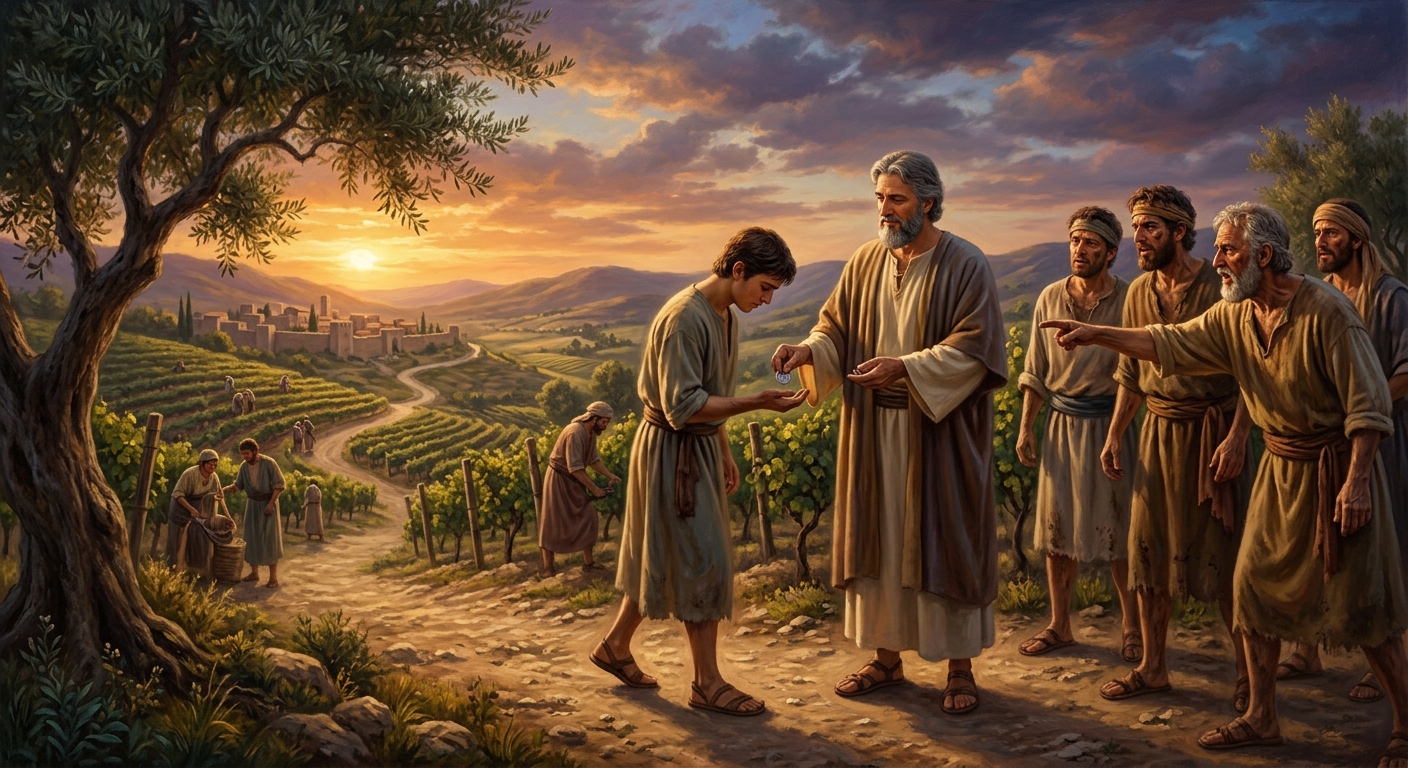
Illustration: Dramatic cinematic biblical illustration for Matthew Chapter 20 showing Graceful reward for faithful service, photorealistic oil painting style.
🔊
Listen to Chapter
Grace Notes Journey Audio Narration
Author
Matthew the Apostle
Written
~80 AD
Key Theme
Graceful reward for faithful service
Setting
Galilean vineyard, Jesus' ministry
Key Verse
Matthew 20:16
Total Verses
34
Chapter Introduction
_Imagine a gentle householder who invites workers at any hour, paying each with the same love. In this parable, Jesus reveals that God's kingdom is not bound by human notions of merit but by divine generosity. As we read, let our hearts be humbled to recognize that every laborer—whether early or late—is welcomed into the vineyard of grace. May this truth stir us to serve faithfully, knowing that our reward comes from a loving Father._
Matthew — Chapter 20 — KJV
1
For the kingdom of heaven is like unto a man that is an householder, which went out early in the morning to hire labourers into his vineyard.
Simply PutThe kingdom of heaven (Greek basileia, G932) is compared to a man who owns a vineyard. He goes out early to hire workers, showing that God's kingdom invites us into His work before the day is fully bright. It reminds us that the invitation to serve Him is always open, no matter what hour it feels like.
2
And when he had agreed with the labourers for a penny a day, he sent them into his vineyard.
Simply PutThe workers agree for a penny a day—a humble wage that speaks of honest labor. Even the smallest coin is a promise kept, showing God’s faithfulness to even our most modest agreements (Greek "agreuo", G1325). If you’re worried about being undervalued, remember that God honors every honest contract.
3
And he went out about the third hour, and saw others standing idle in the marketplace,
Simply PutAt the third hour, he sees people idle (Greek kenos, G2741) in the marketplace—standing without purpose. God calls those who feel empty to step into His vineyard, offering them a place where their idle moments can become productive. In your stillness, there’s an invitation to find meaning.
4
And said unto them; Go ye also into the vineyard, and whatsoever is right I will give you. And they went their way.
Simply PutHe tells them, “Go into the vineyard, and whatever is right I will give you.” The Greek word for “right” (dikaio, G1343) means just and fair. Even if you doubt what’s fair in life, God offers to do what is just for each of us.
5
Again he went out about the sixth and ninth hour, and did likewise.
Simply PutAround the sixth and ninth hours, he repeats his invitation. The rhythm shows that God’s grace is not limited to one moment but comes repeatedly throughout the day, always waiting for those ready to respond.
6
And about the eleventh hour he went out, and found others standing idle, and saith unto them, Why stand ye here all the day idle?
Simply PutNear the eleventh hour, he asks, “Why stand ye here idle?” The question pierces those who have been waiting without purpose. If you’ve felt stuck, God asks you to step out now and claim the work He has prepared.
7
They say unto him, Because no man hath hired us. He saith unto them, Go ye also into the vineyard; and whatsoever is right, that shall ye receive.
Simply PutThe idle workers reply, “Because no one hired us.” Their lack of opportunity is met with a firm invitation: “Go also into the vineyard; whatever is right you shall receive.” God’s doors open to anyone who feels overlooked.
8
So when even was come, the lord of the vineyard saith unto his steward, Call the labourers, and give them their hire, beginning from the last unto the first.
Simply PutWhen evening comes, the owner tells his steward to pay the workers “beginning from the last unto the first.” The Greek word "oikonomos" (G251) for steward shows a trusted manager who follows the owner’s generous command. It assures us that God’s generosity is not bound by our expectations.
9
And when they came that were hired about the eleventh hour, they received every man a penny.
Simply PutThose hired at the eleventh hour each receive a penny. The simple payment highlights that even latecomers are fully included in the blessing.
10
But when the first came, they supposed that they should have received more; and they likewise received every man a penny.
Simply PutWhen the first workers arrived, they thought they deserved more because they worked all day. Yet each received a penny—showing that God’s reward is not based on length of service but on the love and willingness to serve.
11
And when they had received it, they murmured against the goodman of the house,
Simply PutAfter receiving their wage, they murmured against the goodman of the house. Their complaint reflects a human tendency to compare and grumble, even in the presence of God’s generosity.
12
Saying, These last have wrought but one hour, and thou hast made them equal unto us, which have borne the burden and heat of the day.
Simply Put“These last have wrought one hour, and you have borne the burden and heat of the day.” Their sense of injustice is understandable, yet God’s kingdom runs on grace, not human merit.
13
But he answered one of them, and said, Friend, I do thee no wrong: didst not thou agree with me for a penny?
Simply PutThe owner replies, “Friend, I do you no wrong; didst not thou agree for a penny?” He reminds them of their own agreement (Greek "agreuo", G1325), emphasizing that each person’s contract is fulfilled exactly as promised.
14
Take that thine is, and go thy way: I will give unto this last, even as unto thee.
Simply Put“Take thine and go thy way; I will give unto this last, even as unto thee.” The owner’s generosity surpasses the idea of fairness; it reflects a heart that delights in giving abundantly.
15
Is it not lawful for me to do what I will with mine own? Is thine eye evil, because I am good?
Simply Put“Is it not lawful for me to do what I will with mine own? Is thine eye evil, because I am good?” The owner questions whether the first workers’ envy is a misinterpretation of his kindness. It reminds us that God’s goodness isn’t limited—it can overflow to all, without diminishing anyone else.
16
So the last shall be first, and the first last: for many be called, but few chosen.
Simply PutGod’s kingdom turns the world upside down—those who seem least important become most honored. The Greek word “called” (kallēō, G2650) means simply being invited, but “chosen” (eklekto, G1785) carries the weight of divine election. In your doubts, remember that status does not dictate God’s love; He can lift you from obscurity.
17
And Jesus going up to Jerusalem took the twelve disciples apart in the way, and said unto them,
Simply PutJesus took His twelve apart (apokoptō, G559) from the crowd to speak heart-to-heart. He knows when to pause and address you directly in your pain.
18
Behold, we go up to Jerusalem; and the Son of man shall be betrayed unto the chief priests and unto the scribes, and they shall condemn him to death,
Simply PutJesus foretells His betrayal (paradidōmi, G3989) to religious leaders who will falsely accuse Him and condemn (katastasis, G2595) Him to death. Even in betrayal and injustice, God’s purpose remains steadfast.
19
And shall deliver him to the Gentiles to mock, and to scourge, and to crucify him: and the third day he shall rise again.
Simply PutHe will be handed to the Gentiles for mockery, scourging, and crucifixion (stauros, G4985), but He will rise again on the third day (anastasis, G442). In your darkest hour, this guarantees that death is not the end.
20
Then came to him the mother of Zebedee’s children with her sons, worshipping him, and desiring a certain thing of him.
Simply PutJames' mother approaches Jesus in deep reverence (proskynēsis, G4335), bringing her heartfelt desire before Him. True worship includes laying your deepest hopes at His feet.
21
And he said unto her, What wilt thou? She saith unto him, Grant that these my two sons may sit, the one on thy right hand, and the other on the left, in thy kingdom.
Simply PutShe asks for her sons to sit at the highest places—right hand (dexios, G1845) and left—in Jesus’ kingdom. The right hand symbolized supreme authority and favor.
22
But Jesus answered and said, Ye know not what ye ask. Are ye able to drink of the cup that I shall drink of, and to be baptized with the baptism that I am baptized with? They say unto him, We are able.
Simply PutJesus challenges them, asking if they can handle (phialē, G5407) the suffering He will endure. The cup represents trials; baptism means being immersed in that experience.
23
And he saith unto them, Ye shall drink indeed of my cup, and be baptized with the baptism that I am baptized with: but to sit on my right hand, and on my left, is not mine to give, but it shall be given to them for whom it is prepared of my Father.
Simply PutHe assures they will share His cup (phialē) and baptism, but the positions of honor belong to those the Father has prepared. God’s sovereign plan determines our roles, not personal ambition.
24
And when the ten heard it, they were moved with indignation against the two brethren.
Simply PutThe ten disciples feel a burning anger (thymos, G2384) toward James and John. Their hearts stir with jealousy—not just for status but for recognition.
25
But Jesus called them unto him, and said, Ye know that the princes of the Gentiles exercise dominion over them, and they that are great exercise authority upon them.
Simply PutJesus reminds them that worldly rulers (archontēs, G718) dominate people with authority. He points out the contrast between worldly power and kingdom values.
26
But it shall not be so among you: but whosoever will be great among you, let him be your minister;
Simply PutGreatness (megas, G3198) is measured by becoming a minister to others. True greatness lies in humility, not personal ambition.
27
And whosoever will be chief among you, let him be your servant:
Simply PutLeadership (archē, G726) is found in serving. In your burden of leadership, remember that true authority is humble service.
28
Even as the Son of man came not to be ministered unto, but to minister, and to give his life a ransom for many.
Simply PutJesus came not to be served but to serve, offering Himself as a ransom (timoria, G5046) for many—buying them back from sin. This is the ultimate act of love that meets you in your deepest need.
29
And as they departed from Jericho, a great multitude followed him.
Simply PutAfter leaving Jericho, a vast crowd (plethos, G4129) trails Jesus. For those feeling lonely, many are seeking the same hope.
30
And, behold, two blind men sitting by the way side, when they heard that Jesus passed by, cried out, saying, Have mercy on us, O Lord, thou son of David.
Simply PutTwo blind men by the roadside hear of Jesus and cry for mercy (eleos, G1656). Their heartfelt plea shows that when we call upon the Son of David, He compassionately hears and responds.
31
And the multitude rebuked them, because they should hold their peace: but they cried the more, saying, Have mercy on us, O Lord, thou son of David.
Simply PutThe crowd told the blind men to be quiet, but they shouted louder, pleading, “Have mercy on us, O Lord, Thou Son of David.” The Greek word for “Lord” (Kyrios, G2962) is a title for the One who holds ultimate authority and power. For someone in pain, this verse reminds us that even when the world tells us to be silent, we can boldly cry out for the divine help of the One who reigns over everything.
32
And Jesus stood still, and called them, and said, What will ye that I shall do unto you?
Simply PutWhen Jesus stopped and called them, He asked, “What will ye that I shall do unto you?” The Greek verb “do” (poieō, G4160) means to act or perform a work. In the midst of real doubt, this question invites us to bring our deepest needs before Him and expect that He will move on our behalf.
33
They say unto him, Lord, that our eyes may be opened.
Simply PutThey answered, “Lord, that our eyes may be opened.” The word “opened” (anoigo, G584) carries the idea of being made visible and clear. For a soul hungry for God, this is a prayer that our spiritual blindness be lifted so we can see the truth of His love and purpose.
34
So Jesus had compassion on them, and touched their eyes: and immediately their eyes received sight, and they followed him.
Simply PutJesus had deep compassion (splagchnizomai, G5544) for them and touched their eyes; immediately they could see. “Compassion” here is a heartfelt, tender feeling that moves Him to act. It shows us that when we’re broken and hurting, He not only sees our pain but also reaches out to restore us fully.
When you’ve been betrayed or judged unfairly by someone close to you, how does that experience shape the way you treat and respond to others who are facing their own moments of vulnerability?