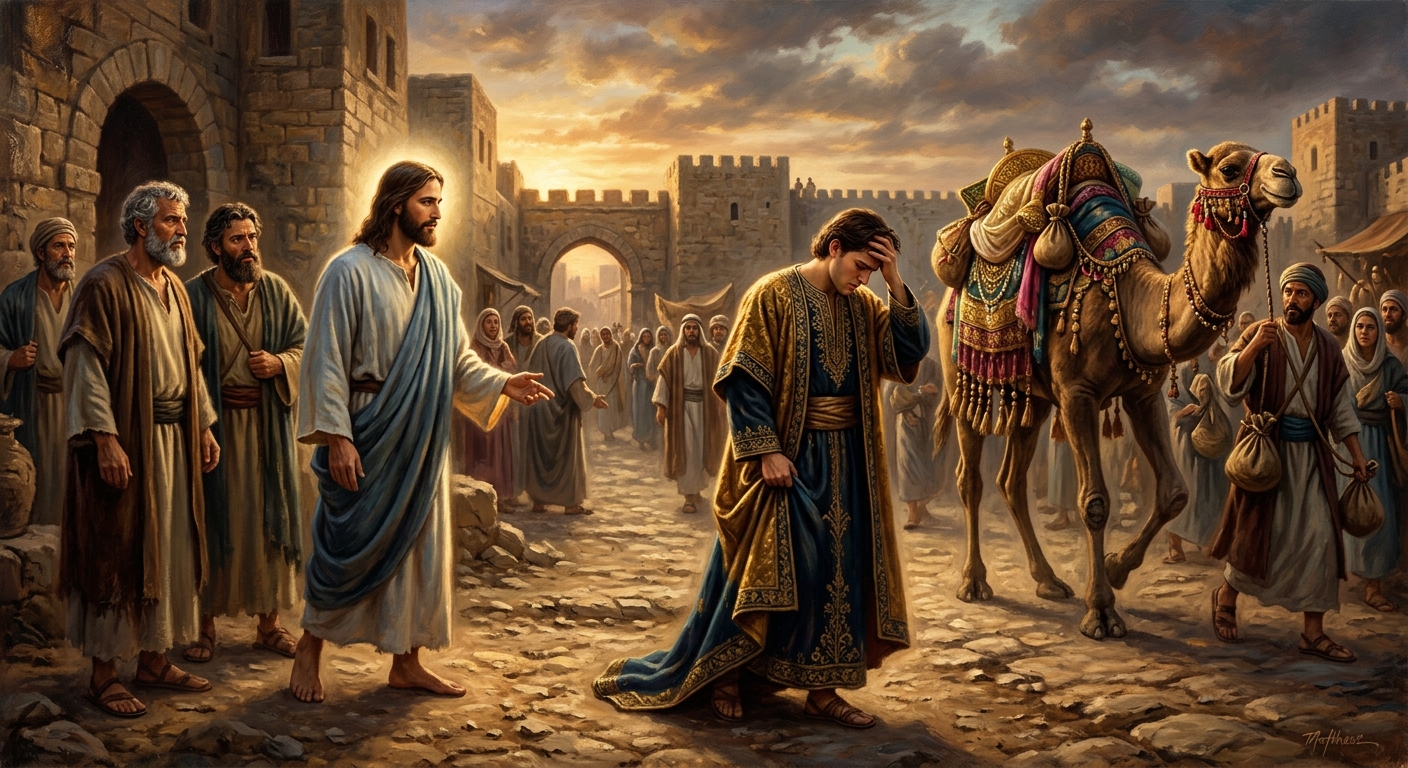
Illustration: Dramatic cinematic biblical illustration for Matthew Chapter 19 showing Kingdom Priorities Over Worldly Commitments, photorealistic oil painting style.
Author
Matthew the Apostle
Written
~70-80 AD
Key Theme
Kingdom Priorities Over Worldly Commitments
Setting
Galilee - traveling toward Jerusalem
Key Verse
Matthew 19:26
Total Verses
30
Chapter Introduction
*Dear friend, as we walk with our Savior through the tender moments of marriage and the trials of wealth, let us be reminded that God's kingdom calls us to a higher love—one that transcends earthly ties and embraces the wholeness of His grace. When we feel burdened by law or duty, remember that with God all things are possible; His mercy is greater than any rule we can devise. Let your heart be like a child’s, open and trusting in the promise of eternal life.*
Matthew — Chapter 19 — KJV
1
And it came to pass, that when Jesus had finished these sayings, he departed from Galilee, and came into the coasts of Judaea beyond Jordan;
Simply PutThe Greek word for “finished” (G2036) means to bring something to its full completion. When Jesus leaves Galilee for the lands beyond Jordan, He’s moving from a place of teaching to one where He’ll be tested by people who really need Him. It’s the moment when a wise friend steps into our mess, ready to meet us where we are.
2
And great multitudes followed him; and he healed them there.
Simply Put“Heal” (G5315) speaks of a deep, intimate restoration that goes beyond the surface. The crowds follow Jesus because He brings hope and relief to those whose bodies, hearts, or lives are broken. It’s a reminder that the One who knows our pain can also bring real, tangible healing.
3
The Pharisees also came unto him, tempting him, and saying unto him, Is it lawful for a man to put away his wife for every cause?
Simply PutThe Pharisees “tempt” (G2521) Jesus, meaning they try to trap Him in a legalistic question. By asking if it’s lawful for a man to divorce his wife “for every cause,” they’re trying to shift the focus from God’s design for marriage to their own rules. It shows how the spiritual elite often miss the heart of God’s intent.
4
And he answered and said unto them, Have ye not read, that he which made them at the beginning made them male and female,
Simply PutThe word “make” (G1123) here points to the Creator’s original purpose—He made them male and female. The focus shifts from societal norms back to the divine blueprint for humanity. It reminds us that our identity is rooted in God’s design, not in human expectations.
5
And said, For this cause shall a man leave father and mother, and shall cleave to his wife: and they twain shall be one flesh?
Simply Put“Cleave” (G2678) means to cling tightly, like a vine to its support. The promise of “one flesh” (G3615) is about unity and partnership that reflects God’s own relational nature. When we understand marriage as a deep, inseparable bond, we see its true purpose.
6
Wherefore they are no more twain, but one flesh. What therefore God hath joined together, let not man put asunder.
Simply Put“Joined” (G2354) and “asunder” (G613) are the key verbs. This verse emphasizes that God’s joining is meant to be permanent; human attempts to split what God has bound are futile. It offers comfort that the divine design is unbreakable, even when life feels unstable.
7
They say unto him, Why did Moses then command to give a writing of divorcement, and to put her away?
Simply PutThe Greek term for “divorce” (G1249) refers to a formal written document. By asking why Moses required it, the Pharisees highlight their reliance on external symbols rather than heart truth. It points to a deeper question: are our relationships built on law or love?
8
He saith unto them, Moses because of the hardness of your hearts suffered you to put away your wives: but from the beginning it was not so.
Simply Put“Hardness of hearts” (G1855) describes the stubbornness that made people rely on a legal loophole. Moses “suffered” (G3980) them to divorce, not because it was ideal but because they weren’t ready for the higher call. This shows that God’s patience accommodates our weakness, but He always points us back to the original design.
9
And I say unto you, Whosoever shall put away his wife, except it be for fornication, and shall marry another, committeth adultery: and whoso marrieth her which is put away doth commit adultery.
Simply Put“Fornication” (G5270) and “adultery” illustrate the seriousness of breaking a covenant. Jesus says that divorcing for any reason other than sexual unfaithfulness leads to marrying again, which can be considered adultery. This challenges us to think beyond paperwork and look at the love that should bind us.
10
His disciples say unto him, If the case of the man be so with his wife, it is not good to marry.
Simply PutThe disciples say, “It is not good to marry.” The word “good” (G519) here reflects a feeling that divorce makes marriage impossible. Their honesty shows the confusion many feel about love’s demands versus society’s standards.
11
But he said unto them, All men cannot receive this saying, save they to whom it is given.
Simply Put“Receive” (G2985) means to accept or understand. Jesus says that not everyone can grasp this teaching—only those to whom it’s given. This invites us to ask God for the humility and insight needed to truly understand His heart.
12
For there are some eunuchs, which were so born from their mother’s womb: and there are some eunuchs, which were made eunuchs of men: and there be eunuchs, which have made themselves eunuchs for the kingdom of heaven’s sake. He that is able to receive it, let him receive it.
Simply Put“Eunuchs” (G2192) were men who lived without sexual bonds, either by birth or choice. Some chose to become eunuchs for the “kingdom of heaven” (G1511) sake, showing that devotion to God can require personal sacrifice. It’s a call to consider what we’re willing to give up for a deeper relationship with Him.
13
Then were there brought unto him little children, that he should put his hands on them, and pray: and the disciples rebuked them.
Simply PutChildren are brought so that Jesus might “lay his hands” on them and pray. The disciples rebuke the children, perhaps seeing them as a distraction. This moment shows that sometimes we underestimate what God values most.
14
But Jesus said, Suffer little children, and forbid them not, to come unto me: for of such is the kingdom of heaven.
Simply Put“Suffer” (G5418) here isn’t about pain but about allowing. Jesus says, “Do not forbid them,” because the kingdom of heaven belongs to those who are like children—full of trust, humility, and wonder. It reminds us that God’s kingdom welcomes the unpretentious heart above all else.
15
And he laid his hands on them, and departed thence.
Simply PutHe “laid his hands” (G2985) on the children, a gesture of blessing and commissioning. After this tender moment, He departs, moving on to the next place where His love is needed. It shows that even after moments of intimacy, He continues to press forward in service.
16
And, behold, one came and said unto him, Good Master, what good thing shall I do, that I may have eternal life?
Simply PutA man approaches Jesus, calling Him “Good Master,” using the Greek word agathos (G26) which means truly good, trustworthy. He’s in a deep spiritual hunger, asking what he must do to secure eternal life (zoē aionios, G2222). This is the universal question of how to be saved, and it shows his sincere desire for a lasting relationship with God.
17
And he said unto him, Why callest thou me good? there is none good but one, that is, God: but if thou wilt enter into life, keep the commandments.
Simply PutJesus challenges the man’s perception of goodness, pointing out that only one is truly good—God Himself. He then tells him that entering life requires keeping the commandments (entolēa, G2064). The message is simple: true righteousness begins with obedience to God’s law.
18
He saith unto him, Which? Jesus said, Thou shalt do no murder, Thou shalt not commit adultery, Thou shalt not steal, Thou shalt not bear false witness,
Simply PutJesus lists the core commandments—no murder, adultery, theft, or false witness. These are not just rules but the heart of God’s moral order, showing how we should treat others with love (agape, G26).
19
Honour thy father and thy mother: and, Thou shalt love thy neighbour as thyself.
Simply PutHe adds “Honor your father and mother” (tima, G5105) and the command to love your neighbor as yourself. This combines respect for family with a universal call to loving others, highlighting the relational nature of God's kingdom.
20
The young man saith unto him, All these things have I kept from my youth up: what lack I yet?
Simply PutThe young man proudly claims he has kept all these rules since youth, yet asks what he still lacks. His question reveals a lingering inner void—a sense that external obedience alone isn’t enough for true spiritual fulfillment.
21
Jesus said unto him, If thou wilt be perfect, go and sell that thou hast, and give to the poor, and thou shalt have treasure in heaven: and come and follow me.
Simply PutJesus tells him, “If you want to be perfect (teleios, G5045), sell what you have and give it to the poor.” By doing so, he will lay up treasure in heaven and follow Jesus. The call is to radical generosity—a willingness to give up earthly security for eternal riches.
22
But when the young man heard that saying, he went away sorrowful: for he had great possessions.
Simply PutThe man leaves sorrowful because he has great possessions (mega, G3171). His sadness shows how wealth can become a spiritual barrier, binding the heart to material comforts.
23
Then said Jesus unto his disciples, Verily I say unto you, That a rich man shall hardly enter into the kingdom of heaven.
Simply PutJesus tells His disciples that a rich man will hardly (oligos, G3739) enter the kingdom of heaven. This startling statement emphasizes that wealth can make it difficult to trust fully in God’s provision.
24
And again I say unto you, It is easier for a camel to go through the eye of a needle, than for a rich man to enter into the kingdom of God.
Simply PutHe adds that it is easier for a camel (kamēlos, G2545) to go through the eye of a needle than for a rich man to enter God's kingdom. The metaphor underscores the extreme challenge of putting spiritual priorities above material ones.
25
When his disciples heard it, they were exceedingly amazed, saying, Who then can be saved?
Simply PutThe disciples, amazed by this difficulty, ask, “Who then can be saved?” (sōzō, G498). Their question reflects the universal anxiety about whether anyone can truly be rescued from sin.
26
But Jesus beheld them, and said unto them, With men this is impossible; but with God all things are possible.
Simply PutJesus looks at them and says, “With men it’s impossible (adunaton, G60), but with God all things are possible (dunaton, G1896).” This reminds us that human effort is insufficient; divine power alone can bring salvation.
27
Then answered Peter and said unto him, Behold, we have forsaken all, and followed thee; what shall we have therefore?
Simply PutPeter says, “We have left everything and followed you—what will we receive?” (apodēmi, G649). This highlights the cost of discipleship and the hope that faithful sacrifice will be rewarded.
28
And Jesus said unto them, Verily I say unto you, That ye which have followed me, in the regeneration when the Son of man shall sit in the throne of his glory, ye also shall sit upon twelve thrones, judging the twelve tribes of Israel.
Simply PutJesus promises that those who have followed Him will sit on twelve thrones, judging the twelve tribes of Israel in a future regeneration (palingenēsis, G3822). This points to the ultimate authority and honor given to faithful believers.
29
And every one that hath forsaken houses, or brethren, or sisters, or father, or mother, or wife, or children, or lands, for my name’s sake, shall receive an hundredfold, and shall inherit everlasting life.
Simply PutHe assures that anyone who has forsaken family or property for His name’s sake will receive a hundredfold (ekaton, G1487) and inherit everlasting life. True devotion is always rewarded—beyond what we can imagine.
30
But many that are first shall be last; and the last shall be first.
Simply PutJesus concludes with the paradox, “Many who are first will be last; and the last will be first.” This flips worldly expectations, urging humility and reliance on God’s grace.