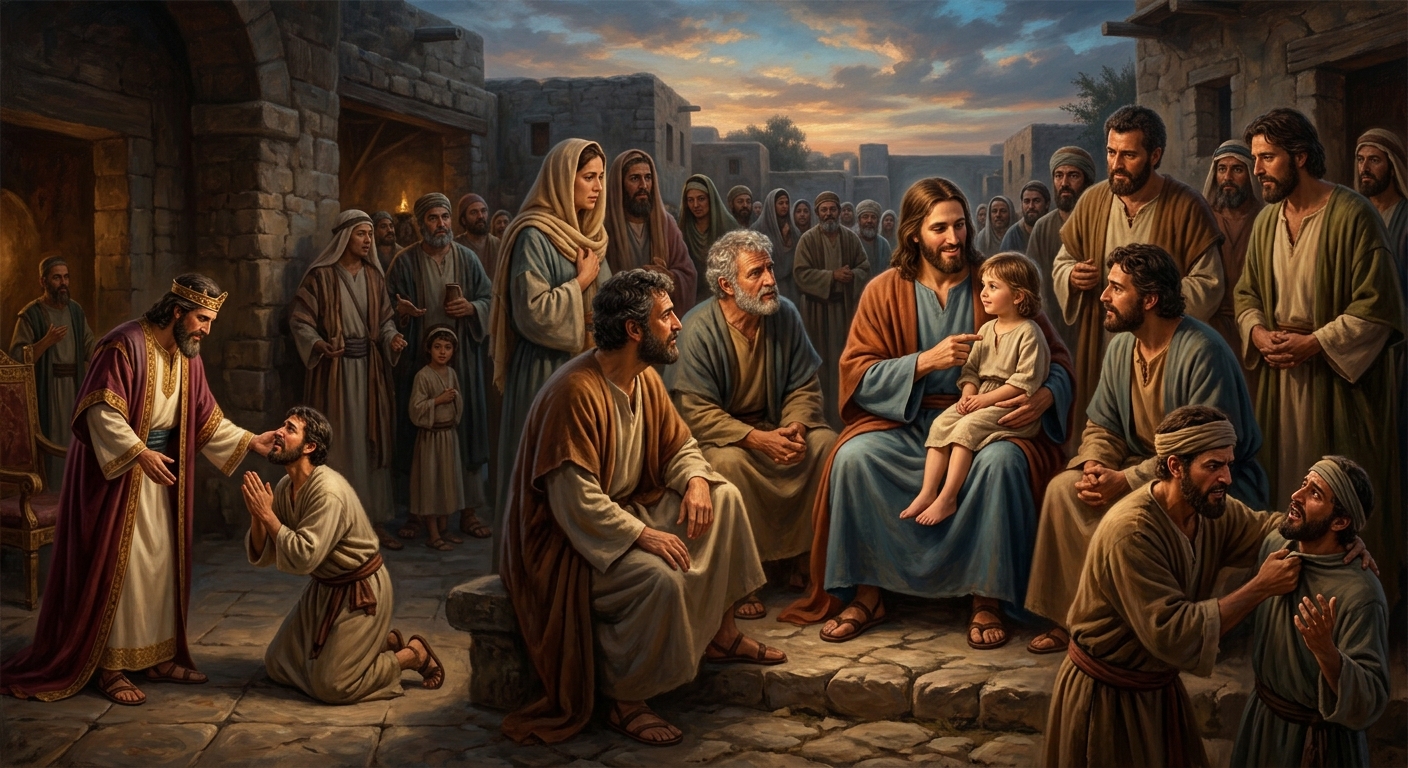
Illustration: Dramatic cinematic biblical illustration for Matthew Chapter 18 showing Humility and Forgiveness in the Kingdom, photorealistic oil painting style.
Author
Matthew the Apostle
Written
~80 AD
Key Theme
Humility and Forgiveness in the Kingdom
Setting
Galilean ministry - teaching disciples
Key Verse
Matthew 18:3
Total Verses
35
Chapter Introduction
*When the disciples gathered around Jesus, they asked a question that touches every heart: who truly stands atop the kingdom of heaven? With gentle authority, He called a child to their midst, showing that greatness is not measured by status but by the humility of a child's spirit. He reminds us that to enter God's kingdom we must become like children—trusting, open, and unassuming. And when we welcome such a child in His name, we are welcoming Christ Himself.*
Matthew — Chapter 18 — KJV
1
At the same time came the disciples unto Jesus, saying, Who is the greatest in the kingdom of heaven?
Simply PutThe disciples asked, "Who is the greatest in the kingdom of heaven?" Here “greatest” (Greek: megas) doesn’t mean power or position; it asks about the heart. They were yearning for status, yet Jesus points them toward a kingdom where greatness is measured by humility and love.
2
And Jesus called a little child unto him, and set him in the midst of them,
Simply PutJesus called a little child to sit among them. The Greek word for child, paidion, represents pure dependence and openness. By placing this innocent in the center, He shows that entering the kingdom requires a childlike trust—not self-sufficiency.
3
And said, Verily I say unto you, Except ye be converted, and become as little children, ye shall not enter into the kingdom of heaven.
Simply PutJesus says, “Unless you become like little children, you will not enter the kingdom of heaven.” The word “converted” (Greek: metanoia) means a radical change of mind and heart. It invites the weary to lay aside their pride, worry, and fear, embracing the simple faith of a child.
4
Whosoever therefore shall humble himself as this little child, the same is greatest in the kingdom of heaven.
Simply PutHe adds that whoever humbles himself like this child is the greatest. “Humble” (Greek: tapeinos) isn’t about feeling small; it’s a willingness to let God lift you up. In real pain, this means surrendering your ego and letting divine grace work through you.
5
And whoso shall receive one such little child in my name receiveth me.
Simply PutWhoever welcomes a child in Jesus' name receives Him. The verb “receive” (Greek: lambano) implies a heartfelt acceptance, not just a polite greeting. For the hungry soul, this promises that caring for others is a way of embracing God Himself.
6
But whoso shall offend one of these little ones which believe in me, it were better for him that a millstone were hanged about his neck, and that he were drowned in the depth of the sea.
Simply PutHe warns that anyone who causes a child who believes in Him to stumble will be weighed down with a millstone and drowned. The Greek “offend” (Greek: skandalon) carries the image of a stumbling block. It tells us that our words and actions can either protect or destroy fragile faith.
7
Woe unto the world because of offences! for it must needs be that offences come; but woe to that man by whom the offence cometh!
Simply Put“Woe to the world because of offenses!” Woe (Greek: eulabeia) is a deep lament for the inevitable sins that arise. It warns that while offense is inevitable, it’s worse when we are the cause of another's downfall.
8
Wherefore if thy hand or thy foot offend thee, cut them off, and cast them from thee: it is better for thee to enter into life halt or maimed, rather than having two hands or two feet to be cast into everlasting fire.
Simply PutIf your hand or foot causes you to sin, cut it off—even if it hurts. Jesus uses vivid language to stress the urgency of removing whatever leads us away from God. He says it’s better to live with a missing limb than be cast into everlasting fire.
9
And if thine eye offend thee, pluck it out, and cast it from thee: it is better for thee to enter into life with one eye, rather than having two eyes to be cast into hell fire.
Simply PutLikewise, if your eye causes you to stumble, pluck it out. The “eye” (Greek: ops) symbolizes how we view the world; a focused, pure vision is essential. It’s a call to eliminate anything that clouds our spiritual sight.
10
Take heed that ye despise not one of these little ones; for I say unto you, That in heaven their angels do always behold the face of my Father which is in heaven.
Simply PutDon’t despise any of these little ones; their angels always see God’s face. “Despise” (Greek: humis) suggests looking down on someone as less important. This reminds us that every humble soul is under divine care.
11
For the Son of man is come to save that which was lost.
Simply PutThe Son of Man has come to save the lost. “Lost” (Greek: apoleo) means those who have wandered far from God’s truth. It reassures the hungry heart that Jesus’ purpose is to bring them back home.
12
How think ye? if a man have an hundred sheep, and one of them be gone astray, doth he not leave the ninety and nine, and goeth into the mountains, and seeketh that which is gone astray?
Simply PutIf a man has 100 sheep and one goes missing, does he not leave the 99 in the open country to find it? “Sheep” (Greek: poimni) illustrate God’s personal concern for each individual. It shows that no one is too insignificant to be pursued.
13
And if so be that he find it, verily I say unto you, he rejoiceth more of that sheep, than of the ninety and nine which went not astray.
Simply PutWhen he finds it, he will lay it on his shoulders with joy. “Rejoiceth” (Greek: charis) reflects the ecstatic celebration of restoring a lost soul. It tells us that God’s heart is full when one person returns to Him.
14
Even so it is not the will of your Father which is in heaven, that one of these little ones should perish.
Simply PutThe Father does not want any of these little ones to perish. “Perish” (Greek: apollymi) underscores the seriousness of spiritual loss. It reminds believers that God’s will is for all to be saved, never abandoned.
15
Moreover if thy brother shall trespass against thee, go and tell him his fault between thee and him alone: if he shall hear thee, thou hast gained thy brother.
Simply PutIf your brother sins against you, go and tell him his fault privately. “Trespass” (Greek: paraptoma) means a moral breach, not just an offense. It teaches that restoration starts with honest, humble conversation—seeking to heal relationships before involving others.
16
But if he will not hear thee, then take with thee one or two more, that in the mouth of two or three witnesses every word may be established.
Simply PutIn this verse the Greek word "hear" (G3956) means more than just listening—it implies taking someone's pleas seriously. When a brother fails to listen, bring one or two others along so that the truth is backed up by witnesses, ensuring fairness and clarity.
17
And if he shall neglect to hear them, tell it unto the church: but if he neglect to hear the church, let him be unto thee as an heathen man and a publican.
Simply PutThe Greek word for "church" (G1577) refers to the gathered body of believers, your spiritual family. If even that community can't bring about repentance, treat him as an outsider—a "heathen" (G5545) and a tax collector, meaning you should separate from him for the sake of righteousness.
18
Verily I say unto you, Whatsoever ye shall bind on earth shall be bound in heaven: and whatsoever ye shall loose on earth shall be loosed in heaven.
Simply PutThe words "bind" (G2361) and "loose" (G3324) are powerful—they speak of authority. When you declare something as settled on earth, God confirms it in heaven; when you release someone or something, Heaven agrees. This is a reminder that the Church's decisions have divine weight.
19
Again I say unto you, That if two of you shall agree on earth as touching any thing that they shall ask, it shall be done for them of my Father which is in heaven.
Simply PutThe Greek word "agree" (G2595) signifies a united, sincere decision. If two believers come together in prayer for any need, God Himself will answer because He honors unity and heartfelt petitions.
20
For where two or three are gathered together in my name, there am I in the midst of them.
Simply PutThe phrase "gathered together" (G4313) and "my name" (G3686) highlight that wherever believers come to worship, Christ is present among them. You are never alone when you join with others in seeking Him.
21
Then came Peter to him, and said, Lord, how oft shall my brother sin against me, and I forgive him? till seven times?
Simply PutPeter asks about the limits of forgiveness, using "seven times" as a figure for completeness. In moments when hurt overwhelms you, this question reveals our longing to understand how far grace can stretch.
22
Jesus saith unto him, I say not unto thee, Until seven times: but, Until seventy times seven.
Simply PutJesus answers with "seventy times seven," a countless number. He teaches that forgiveness is boundless—your heart's capacity to forgive should be as expansive as God's love for you.
23
Therefore is the kingdom of heaven likened unto a certain king, which would take account of his servants.
Simply PutJesus likens the Kingdom to a king who must keep accounts—a reminder that God values justice. He calls us to remember that everyone is accountable before Him.
24
And when he had begun to reckon, one was brought unto him, which owed him ten thousand talents.
Simply PutThe servant owed ten thousand talents (Greek "talanton" G5210), a staggering sum in those days. This illustrates how overwhelming our debts to God can be, yet He is patient and merciful.
25
But forasmuch as he had not to pay, his lord commanded him to be sold, and his wife, and children, and all that he had, and payment to be made.
Simply PutThe servant couldn't pay his debt, so the lord ordered him to be sold along with his family. The Greek word "sold" (G2699) shows the depth of desperation that can arise when we feel unable to meet our obligations.
26
The servant therefore fell down, and worshipped him, saying, Lord, have patience with me, and I will pay thee all.
Simply PutThe servant fell down and begged, "Lord, have patience." In Greek (G4356), to worship includes humbly pleading for mercy. This moment teaches that sincere repentance can move even a harsh creditor.
27
Then the lord of that servant was moved with compassion, and loosed him, and forgave him the debt.
Simply PutThe lord was moved with compassion (Greek "splagchnizomai" G4754) and forgave the entire debt. God's forgiveness is not just a legal transaction; it's a heartfelt release from the weight of guilt.
28
But the same servant went out, and found one of his fellowservants, which owed him an hundred pence: and he laid hands on him, and took him by the throat, saying, Pay me that thou owest.
Simply PutThe forgiven servant went out and demanded one hundred pence from a fellow servant, seizing him by the throat. This shows how quickly grace can be forgotten when we become harsh toward those less powerful than us.
29
And his fellowservant fell down at his feet, and besought him, saying, Have patience with me, and I will pay thee all.
Simply PutThe fellow servant fell down and begged for patience. In Greek (G3956), falling down can symbolize deep humility, acknowledging one's incapacity to repay and seeking mercy.
30
And he would not: but went and cast him into prison, till he should pay the debt.
Simply PutHe refused to forgive; he locked his indebted brother away until the debt was paid. This final scene warns that ungracious hearts can become prisons for others, perpetuating cycles of suffering.
31
So when his fellowservants saw what was done, they were very sorry, and came and told unto their lord all that was done.
Simply PutThe servants were struck with deep remorse (Greek: metanoia, G3329), a heartache that moves us to confess. Their sorrow drove them to the lord, sharing everything they had done with a trembling honesty that any broken heart can recognize.
32
Then his lord, after that he had called him, said unto him, O thou wicked servant, I forgave thee all that debt, because thou desiredst me:
Simply PutThe lord calls the man "wicked servant" (Greek: kakos, G2585), highlighting how far he had strayed. Yet the lord declares, "I forgave you all that debt," using the Greek word forgiveness (aphesis, G589), showing that God's grace covers even the greatest sins when we humbly repent.
33
Shouldest not thou also have had compassion on thy fellowservant, even as I had pity on thee?
Simply PutThe lord asks, "Shouldn't you have had compassion (splagchnizomai, G5582) for your fellow servant?" He reminds us that the same mercy (eleos, G1654) we receive from God ought to flow through us toward those who hurt us.
34
And his lord was wroth, and delivered him to the tormentors, till he should pay all that was due unto him.
Simply PutAngered (Greek: thunai, G5043), the lord hands the servant over to the tormentors until he pays what is due. It's a sobering picture—unforgiveness can imprison us in suffering until we finally let God's grace break the chains.
35
So likewise shall my heavenly Father do also unto you, if ye from your hearts forgive not every one his brother their trespasses.
Simply PutThe heavenly Father will act the same way toward you if you do not forgive your brother from the heart. True forgiveness (aphesis, G589) is a daily demand; without it, we deny the very mercy God showers upon us each day.
When you are faced with the choice to forgive or hold onto a hurt in your family, friendships, or workplace, how does that decision shape both the immediate relationship and your deeper sense of purpose?