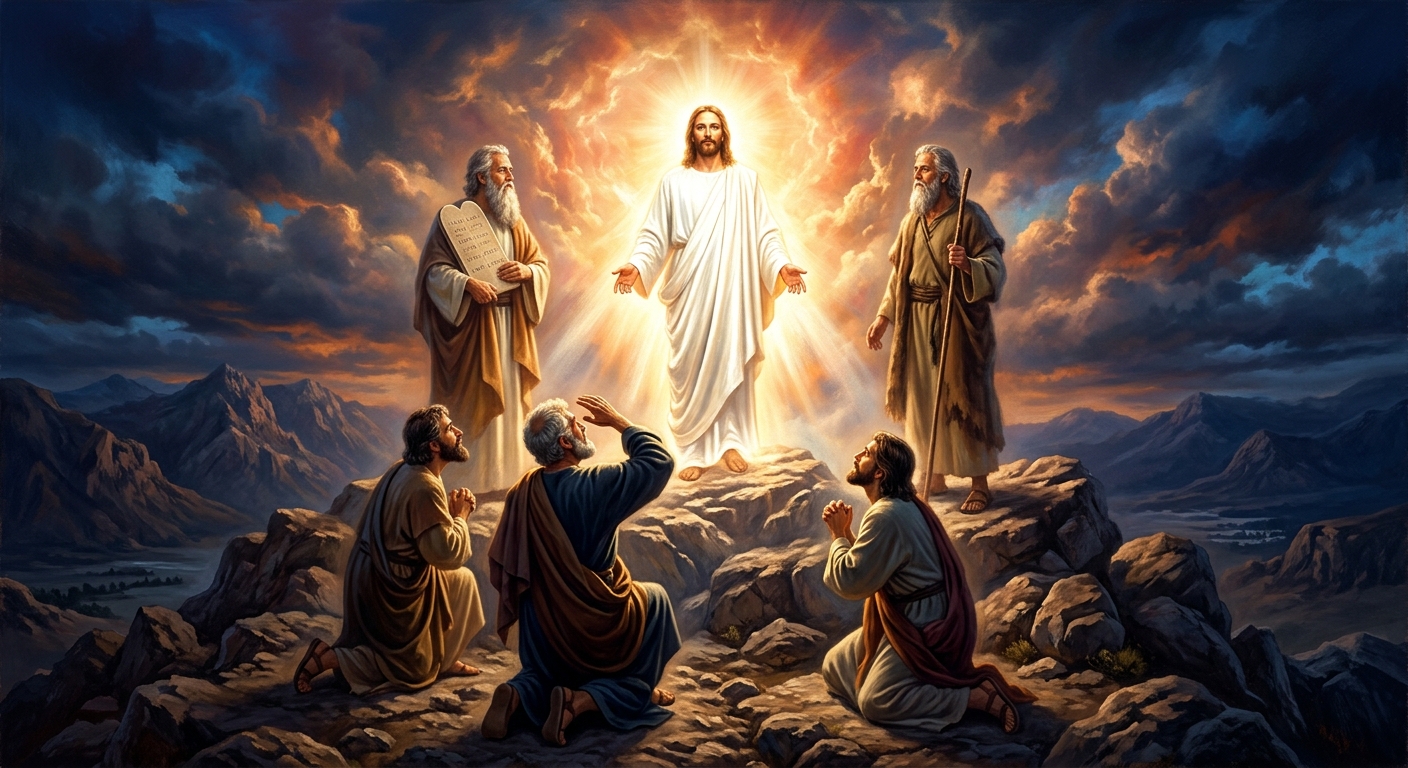
Illustration: Dramatic cinematic biblical illustration for Matthew Chapter 17 showing Christ's Glory Revealed, photorealistic oil painting style.
🔊
Listen to Chapter
Grace Notes Journey Audio Narration
Author
Matthew the Apostle
Written
~60-70 AD
Key Theme
Christ's Glory Revealed
Setting
Mount of Transfiguration
Key Verse
Matthew 17:2
Total Verses
27
Chapter Introduction
_In this holy mountain scene, the disciples are granted a glimpse of Jesus' divine radiance. The shining face and dazzling robes whisper of the Father's love, inviting us to behold His glory. Moses and Elijah stand beside Him, bridging the old covenant with the new promise of salvation. Let this vision deepen our faith, reminding us that Christ is the Light guiding every step of our journey._
Matthew — Chapter 17 — KJV
1
And after six days Jesus taketh Peter, James, and John his brother, and bringeth them up into an high mountain apart,
Simply PutJesus deliberately called Peter, James, and John—his closest friends—to a secluded mountain. The Greek word for "apart" (monos) underscores that this was a private, intimate setting where something extraordinary would be revealed.
2
And was transfigured before them: and his face did shine as the sun, and his raiment was white as the light.
Simply PutIn this moment of transfiguration (Greek, metamorphoo, G5045), Jesus' appearance was gloriously altered—his face shone like the sun and his clothing became as bright as light. This radiant change points to the deeper glory of Christ that is hidden beneath his earthly form.
3
And, behold, there appeared unto them Moses and Elias talking with him.
Simply PutSuddenly, Moses and Elijah appeared (Greek, phaino, G2985) and began speaking with Jesus. Their presence links the Law (Moses) and the Prophets (Elijah), showing that Jesus is the fulfillment of all Scripture.
4
Then answered Peter, and said unto Jesus, Lord, it is good for us to be here: if thou wilt, let us make here three tabernacles; one for thee, and one for Moses, and one for Elias.
Simply PutPeter, overwhelmed by what he saw, suggested building three shelters (Greek, skene, G4444). His instinct was to preserve this holy moment, but the focus should be on listening to Jesus rather than constructing structures.
5
While he yet spake, behold, a bright cloud overshadowed them: and behold a voice out of the cloud, which said, This is my beloved Son, in whom I am well pleased; hear ye him.
Simply PutA bright cloud covered them, and from it a voice declared, "This is my beloved Son (Greek, agapetos, G25), in whom I am well pleased." The cloud represents God's presence, and the voice affirms Jesus' unique identity as the Son of God.
6
And when the disciples heard it, they fell on their face, and were sore afraid.
Simply PutThe disciples fell to their faces in fear. Their reaction shows how overwhelming the divine presence can be—when we glimpse God's glory, our hearts tremble and we realize how small we are.
7
And Jesus came and touched them, and said, Arise, and be not afraid.
Simply PutJesus gently touched them (Greek, thiggeo, G4751) and said, "Arise, be not afraid." This tender reassurance reminds us that even in moments of awe and terror, Jesus offers comfort and stability.
8
And when they had lifted up their eyes, they saw no man, save Jesus only.
Simply PutWhen they looked up again, they saw only Jesus. The vision of Moses and Elijah was a temporary revelation; the real source of power and teaching is still Jesus himself.
9
And as they came down from the mountain, Jesus charged them, saying, Tell the vision to no man, until the Son of man be risen again from the dead.
Simply PutAs they descended, Jesus instructed them to keep the vision secret until after his resurrection. This command (Greek, cheirō, G5358) emphasizes that the full meaning of the transfiguration would only be clear when Christ overcame death.
10
And his disciples asked him, saying, Why then say the scribes that Elias must first come?
Simply PutThe disciples asked why the scribes said Elijah must first come. Their curiosity reflects a common misunderstanding about prophecy and timing.
11
And Jesus answered and said unto them, Elias truly shall first come, and restore all things.
Simply PutJesus clarified that Elijah would indeed "restore all things" (Greek, epistrefō, G259). He means that Elijah's role would involve preparing the way for Christ’s mission and renewal of God's covenant.
12
But I say unto you, That Elias is come already, and they knew him not, but have done unto him whatsoever they listed. Likewise shall also the Son of man suffer of them.
Simply PutHe added that Elijah had already come in the person of John the Baptist, but many failed to recognize him or followed their own agendas. This shows how often we miss God's workings because of our preconceptions.
13
Then the disciples understood that he spake unto them of John the Baptist.
Simply PutThe disciples understood that Jesus was speaking about John the Baptist. This realization connects John's ministry to the prophetic fulfillment of Elijah's return.
14
And when they were come to the multitude, there came to him a certain man, kneeling down to him, and saying,
Simply PutA certain man approached Jesus, kneeling and pleading for help. His posture of humility reflects a deep desperation to bring his son before Christ.
15
Lord, have mercy on my son: for he is lunatick, and sore vexed: for ofttimes he falleth into the fire, and oft into the water.
Simply PutHe begged, "Lord, have mercy on my son," describing his son's severe suffering—often being thrown into fire and water. This vivid plea illustrates the profound anguish of a family seeking divine intervention for a loved one's affliction.
16
And I brought him to thy disciples, and they could not cure him.
Simply PutThe Greek word for “cure” here is therapeuo (G2315), which means to heal or restore. It shows that even the disciples, though powerful in name, were still limited without true faith.
17
Then Jesus answered and said, O faithless and perverse generation, how long shall I be with you? how long shall I suffer you? bring him hither to me.
Simply PutJesus calls them “faithless” (apistos, G155), a word that describes those who turn away from trusting God. He asks them how long they will continue to resist the work of the Holy Spirit and endure His suffering.
18
And Jesus rebuked the devil; and he departed out of him: and the child was cured from that very hour.
Simply PutJesus “rebuked” (ephēkō, G1909) the devil, commanding his name to be broken. In that moment of divine authority, the evil spirit left the boy and he was healed instantly.
19
Then came the disciples to Jesus apart, and said, Why could not we cast him out?
Simply PutThe disciples approached Jesus privately because they felt embarrassed. Their question, “Why could we not cast him out?” reveals their struggle with doubt and the need to understand what fuels true power.
20
And Jesus said unto them, Because of your unbelief: for verily I say unto you, If ye have faith as a grain of mustard seed, ye shall say unto this mountain, Remove hence to yonder place; and it shall remove; and nothing shall be impossible unto you.
Simply PutJesus points to “unbelief” (apistia, G155) as the root cause of their failure. He promises that even faith as small as a mustard seed can move mountains if it is placed in Him.
21
Howbeit this kind goeth not out but by prayer and fasting.
Simply PutThe phrase “prayer and fasting” (proseuchē and nēmphos) indicates that some spiritual battles require deep, disciplined communion with God. This teaches us to depend on God’s strength rather than our own.
22
And while they abode in Galilee, Jesus said unto them, The Son of man shall be betrayed into the hands of men:
Simply PutJesus says the “Son of Man” (Greek: huios tou anthrōpou) will be betrayed, using the verb paradidōmi (G3985), which means to hand over. He warns them of the upcoming suffering that will bring redemption.
23
And they shall kill him, and the third day he shall be raised again. And they were exceeding sorry.
Simply PutJesus tells them He will be “killed” (apothnēskō, G603) and “raised again” (anastasis, G424). Their sorrow reflects the pain of losing a beloved Savior while hoping for resurrection.
24
And when they were come to Capernaum, they that received tribute money came to Peter, and said, Doth not your master pay tribute?
Simply PutThe tax collector questions whether Jesus pays tribute; the Greek word telos (G5043) refers to a specific tax. It shows the tension between worldly obligations and divine authority.
25
He saith, Yes. And when he was come into the house, Jesus prevented him, saying, What thinkest thou, Simon? of whom do the kings of the earth take custom or tribute? of their own children, or of strangers?
Simply PutWhen Peter says “strangers,” he uses the Greek xenoi (G5549). Jesus then reveals that children are free from worldly duties, emphasizing the kingdom’s priority over earthly claims.
26
Peter saith unto him, Of strangers. Jesus saith unto him, Then are the children free.
Simply PutJesus says “children” (Greek: paidi, G5628) are free because they belong to God. He teaches that the true kingdom is not bound by human-imposed taxes.
27
Notwithstanding, lest we should offend them, go thou to the sea, and cast an hook, and take up the fish that first cometh up; and when thou hast opened his mouth, thou shalt find a piece of money: that take, and give unto them for me and thee.
Simply PutJesus shows Peter how to meet the tax collector’s demand through a miracle. By opening the fish’s mouth, they find a coin (stater), illustrating that God provides for us when we obey Him.
Exodus 24:12This verse recounts Moses entering a cloud on Mount Sinai, mirroring the bright cloud that overshadows Jesus and the disciples in the Transfiguration.
2 Kings 2:11‑12Elijah is taken up into heaven and appears with Moses, directly paralleling the appearance of Moses and Elias (Elijah) speaking with Jesus.
Isaiah 6:1‑3Isaiah's vision of the Lord seated on a throne, surrounded by seraphim and accompanied by a voice from heaven, reflects the divine glory revealed in Jesus' transfiguration.
Revelation 1:13‑16John’s description of a glorified Christ with a shining face and white raiment echoes the radiant appearance of Jesus before Peter, James, and John.
Reflect
When you think of that man kneeling before Jesus in Matthew 17, what personal burden or question are you ready to bring before Him today?