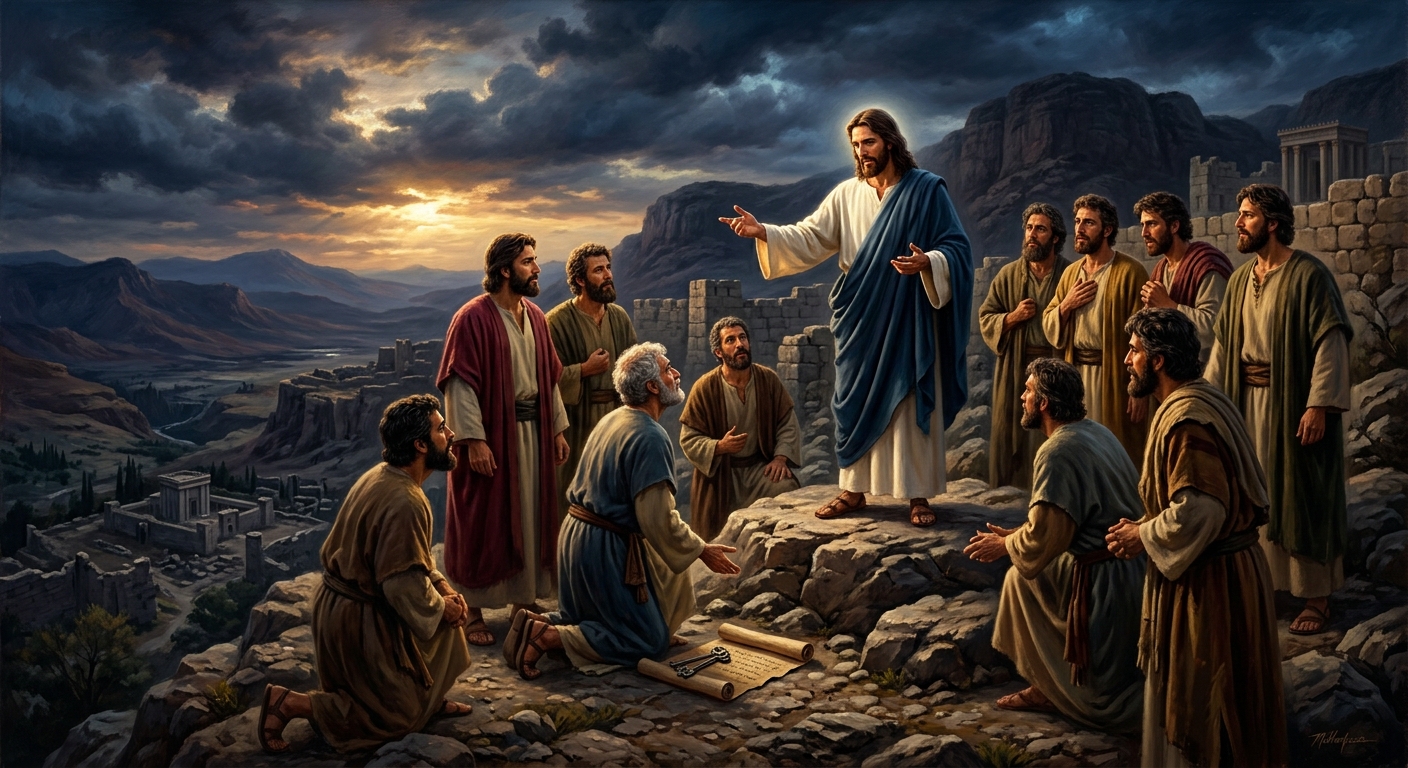
Illustration: Dramatic cinematic biblical illustration for Matthew Chapter 16 showing Christ's identity and true discipleship, photorealistic oil painting style.
🔊
Listen to Chapter
Grace Notes Journey Audio Narration
Author
Matthew the Apostle
Written
~70-80 AD
Key Theme
Christ's identity and true discipleship
Setting
Galilee – lake shore, early morning
Key Verse
Matthew 16:18
Total Verses
28
Chapter Introduction
*In this gentle encounter, our Lord beckons His followers beyond the spectacle of signs and weather. He asks each heart to name Him, revealing that true faith is rooted in the living Christ rather than fleeting wonders. As we cross the lake with His disciples, we learn that genuine discipleship begins with a heartfelt confession of who He truly is. May this moment stir within us an earnest desire to proclaim Him as our Lord and Savior, trusting in His grace alone.*
Matthew — Chapter 16 — KJV
1
The Pharisees also with the Sadducees came, and tempting desired him that he would shew them a sign from heaven.
Simply PutThe Pharisees and Sadducees, the religious elite of the day, were demanding a sign (Greek se·meion, G2822) from heaven. Their hearts were set on a miracle to prove Jesus’ authority rather than opening up to the truth He was teaching.
2
He answered and said unto them, When it is evening, ye say, It will be fair weather: for the sky is red.
Simply Put“When it is evening, you say ‘It will be fair weather,’ for the sky is red.” Jesus points to the natural sense of kai·ros (Greek G2582), an appointed time, showing that they can read the weather but not the spiritual timing of God’s work.
3
And in the morning, It will be foul weather to day: for the sky is red and lowring. O ye hypocrites, ye can discern the face of the sky; but can ye not discern the signs of the times?
Simply Put“You hypocrites (Greek hypokritēs, G1610), you can discern the face of the sky; but can you not discern (Greek gnōskō, G1097) the signs of the times?” He gently rebukes them for being able to read clouds while missing the deeper meaning of God’s presence among them.
4
A wicked and adulterous generation seeketh after a sign; and there shall no sign be given unto it, but the sign of the prophet Jonas. And he left them, and departed.
Simply Put“A wicked and adulterous generation (Greek moichōn, G3370) seeks after a sign; and none shall be given them but the sign of the prophet Jonas (Greek G3036).” He tells them that their only chance for repentance is to heed the call of Jonah’s three days in the fish—God’s warning to turn back.
5
And when his disciples were come to the other side, they had forgotten to take bread.
Simply PutWhen they crossed over, the disciples realized they had forgotten (Greek epilanthánomai, G1910) to take bread. In the midst of their practical worry, Jesus was preparing to teach them about trust in Him over material needs.
6
Then Jesus said unto them, Take heed and beware of the leaven of the Pharisees and of the Sadducees.
Simply Put“Take heed and beware of the leaven (Greek zymē, G2212) of the Pharisees and Sadducees.” He warns that their danger isn’t a yeast on dough but the false doctrines seeping through the hearts of those religious leaders.
7
And they reasoned among themselves, saying, It is because we have taken no bread.
Simply Put“It is because we have taken no bread.” The disciples reasoned (Greek logizomai, G3009) among themselves, missing the point that Jesus’ warning was about spiritual leaven, not their snack.
8
Which when Jesus perceived, he said unto them, O ye of little faith, why reason ye among yourselves, because ye have brought no bread?
Simply Put“O ye of little faith (Greek oligos, G3549), why reason ye among yourselves because ye have brought no bread?” Seeing their anxiety and lack of faith, He gently reminds them that worrying over food blinds them to the greater work He is doing.
9
Do ye not yet understand, neither remember the five loaves of the five thousand, and how many baskets ye took up?
Simply Put“Do ye not yet understand, neither remember the five loaves of the five thousand?” He brings up the miracle (Greek artos, G752) where God fed thousands with five loaves—a reminder that He can supply what they truly need.
10
Neither the seven loaves of the four thousand, and how many baskets ye took up?
Simply Put“Nor the seven loaves of the four thousand.” He recalls another feeding miracle, showing that God’s provision is abundant and not limited to the physical crumbs they carry.
11
How is it that ye do not understand that I spake it not to you concerning bread, that ye should beware of the leaven of the Pharisees and of the Sadducees?
Simply Put“How is it that ye do not understand that I spake it not to you concerning bread, but that ye should beware of the leaven of the Pharisees and Sadducees?” He clarifies that His lesson is about doctrine, not diet.
12
Then understood they how that he bade them not beware of the leaven of bread, but of the doctrine of the Pharisees and of the Sadducees.
Simply Put“Then they understood that He bade them beware of the doctrine (Greek gnōskō, G1097) of the Pharisees and Sadducees.” The disciples finally grasp that their true danger lies in false teaching, not in missing a snack.
13
When Jesus came into the coasts of Caesarea Philippi, he asked his disciples, saying, Whom do men say that I the Son of man am?
Simply Put“Whom do men say that I the Son of man am?” (Greek huios tou anthrōpou, G5203) He asks as they travel through Caesarea Philippi. The title “Son of Man” points to the prophetic identity He carries.
14
And they said, Some say that thou art John the Baptist: some, Elias; and others, Jeremias, or one of the prophets.
Simply Put“Some say thou art John the Baptist; some, Elias; and others, Jeremias, or one of the prophets.” Their answers reflect a confusion about who He truly is—mixing old prophets with their expectations of the Messiah.
15
He saith unto them, But whom say ye that I am?
Simply Put“But whom say ye that I am?” He turns the question to them, inviting a personal confession of who they truly see Jesus as.
16
And Simon Peter answered and said, Thou art the Christ, the Son of the living God.
Simply PutPeter says, “You are the Christ, the Son of the living God.” The Greek word for Christ (Χριστός, G5547) means “the Anointed One,” the one God chose to set apart for a special purpose. And “Son of the living God” (υἱός, G5209) declares a relationship that is real and active—not just a title but a promise of divine life. For anyone feeling lost, this is the moment when hope becomes real because God has entered history.
17
And Jesus answered and said unto him, Blessed art thou, Simon Barjona: for flesh and blood hath not revealed it unto thee, but my Father which is in heaven.
Simply PutJesus replies, “Blessed are you, Simon Bar-Jona; for flesh and blood did not reveal this to you, but my Father in heaven.” The Greek word for blessed (μακάριος, G3117) means “happy” or “fortunate,” a deep joy that comes from God Himself. Peter’s insight isn’t something he figured out on his own; it’s a revelation (ἀποκαλύπτω, G618) from the Father. In times of doubt, this reminds us that God can open our eyes in ways we could never achieve by ourselves.
18
And I say also unto thee, That thou art Peter, and upon this rock I will build my church; and the gates of hell shall not prevail against it.
Simply Put“You are Peter, and on this rock I will build my church, and the gates of hell shall not prevail against it.” The name Peter (Πέτρος, G4074) means “rock,” and the word rock itself (πέτρα, G4056) signifies a firm foundation. Jesus is saying He will build His people upon this dependable truth, and no force of darkness can overcome it. For someone fearing the world’s attacks, this is a promise that God’s church stands on an unshakable foundation.
19
And I will give unto thee the keys of the kingdom of heaven: and whatsoever thou shalt bind on earth shall be bound in heaven: and whatsoever thou shalt loose on earth shall be loosed in heaven.
Simply Put“I will give you the keys of the kingdom of heaven; whatever you bind on earth shall be bound in heaven, and whatever you loose on earth shall be loosed in heaven.” The Greek word for keys (κλῆς, G2815) refers to authority—control over entry and exit. “Bind” (δεσμεύω, G1322) means to set limits, and “loose” (λύω, G3035) means to release. This shows that believers are entrusted with the power to declare God’s will, assuring those in spiritual confusion that they can be agents of divine order.
20
Then charged he his disciples that they should tell no man that he was Jesus the Christ.
Simply Put“He instructed his disciples not to tell anyone that he was the Christ.” The Greek word for charged (ἐνετείλω, G1787) means to give a serious instruction. This secrecy was meant to protect the timing of God’s plan until it was ready to be revealed fully. For people burdened by curiosity, this reminds us that God sometimes works behind the scenes before unveiling His purpose.
21
From that time forth began Jesus to shew unto his disciples, how that he must go unto Jerusalem, and suffer many things of the elders and chief priests and scribes, and be killed, and be raised again the third day.
Simply Put“From then on, Jesus began to teach his disciples that he must go to Jerusalem and suffer many things from the elders, chief priests, and scribes, be killed, and rise again on the third day.” The word “suffer” (παθάω, G3949) means to endure hardship, and “raise again” (ἀνίστημι, G424) points to resurrection. Jesus is showing that the path to victory involves pain and death before triumph. For those facing trials, this provides a roadmap: our suffering is part of God’s larger plan for ultimate life.
22
Then Peter took him, and began to rebuke him, saying, Be it far from thee, Lord: this shall not be unto thee.
Simply Put“Peter took him aside and began to rebuke him, saying, ‘Be far from you, Lord; this must never happen to you.’” The Greek phrase “be far from you” (ἀποστρέφω, G590) is a forceful rejection. Peter’s response reflects human fear and misunderstanding of God’s path. For anyone doubting their own destiny, this shows how easy it is to cling to comfort instead of trusting God’s greater purpose.
23
But he turned, and said unto Peter, Get thee behind me, Satan: thou art an offence unto me: for thou savourest not the things that be of God, but those that be of men.
Simply Put“He turned and said to Peter, ‘Get behind me, Satan! You are an offense to me; you do not understand the things of God, but the things of men.’” The Greek word for Satan (Σατανᾶς, G4561) means “adversary.” Jesus calls Peter’s mindset an offense because it focuses on human expectations rather than divine truth. For those tempted to think only about personal comfort, this warns that true discipleship requires surrendering earthly desires for God’s higher plan.
24
Then said Jesus unto his disciples, If any man will come after me, let him deny himself, and take up his cross, and follow me.
Simply Put“Jesus said to his disciples, ‘If anyone wishes to become my follower, let him deny himself, take up his cross, and follow me.’” The Greek term for “deny himself” (ἀποτιμάω, G583) means to consider oneself lowly or to set aside self-interest. Taking up a cross (σταυρός, G4983) symbolizes embracing sacrifice and obedience. For those longing for purpose, this is a call to let go of self-centered goals and walk the path God has set.
25
For whosoever will save his life shall lose it: and whosoever will lose his life for my sake shall find it.
Simply Put“For whoever wishes to preserve his life will lose it, and whoever wishes to lose his life for my sake will find it.” The Greek word for “lose” (ἀπόλλυμι, G590) means total destruction. This paradox tells us that clinging to life for personal gain leads to loss, while surrendering life to God brings true living. For anyone feeling empty, this offers the truth that real fulfillment comes through selfless devotion.
26
For what is a man profited, if he shall gain the whole world, and lose his own soul? or what shall a man give in exchange for his soul?
Simply Put“What profit is there to a man if he gains the whole world but loses his soul? Or what can a man exchange for his soul?” The Greek word for “profited” (κερδάνω, G2798) means to gain or win. The soul (ψυχή, G5590) is the essence of our being. This question challenges us to examine what we truly value, reminding those in material pursuit that no amount of wealth can replace the priceless treasure of our inner self.
27
For the Son of man shall come in the glory of his Father with his angels; and then he shall reward every man according to his works.
Simply Put“For the Son of Man will come in the glory of his Father with his angels; then he will reward each person according to their deeds.” The Greek word for “reward” (μισθός, G3404) refers to wages or payment. The phrase “according to their deeds” (ἔργον, G2043) emphasizes that every action matters. For those seeking justice, this assures us that God will fairly evaluate and honor our lives.
28
Verily I say unto you, There be some standing here, which shall not taste of death, till they see the Son of man coming in his kingdom.
Simply Put“Truly I say to you, there are some standing here who will not taste death until they see the Son of Man coming in his kingdom.” The Greek word for “taste” (γεύομαι, G1063) means to experience or sample. The title “Son of Man” (υἱὸς τοῦ ἀνθρώπου, G5209) points to Jesus’ humanity and divine authority. For those longing for the future, this promises that some will stay alive to witness the glorious fulfillment of God's kingdom.
Matthew 12:38-40This passage records Jesus rebuking the Pharisees and Sadducees for demanding a sign, directly echoing Matthew 16:1‑4.
Mark 8:11-12The parallel narrative in Mark details the same request for a sign from heaven, confirming the Synoptic consistency of Matthew 16:1‑4.
Luke 11:29-30Jesus' response to the crowd demanding a sign mirrors Matthew 16:1‑4, emphasizing that the generation's request is futile without repentance.
Luke 12:1Jesus warns his disciples to beware of the leaven of the Pharisees, directly paralleling Matthew 16:6‑7.
Reflect
When you consider who Jesus is in your own life, how does that answer shape the choices you make each day?