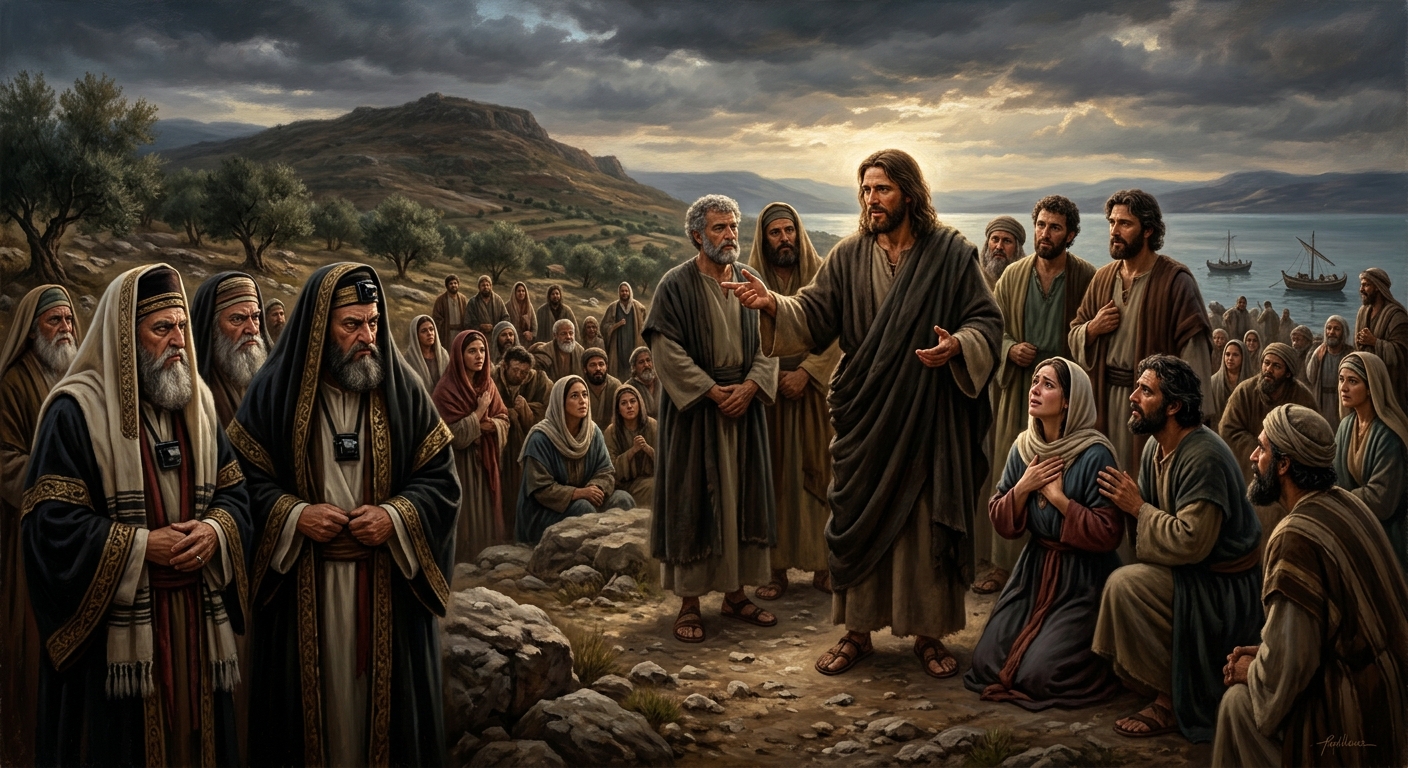
Illustration: Dramatic cinematic biblical illustration for Matthew Chapter 15 showing Heart over ritual, photorealistic oil painting style.
🔊
Listen to Chapter
Grace Notes Journey Audio Narration
Author
Matthew the Apostle
Written
~80-90 AD
Key Theme
Heart over ritual
Setting
Jerusalem - at the synagogue
Key Verse
Matthew 15:9
Total Verses
39
Chapter Introduction
*When the scribes and Pharisees came to Jesus, they were more concerned with outward customs than with inner devotion. He gently reminded them that true worship springs from a clean heart, not merely from washed hands. This chapter invites us to examine our own traditions: are they a cover for deeper issues within? May we seek the grace that renews our hearts, so that every word and deed reflects God's love.*
Matthew — Chapter 15 — KJV
1
Then came to Jesus scribes and Pharisees, which were of Jerusalem, saying,
Simply PutThe scribes (“grammateus,” G1121) and Pharisees (“Pharisaioi,” G5583) were the religious elite of Jerusalem. Their arrival signals a clash between Jesus and the seasoned teachers of the law, inviting us to consider how authority is exercised in our own lives.
2
Why do thy disciples transgress the tradition of the elders? for they wash not their hands when they eat bread.
Simply PutThe word “tradition” (“paradosis,” G3954) refers to the rituals handed down from generation to generation. The scribes accuse the disciples of breaking this ritual purity by not washing their hands, reminding us that outward habits can become a source of judgment when we miss the heart behind them.
3
But he answered and said unto them, Why do ye also transgress the commandment of God by your tradition?
Simply PutJesus flips the accusation by asking, “Why do ye also transgress the commandment of God by your tradition?” The Greek word for “commandment” (“entolē,” G1909) points to God’s law, highlighting that human customs can sometimes become a mask for breaking the very commandments they claim to uphold.
4
For God commanded, saying, Honour thy father and mother: and, He that curseth father or mother, let him die the death.
Simply Put“Honour thy father and mother” comes from the root “timao” (G5088), meaning to value or respect. In this verse, Jesus reminds us that the command to honor parents is a divine directive, not merely a cultural suggestion.
5
But ye say, Whosoever shall say to his father or his mother, It is a gift, by whatsoever thou mightest be profited by me;
Simply PutThe Pharisees use the word “gift” (“charisma,” G547) to excuse their neglect of parental honor, arguing that a child can claim anything as a gift. This reveals how clever excuses can be used to sidestep God’s clear commands.
6
And honour not his father or his mother, he shall be free. Thus have ye made the commandment of God of none effect by your tradition.
Simply PutThe term “free” (“eleutheros,” G1661) is used by the Pharisees to justify their actions, suggesting that a child can be “free” from duty. In reality, this empties the commandment of its purpose, showing how tradition can erode the power of God’s law.
7
Ye hypocrites, well did Esaias prophesy of you, saying,
Simply PutThe Greek word “hypokritēs” (G540) means an actor or a pretender. Jesus calls the scribes and Pharisees “hypocrites,” exposing the gap between their outward appearance of piety and their inward motives.
8
This people draweth nigh unto me with their mouth, and honoureth me with their lips; but their heart is far from me.
Simply PutThe phrase “draweth nigh” (“proseuchomai,” G4329) suggests an outward approach to God, but their hearts are still distant. This reminds us that true worship involves both our actions and the condition of our inner being.
9
But in vain they do worship me, teaching for doctrines the commandments of men.
Simply PutThe phrase “in vain” (“mata”) describes worship that is empty, focused on human-made doctrines rather than God’s truth. It warns us that rituals without sincere belief are like a hollow echo.
10
And he called the multitude, and said unto them, Hear, and understand:
Simply PutJesus calls the crowd to “Hear, and understand,” emphasizing that true comprehension requires more than just listening. This invites us to seek deeper insight beyond surface-level hearing.
11
Not that which goeth into the mouth defileth a man; but that which cometh out of the mouth, this defileth a man.
Simply PutThe Greek word “koinoō” (G2822) means to make common or unclean. Jesus teaches that it’s not what we eat, but the words we speak and the thoughts they reveal that truly defile us.
12
Then came his disciples, and said unto him, Knowest thou that the Pharisees were offended, after they heard this saying?
Simply PutThe disciples ask, “Knowest thou that the Pharisees were offended?” This shows that even those closest to Jesus can be confused by His teachings, reminding us that spiritual truths often challenge conventional wisdom.
13
But he answered and said, Every plant, which my heavenly Father hath not planted, shall be rooted up.
Simply PutThe word “plant” (“geōrgia,” G1100) symbolizes growth and development. Jesus warns that any spiritual “plant” not planted by the Father will be uprooted, encouraging us to trust in God’s divine plan for our growth.
14
Let them alone: they be blind leaders of the blind. And if the blind lead the blind, both shall fall into the ditch.
Simply PutThe “blind” leaders represent those who cannot see the spiritual needs of others. If a blind person leads another blind person, both will stumble—a warning about the importance of spiritual vision in leadership.
15
Then answered Peter and said unto him, Declare unto us this parable.
Simply PutPeter asks Jesus to “Declare unto us this parable,” showing his desire for deeper understanding. This invites us to seek the hidden truths that Jesus reveals through His stories and teachings.
16
And Jesus said, Are ye also yet without understanding?
Simply PutJesus says, “Are you still without understanding?” The Greek word here, νοῦς (G3615), means the faculty of mind or comprehension. He’s gently pointing out that those who cling to ritual rules are missing the deeper purpose of God’s love.
17
Do not ye yet understand, that whatsoever entereth in at the mouth goeth into the belly, and is cast out into the draught?
Simply PutHe asks, “Don’t you understand that what goes into the mouth merely passes through the belly and is expelled?” The Greek term στόμα (G4982) refers to the mouth, and κοιλία (G2819) is the belly. It’s a reminder that our external habits don’t define us; true purity comes from what we hold inside.
18
But those things which proceed out of the mouth come forth from the heart; and they defile the man.
Simply Put“But the words that come out of your mouth spring from the heart, and they make you impure.” Here, καρδία (G2588) means the heart—the inner source of thoughts and feelings. Jesus tells us that our speech reveals what truly lives within us.
19
For out of the heart proceed evil thoughts, murders, adulteries, fornications, thefts, false witness, blasphemies:
Simply Put“From the heart flow evil thoughts, murders, adultery, sexual immorality, theft, false testimony, slander.” The Greek word for “evil thoughts,” πονηρότητα (G4168), captures the twisted nature of sinful thinking. Even if we keep our hands clean, the heart’s darkness can still damage us and others.
20
These are the things which defile a man: but to eat with unwashen hands defileth not a man.
Simply Put“These are what defile a person; but eating without washing hands does not make a person unclean.” The term ἀγνός (G31) means clean or pure. Jesus shows that true defilement is spiritual, not ritual.
21
Then Jesus went thence, and departed into the coasts of Tyre and Sidon.
Simply PutThen Jesus left and went toward the region of Tyre and Sidon. He moved beyond Israel’s borders, showing that God’s grace reaches past the familiar.
22
And, behold, a woman of Canaan came out of the same coasts, and cried unto him, saying, Have mercy on me, O Lord, thou son of David; my daughter is grievously vexed with a devil.
Simply PutA woman from Canaan cried out, “Lord, Son of David, have mercy on me! My daughter is suffering terribly.” The Greek term θυμός (G2376) conveys deep distress. Her plea reflects a heart that trusts God’s power despite her pain.
23
But he answered her not a word. And his disciples came and besought him, saying, Send her away; for she crieth after us.
Simply PutYet Jesus did not answer her, and his disciples urged him to send her away because she kept crying. The Greek word ἀπολύω (G627) means to release or dismiss. It seems like rejection, but there’s a purpose behind this silence.
24
But he answered and said, I am not sent but unto the lost sheep of the house of Israel.
Simply PutHe replied, “I was sent only to the lost sheep of Israel.” The Greek word πρόβατα (G4355) means sheep, symbolizing those who need guidance. It highlights Jesus’s mission to restore the covenant people first.
25
Then came she and worshipped him, saying, Lord, help me.
Simply PutShe fell at his feet and begged, “Lord, help me.” The phrase at his feet (Greek: προσκυνέω) shows humility and reverence. Her desperation opens her heart to receive divine grace.
26
But he answered and said, It is not meet to take the children’s bread, and to cast it to dogs.
Simply PutHe answered, “It is not right to take the children’s bread and toss it to dogs.” The Greek word δίκαιον (G1343) means right or proper. He frames the request as something beyond his primary mission, yet.
27
And she said, Truth, Lord: yet the dogs eat of the crumbs which fall from their masters’ table.
Simply PutShe replied, “Yes, Lord. Even the dogs eat the crumbs that fall from their masters’ table.” The Greek word ψῆφος (G5588) means a small amount or crumb. Her persistence shows that even the smallest faith can be honored.
28
Then Jesus answered and said unto her, O woman, great is thy faith: be it unto thee even as thou wilt. And her daughter was made whole from that very hour.
Simply PutJesus said, “Woman, your faith is great! Let it be done for you.” He then healed her daughter. The Greek word πίστις (G4102) means trust or belief, and the phrase great is thy faith highlights her deep reliance on God.
29
And Jesus departed from thence, and came nigh unto the sea of Galilee; and went up into a mountain, and sat down there.
Simply PutJesus left that area and went near the Sea of Galilee, climbed a mountain, and sat down. The setting invites people to gather around his teaching.
30
And great multitudes came unto him, having with them those that were lame, blind, dumb, maimed, and many others, and cast them down at Jesus’ feet; and he healed them:
Simply PutGreat crowds brought the lame, blind, mute, crippled, and many others to his feet. He healed them all. The Greek word θεραπεύω (G5602) means to heal or restore, showing Jesus’s compassion for the suffering.
31
Insomuch that the multitude wondered, when they saw the dumb to speak, the maimed to be whole, the lame to walk, and the blind to see: and they glorified the God of Israel.
Simply PutThe crowd was stunned to see the mute speak, the crippled made whole, the lame walk and the blind see. The Greek word here, doxazo (G1393), means to give glory or honor. Their amazement turned into worship, because they saw the power of God at work.
32
Then Jesus called his disciples unto him, and said, I have compassion on the multitude, because they continue with me now three days, and have nothing to eat: and I will not send them away fasting, lest they faint in the way.
Simply PutJesus called His disciples close and said He had compassion for the crowd, which in Greek is splagchnizomai (G4472), literally “to have a tender heart.” They had been with Him for three days and were hungry, but He chose not to send them away fasting—He wanted to keep them strong for the journey.
33
And his disciples say unto him, Whence should we have so much bread in the wilderness, as to fill so great a multitude?
Simply PutThe disciples asked, “Where will we get enough bread to feed so many in the wilderness?” Their question reflects our own doubts when resources seem scarce. They saw the desert as a place of lack, yet they were about to witness God’s abundance.
34
And Jesus saith unto them, How many loaves have ye? And they said, Seven, and a few little fishes.
Simply PutJesus asked how many loaves they had—seven. The Greek word for bread, artos (G452), represents the basic sustenance of life. Even with a few small fish, they trusted that God could turn this tiny supply into enough for all.
35
And he commanded the multitude to sit down on the ground.
Simply PutHe told the crowd to sit down on the ground. By arranging them in order, He prepared a space for sharing and for God’s miracle to unfold.
36
And he took the seven loaves and the fishes, and gave thanks, and brake them, and gave to his disciples, and the disciples to the multitude.
Simply PutTaking the seven loaves and fish, He gave thanks—eucharistō (G2190)—showing gratitude for what was given. He broke them, a simple act that symbolized sharing and the opening of God’s provision to all.
37
And they did all eat, and were filled: and they took up of the broken meat that was left seven baskets full.
Simply PutAll ate, were filled, and there were seven baskets of leftovers. The surplus shows that God’s provision isn’t just enough; it overflows, meeting needs beyond the immediate.
38
And they that did eat were four thousand men, beside women and children.
Simply PutFour thousand men ate, plus women and children. The numbers demonstrate that God’s grace reaches every family—a reminder that no one is left out.
39
And he sent away the multitude, and took ship, and came into the coasts of Magdala.
Simply PutHe sent the crowd away, boarded a ship (nau G3525), and went to Magdala. This transition marks the end of a miracle and the beginning of fresh ministry in a new place.
Mark 7:3-6This parallel passage recounts the same dispute over tradition versus commandment, highlighting Jesus' consistent rebuke of Pharisaic hypocrisy.
Exodus 20:12The Decalogue command to "Honour thy father and mother" is the foundational law Jesus references in v4, underscoring the divine origin of the principle.
Isaiah 29:13The prophetic quotation Jesus cites in v7-8, "This people draweth nigh unto me with their mouth... but their heart is far from me," illuminates the theme of external religiosity lacking inner devotion.
Leviticus 15:31This law concerning the washing of hands after touching a dead body provides the historical basis for the "tradition of the elders" that the scribes and Pharisees defend in v2.
Reflect
How often do you notice yourself prioritizing outward appearances—like curating a perfect social media image—over the deeper attitudes and relationships that truly define who you are?