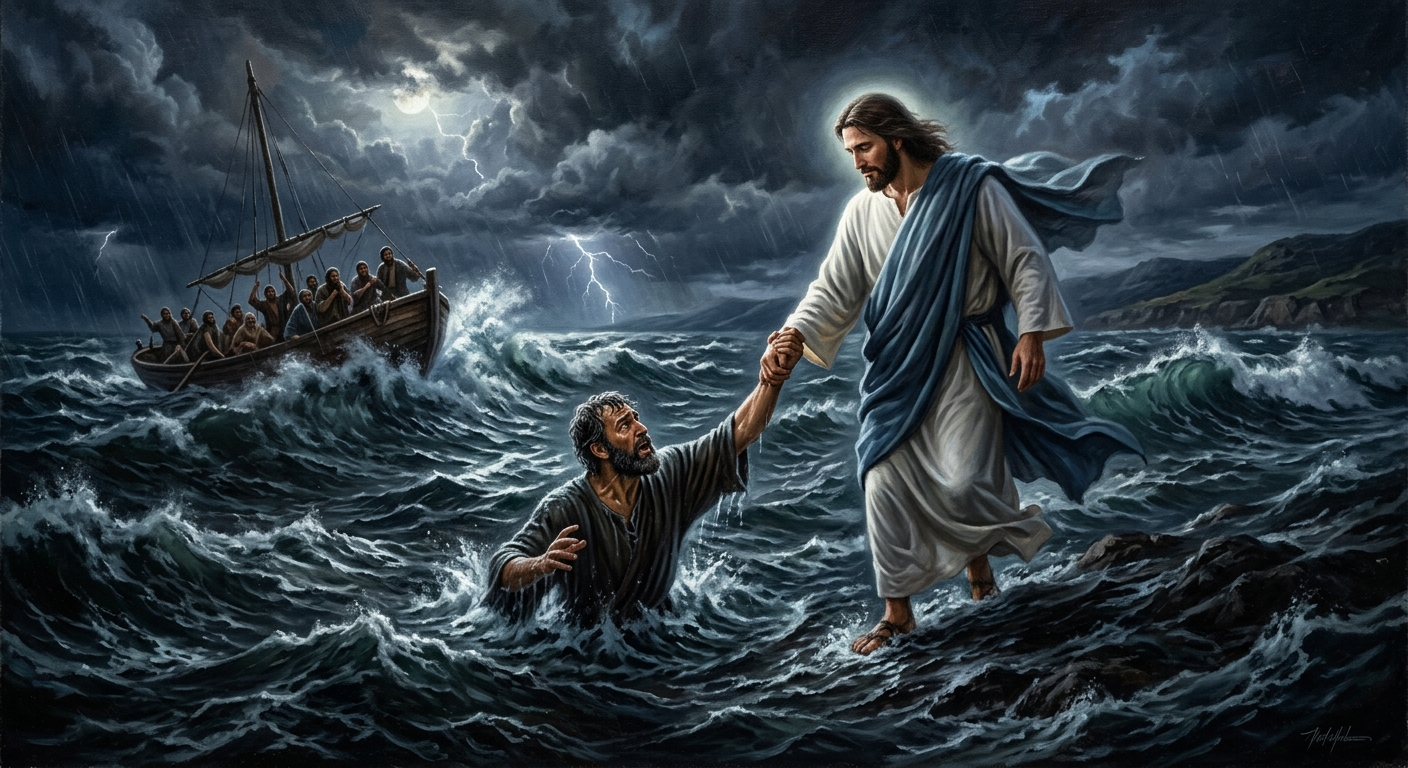
Illustration: Dramatic cinematic biblical illustration for Matthew Chapter 14 showing Faith in Christ's Power, photorealistic oil painting style.
🔊
Listen to Chapter
Grace Notes Journey Audio Narration
Author
Matthew the Apostle
Written
~80-90 AD
Key Theme
Faith in Christ's Power
Setting
Galilee - by Sea of Galilee
Key Verse
Matthew 14:27
Total Verses
36
Chapter Introduction
*In this chapter we see the tender heart of our Savior as He meets the needs of a hungry crowd and whispers peace to trembling disciples on stormy waters. The miracles are not just displays of power, but signs of His deep love and provision for those who trust Him. As we read, may our faith be strengthened, knowing that He cares for both our bodies and souls. Let His words—“Be of good cheer; it is I”—echo in our hearts today.*
Matthew — Chapter 14 — KJV
1
At that time Herod the tetrarch heard of the fame of Jesus,
Simply PutThough Herod ruled over four provinces, he still heard about Jesus' fame. The word “tetrarch” (G2816) reminds us that even worldly rulers couldn't ignore the impact of Christ's ministry.
2
And said unto his servants, This is John the Baptist; he is risen from the dead; and therefore mighty works do shew forth themselves in him.
Simply PutHerod told his servants that “this is John the Baptist; he has risen from the dead,” mistaking John’s death for a miraculous sign. The phrase “mighty works” (G1919) in his mind referred to the wonders people saw, but now he tried to explain them through a mistaken superstition.
3
For Herod had laid hold on John, and bound him, and put him in prison for Herodias’ sake, his brother Philip’s wife.
Simply PutHerod had seized John, bound him, and locked him up in prison because John condemned his unlawful marriage to Herodias—his brother Philip’s wife. The verb “bound” (G1047) shows how John’s boldness was literally shackled by political power.
4
For John said unto him, It is not lawful for thee to have her.
Simply PutJohn told Herod, “It is not lawful for you to have her.” The word “lawful” (G5345) comes from the covenant law that God gave to Israel; John was speaking truthfully about marriage ethics.
5
And when he would have put him to death, he feared the multitude, because they counted him as a prophet.
Simply PutHerod feared the crowd because they regarded John as a prophet. The term “prophet” (G5576) indicates that John’s voice carried divine authority, and the people’s respect made Herod hesitant to silence him outright.
6
But when Herod’s birthday was kept, the daughter of Herodias danced before them, and pleased Herod.
Simply PutDuring Herod's birthday banquet, the daughter of Herodias danced among the guests and pleased him. The phrase “before them” (Greek “en meson”) shows that her performance was a public spectacle, aimed at gaining favor.
7
Whereupon he promised with an oath to give her whatsoever she would ask.
Simply PutHerod swore an oath to grant her any request she desired. The Greek word “oath” (G3686) is a solemn vow, and Herod felt compelled to keep it no matter the cost.
8
And she, being before instructed of her mother, said, Give me here John Baptist’s head in a charger.
Simply PutPrompted by her mother, she demanded John’s head on a charger. The word “charger” (G2722) refers to the wheeled platform used to carry a severed head—her request was shocking and gruesome.
9
And the king was sorry: nevertheless for the oath’s sake, and them which sat with him at meat, he commanded it to be given her.
Simply PutHerod regretted the decision, but for the sake of his oath and his guests at dinner, he commanded that it be carried out. The verb “sorry” (G2451) shows his inner conflict, yet he felt bound to fulfill his promise.
10
And he sent, and beheaded John in the prison.
Simply PutHe sent soldiers to the prison and beheaded John. The verb “beheaded” (G2316) emphasizes the brutal method of execution, ending John’s earthly ministry.
11
And his head was brought in a charger, and given to the damsel: and she brought it to her mother.
Simply PutJohn’s head was placed on a charger and given to the girl, who brought it to her mother. This act fulfilled Herodias’ revenge against John through a gruesome token.
12
And his disciples came, and took up the body, and buried it, and went and told Jesus.
Simply PutJesus’ disciples arrived, took John’s body, buried it, and went to tell Jesus. Their care in burying the prophet shows respect for a faithful servant of God.
13
When Jesus heard of it, he departed thence by ship into a desert place apart: and when the people had heard thereof, they followed him on foot out of the cities.
Simply PutWhen Jesus heard this, he withdrew by boat to a solitary desert place. The phrase “desert place apart” (Greek “erēmia”) signals a moment of quiet prayer and reflection after hearing the news.
14
And Jesus went forth, and saw a great multitude, and was moved with compassion toward them, and he healed their sick.
Simply PutAs He walked among the crowd, Jesus was moved with compassion and healed their sick. The Greek term “splagchnisō” (G5296) literally means to be moved in the inner organs, showing deep heartfelt sympathy.
15
And when it was evening, his disciples came to him, saying, This is a desert place, and the time is now past; send the multitude away, that they may go into the villages, and buy themselves victuals.
Simply PutWhen evening came, the disciples urged Jesus to send the crowds away so they could find food in nearby villages. Their concern for “victuals” (G5539) reflects the practical needs of a large, hungry crowd.
16
But Jesus said unto them, They need not depart; give ye them to eat.
Simply PutJesus tells the crowd, “You don’t need to go away; give them to me to eat.” The word here, “need” (Greek ἀνάγκη, G302), means a pressing necessity. In moments of scarcity or doubt, this verse reminds us that God’s provision isn’t based on our preparation but on His presence. If you’re feeling hungry—physically or spiritually—Jesus is saying, “I’m here; bring your situation to Me.”
17
And they say unto him, We have here but five loaves, and two fishes.
Simply PutThe disciples answer, “We only have five loaves and two fish.” The Greek word for “but” (δὲ, G1163) signals a contrast: what looks insufficient to us. Yet the little they have is enough for God’s miracle. When you think you’re lacking, remember that God works with the little gifts we bring to Him.
18
He said, Bring them hither to me.
Simply PutJesus says, “Bring them here to me.” The verb “bring” (Greek φέρω, G535) conveys moving something toward a destination. Jesus wants the crowd close to Him because He alone can transform their need into abundance. You’re invited to draw nearer to Christ, even when the journey seems small.
19
And he commanded the multitude to sit down on the grass, and took the five loaves, and the two fishes, and looking up to heaven, he blessed, and brake, and gave the loaves to his disciples, and the disciples to the multitude.
Simply Put“He made them sit on the grass, took the loaves and fish, lifted his eyes to heaven, blessed (Greek εὐλογέω, G1658), broke them, and gave the loaves to his disciples.” The blessing is a divine invitation for God’s favor. By looking up, Jesus demonstrates that true provision comes from the Father above, not just human effort.
20
And they did all eat, and were filled: and they took up of the fragments that remained twelve baskets full.
Simply Put“They all ate and were filled (Greek πληρόω, G4102), taking up the leftovers—twelve full baskets.” To be “filled” means more than satisfied; it points to a complete, overflowing provision. Even the remnants are abundant, showing that God’s generosity exceeds our expectations.
21
And they that had eaten were about five thousand men, beside women and children.
Simply Put“About five thousand men, plus women and children.” The figure of five thousand (Greek πεντακισχιλιάδες, G4186) emphasizes the massive reach of Jesus’ compassion. He cares for every individual—men, women, children—no one is left out.
22
And straightway Jesus constrained his disciples to get into a ship, and to go before him unto the other side, while he sent the multitudes away.
Simply Put“Jesus instantly commanded (Greek ἀγγαρεύω, G68) his disciples to go ahead in a boat while he sent the crowd away.” The urgency shows that Jesus was moving toward another purpose—prayer and solitude. He doesn’t linger in the crowd, but seeks a place of communion with the Father.
23
And when he had sent the multitudes away, he went up into a mountain apart to pray: and when the evening was come, he was there alone.
Simply Put“He went up on a mountain alone to pray (Greek προσεύχομαι, G433).” Prayer is the soul’s quiet time with God. Even in the midst of miracles, Jesus still needed personal communion with His Father—a reminder that we too need to retreat for spiritual renewal.
24
But the ship was now in the midst of the sea, tossed with waves: for the wind was contrary.
Simply Put“The ship was tossed (Greek κυκλόω, G3065) by waves; the wind blew contrary.” The sea’s turbulence mirrors life’s hardships. When winds oppose us, we’re reminded that the presence of the Savior can calm our storms.
25
And in the fourth watch of the night Jesus went unto them, walking on the sea.
Simply Put“At the fourth watch of the night Jesus walked on the sea to them.” The “fourth watch” (Greek ὥρα) marks a late, dark hour—yet He appears. Walking on water shows His mastery over nature and the reassurance that He comes to us even in darkness.
26
And when the disciples saw him walking on the sea, they were troubled, saying, It is a spirit; and they cried out for fear.
Simply Put“The disciples were troubled (Greek ταράσσω, G4930), saying ‘It’s a spirit,’ and cried out in fear.” Their terror reflects human tendencies to attribute the unknown to spirits or shadows. Jesus knows our hearts; He sees beyond the fear that paralyzes us.
27
But straightway Jesus spake unto them, saying, Be of good cheer; it is I; be not afraid.
Simply Put“Jesus spoke, ‘Be of good cheer (Greek παρακαλέω, G3836); it is I; don’t be afraid.’” The word “cheer” means encouragement or comfort. He assures them that the voice they hear is His own, a promise of His constant presence.
28
And Peter answered him and said, Lord, if it be thou, bid me come unto thee on the water.
Simply Put“Peter replied, ‘Lord (Greek κύριος, G2962), if it’s really you, command me to come on the water.’” Peter’s request shows his desire for a deeper experience of Christ, while also testing his faith. He acknowledges Jesus’ lordship and is willing to step out in trust.
29
And he said, Come. And when Peter was come down out of the ship, he walked on the water, to go to Jesus.
Simply Put“‘Come,’ Jesus said. Peter stepped out of the boat and walked on water toward Him.” The command “Come” is an invitation to greater faith. Peter’s walk demonstrates that God empowers us when we keep our eyes on Him.
30
But when he saw the wind boisterous, he was afraid; and beginning to sink, he cried, saying, Lord, save me.
Simply Put“When Peter saw the wind boisterous (Greek ἄνεμος, G158), he became afraid and began to sink, crying ‘Lord, save me.’” The wind’s breath represents the pressures that can cause us to falter. Our cry for help is a reminder that we rely on Christ’s salvation when fear overwhelms us.
31
And immediately Jesus stretched forth his hand, and caught him, and said unto him, O thou of little faith, wherefore didst thou doubt?
Simply Put"And immediately Jesus stretched forth his hand, and caught him, and said unto him, O thou of little faith, wherefore didst thou doubt?" The Greek word for "faith" here is pistis (G4102), which means firm trust or belief. When we find ourselves in the middle of a storm, Jesus reminds us that even tiny moments of doubt (merimnaō, G3361 – a worried, uneasy heart) can be met with gentle correction and rescue. He reaches out not just to save us physically, but to call us back into a deeper trust in Him.
32
And when they were come into the ship, the wind ceased.
Simply Put"And when they were come into the ship, the wind ceased." The word for "wind" is aer (G652), and "ceased" is hēmitō (G2240). This reminds us that once we step onto the safety of Jesus' presence—into His boat—the chaotic winds of life calm down. It's a picture of how God's peace can bring stillness to the storms that toss us about.
33
Then they that were in the ship came and worshipped him, saying, Of a truth thou art the Son of God.
Simply Put"Then they that were in the ship came and worshipped him, saying, Of a truth thou art the Son of God." The verb proskyneō (G4375) means to bow down and worship, showing a heartfelt response. Recognizing Jesus as the Son of God (huios Theou: G5205/G2316) is not just an intellectual note; it's a declaration that He has power over our lives. When we truly see His divinity, we naturally fall into worship.
34
And when they were gone over, they came into the land of Gennesaret.
Simply Put"And when they were gone over, they came into the land of Gennesaret." The phrase peragō (G3989) means to go across or pass over. Their journey from the sea into Gennesaret symbolizes moving from a place of trial to one of abundance, just as we move from hardship into the promise of God's provision.
35
And when the men of that place had knowledge of him, they sent out into all that country round about, and brought unto him all that were diseased;
Simply Put"And when the men of that place had knowledge of him, they sent out into all that country round about, and brought unto him all that were diseased;" The word gnōsis (G1109) is "knowledge," indicating a deep, personal awareness of who Jesus is. Their willingness to bring the sick (pathē, G3937) across the region shows a faith that trusts Jesus can bring healing to every brokenness.
36
And besought him that they might only touch the hem of his garment: and as many as touched were made perfectly whole.
Simply Put"And besought him that they might only touch the hem of his garment: and as many as touched were made perfectly whole." The hem (hemi, G219) of a garment was the outermost edge where power was believed to reside. When they reached out with faith, Jesus healed them completely (teleios, G5046 – perfect wholeness). Even a simple touch, done in desperation and belief, can bring complete restoration.
When you consider how Jesus gathered a crowd on the grass and multiplied five loaves and two fishes, what small resource or talent that you possess could be shared today to meet a genuine need in your community?