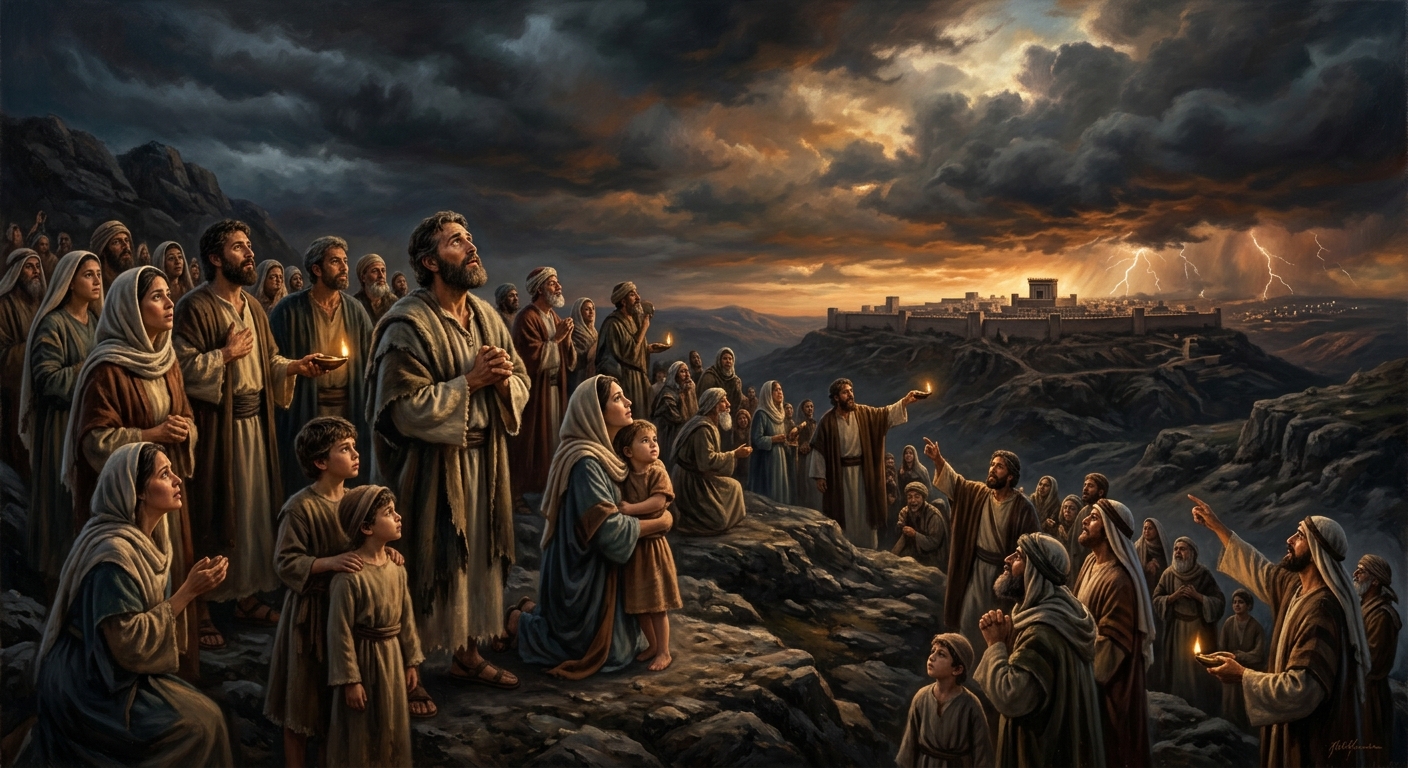
Illustration: Dramatic cinematic biblical illustration for Matthew Chapter 24 showing Watchful waiting for Christ's return, photorealistic oil painting style.
🔊
Listen to Chapter
Grace Notes Journey Audio Narration
Author
Matthew the Apostle
Written
~80-85 AD
Key Theme
Watchful waiting for Christ's return
Setting
Jerusalem - Olivet Mount
Key Verse
Matthew 24:42
Total Verses
51
Chapter Introduction
*Beloved, as we stand on the Mount of Olives with our Savior, He gently warns us to be vigilant. The signs of His coming are like sunrise after a night—certain yet unseen. Let us keep our hearts anchored in hope, trusting His timing and grace. In every whisper of wind, He reminds us that our watchfulness is an act of love toward Him and the world.*
Matthew — Chapter 24 — KJV
1
And Jesus went out, and departed from the temple: and his disciples came to him for to shew him the buildings of the temple.
Simply PutThe disciples were proud of the temple’s splendor, but Jesus had already “departed” (Greek: ἀπῆλθεν, G615) with a purpose beyond architecture. He wants to see what they value before the world shifts. For those in pain, it’s a reminder that sometimes God looks at our treasures before He moves them.
2
And Jesus said unto them, See ye not all these things? verily I say unto you, There shall not be left here one stone upon another, that shall not be thrown down.
Simply PutJesus says, “There shall not be left one stone upon another,” using the Greek word “stone” (λιθός, G2985). He foresees total demolition of the temple as a symbol of God’s transformative plan. If you’re doubting, know that even what seems unshakable can be reshaped for a greater purpose.
3
And as he sat upon the mount of Olives, the disciples came unto him privately, saying, Tell us, when shall these things be? and what shall be the sign of thy coming, and of the end of the world?
Simply PutThe disciples ask, “What shall be the sign of thy coming?” The Greek word “sign” (σημεῖον, G4972) points to a visible marker of God’s return. In your hunger for assurance, this is a cry that the faithful need a clear promise that God isn’t distant.
4
And Jesus answered and said unto them, Take heed that no man deceive you.
Simply Put“Take heed that no man deceive you.” The Greek term “deceive” (πλάνω, G3989) warns of false teachings that will lead believers astray. For those feeling lost, stay rooted in the truth you’ve been taught; don’t be swayed by every new voice.
5
For many shall come in my name, saying, I am Christ; and shall deceive many.
Simply Put“Many shall come in my name, saying, I am Christ.” The Greek word “Christ” (Χριστός, G5547) means the Anointed One. It’s a caution that many will claim divine authority but only some truly bear it—keep your hope on the true, not the false.
6
And ye shall hear of wars and rumours of wars: see that ye be not troubled: for all these things must come to pass, but the end is not yet.
Simply Put“You shall hear of wars and rumors of wars.” The Greek word “rumors” (φάσις, G5315) suggests speculation and fear. Even amid turmoil, the “end is not yet”; this reminds those troubled that present hardships are part of a larger story.
7
For nation shall rise against nation, and kingdom against kingdom: and there shall be famines, and pestilences, and earthquakes, in divers places.
Simply PutNations rising against nations, kingdoms against kingdoms—this paints a picture of escalating conflict. The Greek word “nation” (γένος, G1089) signifies groups of people in opposition. Even as the world seems to crumble, remember that these are stages, not the final act.
8
All these are the beginning of sorrows.
Simply Put“All these are the beginning of sorrows.” The Greek term “sorrows” (θλῖψις, G1145) refers to suffering and distress. These early pains are only the start; there is a promise of relief beyond this present suffering.
9
Then shall they deliver you up to be afflicted, and shall kill you: and ye shall be hated of all nations for my name’s sake.
Simply Put“They shall deliver you up to be afflicted.” The Greek word “afflicted” (ἀπολύω, G601) means to be handed over as a prisoner. Followers of Christ will face persecution and hatred, but this suffering is a testament to the power of His name.
10
And then shall many be offended, and shall betray one another, and shall hate one another.
Simply Put“Many shall be offended and betray one another.” The Greek word “offended” (παρασυστῆναι, G3952) means to be set apart or separated. In times of trial, relationships may break, yet this temporary division does not define your ultimate destiny.
11
And many false prophets shall rise, and shall deceive many.
Simply Put“Many false prophets shall rise.” The Greek word “prophet” (προφήτης, G4262) means one who claims divine authority. Amid confusion, discernment is crucial; many will speak truth while others mislead.
12
And because iniquity shall abound, the love of many shall wax cold.
Simply Put“Because iniquity shall abound, the love of many shall wax cold.” The Greek word “iniquity” (ἀνομία, G172) denotes lawlessness and moral corruption. As wickedness spreads, hearts may grow indifferent—stay vigilant in keeping your love for God alive.
13
But he that shall endure unto the end, the same shall be saved.
Simply Put“He that shall endure unto the end, the same shall be saved.” The Greek term for “endure” (ὑπομονή, G5405) signifies perseverance. This promise assures those on the brink that lasting through trials leads to salvation.
14
And this gospel of the kingdom shall be preached in all the world for a witness unto all nations; and then shall the end come.
Simply Put“This gospel of the kingdom shall be preached in all the world…then shall the end come.” The Greek word “gospel” (εὐαγγέλιον, G209) means good news. The message of Christ will reach every corner before the final day—a comforting sign for those longing for hope.
15
When ye therefore shall see the abomination of desolation, spoken of by Daniel the prophet, stand in the holy place, (whoso readeth, let him understand:)
Simply Put“When ye shall see the abomination of desolation…stand in the holy place.” The Greek phrase “abomination of desolation” (βδέλυγμα τῆς ἐρημώσεως, G970 & G1783) refers to a desecrating event spoken of by Daniel. Recognizing this sign is a call for believers to stay firm in faith when history unfolds.
16
Then let them which be in Judaea flee into the mountains:
Simply PutIn the land of Judah (Greek: Ioudaia, Strong's #2472), Jesus tells those there to run for the hills. The Greek word for "mountains" (oros) signifies places of safety and refuge. If you feel surrounded by danger or fear, this verse reminds you that God calls His people to flee from the storm and trust Him in higher ground.
17
Let him which is on the housetop not come down to take any thing out of his house:
Simply PutIf you are standing on your roof, don't waste time gathering belongings. The Greek term for "housetop" (oxus) indicates an elevated spot where one could look out over the city. In times of crisis, what truly matters is being ready to leave when God calls—not clinging to material things like we often do.
18
Neither let him which is in the field return back to take his clothes.
Simply PutLikewise, if you are out in the fields, don't go back for your coat. The Greek word "agron" (field) represents open spaces where people work and live. When the Spirit nudges you toward a new path, don’t look back to what you're comfortable with; trust that He’s opening a fresh way for you.
19
And woe unto them that are with child, and to them that give suck in those days!
Simply Put"Woe" (Greek: mara, Strong's #3229) to those carrying babies or nursing. These verses point out that times of trouble are especially hard for the vulnerable and those in need of comfort. If you’re feeling overwhelmed by life’s hardships, remember that God sees your struggles and will bring relief in His perfect timing.
20
But pray ye that your flight be not in the winter, neither on the sabbath day:
Simply PutPray your escape isn’t during winter or on the Sabbath. The Greek word for "winter" (cheimon) suggests harsh cold that can make fleeing even harder. This is a reminder to ask God for clear, smooth paths—ones where you don’t have to fight against nature or miss the day He’s set aside for worship.
21
For then shall be great tribulation, such as was not since the beginning of the world to this time, no, nor ever shall be.
Simply PutThen there will be great tribulation (Greek: thlipsis, Strong's #2293) like never before. The phrase "since the beginning of the world" (Greek: archē tēs aionos) emphasizes a level of suffering beyond anything we’ve known. For those in deep pain, this verse assures that God’s timeline includes periods of testing that will ultimately be followed by His deliverance.
22
And except those days should be shortened, there should no flesh be saved: but for the elect’s sake those days shall be shortened.
Simply PutIf those days weren’t cut short, no one would be saved—yet for the elect (Greek: eklektos, Strong's #2092), they will be. The Greek term "saved" (sōzomai) means being preserved from danger. This verse comforts those who feel hopeless by showing that God’s grace shortens suffering for His chosen ones.
23
Then if any man shall say unto you, Lo, here is Christ, or there; believe it not.
Simply PutIf anyone says, “Here is the Christ,” or “There,” do not believe them. The Greek word "Christ" (Christos, Strong's #5547) refers to the Anointed One. In moments of doubt, you’re reminded that true faith isn’t shaken by rumors or signs but rests on the unwavering Word of God.
24
For there shall arise false Christs, and false prophets, and shall shew great signs and wonders; insomuch that, if it were possible, they shall deceive the very elect.
Simply PutMany false Christs and prophets will perform great signs (Greek: sēmeion). These wonders may be so convincing that even the elect could be misled. When you’re yearning for a sign from God, remember that His truth is deeper than any spectacle—focus on the heart of Scripture.
25
Behold, I have told you before.
Simply PutI have told you before. This simple warning (Greek: idete) is a call to watchfulness. If you’re feeling uncertain about the future, keep this promise in mind: Jesus has already prepared you for what’s coming.
26
Wherefore if they shall say unto you, Behold, he is in the desert; go not forth: behold, he is in the secret chambers; believe it not.
Simply PutIf they say, “He is in the desert,” or “In secret chambers,” do not believe. The Greek term for "desert" (erēmos) and “secret chambers” suggest hidden places. True faith isn’t found in secret hideaways; it’s revealed openly by the Lord Himself.
27
For as the lightning cometh out of the east, and shineth even unto the west; so shall also the coming of the Son of man be.
Simply PutAs lightning flashes from the east to the west, so will the Son of Man’s coming. The Greek word for “lightning” (astrapē) signifies swift and undeniable visibility. When you feel lost, think of this promise: the return of Christ will be unmistakable and bright.
28
For wheresoever the carcase is, there will the eagles be gathered together.
Simply PutWherever the carcass is, eagles will gather. The Greek word for "carcass" (sarkas) points to a place of death, and “eagles” (aetos) signify the most majestic birds. Even in times of loss, God’s promise is that His righteous ones will rise and be gathered together.
29
Immediately after the tribulation of those days shall the sun be darkened, and the moon shall not give her light, and the stars shall fall from heaven, and the powers of the heavens shall be shaken:
Simply PutAfter those days, the sun will darken, the moon won’t shine, the stars will fall, and heavenly powers will be shaken. The Greek terms for “sun” (helios), “moon” (selēnē), and “stars” (astron) highlight the cosmic scale of this change. In moments of anxiety, know that God’s ultimate plan includes a grand transformation beyond our current understanding.
30
And then shall appear the sign of the Son of man in heaven: and then shall all the tribes of the earth mourn, and they shall see the Son of man coming in the clouds of heaven with power and great glory.
Simply PutThen the sign of the Son of Man will appear in heaven, and all peoples will mourn as He comes on clouds with great power and glory. The Greek phrase “sign of the Son of man” (sēmeion tou huiou tou anthrōpou) signifies a divine revelation. When you’re seeking hope, this verse assures that Christ’s glorious return will be a cause for worldwide awe and redemption.
31
And he shall send his angels with a great sound of a trumpet, and they shall gather together his elect from the four winds, from one end of heaven to the other.
Simply PutJesus tells us that when He decides it's time, He will send His angels (Greek "angelos," G31) with a mighty trumpet blast ("sphendone," G4776). Those chosen for Him (the "elect," Greek "eklektos," G2098) will be gathered from all corners of the earth. For someone feeling lost or abandoned, this verse is a promise that God's people will never be left behind; He has a grand rescue plan.
32
Now learn a parable of the fig tree; When his branch is yet tender, and putteth forth leaves, ye know that summer is nigh:
Simply PutJesus uses the fig tree ("sukē," G4895) as a living sign of change. When its tender branches begin to sprout leaves, everyone knows that summer is close ("engizo," G1900). In our own restless hearts, this teaches us to look for subtle signs of God's presence and timing rather than waiting for dramatic fireworks.
33
So likewise ye, when ye shall see all these things, know that it is near, even at the doors.
Simply PutJesus says that when we see all these signs, we can be sure the day is near ("engizo," G1900). He says it's like being at a door—ready to be opened. For those in doubt, this is an invitation to stay alert and trust that God’s schedule is unfolding right before our eyes.
34
Verily I say unto you, This generation shall not pass, till all these things be fulfilled.
Simply PutJesus assures that the current generation ("genea," G1089) will not pass away until every promise He made is fulfilled ("plēroō," G4172). For the weary, this means we are not left hanging; God is faithful to bring every prophecy to its completed end.
35
Heaven and earth shall pass away, but my words shall not pass away.
Simply PutJesus tells us that heaven and earth ("ouranos," G3772; "gē," G1093) may fade, but His words ("logoi") will never disappear. This is a comforting anchor for anyone fearing change—God's truth remains stable no matter what else shifts.
36
But of that day and hour knoweth no man, no, not the angels of heaven, but my Father only.
Simply PutNo one, not even the angels ("angelos," G31), knows the exact day or hour of His return; only the Father ("patēr," G3962) does. In our anxiety, this reminds us to surrender control and trust that God’s perfect timing is hidden from all.
37
But as the days of Noe were, so shall also the coming of the Son of man be.
Simply PutJesus compares His return to the days of Noah ("Noe")—when people were living normally, unaware of the coming flood. He says the second coming will be just as sudden and unexpected ("huios tou anthrōpou," G5203). For those hungry for hope, this challenges us to live each day as if the final moment could arrive at any time.
38
For as in the days that were before the flood they were eating and drinking, marrying and giving in marriage, until the day that Noe entered into the ark,
Simply PutBefore the flood, people were eating, drinking, marrying—going about their ordinary lives. This passage shows how easily we can be distracted by the busyness of life, missing the quiet but critical signs from God.
39
And knew not until the flood came, and took them all away; so shall also the coming of the Son of man be.
Simply PutAnd just as they didn’t realize the flood would come until it swept everything away, so will the coming of the Son be. This warns those in doubt that spiritual awakening often comes from a sudden, overwhelming event—so we must stay prepared.
40
Then shall two be in the field; the one shall be taken, and the other left.
Simply PutTwo men will be out in the field; one will be taken and the other left. This stark image reminds us that if we are not ready, we may be caught unaware and miss the invitation to join God.
41
Two women shall be grinding at the mill; the one shall be taken, and the other left.
Simply PutTwo women will be grinding at a mill; one will be taken and the other left. Like the previous verse, this shows that everyday moments can become points of divine decision—stay awake while you work.
42
Watch therefore: for ye know not what hour your Lord doth come.
Simply PutJesus tells us to watch because we don’t know the hour of His return. This is a call for vigilance ("phroua," G5338) in the midst of daily life.
43
But know this, that if the goodman of the house had known in what watch the thief would come, he would have watched, and would not have suffered his house to be broken up.
Simply PutHe says that if the goodman of a house had known when a thief would come, he would have stayed awake and protected his home. This teaches that knowing the likely moment of danger makes us ready to defend what matters most.
44
Therefore be ye also ready: for in such an hour as ye think not the Son of man cometh.
Simply PutTherefore, we must be ready—always prepared—for the Son of Man’s coming at an hour we don’t expect. This is a gentle nudge to live with a heart ready for the unexpected.
45
Who then is a faithful and wise servant, whom his lord hath made ruler over his household, to give them meat in due season?
Simply PutJesus asks, “Who is a faithful (Greek "pistos," G4102) and wise servant?" He describes someone entrusted to manage a household, giving food at the right times. For those seeking purpose, this reveals that faithful stewardship—being dependable and thoughtful—is the mark of true discipleship.
46
Blessed is that servant, whom his lord when he cometh shall find so doing.
Simply PutBlessed (Greek makarios, G3107) means truly fortunate—like finding treasure you didn’t know you had. The servant is discovered doing his work when the master returns, just as a child might be caught playing quietly while waiting for bedtime. This is God’s promise that faithfulness in the ordinary moments brings great reward.
47
Verily I say unto you, That he shall make him ruler over all his goods.
Simply PutVerily (Greek amen, G0155) is a solemn “yes” that underscores certainty. When the faithful servant proves reliable, his master trusts him with all the household’s affairs—a call to steward what God has given us faithfully, knowing He’ll entrust us with even more responsibilities.
48
But and if that evil servant shall say in his heart, My lord delayeth his coming;
Simply PutEvil (Greek kakos, G2580) describes a heart that’s hardened and complacent. By saying his lord is delaying, the servant pretends to be patient while truly ignoring the impending return. It reminds those in doubt that spiritual complacency can turn an opportunity into a missed blessing.
49
And shall begin to smite his fellowservants, and to eat and drink with the drunken;
Simply PutSmite (Greek psallo, G4522) means to strike or flog—a stark shift from serving to abusing fellow servants. By eating and drinking with the drunken, he abandons his duties for indulgence, showing how easy it is to drift into moral decay when we neglect our purpose.
50
The lord of that servant shall come in a day when he looketh not for him, and in an hour that he is not aware of,
Simply PutThe lord comes on a day the servant does not expect (Greek ouk epitrepei, G3762) and at an hour he is unaware of (Greek hora, G5625). It’s a warning that God’s timing can be sudden and unforeseen; the diligent must never become complacent or lose sight of the Master’s return.
51
And shall cut him asunder, and appoint him his portion with the hypocrites: there shall be weeping and gnashing of teeth.
Simply PutCut him asunder (Greek katastrōn) means to be severed from fellowship. The servant’s portion is set with the hypocrites, and there will be weeping and gnashing of teeth (Greek gerasmos), a painful lament that underscores the seriousness of spiritual neglect and the need for genuine, continuous devotion.
Mark 13:1-2This parallel Olivet discourse confirms the authenticity and consistency of Jesus' prophetic teachings about the temple's destruction.
Luke 21:5-6These verses mirror Jesus' warnings about wars and rumors of wars, reinforcing the theme of global turmoil as a precursor to His return.
Daniel 7:13-14The vision of the Son of Man receiving an everlasting kingdom illuminates Jesus' reference to His glorious return in Matthew 24:30.
2 Thessalonians 2:3-4This passage on the deception of a man of sin sheds light on Jesus' warning in Matthew 24:4-5 about false messiahs.
Reflect
When you hear that Jesus may return “in secret chambers,” how does that shape the way you balance waiting for a visible sign with actively living out your faith today?