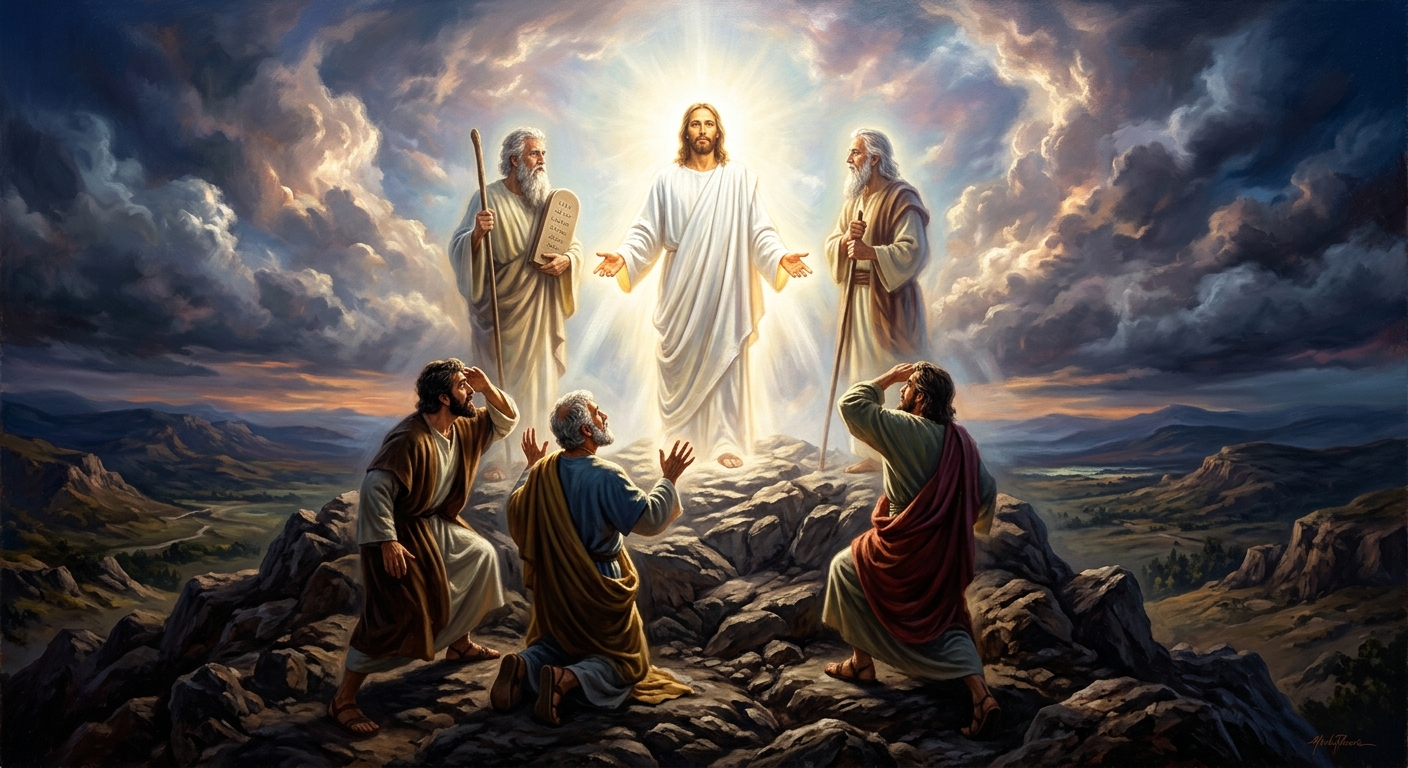
Illustration: Dramatic cinematic biblical illustration for Mark Chapter 9 showing Christ's Glory Revealed to Disciples, photorealistic oil painting style.
🔊
Listen to Chapter
Grace Notes Journey Audio Narration
Author
John Mark
Written
~65-70 AD
Key Theme
Christ's Glory Revealed to Disciples
Setting
High Mountain - before Jerusalem
Key Verse
Mark 9:23
Total Verses
50
Chapter Introduction
*In the hush of a lofty mountain, our Lord revealed His radiant glory to those who followed Him. The disciples witnessed the divine light that shone brighter than any earthly robe, a reminder that our Savior is ever transcendent. As Moses and Elijah appeared, we are reminded of the continuity of God's covenant across ages. Let this vision stir your heart to trust in Christ's power and love, for He is with us always.*
Mark — Chapter 9 — KJV
1
And he said unto them, Verily I say unto you, That there be some of them that stand here, which shall not taste of death, till they have seen the kingdom of God come with power.
Simply PutJesus assures us that some standing there will not die until they witness God's Kingdom power— "kingdom of God" (G932) means His divine reign breaking into the world. In our pain, this promise tells us that hope is alive now; God’s rule will manifest powerfully before death claims us.
2
And after six days Jesus taketh with him Peter, and James, and John, and leadeth them up into an high mountain apart by themselves: and he was transfigured before them.
Simply PutJesus led Peter, James, and John up a high mountain where He was "transfigured" (Greek metamorphoo, G3339), meaning His appearance changed to a radiant form. This moment reminds us that behind everyday life, God can reveal Himself in new, glorious ways.
3
And his raiment became shining, exceeding white as snow; so as no fuller on earth can white them.
Simply PutThe clothing (Greek himation, G2293) of Jesus became dazzlingly bright, whiter than any weaver could fashion. This shining garment symbolizes the purity and holiness that God brings, cleansing our hearts beyond any earthly effort.
4
And there appeared unto them Elias with Moses: and they were talking with Jesus.
Simply PutElijah (Greek Elaias, G1650) and Moses (Greek Mōsēs, G3322) appeared in glory, standing with Jesus. Their presence represents the whole story of God’s covenant—from Law to Prophets—now fulfilled in Christ.
5
And Peter answered and said to Jesus, Master, it is good for us to be here: and let us make three tabernacles; one for thee, and one for Moses, and one for Elias.
Simply PutPeter suggested building three tabernacles (Greek schēma, G4575) for Jesus, Moses, and Elijah. While honoring the divine is natural, true worship comes from listening to Jesus rather than merely constructing structures.
6
For he wist not what to say; for they were sore afraid.
Simply PutPeter was "sore afraid" (Greek phobē, G5346) and didn’t know what to say. Encountering God can be intimidating, but we can trust Him to guide our words when fear grips us.
7
And there was a cloud that overshadowed them: and a voice came out of the cloud, saying, This is my beloved Son: hear him.
Simply PutFrom the cloud, a voice declared Jesus as God's "beloved Son" (Greek agapētos huios), urging them to hear Him. This profound love and approval invites us to listen above all else.
8
And suddenly, when they had looked round about, they saw no man any more, save Jesus only with themselves.
Simply PutWhen they looked around, only Jesus remained; Moses and Elijah had vanished. All divine revelation points back to Him, reminding us that Christ alone is our guide.
9
And as they came down from the mountain, he charged them that they should tell no man what things they had seen, till the Son of man were risen from the dead.
Simply PutJesus charged them (Greek paragōgos, G3932) not to speak until after He rises. The phrase "Son of Man" (Greek huios tou anthrōpou, G5209) emphasizes His humanity as the Messiah; true understanding comes after His resurrection.
10
And they kept that saying with themselves, questioning one with another what the rising from the dead should mean.
Simply PutThe disciples kept pondering what the rising from the dead meant (Greek erōtaō, G2091). Even those closest to Him wrestle with this mystery—our doubts can lead us toward deeper faith.
11
And they asked him, saying, Why say the scribes that Elias must first come?
Simply PutThey asked why the scribes (Greek grammateus, G1121) said Elijah must first come. This reflects the expectation of a precursor before the Messiah, showing that Jesus is redefining prophecy.
12
And he answered and told them, Elias verily cometh first, and restoreth all things; and how it is written of the Son of man, that he must suffer many things, and be set at nought.
Simply PutHe explained that Elijah does indeed come first, preparing the way for Christ's suffering. The Greek word "restore" (kataskeuasō) means to rebuild what was lost, showing that suffering leads to restoration.
13
But I say unto you, That Elias is indeed come, and they have done unto him whatsoever they listed, as it is written of him.
Simply PutJesus said Elijah has already come—referring to John the Baptist—and people have treated him as they wished. Prophecy can be fulfilled in unexpected ways, and God’s promises are being realized today.
14
And when he came to his disciples, he saw a great multitude about them, and the scribes questioning with them.
Simply PutWhen Jesus returned, He found a great multitude (Greek plethos, G4211) and scholars questioning His followers. The world is full of seekers and skeptics alike.
15
And straightway all the people, when they beheld him, were greatly amazed, and running to him saluted him.
Simply PutAll the people were greatly amazed (Greek thaumaō, G2365) and ran to greet Him. Their reaction shows the magnetic pull of Christ’s presence, stirring hearts toward Him.
16
And he asked the scribes, What question ye with them?
Simply PutJesus asks the scribes, “What are you arguing about?” The word for “scribes” (Strong’s G5110) refers to those who were trained in the law. It shows that even educated religious leaders can get tangled up in petty disputes, missing what truly matters.
17
And one of the multitude answered and said, Master, I have brought unto thee my son, which hath a dumb spirit;
Simply PutA man from the crowd says, “Master, I’ve brought my son to you; he has a mute spirit.” The Greek phrase “mute spirit” (pneuma muros) describes a demon that has robbed the boy of speech. The father's plea is raw and desperate—he’s seeking a miracle for his son’s silence.
18
And wheresoever he taketh him, he teareth him: and he foameth, and gnasheth with his teeth, and pineth away: and I spake to thy disciples that they should cast him out; and they could not.
Simply PutThe father describes the boy’s torment: “Wherever he takes him, the spirit tears him apart (dasai), foams, gnashes his teeth (gnasthai), and pinches him.” The word “tears” (Strong’s G1176) conveys a violent, ripping pain. It tells us that the boy’s suffering is relentless and physical.
19
He answereth him, and saith, O faithless generation, how long shall I be with you? how long shall I suffer you? bring him unto me.
Simply PutJesus replies, “O faithless generation, how long will I be with you? How long will I suffer you?” The term “faithless” (apistōs) means lacking trust. Jesus’ frustration is palpable, but He also shows His willingness to bring the boy before Him.
20
And they brought him unto him: and when he saw him, straightway the spirit tare him; and he fell on the ground, and wallowed foaming.
Simply PutThey bring the boy in, and as soon as Jesus sees him, “the spirit tears him apart,” causing him to fall and foam. The immediate reaction shows the power of the demonic presence, but also sets the stage for Jesus’ intervention.
21
And he asked his father, How long is it ago since this came unto him? And he said, Of a child.
Simply PutJesus asks the father, “How long has this been happening?” The father honestly replies, “Since he was a child.” His answer reveals the long history of suffering and his deep concern for his son’s condition.
22
And ofttimes it hath cast him into the fire, and into the waters, to destroy him: but if thou canst do any thing, have compassion on us, and help us.
Simply PutThe father says, “It has often thrown him into fire and water to destroy him (pantote). If you can, have compassion on us.” The Greek “ofttimes” (Strong’s G3956) emphasizes the frequent, relentless attacks. He acknowledges his own limits and begs for divine help.
23
Jesus said unto him, If thou canst believe, all things are possible to him that believeth.
Simply PutJesus says, “If you can believe (pisteuo), all things are possible for the one who believes.” The word “believe” (Strong’s G4100) is about trust in God, and “possible” (dunamoi) underscores that faith unlocks divine power.
24
And straightway the father of the child cried out, and said with tears, Lord, I believe; help thou mine unbelief.
Simply PutThe father cries out, “Lord (kyrios), I believe; help my unbelief.” He admits his weak faith while pleading for strength. It’s a heartfelt confession that even believers wrestle with doubt.
25
When Jesus saw that the people came running together, he rebuked the foul spirit, saying unto him, Thou dumb and deaf spirit, I charge thee, come out of him, and enter no more into him.
Simply PutJesus rebukes the demon, “Mute and deaf spirit, I command you to come out of him.” His authority is absolute—He calls the demon by its condition, showing that spiritual oppression can be identified and tackled.
26
And the spirit cried, and rent him sore, and came out of him: and he was as one dead; insomuch that many said, He is dead.
Simply PutThe spirit cries out (ekriō) and tears the boy, leaving him like a dead man. The vivid description “as one dead” (nekros) underscores the severity of demonic oppression, but also sets up Jesus’ power to restore life.
27
But Jesus took him by the hand, and lifted him up; and he arose.
Simply PutJesus lifts the boy’s hand and he stands up. The Greek word for “lifted” (egeireō) conveys a divine raising from despair to wholeness—a powerful display of healing.
28
And when he was come into the house, his disciples asked him privately, Why could not we cast him out?
Simply PutThe disciples ask privately, “Why couldn’t we cast it out?” Their question shows humility and a desire to understand Jesus’ power. It’s a moment of learning that faith alone isn’t enough.
29
And he said unto them, This kind can come forth by nothing, but by prayer and fasting.
Simply PutJesus answers, “This kind can only be driven out by prayer (proseuchē) and fasting.” He emphasizes that spiritual battles require disciplined communion with God, not just outward action.
30
And they departed thence, and passed through Galilee; and he would not that any man should know it.
Simply PutThey move on through Galilee, and Jesus doesn’t want anyone to know. He often chooses timing over publicity, teaching that miracles are for God’s glory and the recipient’s healing, not for human applause.
31
For he taught his disciples, and said unto them, The Son of man is delivered into the hands of men, and they shall kill him; and after that he is killed, he shall rise the third day.
Simply PutJesus tells his disciples that the "Son of man is delivered (Greek, G1093) into the hands of men," meaning He will be handed over to humanity for their sins. Though they don't yet grasp this, the promise that He "shall rise the third day" (Greek, G530) offers hope to anyone in pain or doubt: death is not the end; resurrection brings new life.
32
But they understood not that saying, and were afraid to ask him.
Simply PutThe disciples "understood not" (Greek, G521) the meaning of Jesus' words and were "afraid to ask him," showing that fear can keep us from seeking the truth. In moments of confusion, we may stay silent rather than confront what truly matters.
33
And he came to Capernaum: and being in the house he asked them, What was it that ye disputed among yourselves by the way?
Simply PutJesus asks, "What was it that ye disputed among yourselves by the way?" The Greek word for "disputed" (G560) hints at a heated argument. He invites us to bring our unresolved conflicts before Him, instead of carrying them in silence.
34
But they held their peace: for by the way they had disputed among themselves, who should be the greatest.
Simply PutThey "held their peace," because they had been "disputed" (G560) over who "should be the greatest." The Greek term "greatest" (megas, G2192) reveals our natural desire for status. This verse reminds us that the quest for power can silence our hearts.
35
And he sat down, and called the twelve, and saith unto them, If any man desire to be first, the same shall be last of all, and servant of all.
Simply PutJesus says, "If any man desire to be first (Greek, G2), the same shall be last of all, and servant of all." The word for "servant" (doulos, G1401) signifies total humility. True greatness is found in serving others, not in seeking personal glory.
36
And he took a child, and set him in the midst of them: and when he had taken him in his arms, he said unto them,
Simply PutHe "took a child" (paidi, G3982) and placed him among the disciples. Children symbolize dependence and openness to receive; their presence challenges those who have grown stiff or self-sufficient.
37
Whosoever shall receive one of such children in my name, receiveth me: and whosoever shall receive me, receiveth not me, but him that sent me.
Simply Put"Whosoever shall receive one of such children in my name, receiveth me," using the Greek "receive" (lambano, G2980). To welcome a child is to receive Christ Himself and the Father who sent Him. In simple acts of love, we encounter God.
38
And John answered him, saying, Master, we saw one casting out devils in thy name, and he followeth not us: and we forbad him, because he followeth not us.
Simply PutJohn says, "We saw one casting out devils (Greek, G2595) in thy name... and we forbade him." The disciples feared the loss of their own authority, showing how jealousy can cloud our judgment.
39
But Jesus said, Forbid him not: for there is no man which shall do a miracle in my name, that can lightly speak evil of me.
Simply PutJesus answers, "Forbid him not; for there is no man who shall do a miracle in my name that can lightly speak evil of me." The Greek "forbid" (engyō, G1201) means to restrain. No one who truly works in His name can be dismissed as a threat.
40
For he that is not against us is on our part.
Simply PutHe declares, "For whosoever is not against us is on our part." Those who are neutral or indifferent can be allies. Unity in the kingdom includes those who don't oppose but also don't actively support.
41
For whosoever shall give you a cup of water to drink in my name, because ye belong to Christ, verily I say unto you, he shall not lose his reward.
Simply Put"Whoever gives you a cup of water to drink in my name" (Greek, G2695) will "not lose his reward." Even the smallest acts of kindness toward fellow believers are treasured by God.
42
And whosoever shall offend one of these little ones that believe in me, it is better for him that a millstone were hanged about his neck, and he were cast into the sea.
Simply Put"Whoever offends one of these little ones that believe in me" (Greek, skandalizō, G4625) will face severe consequences. To cause a fellow believer to stumble is a grave offense that demands serious repentance.
43
And if thy hand offend thee, cut it off: it is better for thee to enter into life maimed, than having two hands to go into hell, into the fire that never shall be quenched:
Simply Put"If your hand offends you, cut it off." The Greek word for "offend" (skandalizō) urges radical self-discipline. It's better to lose a hand than be cast into the eternal fire of hell.
44
Where their worm dieth not, and the fire is not quenched.
Simply Put"Where their worm dieth not, and the fire is not quenched." The Greek imagery points to an unending torment for those who persist in sin.
45
And if thy foot offend thee, cut it off: it is better for thee to enter halt into life, than having two feet to be cast into hell, into the fire that never shall be quenched:
Simply Put"If your foot offends you, cut it off." Even a small misstep can lead to eternal ruin; it's wiser to maim oneself in this life than be condemned forever.
46
Where their worm dieth not, and the fire is not quenched.
47
And if thine eye offend thee, pluck it out: it is better for thee to enter into the kingdom of God with one eye, than having two eyes to be cast into hell fire:
Simply PutThe “eye” (G383) represents how we see and value the world. Jesus says that if a part of our life causes us to stumble, we must be willing to give it up, even if it hurts. It’s better to walk into God’s kingdom with one clear focus than to be dragged into eternal fire (G2586) because of our divided loyalties.
48
Where their worm dieth not, and the fire is not quenched.
49
For every one shall be salted with fire, and every sacrifice shall be salted with salt.
Simply Put“Salted” (G2476) in the Greek means to preserve and flavor. Being salted with fire means that every believer will be refined by trials, just as salt adds taste to food. Every offering we make to God must also be “salted,” meaning it should be sincere and pure, not stale or empty.
50
Salt is good: but if the salt have lost his saltness, wherewith will ye season it? Have salt in yourselves, and have peace one with another.
Simply PutSalt (G2476) is good because it preserves and adds flavor, but if it loses its taste, what can we do with it? Jesus urges us to keep the “salt” of purity in ourselves and live in peace (G1515) with one another. In plain terms, stay true to God’s truth and keep loving each other—otherwise our lives become bland and meaningless.
Matthew 17:2The parallel account of the Transfiguration in Matthew emphasizes the same dazzling white raiment, confirming its authenticity across the synoptic Gospels.
Luke 9:30Luke’s narrative of Moses and Elijah appearing with Jesus mirrors Mark 9:4, underscoring the fulfillment of prophetic expectation.
Exodus 34:29Moses’s radiant face after speaking with God parallels Jesus’ shining clothing, highlighting the divine glory that envelops both leaders.
Isaiah 6:3The voice proclaiming “Holy, holy, holy” from the heavenly throne resonates with the cloud’s voice in Mark 9:7, linking Old Testament theophany to New Testament revelation.
Reflect
After a powerful encounter with God—like the Transfiguration—have you ever felt so overwhelmed that you seemed "as one dead," and what helped you find life again?