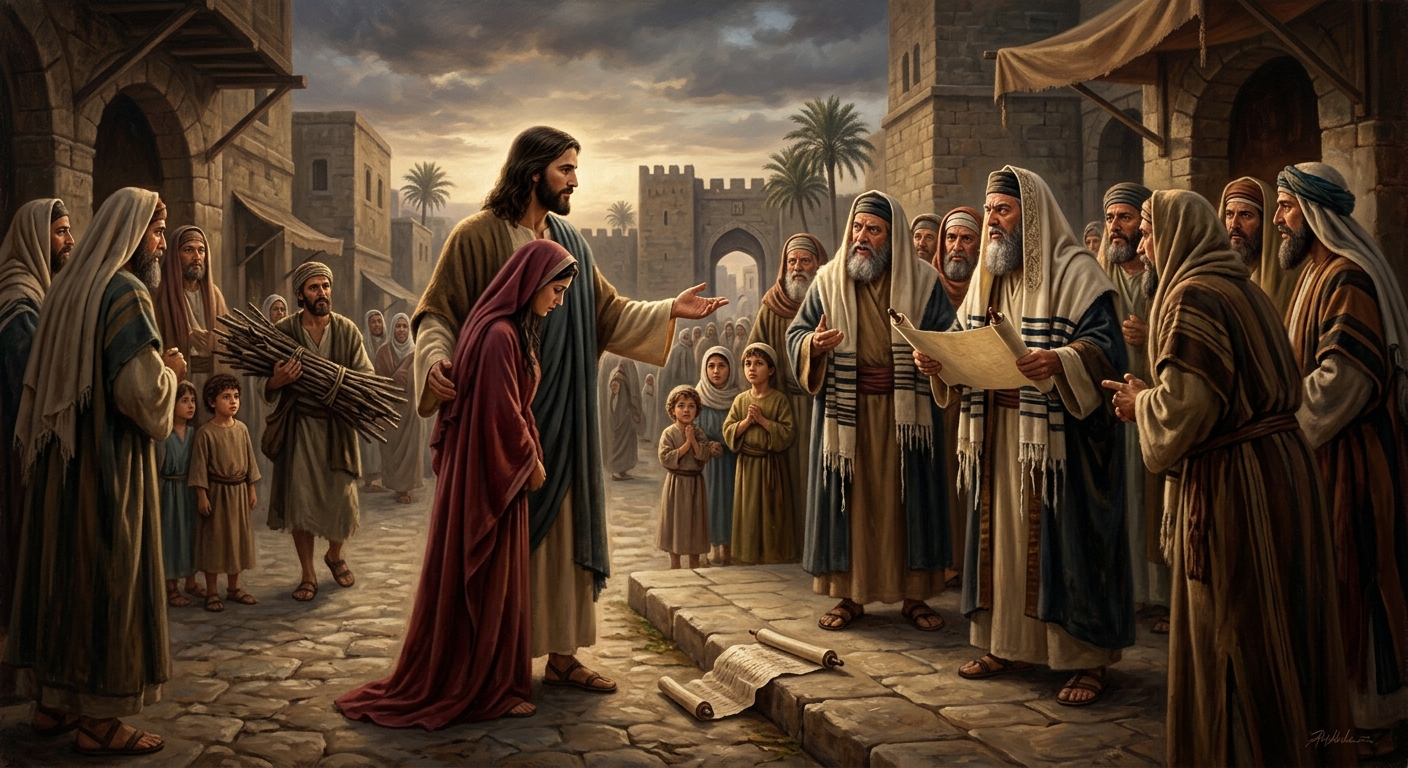
Illustration: Dramatic cinematic biblical illustration for Mark Chapter 10 showing Divorce and Kingdom Values, photorealistic oil painting style.
🔊
Listen to Chapter
Grace Notes Journey Audio Narration
Author
John Mark
Written
~65-70 AD
Key Theme
Divorce and Kingdom Values
Setting
Judea - across the Jordan
Key Verse
Mark 10:27
Total Verses
52
Chapter Introduction
*In this tender passage, Jesus walks with His disciples through the tangled hearts of marriage and divorce. He reveals that God's law is not a cold contract but a living covenant, written for the softness of our hearts. With gentle authority, He invites us to see that true marriage reflects the unbreakable bond between Christ and His Church. May we be reminded that every promise made to God is a promise kept in love.*
Mark — Chapter 10 — KJV
1
And he arose from thence, and cometh into the coasts of Judaea by the farther side of Jordan: and the people resort unto him again; and, as he was wont, he taught them again.
Simply PutJesus lifts himself up (egeiro, G610) from the mountains and walks along the far side of the Jordan. He meets the crowd again, teaching them anew—bringing fresh hope to those who are weary and searching for direction.
2
And the Pharisees came to him, and asked him, Is it lawful for a man to put away his wife? tempting him.
Simply PutThe Pharisees test Jesus with the word “apokopto” (G603), meaning to cut off, asking if it’s lawful for a man to put away his wife. Their question hides their heart's doubt about the true purpose of marriage.
3
And he answered and said unto them, What did Moses command you?
Simply PutJesus turns back to them, asking “What did Moses command?” He invites them to examine the law they claim to uphold and see its deeper intent.
4
And they said, Moses suffered to write a bill of divorcement, and to put her away.
Simply PutThey answer that Moses allowed a “bill of divorcement,” citing the legal document that gave them an easy way out, not God’s original design for marriage.
5
And Jesus answered and said unto them, For the hardness of your heart he wrote you this precept.
Simply PutJesus says this precept was written because of the hardness of their hearts (sklerosis, G4566). Their stubbornness caused them to cling to a legalism that missed the love behind marriage.
6
But from the beginning of the creation God made them male and female.
Simply PutFrom the beginning of creation (genesis, G1078), God made them male and female—a reminder that marriage began in the garden as a perfect union.
7
For this cause shall a man leave his father and mother, and cleave to his wife;
Simply PutA man will leave his parents and cling (klencho, G2823) to his wife. This bond replaces the old family tie and creates a new life together.
8
And they twain shall be one flesh: so then they are no more twain, but one flesh.
Simply PutThe two become one flesh, no longer separate but united as a single living unit.
9
What therefore God hath joined together, let not man put asunder.
Simply PutTherefore, what God has joined together, let no one break apart. This command calls us to honor the divine union He created.
10
And in the house his disciples asked him again of the same matter.
Simply PutBack at home, his disciples ask him again about the same question. Their continued doubt shows they still wrestle with what marriage truly means.
11
And he saith unto them, Whosoever shall put away his wife, and marry another, committeth adultery against her.
Simply PutHe says anyone who divorces and remarries commits adultery (moicheia, G3315) against his wife—highlighting the betrayal of a covenant.
12
And if a woman shall put away her husband, and be married to another, she committeth adultery.
Simply PutThe same applies to women; divorcing and remarrying is also adultery. Both parties are called back to the seriousness of vows.
13
And they brought young children to him, that he should touch them: and his disciples rebuked those that brought them.
Simply PutPeople bring their little children to Jesus, but his disciples rebuke (ephibomai, G1905) them. The disciples miss the point that children are key to understanding His kingdom.
14
But when Jesus saw it, he was much displeased, and said unto them, Suffer the little children to come unto me, and forbid them not: for of such is the kingdom of God.
Simply PutSeeing this, Jesus is deeply displeased; his “thymos” (G2399) shows righteous anger. He says let the children come—they are the model for entering God's kingdom.
15
Verily I say unto you, Whosoever shall not receive the kingdom of God as a little child, he shall not enter therein.
Simply PutTruly, anyone who doesn't receive the kingdom like a child (paidion, G3956) won’t enter it. Humility and trust are the keys to experiencing God’s reign.
16
And he took them up in his arms, put his hands upon them, and blessed them.
Simply PutJesus lifted them up in his arms, laid his hands on their heads, and blessed them. The Greek word for "hands" (G4251) signifies personal touch—a tangible sign of God's favor. The word "blessed" (G305, eulogeō) means to speak well of and confer divine favor; it's a reminder that even in our deepest pain, God's gentle hand can bring comfort and assurance.
17
And when he was gone forth into the way, there came one running, and kneeled to him, and asked him, Good Master, what shall I do that I may inherit eternal life?
Simply PutAs Jesus walked on the road, a man ran up to him, knelt down, and asked, "Good Master, what must I do to inherit eternal life?" The Greek word for "inherit" (G1075, klēronoméō) implies receiving something as a rightful heir. In moments of doubt or yearning, this verse invites us to look beyond worldly gains toward the promise of a lasting relationship with God.
18
And Jesus said unto him, Why callest thou me good? there is none good but one, that is, God.
Simply PutJesus replied, "Why do you call me good? No one is truly good except God alone." The Greek word for "good" (G18, kalos) often means morally excellent. By pointing to God as the source of goodness (G2316), Jesus reminds us that true righteousness comes from Him, not our own deeds.
19
Thou knowest the commandments, Do not commit adultery, Do not kill, Do not steal, Do not bear false witness, Defraud not, Honour thy father and mother.
Simply PutHe said, "You know the commandments—Do not commit adultery; Do not murder; Do not steal; Do not bear false witness; Defraud not; Honor your father and mother." The word "commandments" (G1649, entolas) refers to the laws given by God. This list shows that living a righteous life involves both avoiding wrong and actively honoring those who gave us life.
20
And he answered and said unto him, Master, all these have I observed from my youth.
Simply PutThe man replied, "Master, I have kept all these rules since my youth." The Greek term for "youth" (G3430, neotēs) reflects his confidence in having never broken the law. Yet his response shows a common trap: thinking we have earned favor through our own righteousness rather than trusting in God's grace.
21
Then Jesus beholding him loved him, and said unto him, One thing thou lackest: go thy way, sell whatsoever thou hast, and give to the poor, and thou shalt have treasure in heaven: and come, take up the cross, and follow me.
Simply PutJesus, seeing his heart, loved him and said, "You lack one thing. Go, sell everything you own, give it to the poor, and you'll have treasure in heaven. Then come, take up your cross, and follow me." The word "love" (G26, agapē) is the deepest, selfless affection. Taking up one's "cross" (G2453) means embracing sacrifice and dependence on God, which brings spiritual riches that last forever.
22
And he was sad at that saying, and went away grieved: for he had great possessions.
Simply PutThe man left feeling sad because he had many possessions. The Greek word for "sad" (G3999, penthos) conveys deep sorrow. His grief shows how tightly we can cling to material wealth, even when it hinders a deeper walk with Christ.
23
And Jesus looked round about, and saith unto his disciples, How hardly shall they that have riches enter into the kingdom of God!
Simply PutJesus looked around and said, "How hard it is for those who are rich to enter the kingdom of God!" The word "hardly" (G3825, dyskoloos) indicates difficulty. This truth reminds us that wealth can become a spiritual trap unless we keep our hearts fixed on God's kingdom, not worldly riches.
24
And the disciples were astonished at his words. But Jesus answereth again, and saith unto them, Children, how hard is it for them that trust in riches to enter into the kingdom of God!
Simply PutThe disciples were amazed. Jesus replied, "Children, how hard it is for those who trust in riches to enter the kingdom!" The word "astonished" (G1584, ekplēssō) shows their shock. He uses "children" to convey humility—a reminder that entering God's kingdom requires surrendering our reliance on wealth.
25
It is easier for a camel to go through the eye of a needle, than for a rich man to enter into the kingdom of God.
Simply Put"It is easier for a camel to go through the eye of a needle than for a rich person to enter God's kingdom." The word "camel" (G2584, kamēlos) represents something large and cumbersome. This vivid image underscores how difficult it is for those attached to wealth to experience spiritual freedom.
26
And they were astonished out of measure, saying among themselves, Who then can be saved?
Simply PutThe disciples were amazed beyond measure, asking themselves, "Who can be saved?" Their astonishment (G1584) reflects a feeling of hopelessness. This question invites us to consider that salvation is not based on merit but on God's grace.
27
And Jesus looking upon them saith, With men it is impossible, but not with God: for with God all things are possible.
Simply PutJesus looked at them and said, "With people it is impossible, but not with God; for with God all things are possible." The word "impossible" (G265, adunatos) emphasizes human limitation. However, God's power transcends all barriers, assuring us that even the greatest obstacles can be overcome through Him.
28
Then Peter began to say unto him, Lo, we have left all, and have followed thee.
Simply PutPeter said, "We have left everything and followed you." The word "left" (G3310, leipō) signifies a complete departure from one's past life. This declaration shows the willingness to sacrifice everything for Christ, echoing the call to wholehearted discipleship.
29
And Jesus answered and said, Verily I say unto you, There is no man that hath left house, or brethren, or sisters, or father, or mother, or wife, or children, or lands, for my sake, and the gospel’s,
Simply PutJesus replied, "Truly I tell you, no one has left home or family for my sake and the gospel's without receiving a hundredfold now—homes, families, lands, even persecutions." The word "persecutions" (G3025, diōkō) indicates the trials believers will face. This promise reminds us that following Christ brings both blessings and challenges, all under God's sovereign care.
30
But he shall receive an hundredfold now in this time, houses, and brethren, and sisters, and mothers, and children, and lands, with persecutions; and in the world to come eternal life.
Simply Put"But in the world to come they will have eternal life." The word "eternal" (G165, aionios) means everlasting. This assurance offers hope to those in real hunger for God: the life we receive now points to an unending, fulfilled existence beyond this world.
31
But many that are first shall be last; and the last first.
Simply PutJesus is flipping the usual order on its head. The Greek word for “first” (πρώτος) speaks of the ones who think they’re on top, while “last” (ἔσχατος) points to those at the bottom. In a world that prizes status, He reminds us that true greatness comes from serving others, not from being served.
32
And they were in the way going up to Jerusalem; and Jesus went before them: and they were amazed; and as they followed, they were afraid. And he took again the twelve, and began to tell them what things should happen unto him,
Simply PutAs they walked toward Jerusalem, the disciples were both awed and scared. The word “amazed” (ἐθαύμαζον) captures their sense of wonder at Jesus’ power, yet “afraid” shows the weight of what He was about to reveal. Even when we sense God’s presence, fear can linger as we approach the unknown.
33
Saying, Behold, we go up to Jerusalem; and the Son of man shall be delivered unto the chief priests, and unto the scribes; and they shall condemn him to death, and shall deliver him to the Gentiles:
Simply PutJesus tells them that He, the “Son of Man” (υἱὸς τοῦ ἀνθρώπου), will be handed over to the chief priests and scribes. “Condemn” (καταδικάζω) carries the weight of judgment that will be placed upon Him. It’s a promise that even when we see God being rejected, He is obedient to the plan He set.
34
And they shall mock him, and shall scourge him, and shall spit upon him, and shall kill him: and the third day he shall rise again.
Simply PutThe future includes mockery, scourging (μαστίζω), spitting, and death—pain beyond what we can imagine. Yet the phrase “the third day he shall rise again” (ἀναγινώσκω) assures us that suffering is not the end, and that God’s power turns defeat into victory.
35
And James and John, the sons of Zebedee, come unto him, saying, Master, we would that thou shouldest do for us whatsoever we shall desire.
Simply PutJames and John step forward with the bold request, “Master” (διδάσκαλος), showing they see Jesus as a teacher and leader. Their desire for something “whatever we shall desire” reveals the human longing for control and honor.
36
And he said unto them, What would ye that I should do for you?
Simply PutJesus simply asks, “What do you want me to do for you?” It’s a moment where He invites them (and us) to articulate our true hearts, beyond the surface of what we think we need.
37
They said unto him, Grant unto us that we may sit, one on thy right hand, and the other on thy left hand, in thy glory.
Simply PutThey ask to sit at His “right hand” (δεξιός) and “left hand,” symbols of the highest honor in ancient culture. They’re seeking glory, but often fail to recognize that true glory belongs to God alone.
38
But Jesus said unto them, Ye know not what ye ask: can ye drink of the cup that I drink of? and be baptized with the baptism that I am baptized with?
Simply PutJesus warns them, “You don’t know what you’re asking.” The “cup” (ποτήριον) He drinks of is a symbol of suffering, and the “baptism” (βαπτίζω) He is baptized with represents a life fully committed to God’s will. It’s an invitation to count the cost of true discipleship.
39
And they said unto him, We can. And Jesus said unto them, Ye shall indeed drink of the cup that I drink of; and with the baptism that I am baptized withal shall ye be baptized:
Simply PutTheir reply, “We can,” shows confidence but not the reality of the trial ahead. Jesus confirms they will indeed drink from His cup, urging them to understand that true service requires more than words—it demands sacrificial obedience.
40
But to sit on my right hand and on my left hand is not mine to give; but it shall be given to them for whom it is prepared.
Simply PutThe seats at Jesus’ right and left are “not mine to give” (πρόσθεσις), but are prepared for those He chooses. It reminds us that God’s plan is sovereign, and our role is to seek His will rather than our own ambitions.
41
And when the ten heard it, they began to be much displeased with James and John.
Simply PutWhen the ten heard this, they were “displeased.” Human jealousy can arise when we see others favored or given special positions, but the Gospel reminds us that God’s favor is not a competition.
42
But Jesus called them to him, and saith unto them, Ye know that they which are accounted to rule over the Gentiles exercise lordship over them; and their great ones exercise authority upon them.
Simply PutJesus calls them to Himself and explains the worldly system of “great ones” (μεγάλοι) who rule over the Gentiles. He points out that earthly power is temporary, and true authority comes from serving God’s people.
43
But so shall it not be among you: but whosoever will be great among you, shall be your minister:
Simply PutHe flips that system completely—true greatness is measured by how we “minister” (διακονέω) to others. The message is clear: the path to honor runs through humility and service.
44
And whosoever of you will be the chiefest, shall be servant of all.
Simply PutHe adds that whoever wants to be “chiefest” must be a servant. In the kingdom of God, leadership looks like servanthood, not dominance.
45
For even the Son of man came not to be ministered unto, but to minister, and to give his life a ransom for many.
Simply PutJesus declares that He came to “minister” and give His life as a “ransom” (λύτρον) for many. His sacrifice bought our freedom, showing that the ultimate purpose of life is to love and serve others through Him.
46
And they came to Jericho: and as he went out of Jericho with his disciples and a great number of people, blind Bartimaeus, the son of Timaeus, sat by the highway side begging.
Simply PutThe Greek word for “begging” here, piteo (G4160), captures Bartimaeus’s desperate plea for mercy. Even amid the bustling crowd, his blindness made him vulnerable and invisible, yet his hope was still alive. He sat by the roadside, not expecting a miracle but clinging to any chance of aid.
47
And when he heard that it was Jesus of Nazareth, he began to cry out, and say, Jesus, thou son of David, have mercy on me.
Simply PutWhen he heard that “Jesus of Nazareth” was coming, his heart leapt at the title “Son of David” (huios Daueid, G1515), a messianic promise that had been whispered down through generations. His cry for mercy (eleos, G165) was both a plea and an acknowledgment that only the promised King could meet his need.
48
And many charged him that he should hold his peace: but he cried the more a great deal, Thou son of David, have mercy on me.
Simply PutThe crowd’s urging for silence was a test of faith, but Bartimaeus pressed on, crying louder with every rebuke. His persistence shows that when we’re in real pain, we must keep calling out to God despite the noise around us.
49
And Jesus stood still, and commanded him to be called. And they call the blind man, saying unto him, Be of good comfort, rise; he calleth thee.
Simply PutJesus “stood still” (stēmiō, G4918) – a divine pause that underscored the importance of Bartimaeus’s cry. By calling him “Be of good comfort, rise,” He used the word paraklētos (G3888), meaning an encourager or consoling one, assuring him that help was on the way.
50
And he, casting away his garment, rose, and came to Jesus.
Simply PutThrowing off his cloak (apokoptei, G629) was a symbolic act of total dependence. By leaving his old life behind and rising to meet Jesus, he demonstrated the faith required for a new beginning.
51
And Jesus answered and said unto him, What wilt thou that I should do unto thee? The blind man said unto him, Lord, that I might receive my sight.
Simply PutBartimaeus addresses Jesus as “Lord” (Kyrios, G2962), recognizing His authority over all circumstance. He plainly asks for his “sight” (opsis, G3762), a request that reflects both physical healing and spiritual enlightenment.
52
And Jesus said unto him, Go thy way; thy faith hath made thee whole. And immediately he received his sight, and followed Jesus in the way.
Simply PutJesus declares, “Your faith has made you whole” (holos, G3823), meaning that Bartimaeus’s trust completed the miracle. His immediate sight and his following of Jesus show how genuine belief brings both restoration (sōzō, G4982) and a new path forward.
Genesis 2:24This verse provides the foundational creation ordinance that Jesus cites in Mark 10:7‑8, affirming the divine design for marriage as a permanent union.
Deuteronomy 24:1This passage records the Mosaic law of divorce that Jesus references in Mark 10:3‑4, highlighting the covenantal context for the Pharisees' question.
Matthew 19:3‑9The parallel account of the same teaching on divorce and marriage offers a fuller exposition, including Jesus' additional remarks on remarriage.
Luke 16:18This verse reiterates Jesus' strict stance on divorce, emphasizing that divorcing and remarrying constitutes adultery, thus illuminating the principle in Mark 10:5‑6.
Reflect
What current situation feels impossible for you right now, and how can you invite God's power to bring possibility into it?