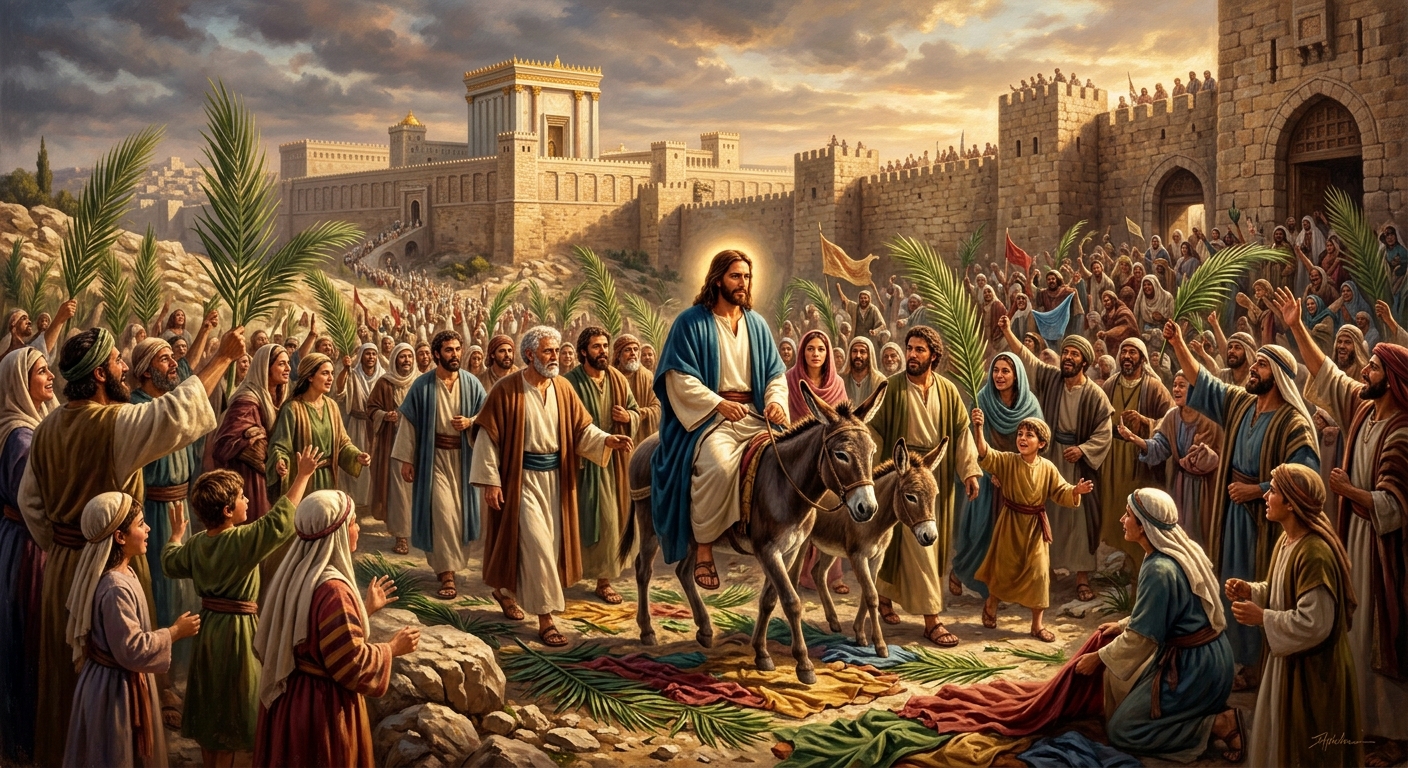
Illustration: Dramatic cinematic biblical illustration for Mark Chapter 11 showing Christ's Messianic Kingship, photorealistic oil painting style.
Author
John Mark
Written
~65-70 AD
Key Theme
Christ's Messianic Kingship
Setting
Jerusalem - Mount of Olives
Key Verse
Mark 11:10
Total Verses
33
Chapter Introduction
*As we walk the dusty road to Bethphage, remember that Jesus invites us into a humble journey of obedience. He sends His disciples to find the colt, showing that true royalty is marked by service and peace. When the crowds shout “Hosanna,” they recognize a King who comes in meekness, not war. Let this triumphal entry remind us that the Lord's need is for our willing hearts, not just grand gestures.*
Mark — Chapter 11 — KJV
1
And when they came nigh to Jerusalem, unto Bethphage and Bethany, at the mount of Olives, he sendeth forth two of his disciples,
Simply PutWhen they drew near to Jerusalem, Jesus sent two of his disciples on a mission. The Greek word here, "sent forth" (G1699), carries the idea of purposefully sending out a messenger. He was setting the stage for a public declaration that would speak directly to those who were hurting, longing, or doubting.
2
And saith unto them, Go your way into the village over against you: and as soon as ye be entered into it, ye shall find a colt tied, whereon never man sat; loose him, and bring him.
Simply PutHe told them to go into the village and find a colt tied up, one on which no man had ever sat. The Greek term for "colt" (G1083) is a young, gentle animal that signifies humility and innocence. This humble entry was meant to show that true power can come in the most unassuming forms, bringing hope to those who feel powerless.
3
And if any man say unto you, Why do ye this? say ye that the Lord hath need of him; and straightway he will send him hither.
Simply PutIf anyone asks why they're doing this, they should say the Lord needs it. The Greek word for "Lord" (G2962) indicates ownership and authority, not just a title. It reminds us that even in moments of confusion and doubt, God’s purpose can be behind the scenes, guiding our steps.
4
And they went their way, and found the colt tied by the door without in a place where two ways met; and they loose him.
Simply PutThey went and found the colt tied by the door where two ways met, and they loosened it. The act of "loosening" (G3326) is a deliberate choice to release what was restrained. For anyone feeling stuck or trapped, this shows that obedience can lead to unexpected freedom.
5
And certain of them that stood there said unto them, What do ye, loosing the colt?
Simply PutSome of the people standing there asked, "What are you doing, loosing the colt?" The question reflects skepticism about a seemingly trivial act. Yet sometimes the simplest gestures—like loosening a tethered animal—can become symbols of breaking chains.
6
And they said unto them even as Jesus had commanded: and they let them go.
Simply PutThey answered as Jesus had instructed, and the people let them go. The obedience to a command (G3326) demonstrates trust in Jesus’ direction despite uncertainty. Even when we’re unsure, following His lead can open paths toward healing.
7
And they brought the colt to Jesus, and cast their garments on him; and he sat upon him.
Simply PutThey brought the colt to Jesus and laid their garments on him, and he sat upon it. To "cast" (G558) one's garment onto the colt is a sign of respect and honor, similar to spreading a cloak over someone. This act shows that through humble service, we can make space for divine presence.
8
And many spread their garments in the way: and others cut down branches off the trees, and strawed them in the way.
Simply PutMany spread their garments in the road, and others cut down branches from trees and laid them on the way. Laying down garments (G558) is a heartfelt gesture of sacrifice and welcome, turning ordinary items into symbols of reverence. In times of need, people often give what they have to honor a promised hope.
9
And they that went before, and they that followed, cried, saying, Hosanna; Blessed is he that cometh in the name of the Lord:
Simply PutThose who went ahead and those who followed shouted, "Hosanna! Blessed is he who comes in the name of the Lord!" The shout of "Hosanna" (G2221) means "save now," a cry for immediate deliverance. For anyone in distress, this collective voice is an affirmation that God’s salvation has arrived.
10
Blessed be the kingdom of our father David, that cometh in the name of the Lord: Hosanna in the highest.
Simply Put"Blessed be the kingdom of our father David that comes in the name of the Lord! Hosanna in the highest!" The phrase "kingdom of David" (G932) points to the promised rule of a righteous King. It speaks directly to those yearning for justice and restoration, reminding them that God’s kingdom is near.
11
And Jesus entered into Jerusalem, and into the temple: and when he had looked round about upon all things, and now the eventide was come, he went out unto Bethany with the twelve.
Simply PutJesus entered Jerusalem and went into the temple, walking around to see everything. The word "temple" (G2691) refers to the sacred place where God’s presence dwells. Even after a triumphant entry, He took time to observe, showing that vigilance and care are essential for those seeking truth.
12
And on the morrow, when they were come from Bethany, he was hungry:
Simply PutOn the next day, after they had come from Bethany, Jesus felt hungry. The Greek word for "hungered" (G560) underscores a deep physical need, reflecting His humanity. It reminds us that even the Son of God experiences basic needs, showing solidarity with our own struggles.
13
And seeing a fig tree afar off having leaves, he came, if haply he might find any thing thereon: and when he came to it, he found nothing but leaves; for the time of figs was not yet.
Simply PutSeeing a fig tree from afar that had leaves, He approached it hoping to find fruit. The "fig tree" (G1073) often represents outward appearance; its leaves suggested it was fruitful. For those feeling empty inside, this moment warns that looks alone don’t guarantee fulfillment.
14
And Jesus answered and said unto it, No man eat fruit of thee hereafter for ever. And his disciples heard it.
Simply PutWhen He reached it, He found only leaves because the season of figs was not yet. He said to the tree, "No one will ever eat fruit from you again." The word "fruit" (G1073) symbolizes life and productivity. This serves as a stark reminder that empty promises will be judged, encouraging us to bear genuine fruit.
15
And they come to Jerusalem: and Jesus went into the temple, and began to cast out them that sold and bought in the temple, and overthrew the tables of the moneychangers, and the seats of them that sold doves;
Simply PutThey came to Jerusalem, and Jesus entered the temple and began driving out those buying and selling there. He overturned the tables of the moneychangers and the seats of those selling doves. This act of cleansing shows that true worship must be free from corruption, urging us to remove the clutter and greed that hinder our devotion.
16
And would not suffer that any man should carry any vessel through the temple.
Simply PutJesus had no patience for merchants carrying pots (Strong’s G1410) through the temple—He wanted that holy space to be for worship, not a marketplace.
17
And he taught, saying unto them, Is it not written, My house shall be called of all nations the house of prayer? but ye have made it a den of thieves.
Simply PutHe reminded them of the prophecy that God's house (the Greek word for prayer, G1086) should be a place where all nations pray. Yet they had turned it into a den of thieves (Greek G2500), a place of robbery and corruption.
18
And the scribes and chief priests heard it, and sought how they might destroy him: for they feared him, because all the people was astonished at his doctrine.
Simply PutThe scribes and chief priests, hearing His powerful teaching (dogma, G1404), plotted to destroy Him because they feared the people's astonishment at His truth.
19
And when even was come, he went out of the city.
Simply PutWhen evening (Greek G1243) fell, He withdrew from the city, perhaps to reflect and rest after confronting the religious leaders.
20
And in the morning, as they passed by, they saw the fig tree dried up from the roots.
Simply PutThe following morning, they saw the fig tree (Greek G1080) withered from its roots (G1153), a stark sign that outward appearances without fruit are useless.
21
And Peter calling to remembrance saith unto him, Master, behold, the fig tree which thou cursedst is withered away.
Simply PutPeter reminded Jesus of the tree He cursed, pointing out that it had withered away—showing even a simple observation can reveal deep spiritual truths.
22
And Jesus answering saith unto them, Have faith in God.
Simply PutJesus urged them to have faith (Greek G4102) in God, a trust that goes beyond feeling and rests on His unchanging character.
23
For verily I say unto you, That whosoever shall say unto this mountain, Be thou removed, and be thou cast into the sea; and shall not doubt in his heart, but shall believe that those things which he saith shall come to pass; he shall have whatsoever he saith.
Simply PutHe taught that anyone who declares a mountain (Greek G1009) should be removed and truly believes it will happen, without doubting in the heart, can see that promise fulfilled.
24
Therefore I say unto you, What things soever ye desire, when ye pray, believe that ye receive them, and ye shall have them.
Simply PutWhen you pray for your desires (Greek G2251), truly believe you have received them, your faith makes those wishes a reality.
25
And when ye stand praying, forgive, if ye have ought against any: that your Father also which is in heaven may forgive you your trespasses.
Simply PutWhile praying, remember to forgive any offense (Greek G938), for this opens the way for your heavenly Father to forgive your trespasses (G3369).
26
But if ye do not forgive, neither will your Father which is in heaven forgive your trespasses.
Simply PutIf you hold onto unforgiveness, your Father will withhold His forgiveness from you—it's a two-way street.
27
And they come again to Jerusalem: and as he was walking in the temple, there come to him the chief priests, and the scribes, and the elders,
Simply PutAs He walked in the temple (Greek G3055), the chief priests, scribes, and elders came to confront Him, testing His authority.
28
And say unto him, By what authority doest thou these things? and who gave thee this authority to do these things?
Simply PutThey demanded to know by what authority He performed these acts, challenging the source of His power.
29
And Jesus answered and said unto them, I will also ask of you one question, and answer me, and I will tell you by what authority I do these things.
Simply PutJesus responded with a question (Greek G2585), turning their own curiosity back upon them to reveal the truth of His authority.
30
The baptism of John, was it from heaven, or of men? answer me.
Simply PutHe asked whether John’s baptism (Greek G908) was from heaven or of men, exposing the need for divine approval over human tradition.
31
And they reasoned with themselves, saying, If we shall say, From heaven; he will say, Why then did ye not believe him?
Simply PutPeople were wrestling with a dilemma—if they claimed the authority came "from heaven," Jesus would ask why they didn't trust Him. The Greek phrase here, ἐξ οὐρανοῦ (G1624), means something that originates in the heavens, a divine source. It shows how fear can make us demand proof instead of simply believing.
32
But if we shall say, Of men; they feared the people: for all men counted John, that he was a prophet indeed.
Simply PutBut if they said the authority was "of men," the crowd got nervous because everyone believed John had truly been a prophet. The Greek word for "people" (G383) captures the whole community's reputation, and their fear shows how much they value what others think over what God says.
33
And they answered and said unto Jesus, We cannot tell. And Jesus answering saith unto them, Neither do I tell you by what authority I do these things.
Simply PutWhen the religious leaders confessed they couldn't answer, Jesus replied that He wouldn't give them a reason either. The Greek word authority (G837) refers to the power and right to act, and Jesus points out that He won't explain His authority just because they fail to trust in it.
Zechariah 9:9This prophetic verse foretells the Messiah's humble entry on a colt, directly fulfilled in Mark 11:1‑4.
Psalm 118:25-26The crowd's shout of "Hosanna" in Mark 11:9‑10 echoes this Psalm, expressing a plea for salvation and recognition of Jesus as the Lord.
John 12:13-15John's parallel account of the triumphal entry mirrors Mark's description, reinforcing the significance of the crowd spreading garments and palm branches.
Matthew 21:12-13This passage parallels Mark 11:15‑19, highlighting Jesus' authority over the temple and his condemnation of its commercial misuse.
Reflect
When you step into your daily spaces—home, work, or even online—do you notice moments where they feel more like personal profit zones than shared places of quiet prayer?