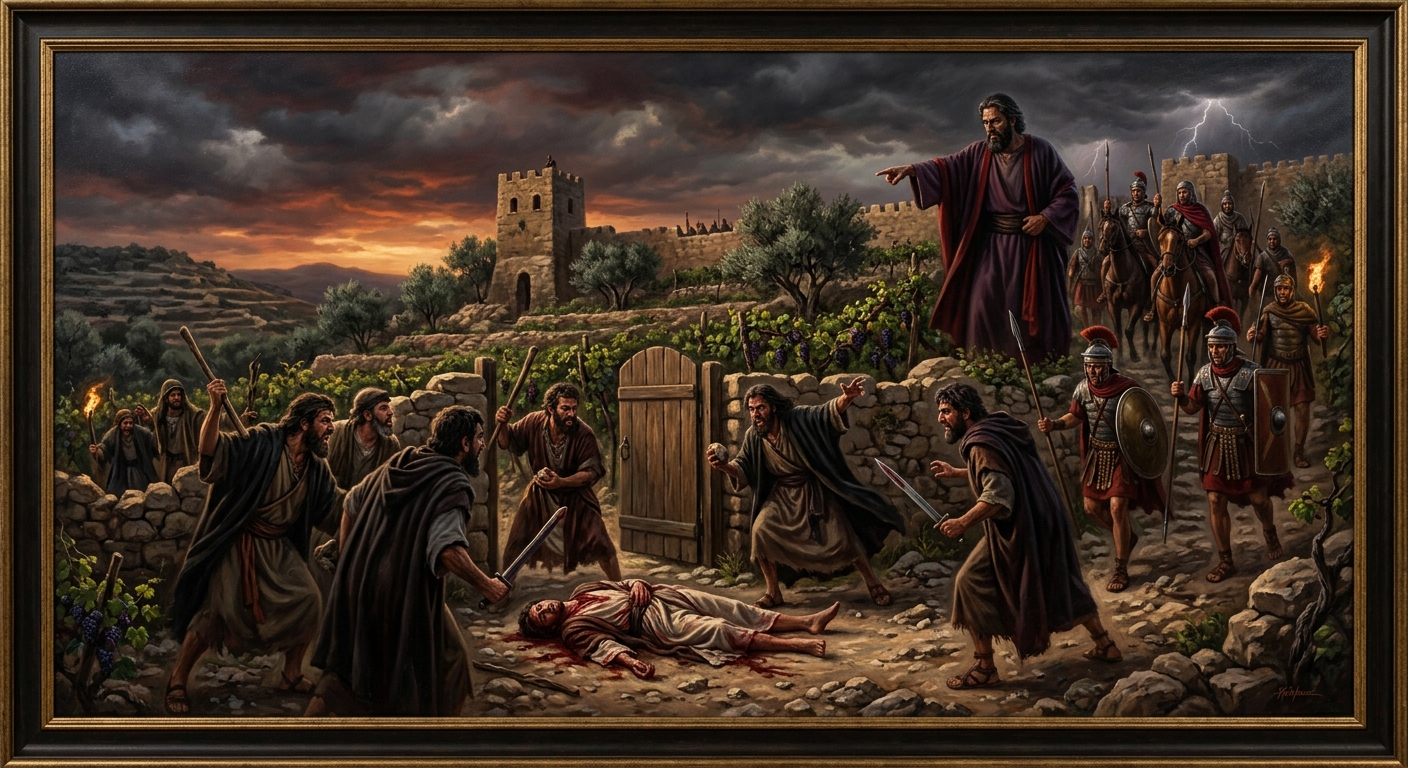
Illustration: Dramatic cinematic biblical illustration for Mark Chapter 12 showing Covenant Responsibility and Divine Judgment, photorealistic oil painting style.
🔊
Listen to Chapter
Grace Notes Journey Audio Narration
Author
John Mark
Written
~68 AD
Key Theme
Covenant Responsibility and Divine Judgment
Setting
Jerusalem - Temple Courtyard
Key Verse
Mark 12:10
Total Verses
44
Chapter Introduction
*In the heart of Jerusalem, Jesus shares a story that echoes through ages. He paints a picture of a vineyard owner who entrusts his laborers, only to be met with betrayal and violence. This parable reminds us that God's grace is patient, yet it calls for a response of faithfulness. As we hear this tale, may our hearts be stirred to receive the blessings He offers and to honor Him with gratitude.*
Mark — Chapter 12 — KJV
1
And he began to speak unto them by parables. A certain man planted a vineyard, and set an hedge about it, and digged a place for the winefat, and built a tower, and let it out to husbandmen, and went into a far country.
Simply PutJesus began teaching in the form of parables—Greek word "parabolē" (G3980) meaning a comparison that reveals a truth. He tells of a man who carefully plants a vineyard, setting boundaries and trusting others to tend it—just as God entrusts us with His kingdom.
2
And at the season he sent to the husbandmen a servant, that he might receive from the husbandmen of the fruit of the vineyard.
Simply PutAt the appointed "season" (Greek, "kairos," G2580), he sends a servant to collect his share. This shows that God expects fruit from those He gives responsibilities, and that timing is part of His perfect plan.
3
And they caught him, and beat him, and sent him away empty.
Simply PutThe workers seize the servant, beat him badly, and send him away "empty" (Greek, "kenos," G2747). It reminds us that when we reject God's messengers, we are left with an emptiness that only He can fill.
4
And again he sent unto them another servant; and at him they cast stones, and wounded him in the head, and sent him away shamefully handled.
Simply PutThe next servant is thrown stones and wounded in the head, then sent away "shamefully handled." The physical beating reflects how God's truth can be bruised, yet He remains steadfast despite humiliation.
5
And again he sent another; and him they killed, and many others; beating some, and killing some.
Simply PutThe third servant is killed, and many others are beaten or slain. This escalation warns that persistent rejection of God's voice leads to severe consequences—yet God never stops reaching out.
6
Having yet therefore one son, his wellbeloved, he sent him also last unto them, saying, They will reverence my son.
Simply Put"Having yet therefore one son, his wellbeloved," the owner sends his cherished heir, confident they will respect him. This is a foreshadowing of Jesus—God's beloved Son sent to humanity.
7
But those husbandmen said among themselves, This is the heir; come, let us kill him, and the inheritance shall be our’s.
Simply PutThe tenants whisper, "This is the heir; let us kill him so the inheritance will be ours." Their greed and desire to possess what belongs to God reveal a heart that seeks power over true stewardship.
8
And they took him, and killed him, and cast him out of the vineyard.
Simply PutThey seize the son, kill him, and cast him out of the vineyard. This dramatizes how Israel rejected Jesus, discarding Him from its promised land.
9
What shall therefore the lord of the vineyard do? he will come and destroy the husbandmen, and will give the vineyard unto others.
Simply PutWhat will the owner do? He will come and destroy the tenants, giving the vineyard to others. God promises judgment on those who reject Him and will entrust His kingdom to those who are faithful.
10
And have ye not read this scripture; The stone which the builders rejected is become the head of the corner:
Simply PutHave you not read this? "The stone which the builders rejected is become the head of the corner." The Greek word for stone, "lithos" (G2980), signifies that what was dismissed becomes the essential cornerstone of the church.
11
This was the Lord’s doing, and it is marvellous in our eyes?
Simply PutThis was the Lord's doing, and it is marvelous in our eyes. God’s work often appears simple but holds profound truth that amazes the faithful.
12
And they sought to lay hold on him, but feared the people: for they knew that he had spoken the parable against them: and they left him, and went their way.
Simply PutThey tried to seize Him, yet they feared the people because He had spoken this parable against them. The truth of God's message often threatens those in power, prompting them to retreat.
13
And they send unto him certain of the Pharisees and of the Herodians, to catch him in his words.
Simply PutThey sent certain Pharisees and Herodians to trap Him in His words. When enemies combine forces, they aim to expose weaknesses, but God’s wisdom remains unshaken.
14
And when they were come, they say unto him, Master, we know that thou art true, and carest for no man: for thou regardest not the person of men, but teachest the way of God in truth: Is it lawful to give tribute to Caesar, or not?
Simply PutThey ask, “Master, we know you are true and care for no man—do we pay tribute to Caesar?” Their question seeks to trap Him between earthly and divine authority.
15
Shall we give, or shall we not give? But he, knowing their hypocrisy, said unto them, Why tempt ye me? bring me a penny, that I may see it.
Simply PutKnowing their hypocrisy, He says, “Why tempt me? Bring a penny.” By asking to see the coin (Greek, "dēnarion," G1170), He reveals that one can honor both earthly and heavenly obligations, seeing beyond the trap.
16
And they brought it. And he saith unto them, Whose is this image and superscription? And they said unto him, Caesar’s.
Simply PutThe Greek words "eikon" (G746) for image and "epigraphe" (G3660) for inscription refer to the portrait and caption on a Roman coin. Even something cheap as a copper piece claims ownership of people, and Jesus asks who it truly belongs to.
17
And Jesus answering said unto them, Render to Caesar the things that are Caesar’s, and to God the things that are God’s. And they marvelled at him.
Simply PutThe Greek word "apodidomi" (G1514) means to give back what is rightfully yours. Jesus says we owe Caesar for his realm, and God for everything beyond that – the infinite, the heart's deep need. The crowd is amazed because He speaks truth without taking sides.
18
Then come unto him the Sadducees, which say there is no resurrection; and they asked him, saying,
Simply PutThe Sadducees claim there is no resurrection, reflecting a common doubt about life after death. They bring a tricky scenario to force Jesus into a corner, hoping to trap Him.
19
Master, Moses wrote unto us, If a man’s brother die, and leave his wife behind him, and leave no children, that his brother should take his wife, and raise up seed unto his brother.
Simply PutThe Greek word "psuchē" (seed) is used metaphorically for offspring. They cite Deuteronomy 25:5, a law that ensures a brother's widow is cared for and his name continues. Their question boils down to: Who does she belong to when all seven brothers die?
20
Now there were seven brethren: and the first took a wife, and dying left no seed.
Simply PutSeven brothers, each takes a wife but leaves no offspring. It's a picture of emptiness and unfulfilled purpose that can echo in our own lives when we feel like we're not bearing fruit.
21
And the second took her, and died, neither left he any seed: and the third likewise.
Simply PutThe second and third brothers die childless as well. It underscores a pattern of loss that drives their question: In resurrection, who is the wife?
22
And the seven had her, and left no seed: last of all the woman died also.
Simply PutAll seven brothers had the same woman and left no seed; finally, she dies too. The puzzle is about identity and belonging in a resurrected state.
23
In the resurrection therefore, when they shall rise, whose wife shall she be of them? for the seven had her to wife.
Simply PutIn the resurrection, whose wife will she be? The question reveals a misunderstanding of God's power and narrative. Jesus points out that the resurrection is not about earthly relationships but something higher.
24
And Jesus answering said unto them, Do ye not therefore err, because ye know not the scriptures, neither the power of God?
Simply Put"Err" (G258) means to miss the mark. Jesus says they err because they don't know "the Scriptures" (G2610) and the power of God. To those wrestling with doubts, He invites them to see beyond surface knowledge.
25
For when they shall rise from the dead, they neither marry, nor are given in marriage; but are as the angels which are in heaven.
Simply PutThe Greek word "gamos" for marriage is used. Jesus teaches that in resurrection, people will neither marry nor be given in marriage; they will be like the angels (G3588) who exist eternally without earthly ties.
26
And as touching the dead, that they rise: have ye not read in the book of Moses, how in the bush God spake unto him, saying, I am the God of Abraham, and the God of Isaac, and the God of Jacob?
Simply PutThe verb "am" (G1519) means to be. God declares Himself as the living God of Abraham, Isaac, Jacob (the patriarchs). The Sadducees' denial of resurrection is challenged by Moses' own testimony.
27
He is not the God of the dead, but the God of the living: ye therefore do greatly err.
Simply PutGod says He is not the God of dead but of living. This reveals that those who have died are still alive in God's eyes; He calls them "living," which gives hope to those mourning.
28
And one of the scribes came, and having heard them reasoning together, and perceiving that he had answered them well, asked him, Which is the first commandment of all?
Simply PutA scribe (G4672) sees that Jesus has answered well in reasoning and asks which command is the greatest.
29
And Jesus answered him, The first of all the commandments is, Hear, O Israel; The Lord our God is one Lord:
Simply PutThe first command is to love (agape, G26) the Lord with all heart, soul, mind, and strength. He declares that the Lord is one God, and loving Him fully is the greatest command.
30
And thou shalt love the Lord thy God with all thy heart, and with all thy soul, and with all thy mind, and with all thy strength: this is the first commandment.
Simply PutThe call to love the Lord with every part of our being—heart, soul, mind, strength—is the most fundamental command for anyone seeking purpose and hope.
31
And the second is like, namely this, Thou shalt love thy neighbour as thyself. There is none other commandment greater than these.
Simply PutThe key word here is love (Greek agape, G26), which the original audience understood as deep, self‑sacrificial love. Jesus says that loving your neighbor just as you love yourself is the most important commandment; it’s not a warm feeling, but an active commitment to others' well‑being that reflects God’s own love.
32
And the scribe said unto him, Well, Master, thou hast said the truth: for there is one God; and there is none other but he:
Simply PutThe scribe uses the Greek word for God (theos, G2316) and declares that there is no other deity besides Him. He’s acknowledging the truth of monotheism—a profound statement for those wrestling with doubts about which God to trust.
33
And to love him with all the heart, and with all the understanding, and with all the soul, and with all the strength, and to love his neighbour as himself, is more than all whole burnt offerings and sacrifices.
Simply PutThe Greek terms heart (kardia, G2588), understanding (nous, G3687), soul (psyche, G5599), and strength (dunamis, G1411) all point to the whole person. Jesus declares that loving God and neighbor with every part of our being outweighs even the grandest sacrifices, showing that genuine devotion is more valuable than ritual.
34
And when Jesus saw that he answered discreetly, he said unto him, Thou art not far from the kingdom of God. And no man after that durst ask him any question.
Simply PutJesus sees the scribe’s humble answer and says, “Thou art not far from the kingdom of God.” The phrase “kingdom of God” (basileia tou theou, G932) represents a realm where God's love reigns. The scribe’s honest humility brings him close to that reality.
35
And Jesus answered and said, while he taught in the temple, How say the scribes that Christ is the son of David?
Simply PutJesus challenges the scribes by asking how they define “Christ is the Son of David.” The Greek term Christ (christos, G5547) means “Anointed One” and “Son of David” is a messianic title. He’s prompting them to examine the true identity of the promised Messiah.
36
For David himself said by the Holy Ghost, The LORD said to my Lord, Sit thou on my right hand, till I make thine enemies thy footstool.
Simply PutJesus quotes a Psalm where “the Lord” (kyrios, G2962) speaks through the Holy Ghost (pneuma hagion, G4154). The reference to “sit on my right hand” (dexios) and “enemies as footstool” highlights the divine authority that the Messiah would possess.
37
David therefore himself calleth him Lord; and whence is he then his son? And the common people heard him gladly.
Simply PutDavid calls the Messiah “Lord,” not merely his “son.” This poses a logical challenge about the nature of Christ’s identity. The crowd, hearing this profound truth, receives it with gladness and hope.
38
And he said unto them in his doctrine, Beware of the scribes, which love to go in long clothing, and love salutations in the marketplaces,
Simply PutJesus warns about scribes who love to wear long clothing (chiton, G5609) and seek greetings in the marketplaces. Their love for outward appearances shows a heart focused on status rather than true service.
39
And the chief seats in the synagogues, and the uppermost rooms at feasts:
Simply PutHe points out that these scribes take the chief seats in synagogues and the best rooms at feasts, seeking honor and visibility. Their desire for prestige outweighs humility.
40
Which devour widows’ houses, and for a pretence make long prayers: these shall receive greater damnation.
Simply PutThe scribes “devour widows' houses” and make long prayers as a pretence. Their greed for others’ property and false piety will bring them greater damnation—i.e., a harsher divine judgment.
41
And Jesus sat over against the treasury, and beheld how the people cast money into the treasury: and many that were rich cast in much.
Simply PutJesus watches the treasury (korēthōria, G2772) as people give money. The rich cast in large sums of copper coins (nomisma, G3461), showing off their generosity.
42
And there came a certain poor widow, and she threw in two mites, which make a farthing.
Simply PutA poor widow steps forward and drops in two tiny copper coins (mites, G3105), which together are only a farthing. Though her contribution is small in value, it’s massive in sacrifice.
43
And he called unto him his disciples, and saith unto them, Verily I say unto you, That this poor widow hath cast more in, than all they which have cast into the treasury:
Simply PutJesus tells his disciples that this poor widow has contributed more than all those who gave from their surplus. Her giving comes from a place of genuine need, not abundance.
44
For all they did cast in of their abundance; but she of her want did cast in all that she had, even all her living.
Simply PutThe rich gave out of their excess, while the widow gave all she had to live on—her entire livelihood. Her heart’s devotion is what truly counts before God.
Isaiah 5:1-7This passage presents the prophetic "Song of the Vineyard," using identical vineyard imagery to illustrate Israel's failure to produce fruit, prefiguring the parable in Mark 12.
Psalm 118:22-23The verses about the rejected stone becoming the chief cornerstone are quoted in Mark 12:10-11, linking the son’s death to Christ as the cornerstone of faith.
Matthew 21:33-46This Gospel recounts the same Parable of the Tenants, providing a parallel narrative that reinforces the theme of judgment upon unfaithful leaders.
Luke 20:9-19Luke’s version of the vineyard parable mirrors Mark’s account, offering a synoptic perspective that highlights the consistent message across the Gospels.
Reflect
When you think about the promise that those who are resurrected will have a new, heavenly marriage, how does this shape your hopes and priorities for the relationships you are building today?