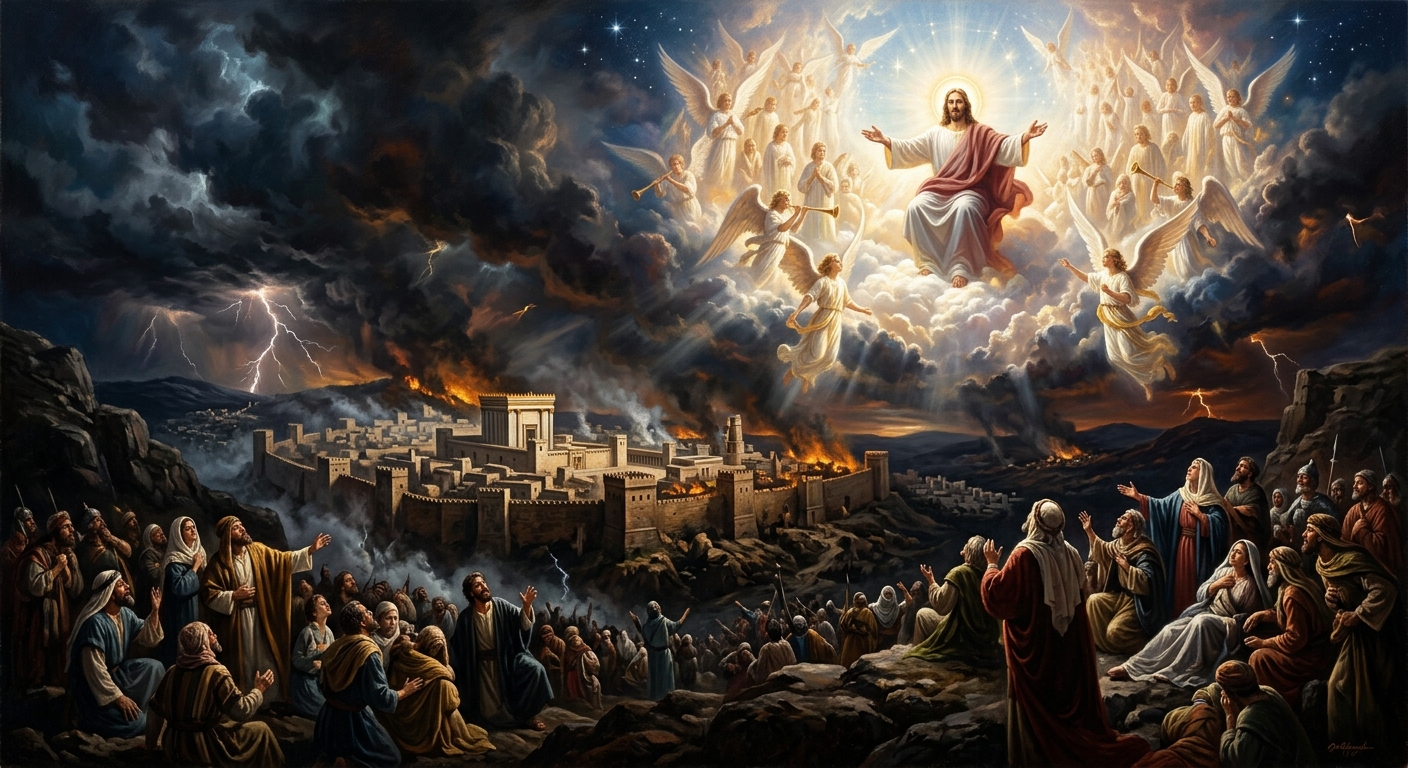
Illustration: Dramatic cinematic biblical illustration for Mark Chapter 13 showing The Coming of the Kingdom, photorealistic oil painting style.
🔊
Listen to Chapter
Grace Notes Journey Audio Narration
Author
John Mark (traditionally linked to Peter)
Written
~65-70 AD
Key Theme
The Coming of the Kingdom
Setting
Olivet Hill, Jerusalem
Key Verse
Mark 13:33
Total Verses
37
Chapter Introduction
*When Jesus stepped out of the temple and looked up at its towering stone walls, He reminded His disciples that these earthly edifices would not stand forever. As they gathered on the Mount of Olives, He shared a vision of hope—a future where God's Kingdom would be fully realized. This chapter invites us to keep watch, not with fear but with trusting hearts, knowing that God's promises endure beyond the fleeting world. Let us hold fast to this blessed assurance as we await the glorious return of our Savior.*
Mark — Chapter 13 — KJV
1
And as he went out of the temple, one of his disciples saith unto him, Master, see what manner of stones and what buildings are here!
Simply PutThe disciple marvels at the temple’s grandeur, seeing its "temple" (Greek: ναός, Strong's G3493) as a testament to God’s splendor. Amid life's turmoil, this reminds us that God's glory is not hidden—it stands before us in the very architecture of His worship.
2
And Jesus answering said unto him, Seest thou these great buildings? there shall not be left one stone upon another, that shall not be thrown down.
Simply PutJesus warns that not one "stone" (Greek: λίθος, Strong's G3023) will be left upon another; the temple will be completely demolished. For those in doubt, He tells us that even the most solid foundations can fall, urging us to place our trust in the eternal rather than earthly structures.
3
And as he sat upon the mount of Olives over against the temple, Peter and James and John and Andrew asked him privately,
Simply PutWhile Jesus rests on the "Mount of Olives" (Greek: Ὀλιβὰ, Strong's G3989), He meets privately (Greek: μυστικῶς, Strong's G3471) with Peter, James, John, and Andrew. In our quiet moments, He invites us into intimate conversation—away from crowds, into the hush where true understanding is whispered.
4
Tell us, when shall these things be? and what shall be the sign when all these things shall be fulfilled?
Simply PutThe disciples ask about the "sign" (Greek: σῆμα, Strong's G4596) that will signal the fulfillment of all these events. For those hungry for certainty, Jesus acknowledges their yearning and promises to reveal the milestones that accompany His divine plan.
5
And Jesus answering them began to say, Take heed lest any man deceive you:
Simply Put"Take heed," Jesus warns, lest any "man" (Greek: πλάνης, Strong's G4170) deceive you. In the midst of personal pain, this is a gentle reminder to guard our hearts against false comfort and to stay anchored in the truth that only Christ can give.
6
For many shall come in my name, saying, I am Christ; and shall deceive many.
Simply PutHe predicts many will claim to be "Christ" (Greek: Χριστός, Strong's G5547), deceiving many believers. When doubts arise, remember that true identity is found not in titles or appearances but in the living presence of Jesus Himself.
7
And when ye shall hear of wars and rumours of wars, be ye not troubled: for such things must needs be; but the end shall not be yet.
Simply PutJesus urges us not to be troubled by "wars and rumours," for such things "must needs be" (Greek: δεῖ, Strong's G1220). Even when the world seems chaotic, He reminds us that these events are part of His predetermined timeline, and the ultimate "end" is still to come.
8
For nation shall rise against nation, and kingdom against kingdom: and there shall be earthquakes in divers places, and there shall be famines and troubles: these are the beginnings of sorrows.
Simply PutNations will rise against nations, and there will be earthquakes—a beginning of "sorrows" (Greek: πενιγχεῖα, Strong's G4079), like a woman in labor. For those weary of sorrow, this painful image points to the anticipation that precedes the birth of a new divine reality.
9
But take heed to yourselves: for they shall deliver you up to councils; and in the synagogues ye shall be beaten: and ye shall be brought before rulers and kings for my sake, for a testimony against them.
Simply PutBelievers will be handed over to councils, beaten in synagogues, and brought before rulers for a testimony against them. In moments of persecution, this verse assures us that the witness we give is powerful enough to confront even those in authority.
10
And the gospel must first be published among all nations.
Simply PutThe "gospel" (Greek: εὐαγγέλιον, Strong's G2090) must first be declared to all nations before the end comes. For those yearning for outreach, this is a call to spread God's good news far and wide—making every heart hear the message of salvation.
11
But when they shall lead you, and deliver you up, take no thought beforehand what ye shall speak, neither do ye premeditate: but whatsoever shall be given you in that hour, that speak ye: for it is not ye that speak, but the Holy Ghost.
Simply PutWhen you are led to speak, do not premeditate (Greek: προμελετῶ, Strong's G4281); the Holy Spirit (Greek: πνεῦμα, Strong's G4155) will give you words. In times of uncertainty, trust that the Spirit will speak through you, not your own rehearsed thoughts.
12
Now the brother shall betray the brother to death, and the father the son; and children shall rise up against their parents, and shall cause them to be put to death.
Simply PutThe brother will betray his sibling to death, and children will rise up against parents. This harsh reality reminds us that the coming age will bring intense trials, yet it also underscores the depth of love required to endure such division.
13
And ye shall be hated of all men for my name’s sake: but he that shall endure unto the end, the same shall be saved.
Simply PutYou will be hated by all "men" for Christ’s sake, but He who endures unto the end (Greek: ὑπομένω, Strong's G5273) will be saved. In the midst of hostility, perseverance becomes our salvation—holding fast to Jesus even when everyone else turns away.
14
But when ye shall see the abomination of desolation, spoken of by Daniel the prophet, standing where it ought not, (let him that readeth understand,) then let them that be in Judaea flee to the mountains:
Simply PutWhen you see the "abomination of desolation" (Greek: βδέλυγμα, Strong's G932) spoken of by Daniel standing where it shouldn't, those in Judea should flee to the mountains. This prophetic warning urges believers to recognize and escape from profound spiritual desecration.
15
And let him that is on the housetop not go down into the house, neither enter therein, to take any thing out of his house:
Simply PutThose on the housetop should not go down or enter the house to retrieve anything; they must flee. When danger looms, this command teaches us that urgency and obedience outweigh the desire to protect material possessions.
16
And let him that is in the field not turn back again for to take up his garment.
Simply PutWhen you’re in the thick of life’s work, don’t panic and rush back home for your clothes. The Greek word “peristrepsē” (G4030) means to turn around or double back—Jesus is urging you to stay where you are and keep doing what He’s already set you on.
17
But woe to them that are with child, and to them that give suck in those days!
Simply PutWoe (Greek “ouai,” G5608) to the pregnant and nursing mothers during those hard days. Their bodies are already taxed, so a sudden trial would stretch them beyond what they can bear.
18
And pray ye that your flight be not in the winter.
Simply PutPray that your escape isn’t forced in winter (Greek “cheimon,” G5541). Imagine fleeing when cold bites your bones and food is scarce—prayer keeps you from being caught unprepared.
19
For in those days shall be affliction, such as was not from the beginning of the creation which God created unto this time, neither shall be.
Simply PutIn those days there will be affliction (Greek “ponos,” G5536) unlike anything since the beginning of creation (G2718). It’s a deep, soul‑shaking distress that will feel like the universe itself is breaking apart.
20
And except that the Lord had shortened those days, no flesh should be saved: but for the elect’s sake, whom he hath chosen, he hath shortened the days.
Simply PutIf God hadn’t shortened those days, no one could be saved. He made them brief for the elect (Greek “eklektos,” G2128)—the people He chose—so they could survive the onslaught.
21
And then if any man shall say to you, Lo, here is Christ; or, lo, he is there; believe him not:
Simply PutIf someone says, “Look, Christ is here!” or “There!”, do not trust (Greek “pisteusēte,” G3615) them. The word “behold” (Greek “idou,” G2399) is a warning that appearances can be deceiving.
22
For false Christs and false prophets shall rise, and shall shew signs and wonders, to seduce, if it were possible, even the elect.
Simply PutFalse Christs and false prophets (Greek “pseudapostoloi,” G5595) will arise, showing signs and wonders to tempt (Greek “planēsontai,” G3999) even the elect if they could. Their miracles will be a snare, not a sign.
23
But take ye heed: behold, I have foretold you all things.
Simply PutBe alert—Jesus has already foretold (Greek “propheteian,” G4025) everything you’ll see. Trust that He’s already spoken the truth of these events.
24
But in those days, after that tribulation, the sun shall be darkened, and the moon shall not give her light,
Simply PutIn those days, after tribulation, the sun will be darkened (Greek “skotistēsetai,” G4622) and the moon will not shine (Greek “phanēsētai,” G5352). Even the celestial lights you rely on will fail.
25
And the stars of heaven shall fall, and the powers that are in heaven shall be shaken.
Simply PutThe stars of heaven will fall (Greek “prosteleitai,” G4325), and the powers in heaven will be shaken (Greek “thambēsontai,” G5534). The whole heavenly order will tremble, like a building under an earthquake.
26
And then shall they see the Son of man coming in the clouds with great power and glory.
Simply PutThen you’ll see the Son of Man (Greek “huios tou anthrōpou,” G5205) coming in the clouds with great power and glory. It’s a dramatic, visible return—no mystery left of Him.
27
And then shall he send his angels, and shall gather together his elect from the four winds, from the uttermost part of the earth to the uttermost part of heaven.
Simply PutHe will send His angels and gather His elect from the four winds (Greek “tessara pneumata,” G4175), from the ends of earth to the heights of heaven. All who belong to Him will be united.
28
Now learn a parable of the fig tree; When her branch is yet tender, and putteth forth leaves, ye know that summer is near:
Simply PutLook at the fig tree (Greek “sykia,” G4534). When its branch is still tender and leaves appear, you know summer is near. Watch the signs that indicate God’s work is close.
29
So ye in like manner, when ye shall see these things come to pass, know that it is nigh, even at the doors.
Simply PutSo, when you see these events happening, recognize that the end (Greek “engys,” G1425) is near—right at your doorstep.
30
Verily I say unto you, that this generation shall not pass, till all these things be done.
Simply PutTruly, I say this generation will not pass away until all these things are fulfilled. Everything spoken about will come to pass in full time.
31
Heaven and earth shall pass away: but my words shall not pass away.
Simply PutEven as the heavens and earth crumble away, the Word of God endures forever—His promises are unshakable in our stormy lives.
32
But of that day and that hour knoweth no man, no, not the angels which are in heaven, neither the Son, but the Father.
Simply PutNo one, not even the angels or Jesus Himself, knows the exact day or hour of His return; only the Father holds that mystery.
33
Take ye heed, watch and pray: for ye know not when the time is.
Simply PutStay alert and pray, because we cannot guess when the moment will come; vigilance is our only safeguard.
34
For the Son of man is as a man taking a far journey, who left his house, and gave authority to his servants, and to every man his work, and commanded the porter to watch.
Simply PutJesus likens Himself to a man on a long journey who leaves his servants in charge and tells the porter to keep watch—it's a picture of constant readiness.
35
Watch ye therefore: for ye know not when the master of the house cometh, at even, or at midnight, or at the cockcrowing, or in the morning:
Simply PutWe must stay awake, for the master could return at any hour—whether evening, midnight, dawn, or even as a rooster crows.
36
Lest coming suddenly he find you sleeping.
Simply PutIf we are caught off guard, He will find us asleep and miss the blessings He brings.
37
And what I say unto you I say unto all, Watch.
Simply PutThis warning isn’t just for a few; it’s a call to everyone—watch, be ready, and live with expectation.
Matthew 24:3-8This passage records the identical Olivet discourse, confirming Jesus' warnings about wars, rumors of wars, and earthquakes as signs of the end times.
Luke 21:25-28This parallel account emphasizes the cosmic disturbances and the need for vigilance, mirroring Mark 13:24-27’s description of signs preceding Christ's return.
Daniel 7:13-14The prophetic vision of the Son of Man receiving an everlasting kingdom illuminates Mark 13:26-27’s promise that "the Son of Man shall come in the clouds."
Revelation 1:7John’s apocalyptic vision of Christ returning on the clouds, visible to every eye, directly echoes the eschatological expectation set forth in Mark 13:26-27.
Reflect
Reflecting on Jesus' words about unprecedented affliction in Mark 13, how has the unique pressure or uncertainty you face today affected your sense of hope and direction?