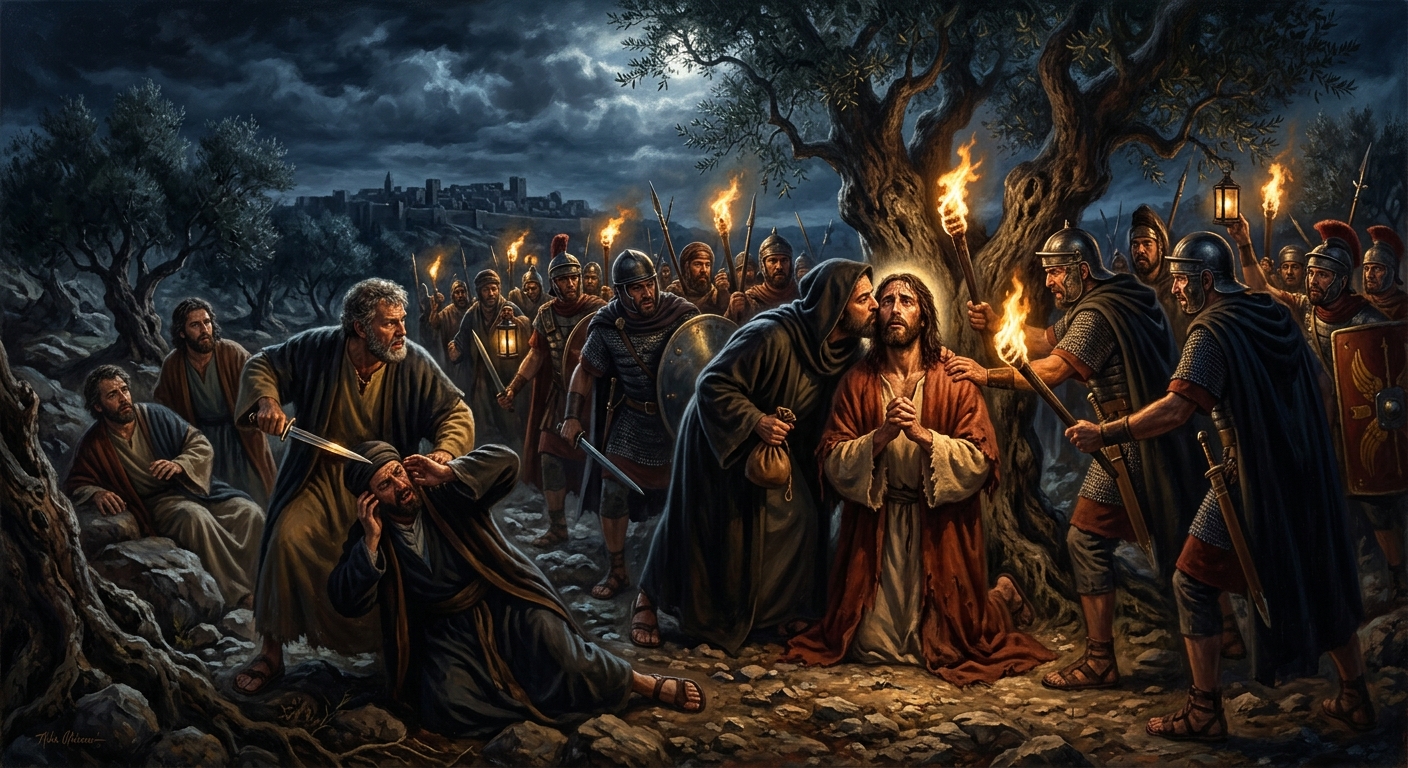
Illustration: Dramatic cinematic biblical illustration for Mark Chapter 14 showing The Passion and Betrayal of Christ, photorealistic oil painting style.
🔊
Listen to Chapter
Grace Notes Journey Audio Narration
Author
John Mark
Written
~65-70 AD
Key Theme
The Passion and Betrayal of Christ
Setting
Jerusalem - Passover week
Key Verse
Mark 14:36
Total Verses
72
Chapter Introduction
_Amid the bustling streets of Jerusalem during Passover, we find our Savior in a moment of deep prayer and surrender. He calls out to the Father with intimate reverence, yet wrestles with the weight of His impending sacrifice. This chapter invites us to sit at the table of grace, witnessing both human frailty and divine purpose. May we be reminded that even in our darkest trials, Christ's love remains steadfast._
Mark — Chapter 14 — KJV
1
After two days was the feast of the passover, and of unleavened bread: and the chief priests and the scribes sought how they might take him by craft, and put him to death.
Simply PutTwo days before Passover—a festival remembering God’s rescue of Israel—Jesus meets the schemers. The Greek word for Passover (G2748) points to a time of deliverance, yet here the chief priests plot his death. Even in holy moments, God’s story can unfold amid human betrayal.
2
But they said, Not on the feast day, lest there be an uproar of the people.
Simply PutThe priests whisper their plan to avoid an uproar on the feast day. Their fear of a public “uproar” (Greek: thēkō, G2365) shows how they cling to power and control, trying to keep the crowd calm while they plot behind the scenes.
3
And being in Bethany in the house of Simon the leper, as he sat at meat, there came a woman having an alabaster box of ointment of spikenard very precious; and she brake the box, and poured it on his head.
Simply PutIn Bethany, a woman breaks an alabaster jar (Greek: G84) of spikenard—a rare, fragrant oil—and pours it over Jesus’ head. The precious perfume (G3063) is a vivid act of worship, an offering that costs more than the price they could have sold it for.
4
And there were some that had indignation within themselves, and said, Why was this waste of the ointment made?
Simply PutSome disciples grumble, “Why waste the ointment?” Their frustration (the Greek word for indignation) reveals how human eyes sometimes miss the deeper value of a heartfelt sacrifice.
5
For it might have been sold for more than three hundred pence, and have been given to the poor. And they murmured against her.
Simply PutThey argue it could have been sold for three hundred silver coins to help the poor. The murmuring (Greek: gēmi, G1082) shows the tension between practical charity and deep devotion.
6
And Jesus said, Let her alone; why trouble ye her? she hath wrought a good work on me.
Simply PutJesus gently rebukes them, saying the woman has done a good work. The Greek word “wrought” (poieō, G4160) means to create or accomplish—her act of love is a true work for Him.
7
For ye have the poor with you always, and whensoever ye will ye may do them good: but me ye have not always.
Simply PutHe reminds them, “You have the poor always; you can help them anytime. But you do not always have me.” The word “always” (pantote, G3958) underscores that Jesus’ presence is a fleeting gift we must cherish.
8
She hath done what she could: she is come aforehand to anoint my body to the burying.
Simply PutHe explains she has prepared his body for burial. The Greek “anoint” (chōrazo, G5602) means to cover with oil—a symbolic preparation for the ultimate sacrifice.
9
Verily I say unto you, Wheresoever this gospel shall be preached throughout the whole world, this also that she hath done shall be spoken of for a memorial of her.
Simply PutHe promises that wherever this gospel spreads, her story will be a lasting remembrance. The Greek “memorial” (mnēmon, G3363) signifies an enduring honor—a testament that love remembered outlasts even death.
10
And Judas Iscariot, one of the twelve, went unto the chief priests, to betray him unto them.
Simply PutJudas, one of the twelve, quietly approaches the chief priests to betray Jesus. The Greek “betray” (paradidōmi, G3952) means to hand over or deliver—Judas is set on a secret transaction.
11
And when they heard it, they were glad, and promised to give him money. And he sought how he might conveniently betray him.
Simply PutThe chief priests rejoice, promising payment. Judas looks for the most convenient moment to hand Him over (Greek: eukairō, G2156), seeking the perfect opportunity for his betrayal.
12
And the first day of unleavened bread, when they killed the passover, his disciples said unto him, Where wilt thou that we go and prepare that thou mayest eat the passover?
Simply PutOn the first day of unleavened bread, as they “kill” (Greek: thēi, G2303) the Passover offering, Jesus asks where to prepare for the meal. The word “killed” here refers to the sacrificial rites that will be carried out.
13
And he sendeth forth two of his disciples, and saith unto them, Go ye into the city, and there shall meet you a man bearing a pitcher of water: follow him.
Simply PutHe sends two disciples ahead, telling them to follow a man carrying a pitcher of water. The simplicity of this instruction emphasizes the humble preparations for what is to come.
14
And wheresoever he shall go in, say ye to the goodman of the house, The Master saith, Where is the guestchamber, where I shall eat the passover with my disciples?
Simply PutHe instructs them to ask the homeowner where the guest chamber is, a large room for the Passover with His disciples. The term “guestchamber” (katheuma, G2695) points to a spacious upper room that will become the setting for His final supper.
15
And he will shew you a large upper room furnished and prepared: there make ready for us.
Simply PutThe homeowner will show them a furnished upper room, where they are to make ready for the Passover. This “upper room” (anōtē, G437) becomes a sacred place where the heart of the gospel will unfold.
16
And his disciples went forth, and came into the city, and found as he had said unto them: and they made ready the passover.
Simply PutThe disciples obey Jesus’ command and go to the city, where they find everything ready just as He had said. The Passover (G3993), the Jewish feast remembering God’s deliverance from Egypt, is being prepared. This reminds us that God honors the promises He gives us.
17
And in the evening he cometh with the twelve.
Simply PutAt evening, Jesus arrives with the twelve disciples—His closest friends. Their gathering shows that even in the darkest hour, Jesus walks among those He loves.
18
And as they sat and did eat, Jesus said, Verily I say unto you, One of you which eateth with me shall betray me.
Simply PutWhile they ate together, Jesus warned them that one of their group would betray Him. The Greek word “betray” (G547) means to hand over or deliver; it tells us that even among the faithful, betrayal can creep in.
19
And they began to be sorrowful, and to say unto him one by one, Is it I? and another said, Is it I?
Simply PutThe disciples fell into sorrowful (G229) anxiety, each asking, “Is it I?” Their fear shows how weighty the charge of betrayal is on those who love Him.
20
And he answered and said unto them, It is one of the twelve, that dippeth with me in the dish.
Simply PutJesus answered that it would be one of the twelve, the one who dips his cup with Him. The “dish” (G2420) represents that intimate sharing of a drink, showing the betrayal comes from within their own circle.
21
The Son of man indeed goeth, as it is written of him: but woe to that man by whom the Son of man is betrayed! good were it for that man if he had never been born.
Simply PutJesus warns that woe (G5625) to the man who betrays him; it would have been better for that person never to have existed. The title “Son of man” (G5209) points back to the prophetic figure who must fulfill God’s plan, even at great cost.
22
And as they did eat, Jesus took bread, and blessed, and brake it, and gave to them, and said, Take, eat: this is my body.
Simply PutDuring the meal, Jesus took bread, blessed it, broke it, and gave it to His disciples, saying, “Take, eat; this is My body.” The Greek word “body” (G2258) means the whole physical substance, hinting that He will give Himself as sustenance for our souls.
23
And he took the cup, and when he had given thanks, he gave it to them: and they all drank of it.
Simply PutJesus took the cup, gave thanks (Greek eukharistō), and handed it to them. The cup (G2608) represents His blood; drinking from it signifies participating in the covenant of His sacrifice.
24
And he said unto them, This is my blood of the new testament, which is shed for many.
Simply PutHe declared, “This is My blood of the new testament (G250), shed for many.” The word diatheke means a covenant, showing that His blood seals a new agreement between God and humanity.
25
Verily I say unto you, I will drink no more of the fruit of the vine, until that day that I drink it new in the kingdom of God.
Simply PutJesus said He would not drink again from the fruit of the vine (G1075) until He drinks it anew in God’s kingdom. This promises a future feast of joy and fulfillment when His reign is made real.
26
And when they had sung an hymn, they went out into the mount of Olives.
Simply PutAfter singing a hymn, they went to the Mount of Olives (G2585), a place for prayer and prophecy. The setting prepares them for the upcoming trial that will unfold below.
27
And Jesus saith unto them, All ye shall be offended because of me this night: for it is written, I will smite the shepherd, and the sheep shall be scattered.
Simply PutJesus told them they would be offended (G2795) that night because He was to smite the shepherd and scatter the sheep. This foretells the chaos of the arrest and desertion that would follow.
28
But after that I am risen, I will go before you into Galilee.
Simply PutHe promised that after He rises, He will go ahead of them into Galilee. The resurrection (G534) is the hope that turns their fear into expectation.
29
But Peter said unto him, Although all shall be offended, yet will not I.
Simply PutPeter declared his confidence, saying he would not be offended. His statement reflects the common human belief that we can stay steady when storms approach.
30
And Jesus saith unto him, Verily I say unto thee, That this day, even in this night, before the cock crow twice, thou shalt deny me thrice.
Simply PutJesus warned Peter that that night, before the rooster crows twice, he would deny Him three times. The word “deny” (G3416) means to reject or disown, showing that even the strongest can stumble when fear strikes.
31
But he spake the more vehemently, If I should die with thee, I will not deny thee in any wise. Likewise also said they all.
Simply PutPeter's vow hinges on the Greek word "die" (apothnesko, G601) and "deny" (arnomai, G622). He declares that even if he had to die alongside Jesus, he would never refuse Him. This is a raw promise born from love and fear—an oath spoken by someone terrified of loss, yet clinging to his faith.
32
And they came to a place which was named Gethsemane: and he saith to his disciples, Sit ye here, while I shall pray.
Simply PutThe garden called Gethsemane (Greek "Gethsémáne") means "oil press," a place where olives are pressed into oil—symbolic of pressure. Jesus tells His disciples to sit while He prays, showing that even the Son of God takes moments to bow in humility before the Father amidst looming trial.
33
And he taketh with him Peter and James and John, and began to be sore amazed, and to be very heavy;
Simply PutJesus "takes with Him Peter, James, and John," the three He loves most; He is "sore amazed" (exístēsi, G1849) and feels a "very heavy" weight (báros, G935). He is deeply overwhelmed—his heart pressed like olives in a press—as He confronts the immense cost of His coming sacrifice.
34
And saith unto them, My soul is exceeding sorrowful unto death: tarry ye here, and watch.
Simply PutJesus says, "My soul is exceeding sorrowful unto death" (lypērós, G3060), a grief that goes beyond normal distress. He asks His friends to stay and watch, urging them to be present even when the weight of sorrow threatens to crush their spirit.
35
And he went forward a little, and fell on the ground, and prayed that, if it were possible, the hour might pass from him.
Simply PutHe moves a short distance away, "falls on the ground," and prays that "if it were possible, the hour might pass from Him" (hṓra, G2211). He is pleading with God for a delay—an earnest cry of a man faced with imminent suffering, asking for a moment's reprieve.
36
And he said, Abba, Father, all things are possible unto thee; take away this cup from me: nevertheless not what I will, but what thou wilt.
Simply PutJesus calls out "Abba," an intimate term meaning Father (G5), and declares, "all things are possible unto Thee." He asks to remove this cup (kúpē, G3069)—the symbol of suffering—yet submits, saying "not what I will, but what Thou wilt." This is a surrender from the deepest desire to the divine will.
37
And he cometh, and findeth them sleeping, and saith unto Peter, Simon, sleepest thou? couldest not thou watch one hour?
Simply PutReturning, He finds them sleeping and gently asks Peter, "Sleepest thou? Couldst not thou watch one hour?" (gri̱gorein, G1813). He rebukes gently, emphasizing that staying awake for even a short time is a privilege and responsibility in moments of trial.
38
Watch ye and pray, lest ye enter into temptation. The spirit truly is ready, but the flesh is weak.
Simply Put"Watch ye, lest ye enter into temptation" (peirasmos, G3998). He explains that the spirit is ready while the flesh is weak (spíriton, G4151; sárkhos, G4560). The tension between the inner resolve and outer frailty is a daily battle for every believer.
39
And again he went away, and prayed, and spake the same words.
Simply PutHe leaves again, praying and repeating the same words. This shows a relentless perseverance—he does not give up after initial failure but returns to the Father, seeking strength for what’s ahead.
40
And when he returned, he found them asleep again, (for their eyes were heavy,) neither wist they what to answer him.
Simply PutUpon returning, He finds them asleep again because their eyes were heavy (oída, G1492). Not knowing how to respond, they are overwhelmed—illustrating how fatigue can silence even the most devoted hearts when faced with divine calling.
41
And he cometh the third time, and saith unto them, Sleep on now, and take your rest: it is enough, the hour is come; behold, the Son of man is betrayed into the hands of sinners.
Simply PutHe comes a third time and tells them to sleep; "the hour is come," the Son of Man is betrayed. The Greek for "hour" (hṓra) signals that God's redemptive plan has arrived, and the betrayal is a necessary part of that divine timeline.
42
Rise up, let us go; lo, he that betrayeth me is at hand.
Simply PutHe commands them to rise and go; the betrayer is near. This “rise” (anistēmi, G425) signals a transition from prayer to action—moving toward the fulfillment of prophecy.
43
And immediately, while he yet spake, cometh Judas, one of the twelve, and with him a great multitude with swords and staves, from the chief priests and the scribes and the elders.
Simply PutWhile He speaks, Judas arrives with a crowd—swords and staves—from the chief priests. This abrupt arrival underscores how quickly betrayal can manifest, turning peaceful prayer into a moment of violent confrontation.
44
And he that betrayed him had given them a token, saying, Whomsoever I shall kiss, that same is he; take him, and lead him away safely.
Simply PutJudas gives them a "token" (sēmeion, G4980), instructing them to seize the one He kisses. The token serves as a simple yet profound signal, ensuring that the betrayal is unmistakable and swift.
45
And as soon as he was come, he goeth straightway to him, and saith, Master, master; and kissed him.
Simply PutAs soon as Judas arrives, he kisses Jesus, the very "kiss" (philóō, G5275) that seals the betrayal. This intimate act of affection becomes the very mark by which Jesus is taken, reminding us that love can sometimes be the doorway to pain.
46
And they laid their hands on him, and took him.
Simply PutThey put their hands on him and seized him—this act of laying on the hand (Greek cheir, G2544) signified an assumption of authority. In that moment, the calm Teacher was caught in a violent snare.
47
And one of them that stood by drew a sword, and smote a servant of the high priest, and cut off his ear.
Simply PutOne of them drew a sword and struck the servant of the high priest, cutting off his ear (Greek psila, G4568). Even a small wound in the night shows how fear can drive people to desperate violence.
48
And Jesus answered and said unto them, Are ye come out, as against a thief, with swords and with staves to take me?
Simply PutJesus asked, “Did you come out against a thief with swords and staves?” (Greek rhabdos, G4445). He gently reminded them that his kingdom is not of force but of peace.
49
I was daily with you in the temple teaching, and ye took me not: but the scriptures must be fulfilled.
Simply Put“I was daily with you in the temple teaching, and you did not take me,” He said, noting that the scriptures must be fulfilled (Greek plēroō, G4160). His words remind us that God’s promises are true even when we fail to see them.
50
And they all forsook him, and fled.
Simply PutThey all abandoned him and fled. The word for forsake (Greek aphistēmi, G586) captures the sharp sting of being left alone at a critical time.
51
And there followed him a certain young man, having a linen cloth cast about his naked body; and the young men laid hold on him:
Simply PutA young man fled, wearing only a linen cloth (Greek chiton, G5495), leaving it behind. His nakedness in the night is a vivid picture of panic and shame.
52
And he left the linen cloth, and fled from them naked.
Simply PutHe left his linen cloth and ran away naked. The Greek word for naked (anōrēs, G297) paints a stark picture of vulnerability when fear overtakes us.
53
And they led Jesus away to the high priest: and with him were assembled all the chief priests and the elders and the scribes.
Simply PutThey led Jesus to the high priest, gathering all the chief priests, elders, and scribes (Greek hiereus, G2520). The setting underscores how formal power can turn into a courtroom of judgment.
54
And Peter followed him afar off, even into the palace of the high priest: and he sat with the servants, and warmed himself at the fire.
Simply PutPeter followed far off, sitting by the fire with the servants. He kept warm in the background, watching as his Master faced the council.
55
And the chief priests and all the council sought for witness against Jesus to put him to death; and found none.
Simply PutThe chief priests and the council searched for testimony to put Jesus to death but found none. The Greek word for witness (marturia, G3145) reveals their desperation to legitimize a sentence of death.
56
For many bare false witness against him, but their witness agreed not together.
Simply PutMany gave false witness (Greek pseudomarturia, G4599), but their testimonies didn’t agree. This highlights how even lies can be inconsistent when they are not rooted in truth.
57
And there arose certain, and bare false witness against him, saying,
Simply PutCertain people arose and falsely accused him, saying,
58
We heard him say, I will destroy this temple that is made with hands, and within three days I will build another made without hands.
Simply Put“We heard him say, ‘I will destroy this temple made by human hands and in three days raise another without hands.’” (Greek katabolē, G2588). Their misunderstanding twists Jesus’ spiritual promise into a physical threat.
59
But neither so did their witness agree together.
Simply PutYet their testimonies did not agree. The Greek for agreement (sunagō, G4953) shows how their false claims were fragmented and weak.
60
And the high priest stood up in the midst, and asked Jesus, saying, Answerest thou nothing? what is it which these witness against thee?
Simply PutThe high priest stood up in the midst and asked Jesus, “Do you answer nothing? What is it that these witnesses are accusing you of?” (Greek exēlthen, G1794). He pressed Jesus for a defense as the council’s drama unfolded.
61
But he held his peace, and answered nothing. Again the high priest asked him, and said unto him, Art thou the Christ, the Son of the Blessed?
Simply PutThe high priest demands, “Are you the Christ?” The Greek word Χριστός (G5549) means “the Anointed One,” the promised Savior. Jesus stays silent, holding his peace, because He knows that His identity will be revealed in the most powerful way on the cross.
62
And Jesus said, I am: and ye shall see the Son of man sitting on the right hand of power, and coming in the clouds of heaven.
Simply PutJesus replies, “I am.” The phrase εἰμι (G1693) is the same verb God used in Genesis to reveal Himself. He tells them they will see the “Son of man” at the right hand (δεξιά, G1325) of power and coming in the clouds (νεφέλαι, G3517) of heaven—pictures that point to divine authority and a glorious return.
63
Then the high priest rent his clothes, and saith, What need we any further witnesses?
Simply PutThe high priest tears his robes, a sign of shock, and asks, “What need we any further witnesses?” The Greek word for witness is μάρτυρας (G3125); the crowd’s reaction shows that they recognize Jesus as truly the Messiah, though fear still drives them to condemn.
64
Ye have heard the blasphemy: what think ye? And they all condemned him to be guilty of death.
Simply PutThe crowd calls it blasphemy (βλασφημία, G917), accusing Jesus of claiming divinity. Their demand for death reveals how fear can twist reverence into hostility, and it underscores the cost of proclaiming truth in a hostile world.
65
And some began to spit on him, and to cover his face, and to buffet him, and to say unto him, Prophesy: and the servants did strike him with the palms of their hands.
Simply PutThe soldiers mock and beat Jesus while demanding He “prophesy.” Their cruelty reminds us that the kingdom of God often begins in suffering, and that true worship may be tested by humiliation.
66
And as Peter was beneath in the palace, there cometh one of the maids of the high priest:
Simply PutPeter stays below in the palace, unaware that his trial is about to begin. The quiet tension of the courtyard reflects how we often sit in shadows, waiting for God’s next move.
67
And when she saw Peter warming himself, she looked upon him, and said, And thou also wast with Jesus of Nazareth.
Simply PutA servant girl sees Peter warming himself and says, “Were you also with Jesus of Nazareth?” Her simple question sets the stage for a test of loyalty and truth.
68
But he denied, saying, I know not, neither understand I what thou sayest. And he went out into the porch; and the cock crew.
Simply PutPeter denies, saying, “I do not understand what you are saying.” The rooster’s crow (κόραξ, G2889) sounds a prophetic alarm bell—God’s warning that the moment of truth has arrived.
69
And a maid saw him again, and began to say to them that stood by, This is one of them.
Simply PutThe servant sees Peter again and points him out, saying, “This is one of them.” Even small observations can become turning points in God’s story.
70
And he denied it again. And a little after, they that stood by said again to Peter, Surely thou art one of them: for thou art a Galilaean, and thy speech agreeth thereto.
Simply PutPeter denies again; the observers note his Galilean accent (Γαλιλαίος, G1044) and say, “Surely you are one of them.” The detail of speech reveals how our true identity can be exposed in the simplest way.
71
But he began to curse and to swear, saying, I know not this man of whom ye speak.
Simply PutPeter begins to curse and swear (ὀμνύω, G361), insisting he knows nothing of the man spoken about. In his fear, he tries to protect himself by denying even what is dear to him.
72
And the second time the cock crew. And Peter called to mind the word that Jesus said unto him, Before the cock crow twice, thou shalt deny me thrice. And when he thought thereon, he wept.
Simply PutThe rooster cries a second time, and Peter remembers Jesus’ words. He weeps (κλαίω, G2810), realizing the weight of his denial and turning to heartfelt repentance.
Matthew 26:17-19This passage parallels Mark 14's description of the Passover timing and the chief priests' plotting to arrest Jesus, emphasizing the coordinated fulfillment of prophecy.
John 12:1-8It recounts the same anointing at Bethany, providing additional details about the cost of the ointment and reinforcing Jesus' teaching on the priority of honoring Him.
Luke 7:36-50This narrative mirrors the anointing incident, highlighting themes of forgiveness and devotion that illuminate Jesus' defense of the woman's act in Mark 14.
Exodus 12:1-14The Passover ordinance establishes the symbolic backdrop for Mark 14's mention of the feast, linking Jesus' impending sacrifice to Israel's deliverance from Egypt.
Reflect
Recall a recent time you were asked to stay awake for someone in need; what specific personal habit or circumstance pulled you away from that "hour" of watchfulness?