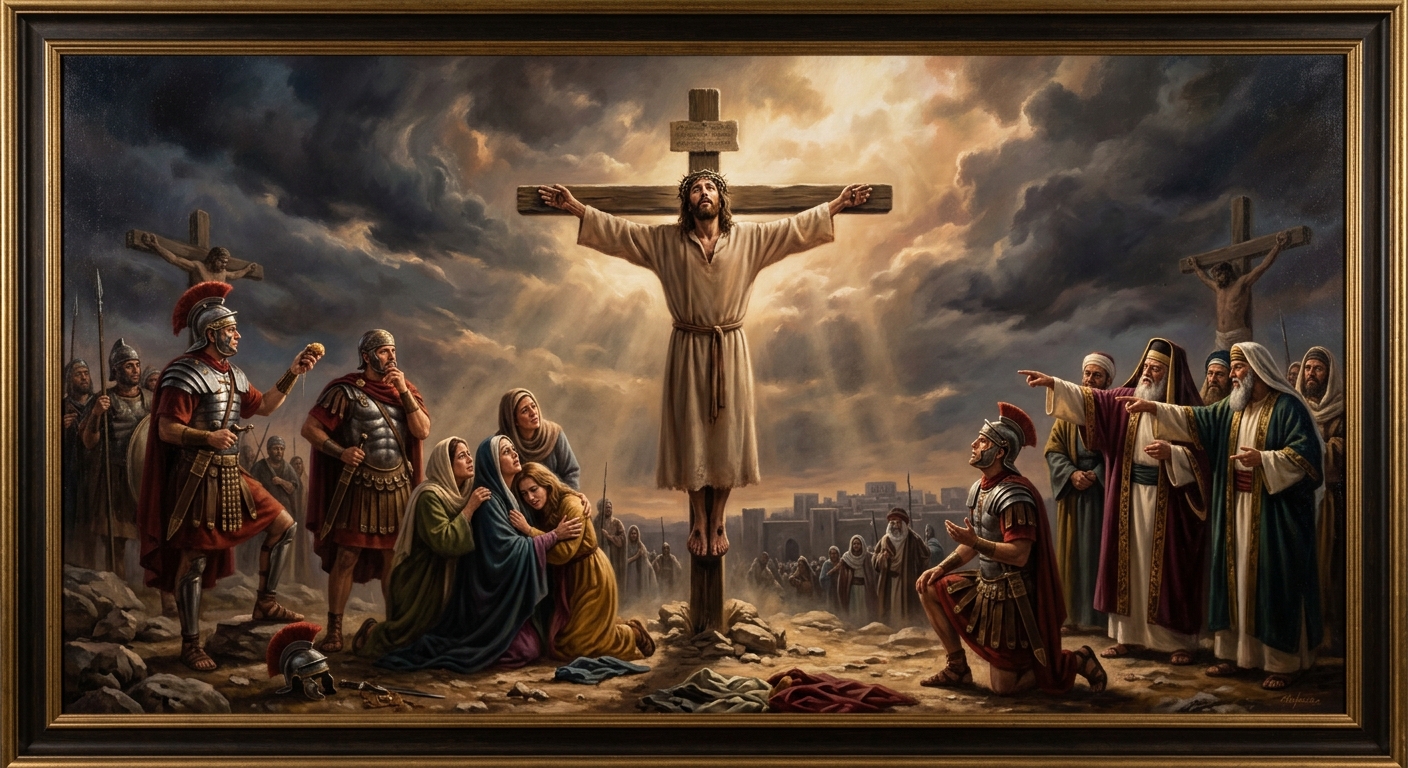
Illustration: Dramatic cinematic biblical illustration for Mark Chapter 15 showing Christ's suffering and vindication, photorealistic oil painting style.
🔊
Listen to Chapter
Grace Notes Journey Audio Narration
Author
John Mark (the Evangelist)
Written
~68 AD
Key Theme
Christ's suffering and vindication
Setting
Jerusalem - before Pilate
Key Verse
Mark 15:39
Total Verses
47
Chapter Introduction
In the stillness of early morning, the chief priests and elders gathered to plot against the One they could not silence. Even as Pilate asked Jesus about His kingship, our Savior answered with a profound love that transcended words. His silence was not emptiness but an invitation to trust in the One who bears our sins fully and willingly. May this chapter remind us that God's grace shines brightest in moments of trial, inviting us to rest in His divine authority.
Mark — Chapter 15 — KJV
1
And straightway in the morning the chief priests held a consultation with the elders and scribes and the whole council, and bound Jesus, and carried him away, and delivered him to Pilate.
Simply PutThe chief priests didn't waste any time; they held a council (Greek "synodos," G3416) and seized Jesus, binding him in chains. Imagine the weight of those iron cuffs as they dragged Him away—first to Roman hands, then to a cruel destiny. It reminds us that the world can be swift and ruthless when it feels threatened.
2
And Pilate asked him, Art thou the King of the Jews? And he answering said unto him, Thou sayest it.
Simply PutWhen Pilate asks, "Are you the King of the Jews?" Jesus replies, "You say it." The Greek word for king here is "basileus" (G935), a title that can be both political and spiritual. In the midst of doubt, Jesus isn't denying His identity; He's pointing out that it's a label others have placed on Him.
3
And the chief priests accused him of many things: but he answered nothing.
Simply PutThe chief priests piled accusations upon Jesus, but He stayed silent. His quietness isn't weakness—it's a deep trust that God knows the truth beyond human arguments. For those wrestling with guilt, His stillness shows that sometimes silence can speak louder than words.
4
And Pilate asked him again, saying, Answerest thou nothing? behold how many things they witness against thee.
Simply PutPilate presses, "Why do you say nothing?" He points to the witness (Greek "martureō," G3145) of many accusations. In moments when we feel unheard, this verse asks us to consider whether we truly trust the One who sees all our heartaches.
5
But Jesus yet answered nothing; so that Pilate marvelled.
Simply PutJesus continues to answer nothing, and Pilate marvels (Greek "thaumaō," G2357). The Roman governor is amazed not at the silence itself, but at the profound calm within it. It reminds us that in real pain, a quiet confidence can be startling to those around us.
6
Now at that feast he released unto them one prisoner, whomsoever they desired.
Simply PutAt the Passover feast, Pilate offers to release a prisoner for the crowd. This tradition shows how even in the midst of power, there are moments of mercy—though it's often influenced by what people demand.
7
And there was one named Barabbas, which lay bound with them that had made insurrection with him, who had committed murder in the insurrection.
Simply PutOne prisoner named Barabbas, a rebel who committed murder, was bound with other insurrectionists. His name means "son of the father," yet his deeds speak of rebellion against authority, echoing how many choose to fight rather than submit.
8
And the multitude crying aloud began to desire him to do as he had ever done unto them.
Simply PutThe crowd loudly cries for Barabbas, wanting him "to do as he had ever done unto them." Their voice is a powerful reminder of how easy it is for the masses to favor those who seem familiar, even if they have a darker past.
9
But Pilate answered them, saying, Will ye that I release unto you the King of the Jews?
Simply PutPilate asks the crowd, "Do you want me to release to you the King of the Jews?" He offers a choice between two very different fates. In our own lives, God often puts us before a fork in the road—choose Him or another way.
10
For he knew that the chief priests had delivered him for envy.
Simply PutPilate recognizes that the chief priests delivered Jesus out of envy (Greek "phthonos," G5352). Their jealousy drove them to plot, showing that envy can blind people to truth and cause harm.
11
But the chief priests moved the people, that he should rather release Barabbas unto them.
Simply PutThe chief priests stir the crowd, urging them to release Barabbas instead. Their influence over the people reveals how leaders can manipulate public opinion for their own agendas.
12
And Pilate answered and said again unto them, What will ye then that I shall do unto him whom ye call the King of the Jews?
Simply PutPilate asks again, "What then shall I do with the one you call King of the Jews?" He finally offers a concrete decision, highlighting how authorities can be swayed by persistent demands.
13
And they cried out again, Crucify him.
Simply PutThe crowd cries again, "Crucify him!" Their voices grow louder—an echo of how public pressure can push a decision toward brutal consequences.
14
Then Pilate said unto them, Why, what evil hath he done? And they cried out the more exceedingly, Crucify him.
Simply PutPilate wonders, "Why? What evil has he done?" Yet the crowd insists, "Crucify him!" Their insistence shows how fear and hatred can override reason.
15
And so Pilate, willing to content the people, released Barabbas unto them, and delivered Jesus, when he had scourged him, to be crucified.
Simply PutWanting to please the crowd, Pilate releases Barabbas and hands over Jesus after scourging Him (Greek "plakō," G4121). In the end, the innocent one is condemned while the guilty go free—a painful truth that often reflects our own world.
16
And the soldiers led him away into the hall, called Praetorium; and they call together the whole band.
Simply PutThe soldiers led Jesus into the Praetorium, the governor's hall of judgment—where lives were decided. It was a place of power and authority, but also where the innocent could be condemned.
17
And they clothed him with purple, and platted a crown of thorns, and put it about his head,
Simply PutThey draped Him in purple (Greek "porphyra," Strong's #4070), the color of royalty, and placed a crown of thorns on His head. The Greek word for crown here, "stephanos" (G4715), meant a garland of victory—yet the thorns mocked His kingship, turning honor into pain.
18
And began to salute him, Hail, King of the Jews!
Simply Put“Hail, King of the Jews!”—the word for king is "basileus" (G932). In a cruel twist, they used the title to mock Him even as He bore the weight of true kingship in His suffering.
19
And they smote him on the head with a reed, and did spit upon him, and bowing their knees worshipped him.
Simply PutThey struck Him with a reed (Greek "rhabdos," G4471) and spat on Him, yet bowed their knees to worship. The word "worship" ("proskuneo," G4332) shows that even in mockery, there was an acknowledgment of His divine authority.
20
And when they had mocked him, they took off the purple from him, and put his own clothes on him, and led him out to crucify him.
Simply PutAfter the scornful jest ("gamelia," G1116), they stripped Him of the purple and led Him out to be crucified. The cruel shift from mockery to death underlines the depth of His suffering.
21
And they compel one Simon a Cyrenian, who passed by, coming out of the country, the father of Alexander and Rufus, to bear his cross.
Simply PutSimon of Cyrene ("Kyrenaikos," G2975) was forced to bear the cross—a symbol of suffering (Greek "passus," G3840). His reluctant help reminds us that even strangers can be called to share in the burdens of faith.
22
And they bring him unto the place Golgotha, which is, being interpreted, The place of a skull.
Simply PutThey brought Him to Golgotha ("Kolobos," G2831), meaning the place of a skull. It was a stark reminder that death can appear in any form, even as a silent monument.
23
And they gave him to drink wine mingled with myrrh: but he received it not.
Simply PutThey offered Him wine mixed with myrrh (Greek "oinos" G2882, "myrrha" G3327), but He took none. The word "receive" ("lambano," G2980) shows His deliberate refusal to numb the pain, embracing the full weight of His sacrifice.
24
And when they had crucified him, they parted his garments, casting lots upon them, what every man should take.
Simply PutWhile He hung on the cross, the soldiers divided His garments and cast lots ("klasma," G2949). The act of gambling over His clothing reflects the depth of His abandonment and humanity.
25
And it was the third hour, and they crucified him.
Simply PutAt the third hour (Greek "hora," G5596), they nailed Him to the cross. In Jewish timekeeping, this was about 9 a.m., a moment when daylight begins—signifying the dawn of redemption.
26
And the superscription of his accusation was written over, THE KING OF THE JEWS.
Simply PutThe inscription "THE KING OF THE JEWS" was placed over Him. This "epigraphe" (Greek G1845) boldly declared His identity, even as the authorities tried to silence it.
27
And with him they crucify two thieves; the one on his right hand, and the other on his left.
Simply PutTwo thieves were crucified alongside Him, one on His right and the other on His left. The word "evildoer" ("kakourgos," G2776) shows that even the guilty can be part of God's redemptive plan.
28
And the scripture was fulfilled, which saith, And he was numbered with the transgressors.
Simply PutThe scriptures were fulfilled, which says He would be numbered with the transgressors. "Fulfilling" ("plēroō," G4185) means God’s promises were being kept, even in the darkest moments.
29
And they that passed by railed on him, wagging their heads, and saying, Ah, thou that destroyest the temple, and buildest it in three days,
Simply PutPassersby mocked Him, saying “Ah, you who destroy the temple and rebuild it in three days.” They used "kollō" (G2816) for railing—a bitter accusation that missed the true meaning of His mission.
30
Save thyself, and come down from the cross.
Simply Put“Save yourself!”—the word for save is "sōzō" (G4982). Their plea reveals a deep misunderstanding: true salvation comes not from escaping the cross, but by staying upon it.
31
Likewise also the chief priests mocking said among themselves with the scribes, He saved others; himself he cannot save.
Simply PutThe chief priests scoffed that Christ had saved others but could not save Himself, using the Greek word “sōzō” (G4989) which means to rescue. Their mocking reveals the bitter irony of those who claim a relationship with God yet cannot walk it themselves.
32
Let Christ the King of Israel descend now from the cross, that we may see and believe. And they that were crucified with him reviled him.
Simply PutThe crowd demanded that “Christ the King of Israel descend now from the cross,” using “katabaino” (G2598) which means to come down or descend. Their demand for a miracle turned into reviling, showing how hunger for proof can become an excuse to reject the One who is already there.
33
And when the sixth hour was come, there was darkness over the whole land until the ninth hour.
Simply PutDarkness fell over all the land from the sixth to the ninth hour, “skotos” (G4565) describing a deep gloom. In moments of pain and doubt, this darkness can feel like all hope is gone, yet it also signals that something profound is taking place in the light of God’s plan.
34
And at the ninth hour Jesus cried with a loud voice, saying, Eloi, Eloi, lama sabachthani? which is, being interpreted, My God, my God, why hast thou forsaken me?
Simply PutAt the ninth hour, Jesus cried out, “My God, my God, why hast thou forsaken me?” The Greek verb “aporiaō” (G608) means to be abandoned. Even the Son of God felt the weight of separation, reminding anyone in anguish that it's okay to cry out honestly before the Father.
35
And some of them that stood by, when they heard it, said, Behold, he calleth Elias.
Simply PutThose standing nearby misheard Jesus’s cry and said, “Behold, he calleth Elias.” Their mistake shows how easily we can misinterpret God’s voice in the midst of suffering.
36
And one ran and filled a spunge full of vinegar, and put it on a reed, and gave him to drink, saying, Let alone; let us see whether Elias will come to take him down.
Simply PutOne ran and offered Jesus a sponge soaked in vinegar (“oxus,” G2106), saying, “Let alone; let us see whether Elias will come to take him down.” The sour wine was a cruel mockery, reflecting how some people use bitterness to test or diminish the suffering of others.
37
And Jesus cried with a loud voice, and gave up the ghost.
Simply PutJesus cried out loudly and “gave up the ghost,” using the verb “ekpno” (G1734) to describe breathing out his spirit. In our deepest moments of loss, this is the ultimate surrender—turning over everything to God’s will.
38
And the veil of the temple was rent in twain from the top to the bottom.
Simply PutThe veil of the temple was torn from top to bottom, “kymatisma” (G2842) being the curtain separating God and man. Its rupture signifies that the barrier between us and our Father has been removed; we now have direct access to Him.
39
And when the centurion, which stood over against him, saw that he so cried out, and gave up the ghost, he said, Truly this man was the Son of God.
Simply PutThe centurion, a Roman officer, saw Jesus’s death and declared, “Truly this man was the Son of God.” Even a foreign soldier recognized divine power, showing that the truth of Christ can pierce any cultural or spiritual barrier.
40
There were also women looking on afar off: among whom was Mary Magdalene, and Mary the mother of James the less and of Joses, and Salome;
Simply PutWomen watched from afar, including Mary Magdalene and the mother of James. “Gunaika” (G1135) reminds us that faithful women were present at the crucifixion, showing their steadfast devotion in a moment of crisis.
41
(Who also, when he was in Galilee, followed him, and ministered unto him;) and many other women which came up with him unto Jerusalem.
Simply PutThese women had followed and “ministered” (G1325) to Jesus throughout his ministry. Their service underscores that true discipleship involves caring for others, especially when the world turns away.
42
And now when the even was come, because it was the preparation, that is, the day before the sabbath,
Simply PutThe evening of preparation—“paraskeuas” (G3957), the day before the Sabbath—set the stage for Jesus’s burial. In times of waiting, we can trust that God’s timing is perfect and purposeful.
43
Joseph of Arimathaea, an honourable counsellor, which also waited for the kingdom of God, came, and went in boldly unto Pilate, and craved the body of Jesus.
Simply PutJoseph of Arimathaea, a respected counselor who “craved” (G5365) Jesus’s body, boldly approached Pilate. His desire to honor Christ shows that reverence for God often requires bold action.
44
And Pilate marvelled if he were already dead: and calling unto him the centurion, he asked him whether he had been any while dead.
Simply PutPilate “marveled” (G2364) whether Jesus was already dead, calling the centurion to confirm. Even skeptics may be surprised by the reality of Christ’s death, prompting deeper inquiry.
45
And when he knew it of the centurion, he gave the body to Joseph.
Simply PutUpon learning the truth from the centurion, Pilate “gave” (G1325) the body to Joseph. This final act ensured that Jesus was laid in a tomb, fulfilling prophecy and providing hope for the resurrection.
46
And he bought fine linen, and took him down, and wrapped him in the linen, and laid him in a sepulchre which was hewn out of a rock, and rolled a stone unto the door of the sepulchre.
Simply PutJoseph of Arimathea, a secret disciple, bought the best linen (Greek: kouphia, G2856) to wrap Jesus' body. This fine cloth wasn't just for decency—it honored the dignity of Christ even in death, echoing the splendor He carried on earth. Laying Him in a rock-hewn tomb (Greek: monēma, G3407) was like placing Him in a sturdy vault of stone, but that very stone would later be rolled away to reveal the miracle that follows.
47
And Mary Magdalene and Mary the mother of Joses beheld where he was laid.
Simply PutMary Magdalene and Mary, mother of Joses, gazed closely at the tomb (Greek: opsō, G3775). Their eyes were the first to witness where He was laid. In their quiet watchfulness, they become the entry point into the story of resurrection—reminding us that God often works through those who quietly stand by, waiting in hope.
Matthew 27:11-14This passage parallels Mark's account of Pilate questioning Jesus and highlights the fulfillment of prophecy concerning the silent suffering servant.
John 18:40This verse records Pilate's customary release of a prisoner at the feast, directly aligning with Mark 15:6-8’s mention of Barabbas.
Luke 22:2-5The chief priests and elders' consultation to plot against Jesus sets the stage for the trial depicted in Mark 15:1.
Isaiah 53:7The prophetic description of the servant opening not his mouth before his accusers mirrors Jesus' silence before Pilate in Mark 15:5.
Reflect
Think about moments when you or others divide someone else's belongings—like in a workplace or shared living space. How do you choose what to take, and does your decision reflect care for the other's dignity?