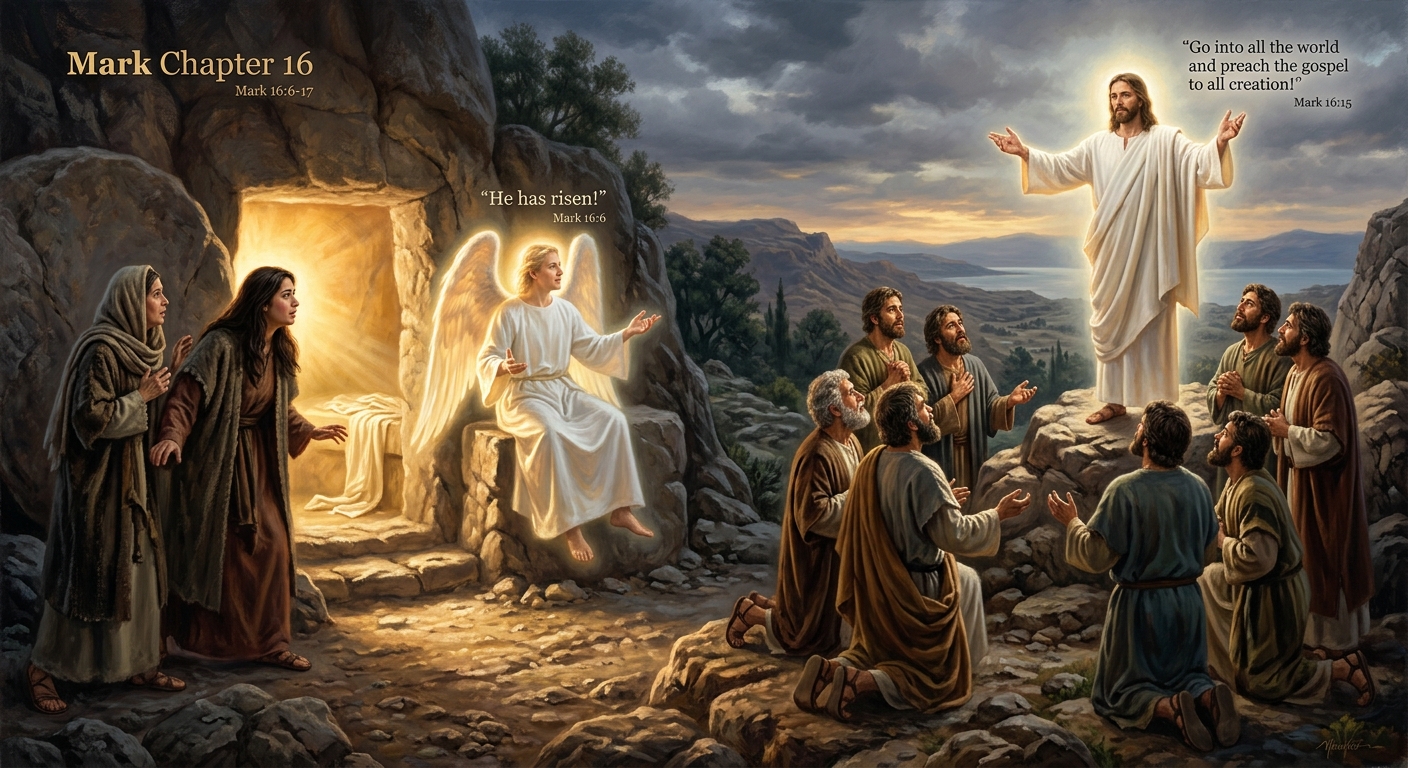
Illustration: Dramatic cinematic biblical illustration for Mark Chapter 16 showing Resurrection and the Great Commission, photorealistic oil painting style.
🔊
Listen to Chapter
Grace Notes Journey Audio Narration
Author
John Mark (traditionally linked to the Apostle Peter)
Written
~65-70 AD
Key Theme
Resurrection and the Great Commission
Setting
Jerusalem - early morning after Sabbath
Key Verse
Mark 16:15
Total Verses
20
Chapter Introduction
*Beloved reader, the dawn of this chapter brings us into a moment of awe and wonder. The women who loved Jesus step out of their grief to discover the empty tomb, a sign that He has risen. As they stand before the stone, their hearts are filled with both question and hope. This is where we encounter the living Christ, who calls us to go forth in His name and share this glorious news.*
Mark — Chapter 16 — KJV
1
And when the sabbath was past, Mary Magdalene, and Mary the mother of James, and Salome, had bought sweet spices, that they might come and anoint him.
Simply PutAfter the Sabbath (Hebrew shabbat, H7714) had ended, Mary Magdalene, another Mary, and Salome bought fragrant spices (Greek aromata, G726) to anoint Jesus. Their preparation shows a deep love and hope that they would meet Him again, even though death seemed final.
2
And very early in the morning the first day of the week, they came unto the sepulchre at the rising of the sun.
Simply PutAt the earliest light of the first day (Greek protos, G5345) of the week, they hurried to the tomb as the sun rose. In that moment, the darkness of grief is about to be broken by a new dawn.
3
And they said among themselves, Who shall roll us away the stone from the door of the sepulchre?
Simply PutThey whispered among themselves, “Who will roll away the heavy stone (Greek petra, G4085) that blocks the door?” Their question reveals both fear of the barrier and a longing for what lies beyond it.
4
And when they looked, they saw that the stone was rolled away: for it was very great.
Simply PutWhen they looked, they saw the stone had already been rolled away—it was very great (Greek para megas, G3959). The enormity of the move signals that something far greater than they imagined has happened.
5
And entering into the sepulchre, they saw a young man sitting on the right side, clothed in a long white garment; and they were affrighted.
Simply PutInside, a young man (Greek nean, G3535) sat on the right side, dressed in a bright white garment (Greek leucós). Their fear (Greek phoboumenoi, G5315) reminds us that the presence of God can be both startling and comforting.
6
And he saith unto them, Be not affrighted: Ye seek Jesus of Nazareth, which was crucified: he is risen; he is not here: behold the place where they laid him.
Simply Put“Do not be afraid,” He said. “You seek Jesus of Nazareth, who was crucified (Greek stauroo, G5605). He is risen (Greek anistēsen, G554); He’s not here—look at the place where you laid Him.” This declares that death has been defeated, offering hope to the grieving.
7
But go your way, tell his disciples and Peter that he goeth before you into Galilee: there shall ye see him, as he said unto you.
Simply Put“Go,” He instructed. “Tell the disciples and Peter that you will find Him in Galilee (Greek Galilaia, G1084).” He points them to a familiar place where the promise of resurrection will be witnessed.
8
And they went out quickly, and fled from the sepulchre; for they trembled and were amazed: neither said they any thing to any man; for they were afraid.
Simply PutThey fled the tomb, trembling (Greek trembō, G5046) and amazed (Greek ekoxomai, G1673). Their silence shows the weight of what they saw—real fear before they could trust.
9
Now when Jesus was risen early the first day of the week, he appeared first to Mary Magdalene, out of whom he had cast seven devils.
Simply PutEarly on that first day, Jesus (Greek Iesous, G2424) rose and appeared first to Mary Magdalene, from whom He had cast out seven devils (Greek daimonion, G965). Her encounter illustrates that even the most tormented can be healed and become the first witness.
10
And she went and told them that had been with him, as they mourned and wept.
Simply PutShe ran to tell those who had been with Him while they mourned and wept (Greek pentheo, G3975). Her message bridges the gap between sorrow and joy.
11
And they, when they had heard that he was alive, and had been seen of her, believed not.
Simply PutYet when they heard that He was alive, they did not believe (Greek ou pisteusēsan, G3765 + G2814). Their doubt reflects the human tendency to cling to what we see, even when God has moved beyond sight.
12
After that he appeared in another form unto two of them, as they walked, and went into the country.
Simply PutLater He appeared in another form to two of them as they walked into the country. This reminds us that God can reveal Himself in unexpected places and ways.
13
And they went and told it unto the residue: neither believed they them.
Simply PutThey told the rest (Greek loipa, G3066), but still no one believed. The stubbornness of the heart can resist even clear miracles.
14
Afterward he appeared unto the eleven as they sat at meat, and upbraided them with their unbelief and hardness of heart, because they believed not them which had seen him after he was risen.
Simply PutHe later appeared to the eleven as they ate together, rebuking (Greek epitropē, G1865) their unbelief and hardness of heart because they refused to trust the testimony of those who had seen Him risen. The warning is that spiritual complacency can blind us to Christ’s work.
15
And he said unto them, Go ye into all the world, and preach the gospel to every creature.
Simply PutHe commissioned them, “Go into all the world (Greek kosmos, G2887), preach the gospel (Greek euangelion, G2105) to every creature.” The simple command is a call for all of us to share the good news everywhere.
16
He that believeth and is baptized shall be saved; but he that believeth not shall be damned.
Simply PutFaith (Greek πιστεύων, G4100) is the heart’s response to God—trusting Him with all that we are. Baptism (Greek βαπτισθῇς, G908) is the outward token of that inward trust. If you truly believe and step into this water, God promises to set your soul free; if you never turn that belief toward Him, the consequence is just as clear.
17
And these signs shall follow them that believe; In my name shall they cast out devils; they shall speak with new tongues;
Simply PutThe Greek word for signs (σημεῖα, G2476) points to God’s real power stepping out of the believer’s life. Those who truly trust in Jesus will find that, in His name, they can cast out demons (Greek ἐκβάλλουσιν τὰ δαιμονία, G1705) and speak in new tongues (γλώσσας καιναίς, G5634), showing the world that God’s Spirit is alive and active.
18
They shall take up serpents; and if they drink any deadly thing, it shall not hurt them; they shall lay hands on the sick, and they shall recover.
Simply PutWhen it says they’ll take up serpents (Greek ὄφεις, G3685), it’s a promise of protection—if you are walking with God and trusting Him, even the most poisonous situations won’t harm you. The same trust will enable believers to lay hands (Greek προσάπτειν χεῖρας, G4265) on the sick and see God’s healing power at work.
19
So then after the Lord had spoken unto them, he was received up into heaven, and sat on the right hand of God.
Simply PutAfter speaking to them, Jesus was “received up” (Greek ἀνελήμφθη, G376) into heaven and now sits at the right hand (Greek δεξιὰ τοῦ Θεοῦ, G1162) of God—the place of highest honor and authority. This means He is not distant; He’s actively ruling over all and watching over His church.
20
And they went forth, and preached every where, the Lord working with them, and confirming the word with signs following. Amen.
Simply PutThe disciples went out, preaching (Greek κηρύσσω, G2819) everywhere with the Lord working alongside them. As they shared His Word, signs (σημεῖα, G2476) confirmed it—proof that the message they carried was alive and true. Amen.
Matthew 28:5-7The angelic proclamation that “He is risen” and the instruction to go into Galilee directly mirrors the young man’s message in Mark 16:5-7, confirming the empty tomb and future appearance.
Luke 24:6-7The angel’s words that “He is risen” and the directive to go into Galilee parallel Mark 16:6-7, reinforcing the resurrection narrative across the Synoptic Gospels.
John 20:1-8John’s detailed account of Mary Magdalene at the empty tomb and the rolled-away stone provides a fuller parallel to Mark 16:1-5, highlighting the same discovery of the resurrection.
Psalm 16:10This Old Testament prophecy that “thine Holy One shall not see corruption” is fulfilled in the resurrection accounts of Mark 16, confirming Jesus as the promised Messiah.
Reflect
When you hear about a profound change in someone's life—like a friend’s story of hope or a new perspective—do you find yourself truly believing, or do you notice an inner resistance that keeps you from fully embracing it?