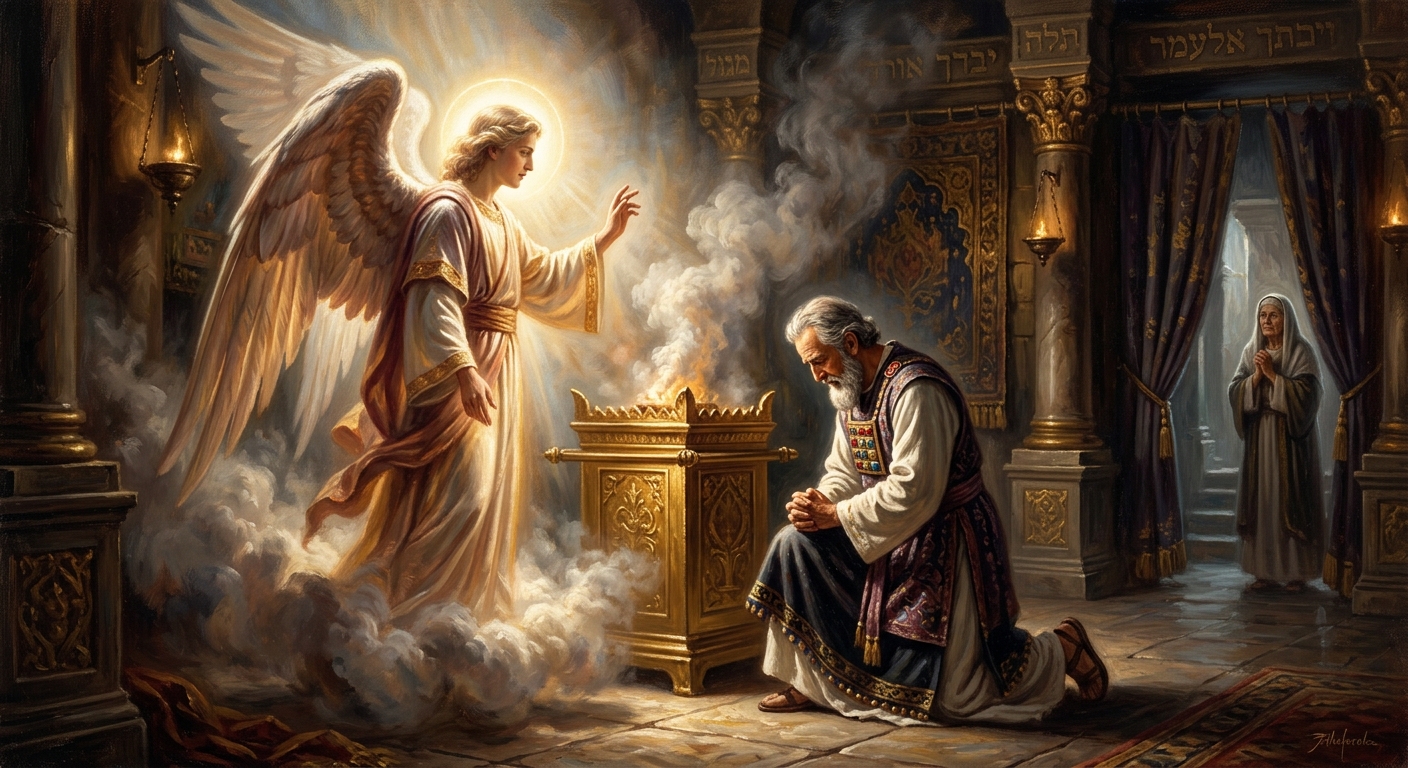
Illustration: Dramatic cinematic biblical illustration for Luke Chapter 1 showing God's Faithful Promise Fulfilled, photorealistic oil painting style.
🔊
Listen to Chapter
Grace Notes Journey Audio Narration
Author
Luke the Evangelist
Written
~65 AD
Key Theme
God's Faithful Promise Fulfilled
Setting
Judea under Herod
Key Verse
Luke 1:31
Total Verses
80
Chapter Introduction
*Beloved child of God, let your heart be lifted up as you read the first chapter of Luke. In these verses we see the hand of God weaving together history and hope, preparing a child for the greatest work ever done. The faithful priest Zacharias, though doubting, is reminded that God's timing is perfect and His promises never fail. May this chapter stir your faith to trust in the divine plan that surrounds you, even when it seems hidden.*
Luke — Chapter 1 — KJV
1
Forasmuch as many have taken in hand to set forth in order a declaration of those things which are most surely believed among us,
Simply PutThe word “declare” (Greek, apokalypsis G322) means a revealing or unveiling of something hidden. This opening says that many have taken it upon themselves to give an account of the things that we truly hold dear. It’s a reminder that we keep looking for trustworthy accounts in these turbulent times.
2
Even as they delivered them unto us, which from the beginning were eyewitnesses, and ministers of the word;
Simply Put“Eyewitnesses” (Greek, martyrēs G3166) literally means “martyr,” a person who bears witness by being present. The people who passed this story to us were there, they saw it happen, and they served the word. It assures those of us who doubt that this isn’t a collection of second-hand rumors.
3
It seemed good to me also, having had perfect understanding of all things from the very first, to write unto thee in order, most excellent Theophilus,
Simply Put“Perfect understanding” (Greek, katechēmenos G2663) means to be fully acquainted or comprehended. Luke, the author, claims he knows the story from its very beginning and is writing to a man named Theophilus. For anyone feeling lost or confused, this verse says there is someone who has studied the whole story and cares enough to share it with you.
4
That thou mightest know the certainty of those things, wherein thou hast been instructed.
Simply Put“Certainty” (Greek, pistis G4102) means faith or proof. The purpose is to give you a firm foundation in what you've been taught. If your heart feels shaky, this verse invites you to rest on a solid ground.
5
There was in the days of Herod, the king of Judaea, a certain priest named Zacharias, of the course of Abia: and his wife was of the daughters of Aaron, and her name was Elisabeth.
Simply Put“Righteous” (Greek, dikaios G1343) means just or upright. Zacharias was a priest of the line of Abia, married to Elizabeth from Aaron’s family. To those feeling unworthy, this shows that God works through ordinary families and calls them into His story.
6
And they were both righteous before God, walking in all the commandments and ordinances of the Lord blameless.
Simply Put“Walk in” (Greek, peripathē) means to live out or conduct oneself. They followed all the commandments blamelessly. If you’re struggling to be “good enough,” this reminds you that God sees your obedience, even in small daily steps.
7
And they had no child, because that Elisabeth was barren, and they both were now well stricken in years.
Simply Put“Barren” (Greek, maō) means to be unable to conceive. Their childlessness and advancing years weighed heavily upon them. For anyone facing the sting of infertility or disappointment, this verse says that God can turn emptiness into fullness.
8
And it came to pass, that while he executed the priest’s office before God in the order of his course,
Simply Put“Priest’s office” (Greek, diakonia) means service or ministry. Zacharias performed his duties before God. It shows that even in the midst of routine service, divine encounters can happen.
9
According to the custom of the priest’s office, his lot was to burn incense when he went into the temple of the Lord.
Simply Put“Incense” (Greek, thymiama) is the fragrant smoke that rises to God as a symbolic prayer. The priest’s lot was to burn incense, representing his prayers ascending. For those who feel their prayers are unheard, the image of rising smoke offers hope that God receives them.
10
And the whole multitude of the people were praying without at the time of incense.
Simply Put“Multitude” (Greek, plethos) means a great crowd. Everyone was praying outside as the incense rose. It shows that communal prayer is powerful, especially when we gather in the presence of God.
11
And there appeared unto him an angel of the Lord standing on the right side of the altar of incense.
Simply Put“Angel” (Greek, angelos) means messenger. The angel stood on the right side of the altar, a place of honor and authority. This tells us that God sends messengers to remind us He’s still at work.
12
And when Zacharias saw him, he was troubled, and fear fell upon him.
Simply Put“Troubled” (Greek, thrēskō) means to be afraid or shaken. Zacharias was startled and fear fell upon him. For anyone frightened by the unknown, this verse acknowledges that fear is a natural response to divine encounters.
13
But the angel said unto him, Fear not, Zacharias: for thy prayer is heard; and thy wife Elisabeth shall bear thee a son, and thou shalt call his name John.
Simply Put“Fear not” (Greek, phobē) is a command to release anxiety. The angel reassures Zacharias that his prayer has been heard and Elizabeth will bear a son named John. It invites us to trust God’s timing even when it seems impossible.
14
And thou shalt have joy and gladness; and many shall rejoice at his birth.
Simply Put“Joy” (Greek, charis) means gladness or delight. The angel promises that many will rejoice at the birth of this child. It reminds us that God’s blessings bring hope to those who are weary.
15
For he shall be great in the sight of the Lord, and shall drink neither wine nor strong drink; and he shall be filled with the Holy Ghost, even from his mother’s womb.
Simply Put“Filled with the Holy Ghost” (Greek, pneuma) means to be empowered by God’s spirit. John will live a life of greatness without wine or strong drink, and he’ll be saturated with the Holy Spirit from his mother’s womb. For those longing for spiritual vitality, this verse shows that true greatness comes from God’s Spirit alone.
16
And many of the children of Israel shall he turn to the Lord their God.
Simply PutIn this verse, the Greek word "turn" (G534) carries a weighty sense of being drawn or brought back. Imagine God reaching into the lives of his people, especially those feeling lost or broken, and gently pulling them toward a fresh, living relationship with Him.
17
And he shall go before him in the spirit and power of Elias, to turn the hearts of the fathers to the children, and the disobedient to the wisdom of the just; to make ready a people prepared for the Lord.
Simply PutThe phrase "spirit and power of Elias" (G4154) points to the Holy Spirit’s strength, just as it empowered Elijah. This verse tells us that a special messenger—John the Baptist—is coming to stir hearts, guiding the stubborn toward righteousness and preparing a faithful people for the Lord’s arrival.
18
And Zacharias said unto the angel, Whereby shall I know this? for I am an old man, and my wife well stricken in years.
Simply PutZacharias asks, "Whereby shall I know this?" His doubt is rooted in his age ("old man," G560) and his wife's frailty. In moments of uncertainty, this reminds us that God can still work wonders regardless of our physical limits or the timeline we imagine.
19
And the angel answering said unto him, I am Gabriel, that stand in the presence of God; and am sent to speak unto thee, and to shew thee these glad tidings.
Simply PutThe angel introduces himself as Gabriel (G1243), meaning "strength of God." He brings not just news, but "glad tidings," a promise that divine hope is on the horizon, even when human circumstances feel bleak.
20
And, behold, thou shalt be dumb, and not able to speak, until the day that these things shall be performed, because thou believest not my words, which shall be fulfilled in their season.
Simply PutThe angel says Zacharias will be "dumb" (G3415) because he doubted. This physical silence serves as a living testimony—an outward sign that sometimes we must be humbled before God’s promises come to fruition.
21
And the people waited for Zacharias, and marvelled that he tarried so long in the temple.
Simply PutThe people "marvelled" (G2812) at Zacharias' delay. Their curiosity reflects a longing for divine revelation, and it reminds us that God’s timing often defies our expectations but is always perfect.
22
And when he came out, he could not speak unto them: and they perceived that he had seen a vision in the temple: for he beckoned unto them, and remained speechless.
Simply PutUpon his return, Zacharias could not speak. The people "perceived" (G2878) that he had seen a vision, recognizing the power of divine encounter to render even the most eloquent man speechless. It shows that seeing God changes us from the inside out.
23
And it came to pass, that, as soon as the days of his ministration were accomplished, he departed to his own house.
Simply Put"As soon as the days of his ministration were accomplished" (G1400), Zacharias left the temple. This marks the completion of his priestly duty, signaling that what began in sacred service now moves into everyday life—a reminder that God’s work follows us wherever we go.
24
And after those days his wife Elisabeth conceived, and hid herself five months, saying,
Simply Put"After those days his wife Elizabeth conceived." The verb "conceived" (G3820) signifies a new beginning, and her five months of hiding speak to the quiet patience required during divine miracles.
25
Thus hath the Lord dealt with me in the days wherein he looked on me, to take away my reproach among men.
Simply PutElizabeth declares, "Thus hath the Lord dealt with me... to take away my reproach among men." The term "reproach" (G3949) points to past shame; this verse celebrates how God restores honor and confidence in those who have once felt dismissed.
26
And in the sixth month the angel Gabriel was sent from God unto a city of Galilee, named Nazareth,
Simply PutThe angel Gabriel (G1243) appears from God to Nazareth, a humble town in Galilee (G1119). This reminds us that God's messages often arrive in simple places, reminding the weary that divine purpose can arise from ordinary surroundings.
27
To a virgin espoused to a man whose name was Joseph, of the house of David; and the virgin’s name was Mary.
Simply PutMary is described as a "virgin espoused" to Joseph of the house of David. The lineage (G567) highlights God’s promise that a child would arise from the royal line—a beacon of hope for anyone longing for fulfillment and identity.
28
And the angel came in unto her, and said, Hail, thou that art highly favoured, the Lord is with thee: blessed art thou among women.
Simply PutThe angel greets Mary with "Hail" (G56), meaning a warm welcome, and says she is "highly favored." The phrase suggests that God’s grace has chosen her; it comforts those feeling unworthy, showing that divine favor is not about merit but about God's gracious selection.
29
And when she saw him, she was troubled at his saying, and cast in her mind what manner of salutation this should be.
Simply PutWhen Mary saw the angel, she was "troubled" (G2291) and wondered about his words. Her inner turmoil mirrors the confusion many feel when faced with unexpected divine callings, reminding us that uncertainty often precedes trust.
30
And the angel said unto her, Fear not, Mary: for thou hast found favour with God.
Simply PutThe angel reassures Mary, "Fear not," and tells her she has found favor with God. The phrase "found favour" (G5350) underscores that God's love often comes with a gentle voice, encouraging us to trust in the midst of uncertainty.
31
And, behold, thou shalt conceive in thy womb, and bring forth a son, and shalt call his name JESUS.
Simply PutMary will conceive a son and name him JESUS. The Greek word for “conceive” (gennáō) means to bring forth life from the womb, and JESUS (Iēsous) carries the meaning “Jehovah saves.” This is God’s promise that He will send a Savior to rescue His people.
32
He shall be great, and shall be called the Son of the Highest: and the Lord God shall give unto him the throne of his father David:
Simply PutHe will be great and called the Son of the Highest. The word “Highest” (hypsistos) refers to God’s supreme authority, and the promise that the Lord will give him David’s throne shows that He is the rightful heir to Israel’s covenant. This points to a ruler who embodies God’s own power.
33
And he shall reign over the house of Jacob for ever; and of his kingdom there shall be no end.
Simply PutHe will reign over the house of Jacob forever, and his kingdom will never end. The Greek term for “reign” (basileuō) means to rule as a king, and the endless nature of His kingdom assures us that Christ’s authority is eternal, unshakable by any earthly power.
34
Then said Mary unto the angel, How shall this be, seeing I know not a man?
Simply PutMary asks, “How shall this be? I do not know a man.” She voices the common human doubt about how God’s plan can be fulfilled through a virgin. Her question reflects our own struggles to understand divine mysteries.
35
And the angel answered and said unto her, The Holy Ghost shall come upon thee, and the power of the Highest shall overshadow thee: therefore also that holy thing which shall be born of thee shall be called the Son of God.
Simply PutThe angel says, “The Holy Ghost will come upon you, and the power of the Highest will overshadow you.” The Greek word for “Holy Ghost” (pneuma) means breath or wind, symbolizing God’s life-giving presence. To “overshadow” (skioō) is to be covered in divine protection, resulting in a holy child called the Son of God.
36
And, behold, thy cousin Elisabeth, she hath also conceived a son in her old age: and this is the sixth month with her, who was called barren.
Simply PutLook at Elizabeth—she has conceived a son in her old age, even though she was once called barren. The Greek word for “barren” (stēros) emphasizes how God can bring life where there seemed to be none, showing His power over human limitations.
37
For with God nothing shall be impossible.
Simply Put“With God nothing shall be impossible.” The Greek term for “impossible” (adunatos) literally means unable. This reminds us that when we trust God, even what looks impossible can become possible.
38
And Mary said, Behold the handmaid of the Lord; be it unto me according to thy word. And the angel departed from her.
Simply PutMary says, “Behold the handmaid of the Lord; be it unto me according to thy word.” The Greek term for “handmaid” (doura) conveys humble servitude. Mary’s response shows a heartfelt surrender to God’s plan, trusting that He will fulfill His promise.
39
And Mary arose in those days, and went into the hill country with haste, into a city of Juda;
Simply PutMary rose quickly and traveled up to the hill country in Judah. The word “hastily” (tachy) suggests an urgent desire to obey God’s call without delay, reflecting a heart ready for the journey ahead.
40
And entered into the house of Zacharias, and saluted Elisabeth.
Simply PutShe entered Zacharias’s house and greeted Elizabeth. The Greek word for “greeting” (chairetismos) expresses a warm, joyful salutation that opens the door for fellowship and shared blessing.
41
And it came to pass, that, when Elisabeth heard the salutation of Mary, the babe leaped in her womb; and Elisabeth was filled with the Holy Ghost:
Simply PutWhen Elizabeth heard Mary’s greeting, the baby leaped in her womb, and she was filled with the Holy Ghost. The Greek term for “leaped” (exestai) implies a joyous, sudden movement, signifying that John’s spirit recognized the presence of Christ. The filling of the Holy Ghost shows how God’s power operates within believers.
42
And she spake out with a loud voice, and said, Blessed art thou among women, and blessed is the fruit of thy womb.
Simply PutElizabeth cried out, “Blessed are you among women, and blessed is the fruit of your womb.” The Greek word for “blessed” (eulogēmenē) indicates being praised and favored by God, highlighting Mary’s unique role in salvation history.
43
And whence is this to me, that the mother of my Lord should come to me?
Simply Put“Why is this to me? The mother of my Lord comes to me.” The Greek term for “mother” (mētēr) emphasizes the close personal relationship that John has with Jesus, even before He is born. This underscores how God’s presence brings joy to those who await Him.
44
For, lo, as soon as the voice of thy salutation sounded in mine ears, the babe leaped in my womb for joy.
Simply Put“When your greeting reached my ears, the baby leaped in my womb for joy.” The Greek word for “joy” (chara) captures the pure, innocent delight that John’s spirit feels at Mary’s arrival. It shows how love for God can cause even the unborn to rejoice.
45
And blessed is she that believed: for there shall be a performance of those things which were told her from the Lord.
Simply Put“Blessed is she who believed, for there shall be a fulfillment of those things which were spoken to her from the Lord.” The Greek words for “blessed” (eulogēmenē) and “believed” (pepisteuken) together affirm that Mary’s trust in God has been rewarded. Her belief was the gateway to seeing God’s promises realized.
46
And Mary said, My soul doth magnify the Lord,
Simply PutMary proclaims that her very being (soul) exalts the Lord, using the Greek word μεγαλωσσω (G3115), which means to lift up in greatness. Even in the midst of doubt and pain, she declares that God is worthy of the highest praise.
47
And my spirit hath rejoiced in God my Saviour.
Simply PutShe says her spirit has found joy in God, who is her Savior. The Greek verb ηδούομαι (G2192) conveys a deep, heartfelt gladness that lifts the spirit above fear and sorrow.
48
For he hath regarded the low estate of his handmaiden: for, behold, from henceforth all generations shall call me blessed.
Simply PutMary acknowledges God's attentiveness to her humble status as a handmaiden (δούλη, G1222). In this moment of need, she sees God's promise that all future generations will regard her as blessed (εὐλογημένον, G527).
49
For he that is mighty hath done to me great things; and holy is his name.
Simply PutShe reflects on God's mighty power (μέγας, G3171) and declares that He has done great things for her. The holiness of His name (ἅγιος, G40) assures that He is steadfast and pure.
50
And his mercy is on them that fear him from generation to generation.
Simply PutMary's gratitude turns to God's enduring mercy (ἔλεος, G1656), extending from generation to generation for those who fear Him (φοβέω, G540). This promises that even the doubtful will be wrapped in God's unfading love.
51
He hath shewed strength with his arm; he hath scattered the proud in the imagination of their hearts.
Simply PutShe declares that God has shown His strength (ἰσχύς, G2565) with His arm, scattering the proud in the imagination of their hearts (φαντασίαν, G5272). In your struggles, God dismantles the proud and lifts up those who stand firm.
52
He hath put down the mighty from their seats, and exalted them of low degree.
Simply PutShe continues that He has humbled the mighty from their seats (θρόνος, G2364) and lifted up those of low degree (ταπεινός, G5170). God cares for the meek and brings them up in times of doubt.
53
He hath filled the hungry with good things; and the rich he hath sent empty away.
Simply PutMary says He satisfies the hungry with good things (πληροώ, G4175) and sends the rich away empty. It reminds us that God provides for those in real need, and wealth alone cannot satisfy the soul.
54
He hath holpen his servant Israel, in remembrance of his mercy;
Simply PutShe declares that He has helped His servant Israel in remembrance of His mercy. The word δοῦλος (G1222) reminds us that God's help is not distant but personal to those He calls His own.
55
As he spake to our fathers, to Abraham, and to his seed for ever.
Simply PutMary recalls that God spoke to Abraham and his descendants forever. This assures us that God's promises are unbroken, stretching through all ages.
56
And Mary abode with her about three months, and returned to her own house.
Simply PutMary stayed with Elizabeth for about three months before returning home. In her patience and devotion, she models the quiet waiting that often precedes great blessings.
57
Now Elisabeth’s full time came that she should be delivered; and she brought forth a son.
Simply PutAt her appointed time, Elizabeth gave birth to a son. This reminds us that God’s timing is perfect, even when it seems delayed.
58
And her neighbours and her cousins heard how the Lord had shewed great mercy upon her; and they rejoiced with her.
Simply PutNeighbors and relatives rejoiced as they heard of the Lord’s great mercy upon Elizabeth. The community's celebration underscores how God’s blessings become shared joy.
59
And it came to pass, that on the eighth day they came to circumcise the child; and they called him Zacharias, after the name of his father.
Simply PutOn the eighth day, they were to circumcise the child and named him Zacharias after his father. This rite tied the new life to the covenant promises of God.
60
And his mother answered and said, Not so; but he shall be called John.
Simply PutElizabeth’s mother corrected the name, declaring that his destiny is to be called John. The name John (Ἰωάννης) signifies a special purpose, pointing to God's unique plans for each life.
61
And they said unto her, There is none of thy kindred that is called by this name.
Simply PutThe Greek word for "kindred" (genea, Strong's #1077) is the term for one's family line or tribe. Their amazement shows that no one in their family had ever been called John, a name set apart for God's purpose. In our own lives, this reminds us that God can give us a name or identity unlike any we or anyone else have known before—a fresh start that points to who He is for us.
62
And they made signs to his father, how he would have him called.
Simply PutThe word "signs" (semeion, Strong's #4585) points to a visible token of a divine purpose. They took this as a sign that the father should name his son John, trusting in God's leading. When we are stuck in doubt, God often gives us small signs—gentle nudges or coincidences—to steer us toward His promises.
63
And he asked for a writing table, and wrote, saying, His name is John. And they marvelled all.
Simply PutZacharias asked for a writing tablet (gramma, Strong's #1123), and when he wrote “His name is John,” everyone marvelled (thauma, Strong's #7565). The wonder here isn’t just about a name; it’s about God speaking directly into the present moment. In moments of anxiety, remember that God can write His name on our hearts in ways we never expect.
64
And his mouth was opened immediately, and his tongue loosed, and he spake, and praised God.
Simply PutThe Greek phrase “his mouth was opened” (egeiro, Strong's #1190) means God lifted his voice and gave him speech. His tongue was loosed (glossa, Strong's #1105), and he praised God. This shows that when we feel silenced, the Holy Spirit can open our mouths to declare His goodness.
65
And fear came on all that dwelt round about them: and all these sayings were noised abroad throughout all the hill country of Judaea.
Simply PutFear (phobos, Strong's #5625) here is reverent awe, not terror. All who were around them felt this holy reverence as the news spread through the hills of Judea. In our own trials, true fear is a trembling respect for God's power, reminding us that He is in control.
66
And all they that heard them laid them up in their hearts, saying, What manner of child shall this be! And the hand of the Lord was with him.
Simply PutThey “laid them up” (katecheō, Strong's #2596) in their hearts, treasuring the words about this child. The hand (cheir, Strong's #2815) of the Lord was with him from the start. When life feels uncertain, store God’s promises in your heart; they become a source of strength.
67
And his father Zacharias was filled with the Holy Ghost, and prophesied, saying,
Simply PutZacharias was filled with the Holy Ghost (pneuma, Strong's #4151), and he prophesied. The Spirit moves us beyond our own thoughts, giving voice to God’s plan. In times of weariness, let the Holy Spirit fill you—He can speak truth into your silence.
68
Blessed be the Lord God of Israel; for he hath visited and redeemed his people,
Simply Put“Blessed” (eulogēo, Strong's #3336) the Lord is a word of praising and honoring. He has “visited” (episkopē, Strong's #1816) and “redeemed” (lutroō, Strong's #3060) His people—meaning He has rescued them from bondage. No matter how lost we feel, God's redemption is a personal rescue mission.
69
And hath raised up an horn of salvation for us in the house of his servant David;
Simply PutHe raised up an “horn of salvation” (karabos, Strong's #2600), a symbol of strength and victory. This comes in the house of David, fulfilling long-awaited promises. In our struggles, God’s power is like a horn—strong and ready to rescue.
70
As he spake by the mouth of his holy prophets, which have been since the world began:
Simply PutHe spoke “by the mouth of his holy prophets” (logoi, Strong's #3059), meaning He delivers His message through human vessels. God’s Word has been spoken since the world began; it remains trustworthy today. When doubts creep in, remember that the same God has spoken throughout history.
71
That we should be saved from our enemies, and from the hand of all that hate us;
Simply PutHe promised we would be “saved” (sōzō, Strong's #4982) from enemies and from those who hate us. Salvation is a divine rescue plan against all forces that oppress us. In darkness, this promise assures us of God’s protective hand.
72
To perform the mercy promised to our fathers, and to remember his holy covenant;
Simply PutHe intends to “perform the mercy promised” (eleos, Strong's #1650) and keep His covenant (diatheke, Strong's #1325). A covenant is a binding promise that never fades. In moments of brokenness, God’s mercy and covenant remind us He remains faithful.
73
The oath which he sware to our father Abraham,
Simply PutThe oath (hēthēmi, Strong's #2193) He swore to Abraham was a solemn vow that set the foundation for all nations. This oath anchors us in a legacy of faithfulness spanning generations.
74
That he would grant unto us, that we being delivered out of the hand of our enemies might serve him without fear,
Simply PutHe would grant that we might serve Him “without fear” (phobos, Strong's #5625). True service comes when we trust God’s protection and let reverence replace anxiety. In trials, remember that fear can turn into a deep trust in God.
75
In holiness and righteousness before him, all the days of our life.
Simply PutWe are called to live in “holiness” (hagios, Strong's #40) and “righteousness” (dikaiosuneē, Strong's #1342), meaning we are set apart and walk in right standing before Him. This is a lifelong journey of aligning our hearts with God’s standards, trusting He guides us each day.
76
And thou, child, shalt be called the prophet of the Highest: for thou shalt go before the face of the Lord to prepare his ways;
Simply PutGod tells this little boy that he will be called the prophet of the Most High (Greek "Hypsistos," meaning supreme). He’s set to go before God, preparing people’s hearts so they can meet Him.
77
To give knowledge of salvation unto his people by the remission of their sins,
Simply PutHe will bring the knowledge of salvation ("gnosis" in Greek) to the people, and that comes through the forgiveness or release ("apolysis") of their sins.
78
Through the tender mercy of our God; whereby the dayspring from on high hath visited us,
Simply PutBy God’s tender mercies—His deep, heartfelt compassion—He brings us a new dawn from Heaven (the "dayspring," Greek "pharōma"), brightening the world with hope.
79
To give light to them that sit in darkness and in the shadow of death, to guide our feet into the way of peace.
Simply PutThis light shines into those living in darkness and near death, guiding our steps toward a path of peace.
80
And the child grew, and waxed strong in spirit, and was in the deserts till the day of his shewing unto Israel.
Simply PutThe child grew stronger in spirit, spending his days in the wilderness ("erēmia") until it was time for him to reveal himself to Israel.
Genesis 5:1This verse’s phrase “the beginning” mirrors Luke 1:1’s reference to the “beginning,” underscoring the continuity of God’s salvific narrative from creation onward.
Isaiah 40:3John the Baptist’s role in Luke 1:5–6 as “the voice of one crying in the wilderness” directly fulfills this prophetic declaration, preparing the way for Christ.
Malachi 4:2Luke 1:5’s description of John as “the sun of righteousness” aligns with this prophecy, highlighting his mission to bring healing in the spirit and truth.
1 Samuel 3:10‑12Zacharias’s priestly service and divine encounter in Luke 1:5‑8 echo the experience of Samuel, emphasizing God’s communication through the priesthood.
Reflect
Recall a time when hearing someone's words—perhaps just a simple greeting—made your heart leap with joy; how does that memory influence the way you approach everyday conversations now?