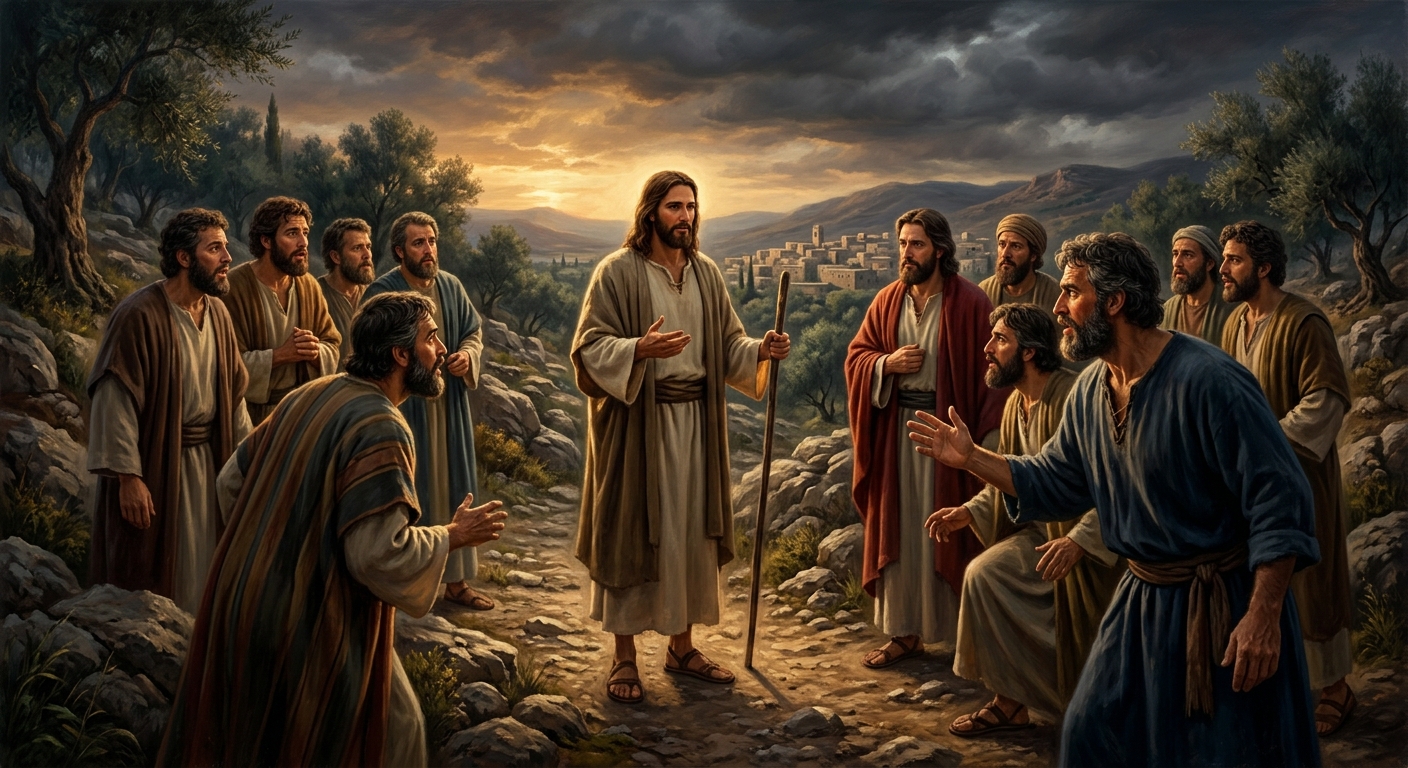
Illustration: Dramatic cinematic biblical illustration for Mark Chapter 8 showing Disciples' Faith in Christ's Identity, photorealistic oil painting style.
🔊
Listen to Chapter
Grace Notes Journey Audio Narration
Author
John Mark (Mark)
Written
~65-70 AD
Key Theme
Disciples' Faith in Christ's Identity
Setting
Bethsaida – after the feeding miracle
Key Verse
Mark 8:30
Total Verses
37
Chapter Introduction
_In the gentle hush of Bethsaida, Jesus gathers his weary followers. He sees their hunger—not just for food, but for the truth of who He is. With compassion, He asks them to look beyond the surface and recognize Him as the promised Messiah. This invitation is a tender call to trust, even when the road ahead seems uncertain._
Mark — Chapter 8 — KJV
1
In those days the multitude being very great, and having nothing to eat, Jesus called his disciples unto him, and saith unto them,
Simply PutIn this moment the crowd is huge—more than a few thousand souls—yet they have nothing to eat. Jesus summons his twelve closest followers (Greek κλῴω, G2915, means to call or invite personally) and tells them what’s on his mind. He’s about to show that divine provision isn’t limited by the size of the crowd, but by his compassion.
2
I have compassion on the multitude, because they have now been with me three days, and have nothing to eat:
Simply Put“Compassion” (Greek σπλαγχνίζομαι, G5404) is the deep feeling of a mother for her child. The disciples had been traveling with Jesus for three days, and the people were hungry and exhausted. This verse reminds us that God’s heart aches for those who are weak, no matter how far they’ve journeyed.
3
And if I send them away fasting to their own houses, they will faint by the way: for divers of them came from far.
Simply PutThe disciples suggest sending the people home “fasting” (Greek νηστεύω, G3588), meaning they would continue without food. They warn that many have come from far away and would faint on the road. Jesus is about to reveal a miracle that turns lack into abundance, so no one has to suffer the agony of hunger.
4
And his disciples answered him, From whence can a man satisfy these men with bread here in the wilderness?
Simply PutThe disciples ask, “From where can we feed these people in the wilderness?” (Greek ἄνθρωποι, G444, refers to ordinary human beings). Their question shows their limited perspective—they see only the desert’s emptiness, not God’s ability to fill it. It invites us to trust that God can provide even where resources seem impossible.
5
And he asked them, How many loaves have ye? And they said, Seven.
Simply PutJesus asks, “How many loaves do you have?” The disciples count seven (Greek ἄρτος, G752, meaning a loaf of bread). Seven is often a number of completeness in Scripture. The response shows that their supplies are meager, setting the stage for God’s power to multiply what little we have.
6
And he commanded the people to sit down on the ground: and he took the seven loaves, and gave thanks, and brake, and gave to his disciples to set before them; and they did set them before the people.
Simply PutJesus tells everyone to sit on the ground, then takes the seven loaves, gives thanks (Greek εὐχαριστέω, G2190), and breaks them. By breaking the loaves He shows that sharing is key to abundance; the disciples distribute them, and the people receive. This act reminds us that gratitude and generosity unlock God’s blessings.
7
And they had a few small fishes: and he blessed, and commanded to set them also before them.
Simply PutHe also blesses a few small fishes (Greek ἰχθὺς, G2481) and tells the disciples to set them before the crowd. Even a tiny fish becomes part of the feast when God’s hand is on it. The miracle teaches that no provision is too small to be used for God's purposes.
8
So they did eat, and were filled: and they took up of the broken meat that was left seven baskets.
9
And they that had eaten were about four thousand: and he sent them away.
Simply PutAfter eating, about four thousand men are satisfied—a massive crowd fed with just seven loaves and a few fish. Jesus then sends them away, sending them out refreshed and fed. This shows how divine provision can meet the needs of many when we trust in God’s power.
10
And straightway he entered into a ship with his disciples, and came into the parts of Dalmanutha.
Simply PutJesus and his disciples quickly board a boat and sail to Dalmanutha, a region on the Sea of Galilee. This movement reminds us that life’s journey often takes unexpected routes, and we must be ready to follow wherever He leads.
11
And the Pharisees came forth, and began to question with him, seeking of him a sign from heaven, tempting him.
Simply PutThe Pharisees approach Jesus, demanding a “sign” (Greek σῆμα, G4592) from heaven to test Him. They are trying to trap Jesus with a miracle that fits their own agenda, not seeking genuine truth. It shows how some people search for outward proof rather than a heart change.
12
And he sighed deeply in his spirit, and saith, Why doth this generation seek after a sign? verily I say unto you, There shall no sign be given unto this generation.
Simply PutJesus sighs deeply (Greek πνεῦμα, G4152, refers to the spirit) and wonders why this generation keeps looking for signs. He tells them that no new sign will be given because they already have the greatest one—His presence. This reminds us that the most powerful sign is simply encountering Christ.
13
And he left them, and entering into the ship again departed to the other side.
Simply PutHe leaves the Pharisees and boards the boat again, heading to the other side of the lake. This shows that when people reject God’s presence, He continues on His mission—always moving toward those who will receive Him.
14
Now the disciples had forgotten to take bread, neither had they in the ship with them more than one loaf.
15
And he charged them, saying, Take heed, beware of the leaven of the Pharisees, and of the leaven of Herod.
Simply PutJesus warns them to “beware of the leaven of the Pharisees and Herod.” Leaven (Greek ζύμη, G2222) is a metaphor for the hidden influence of false teaching and political power that can corrupt belief. He’s urging them to guard their hearts from subtle doctrines that might infiltrate and change the whole community.
16
And they reasoned among themselves, saying, It is because we have no bread.
Simply PutThe disciples misunderstand, thinking He’s talking about literal bread. This misunderstanding highlights how spiritual truths can be missed when we focus too narrowly on the material. It reminds us to seek the deeper meaning behind Jesus’ words rather than just the surface details.
17
And when Jesus knew it, he saith unto them, Why reason ye, because ye have no bread? perceive ye not yet, neither understand? have ye your heart yet hardened?
18
Having eyes, see ye not? and having ears, hear ye not? and do ye not remember?
Simply PutWith eyes to see and ears to hear, they still fail to grasp the truth. In Greek, "ears" (ous, G4160) and "eyes" (ophthalmos, G3829) symbolize our inner perception. Jesus reminds them that they have the tools of understanding but choose not to use them.
19
When I brake the five loaves among five thousand, how many baskets full of fragments took ye up? They say unto him, Twelve.
Simply PutWhen Jesus multiplied five loaves for five thousand, the people counted twelve full baskets of leftovers. The Greek word for "loaves" (artos, G791) reflects the sustenance that Jesus provides. Even in abundance, they remain puzzled about its deeper meaning.
20
And when the seven among four thousand, how many baskets full of fragments took ye up? And they said, Seven.
Simply PutWith seven loaves for four thousand, the people gathered seven full baskets of leftovers. Their counting shows they recognize a miracle but still lack the insight to see who Jesus truly is.
21
And he said unto them, How is it that ye do not understand?
Simply PutHe asks, "Why do you not understand?" The Greek word for "understand" (gnōsēte, G1115) conveys deep knowledge. He is frustrated that they can see miracles but fail to grasp the heart of His mission.
22
And he cometh to Bethsaida; and they bring a blind man unto him, and besought him to touch him.
Simply PutIn Bethsaida a blind man is brought before Jesus, and they "besought" (ephēma, G1998) Him to touch him. Their desperation reveals a yearning for sight—both physical and spiritual.
23
And he took the blind man by the hand, and led him out of the town; and when he had spit on his eyes, and put his hands upon him, he asked him if he saw ought.
Simply PutJesus takes the blind man’s hand, spits on his eyes (kōpōi, G2795), and lays His hands upon him. This humble act shows that healing often comes through lowly, intimate contact rather than grand gestures.
24
And he looked up, and said, I see men as trees, walking.
Simply PutThe man looks up and says he sees men like trees walking. In Greek, "men" (anthrōpous, G444) indicates limited perception; the blind man can sense presence but cannot yet see clearly.
25
After that he put his hands again upon his eyes, and made him look up: and he was restored, and saw every man clearly.
26
And he sent him away to his house, saying, Neither go into the town, nor tell it to any in the town.
Simply PutJesus sends him home without entering the town or telling anyone. The Greek word for "tell" (legēte, G3004) emphasizes a private, personal revelation rather than public proclamation.
27
And Jesus went out, and his disciples, into the towns of Caesarea Philippi: and by the way he asked his disciples, saying unto them, Whom do men say that I am?
Simply PutAs they travel to Caesarea Philippi, Jesus asks the disciples, "Whom do men say that I am?" The Greek phrase (ti legousin) probes the public’s perception of His identity.
28
And they answered, John the Baptist: but some say, Elias; and others, One of the prophets.
Simply PutThey answer, "John the Baptist; some say Elias (Elijah); others, one of the prophets." The mention of "Elias" (G2470) reflects Jewish expectations that the Messiah would be like Elijah.
29
And he saith unto them, But whom say ye that I am? And Peter answereth and saith unto him, Thou art the Christ.
Simply PutHe then asks them directly, "But whom say ye that I am?" Peter declares, "You are the Christ." The Greek word for "Christ" (Christos, G5547) means "the Anointed One," confirming Jesus' true identity.
30
And he charged them that they should tell no man of him.
Simply PutHe commands them not to tell anyone about Him. The Greek word for "charge" (entolē, G1744) implies a serious instruction to keep the revelation private for now.
31
And he began to teach them, that the Son of man must suffer many things, and be rejected of the elders, and of the chief priests, and scribes, and be killed, and after three days rise again.
Simply PutJesus begins teaching about what lies ahead: the Son of Man must suffer (dei, G1325) many things, be rejected by elders and priests, be killed, and rise again after three days. The word for "suffer" (paschō, G3932) points to the necessary sacrifice that brings redemption.
32
And he spake that saying openly. And Peter took him, and began to rebuke him.
Simply PutPeter, in his haste and love for Jesus, started to rebuke Him. The Greek word here, precheirizomai (G4265), means to scold or rebuke. Peter’s sudden rush of emotion shows how often our hearts can leap ahead of God's timing, especially when we’re scared or confused.
33
But when he had turned about and looked on his disciples, he rebuked Peter, saying, Get thee behind me, Satan: for thou savourest not the things that be of God, but the things that be of men.
Simply PutJesus turned and rebuked Peter, calling him "Satan" (Greek: Σατανάς, G4563), which means an adversary or one who tempts. He warned that Peter was thinking about human concerns—comfort, reputation—rather than the divine purpose God had set for Him. In moments of doubt, we must check whether our worries are rooted in God's plan or merely the opinions of people.
34
And when he had called the people unto him with his disciples also, he said unto them, Whosoever will come after me, let him deny himself, and take up his cross, and follow me.
Simply PutJesus gathered His followers and said, “Whoever wants to follow Me must deny himself (Greek: ἀποσαλεύω, G571), pick up his cross (Greek: σταυρός, G4982), and follow.” This isn’t about a literal wooden cross but taking on the hardships God places before us. For those in pain, it means trusting that following Christ may involve sacrifice and loss, but it's the path to real peace.
35
For whosoever will save his life shall lose it; but whosoever shall lose his life for my sake and the gospel’s, the same shall save it.
Simply Put“Whoever wants to keep his life will lose it, but whoever’s willing to lose his life for My sake and the gospel (Greek: εὐαγγέλιον, G2095) will find true life.” Life is deeper than the length of days; it’s about living in God’s purpose. If you're feeling empty, give up your selfish plans and submit to the One who knows what's truly best for you.
36
For what shall it profit a man, if he shall gain the whole world, and lose his own soul?
Simply Put“What good is it if a man gains the whole world (Greek: κτῆναι τὸν κόσμον, G2885) but loses his soul?” A career, wealth, or fame might seem important, but they mean nothing if your heart is far from God. If you’re chasing success, remember that true worth comes from being right with the Creator.
37
Or what shall a man give in exchange for his soul?
Simply Put“What can anyone give in exchange for his soul?” The soul is priceless—no amount of money or status can replace it. When you feel the pressure to compromise, remember that nothing on earth can redeem a soul unless God does.
38
Whosoever therefore shall be ashamed of me and of my words in this adulterous and sinful generation; of him also shall the Son of man be ashamed, when he cometh in the glory of his Father with the holy angels.
Simply Put“Anyone who is ashamed of me and my words in this adulterous (Greek: πορνικοί, G4060) and sinful generation will be made ashamed by the Son of Man (Christ) when He comes in the glory of His Father with holy angels.” If you hide your faith out of fear, you risk being humbled when Christ returns. For those doubting, know that genuine faith is a bright testimony before the world.
Mark 6:30-44This earlier miracle of feeding the five thousand prefigures the later feeding of four thousand, highlighting Jesus' consistent provision and authority over nature.
Matthew 15:32-39Matthew's parallel account of feeding the four thousand confirms the historic reliability and expands on the details, such as the number of baskets left over.
Luke 9:12-17Luke's narrative of the five thousand feeding shares structural elements, underscoring the theme of compassion and divine multiplication across the Synoptic Gospels.
Exodus 16:4-36The Israelites' experience of manna in the wilderness serves as a typological foreshadowing of Christ's miraculous feeding, emphasizing God's sustenance for His people.
Reflect
Reflecting on how seven loaves fed four thousand, what simple act of generosity you could offer today might become the unexpected “baskets full” that meets a need in your family or community?