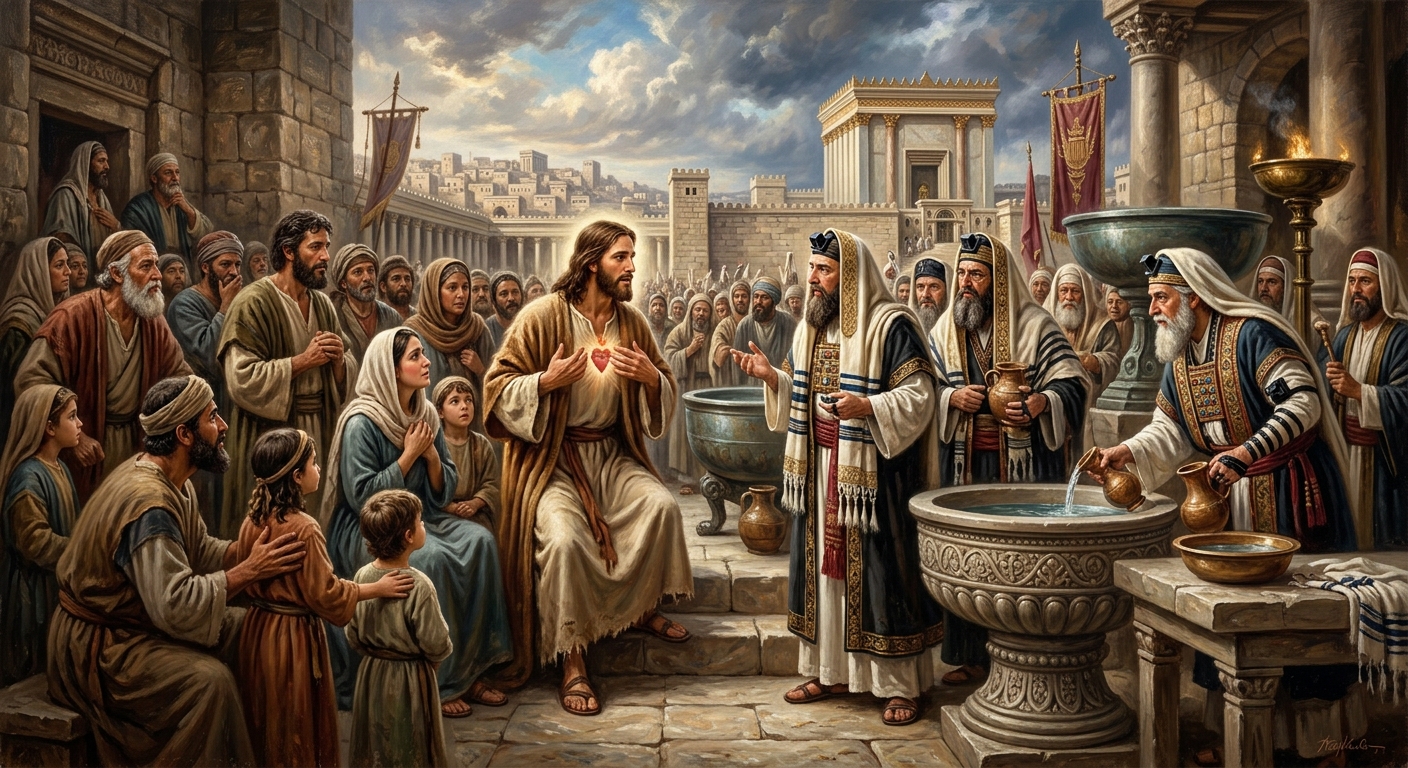
Illustration: Dramatic cinematic biblical illustration for Mark Chapter 7 showing Heart purity over external rituals, photorealistic oil painting style.
🔊
Listen to Chapter
Grace Notes Journey Audio Narration
Author
John Mark
Written
~65-70 AD
Key Theme
Heart purity over external rituals
Setting
Galilee - near the marketplace
Key Verse
Mark 7:9
Total Verses
36
Chapter Introduction
*In this tender encounter, Jesus gently pulls the veil from our eyes, revealing that true worship springs not from washed hands but from a heart softened by love. He reminds us that the weight of tradition is light when carried on the shoulders of grace, and that the divine appetite is for sincerity over ceremony. May we lay aside our own rituals of self-righteousness and walk humbly before the Lord, trusting in His mercy.*
Mark — Chapter 7 — KJV
1
Then came together unto him the Pharisees, and certain of the scribes, which came from Jerusalem.
2
And when they saw some of his disciples eat bread with defiled, that is to say, with unwashen, hands, they found fault.
3
For the Pharisees, and all the Jews, except they wash their hands oft, eat not, holding the tradition of the elders.
4
And when they come from the market, except they wash, they eat not. And many other things there be, which they have received to hold, as the washing of cups, and pots, brasen vessels, and of tables.
5
Then the Pharisees and scribes asked him, Why walk not thy disciples according to the tradition of the elders, but eat bread with unwashen hands?
6
He answered and said unto them, Well hath Esaias prophesied of you hypocrites, as it is written, This people honoureth me with their lips, but their heart is far from me.
7
Howbeit in vain do they worship me, teaching for doctrines the commandments of men.
8
For laying aside the commandment of God, ye hold the tradition of men, as the washing of pots and cups: and many other such like things ye do.
9
And he said unto them, Full well ye reject the commandment of God, that ye may keep your own tradition.
10
For Moses said, Honour thy father and thy mother; and, Whoso curseth father or mother, let him die the death:
11
But ye say, If a man shall say to his father or mother, It is Corban, that is to say, a gift, by whatsoever thou mightest be profited by me; he shall be free.
12
And ye suffer him no more to do ought for his father or his mother;
13
Making the word of God of none effect through your tradition, which ye have delivered: and many such like things do ye.
14
And when he had called all the people unto him, he said unto them, Hearken unto me every one of you, and understand:
15
There is nothing from without a man, that entering into him can defile him: but the things which come out of him, those are they that defile the man.
16
If any man have ears to hear, let him hear.
17
And when he was entered into the house from the people, his disciples asked him concerning the parable.
Simply PutThe Greek word here, eisō (G1510), means “to enter.” When Jesus walked into the house, His disciples were still grappling with the lesson He’d just taught about food and purity. Their question shows they wanted a clear picture of how the heart’s condition mattered more than outward rituals.
18
And he saith unto them, Are ye so without understanding also? Do ye not perceive, that whatsoever thing from without entereth into the man, it cannot defile him;
Simply PutThe Greek term for “without understanding” is sunistēmi (G4710). Jesus turns their confusion into a lesson: things that come “from without” – like what we eat – cannot make us unclean unless they affect our inner being. He’s reminding them that true purity starts in the heart, not on the plate.
19
Because it entereth not into his heart, but into the belly, and goeth out into the draught, purging all meats?
Simply PutHere “heart” is kardia (G2588) and “belly” is koili (G2824). Jesus explains that food passes through the stomach and is expelled, never staying in the heart. The point for us is that external experiences only matter when we let them shape our inner thoughts.
20
And he said, That which cometh out of the man, that defileth the man.
Simply PutThe phrase “that which comes out of the man” (ek tou anthropou, G157) flips the earlier idea. It’s not what we eat that defiles us, but what we emit from our hearts – our words and actions. This teaches that inner character determines outward righteousness.
21
For from within, out of the heart of men, proceed evil thoughts, adulteries, fornications, murders,
Simply Put“Evil thoughts” is dyslogia (G1406), and “heart” remains kardia (G2588). Jesus says sin starts inside us, with thoughts that lead to adultery, murder, and more. In real life, this reminds us to guard our minds, for they are the wellspring of all deeds.
Simply Put“Covetousness” is epithymia (G1905) and “wickedness” is kakía (G2582). These are the first fruits of a heart turned away from God. The list shows that every destructive habit begins as an internal desire, urging us to seek inner renewal.
23
All these evil things come from within, and defile the man.
Simply Put“Evil” (kakos, G2583) and “defile” highlight that the true source of impurity is within. No external rule can cleanse a heart stained by sin; only God’s grace can transform it from the inside out.
24
And from thence he arose, and went into the borders of Tyre and Sidon, and entered into an house, and would have no man know it: but he could not be hid.
Simply PutThe Greek word for “arose” is anistēmi (G276), and “hid” is krypō (G2913). Jesus goes to Tyre and Sidon, trying to hide His presence in a house, yet He cannot be concealed. This shows that God’s purpose will shine through no matter where we go.
25
For a certain woman, whose young daughter had an unclean spirit, heard of him, and came and fell at his feet:
26
The woman was a Greek, a Syrophenician by nation; and she besought him that he would cast forth the devil out of her daughter.
Simply Put“Greek” (Hellēn, G5542) and “Syrophenician” (Phoinikes, G5405) identify the woman’s cultural background. Though she was a Gentile, she sought Jesus’ help for her daughter. This reminds us that the Savior’s love reaches beyond any boundary.
27
But Jesus said unto her, Let the children first be filled: for it is not meet to take the children’s bread, and to cast it unto the dogs.
Simply Put“Children” (tekna, G5043) and “dogs” (kynes, G2967) serve as a metaphor for those who are considered “insiders” and “outsiders.” Jesus says the children must be fed first, but He never meant to exclude the dogs. The lesson is that God’s mercy expands when we recognize our own need.
28
And she answered and said unto him, Yes, Lord: yet the dogs under the table eat of the children’s crumbs.
Simply Put“Crumbs” (psēma, G4473) represents even the smallest portion of grace. The woman’s humble reply shows her faith that even a bit will suffice for her daughter. Her persistence teaches us to trust in God’s provision, no matter how limited it seems.
29
And he said unto her, For this saying go thy way; the devil is gone out of thy daughter.
Simply Put“Go” (poreuomai, G4182) signals a command of faith. Jesus affirms her faith and declares the demon cast out. For anyone in need, this verse assures that belief can bring liberation.
30
And when she was come to her house, she found the devil gone out, and her daughter laid upon the bed.
Simply Put“Laid” (kathēskō, G2885) describes the daughter’s peaceful state after healing. The word “devil” being gone indicates a complete victory over spiritual oppression. This demonstrates that true healing restores both body and spirit.
31
And again, departing from the coasts of Tyre and Sidon, he came unto the sea of Galilee, through the midst of the coasts of Decapolis.
Simply Put“Departing” (katapto, G2596) and “sea” (thalassa, G2295) show Jesus moving from the Gentile regions to Galilee. His journey reminds us that even after ministering to others, He returns to the places where He began. The story encourages us to follow wherever God leads, trusting in His ongoing work.
32
And they bring unto him one that was deaf, and had an impediment in his speech; and they beseech him to put his hand upon him.
Simply PutIn this scene, the man is “deaf” (Greek mkros, G3328) and his speech is tangled. The Greek speaks of hearing not just as a physical sense but as the heart’s ability to listen to God. The people bring him to Jesus with hope that He can unclog what’s stuck inside, both ears and tongue.
33
And he took him aside from the multitude, and put his fingers into his ears, and he spit, and touched his tongue;
Simply PutJesus takes the man away from the crowd, puts his fingers (Greek xyris, G3072) into the man's ears, spits on his tongue (Greek kyruxai, G2880), and touches it. This tactile method shows that healing begins with a personal touch—God reaches out into our brokenness, not from afar.
34
And looking up to heaven, he sighed, and saith unto him, Ephphatha, that is, Be opened.
Simply PutLooking up to heaven, Jesus sighs and says “Ephphatha” (Greek aphthesis, G562), meaning “be opened.” The sigh is a prayerful breath; the command opens not only ears but also the soul, inviting divine light to flood in where there has been darkness.
35
And straightway his ears were opened, and the string of his tongue was loosed, and he spake plain.
Simply PutInstantly the man’s ears are opened and his tongue is loosed (Greek glossa, G1105), so he “spake plain.” This sudden freedom is a reminder that when God restores us, He lets us speak the truth of our gratitude without stammering or fear.
36
And he charged them that they should tell no man: but the more he charged them, so much the more a great deal they published it;
Simply PutJesus tells them “Tell no one,” yet the more He asks, the louder they proclaim. The Greek word for charge (ephain, G1804) and the idea of publishing (dokimazo, G1415) show that divine truth cannot be contained; it spills over into the world.
37
And were beyond measure astonished, saying, He hath done all things well: he maketh both the deaf to hear, and the dumb to speak.
Simply PutThe crowd is “astonished” (Greek thauma, G2358), saying He makes the deaf hear and the mute speak. The word “mute” (aphonos, G571) refers to someone without voice; here God gives them a new story—a chance to speak the name of the Savior.