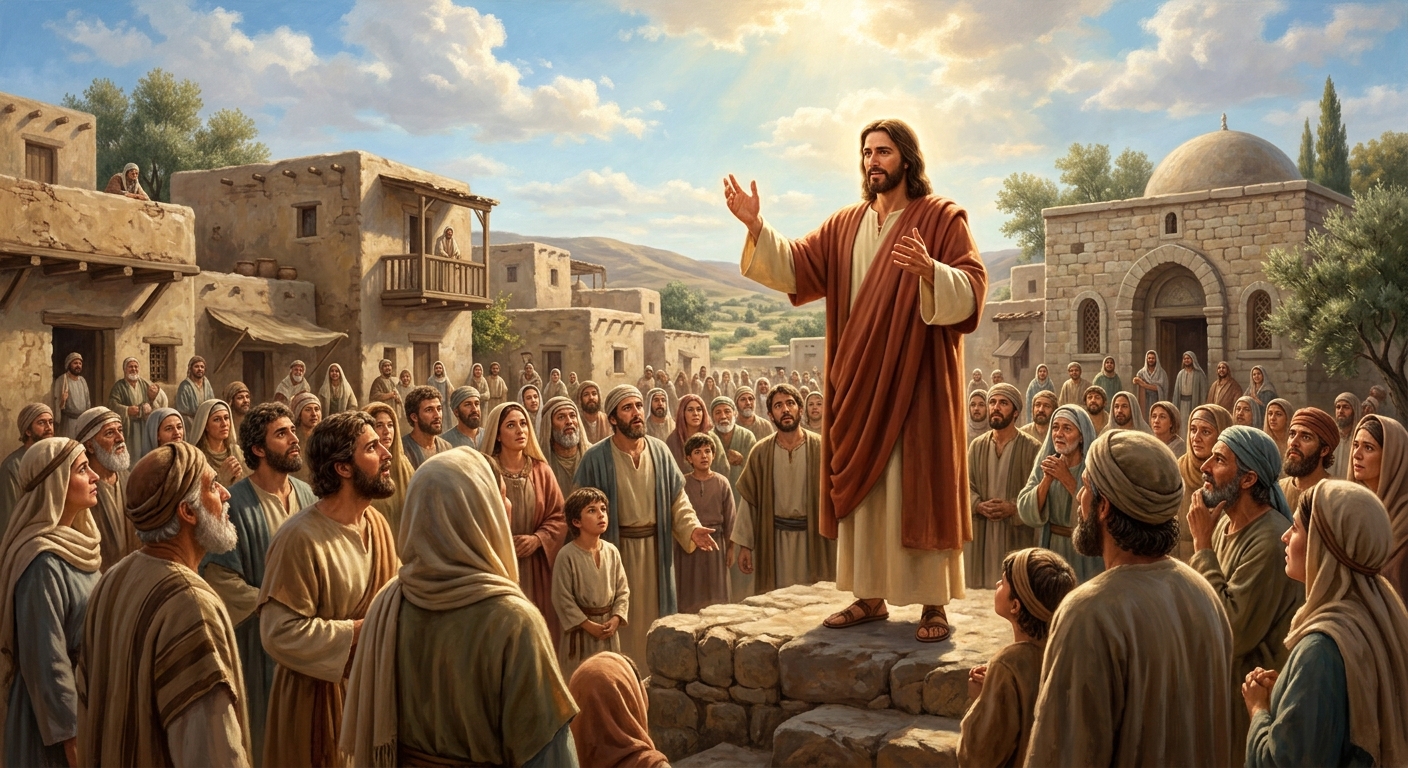
Illustration: A photorealistic oil painting of Jesus standing before the bustling crowd in Nazareth, his hands raised as he preaches with compassion, surrounded by humble stone houses and a modest synagogue under a bright azure sky, while villagers in simple linen garments listen with awe and skepticism; dramatic golden sunlight streams through the clouds, casting warm highlights on his face and robes, creating deep shadows that emphasize the tension between reverence and doubt in their eyes, with a cinematic depth of field that pulls the viewer into the intimate moment of faith and honor in his homeland.
🔊
Listen to Chapter
Grace Notes Journey Audio Narration
Author
John Mark
Written
~68 AD
Key Theme
Faith and Honor in One's Homeland
Setting
Nazareth - Sabbath Teaching
Key Verse
Mark 6:6
Total Verses
56
Chapter Introduction
*When He stepped back into the humble lanes of Nazareth, the Son of God walked among those who knew Him as a carpenter. Yet even in His own home, the hearts of many were closed to the miracle He offered. This chapter reminds us that true honor comes from recognizing God's work, even when it seems small or ordinary. May we be ever ready to receive the Savior's grace where He meets us, in our own familiar places.*
Mark — Chapter 6 — KJV
1
And he went out from thence, and came into his own country; and his disciples follow him.
Simply PutJesus left Nazareth and returned to the place where He grew up. Though His disciples walked with Him, they were still strangers to those who knew Him as just a carpenter’s son.
2
And when the sabbath day was come, he began to teach in the synagogue: and many hearing him were astonished, saying, From whence hath this man these things? and what wisdom is this which is given unto him, that even such mighty works are wrought by his hands?
Simply PutWhen the Sabbath arrived, He taught in the synagogue. The Greek word for "astonished" (thaumazo, G2300) captures the awe of the crowd as they wondered, “Where does this man’s wisdom come from? How can He perform such mighty works?”
3
Is not this the carpenter, the son of Mary, the brother of James, and Joses, and of Juda, and Simon? and are not his sisters here with us? And they were offended at him.
Simply PutThe people asked, “Isn’t this the carpenter’s son? Isn’t He a brother of James and Joses, and are His sisters here with us?” Their doubt turned into scandal (the Greek word "skandalizō," G4599), meaning they were offended and refused to see Him as more than a local boy.
4
But Jesus said unto them, A prophet is not without honour, but in his own country, and among his own kin, and in his own house.
Simply PutJesus replied, “A prophet is not without honor, but in his own country, among his own kin, and at home, he faces skepticism.” He acknowledges that those closest to Him often doubt Him the most.
5
And he could there do no mighty work, save that he laid his hands upon a few sick folk, and healed them.
Simply PutIn Nazareth, He could only heal a few sick people by laying His hands on them. This shows that even in familiar surroundings, the power of God is still at work, though it may be limited by unbelief.
6
And he marvelled because of their unbelief. And he went round about the villages, teaching.
Simply PutHe marveled at their lack of faith, then traveled through the villages teaching. The Greek word for "marveled" (thaumazō, G2300) reflects His disappointment that they missed the miracle of simply believing.
7
And he called unto him the twelve, and began to send them forth by two and two; and gave them power over unclean spirits;
Simply PutHe called the twelve disciples and sent them out in pairs, giving them authority over unclean spirits. This empowerment reminds us that God’s work isn’t done alone but through those He appoints.
8
And commanded them that they should take nothing for their journey, save a staff only; no scrip, no bread, no money in their purse:
Simply PutJesus instructed them to travel light, taking only a staff and sandals. The Greek word for "money" (nomisma, G3546) signifies even a tiny brass coin—yet He told them to rely on God’s provision, not on material wealth.
9
But be shod with sandals; and not put on two coats.
Simply PutHe emphasized that they should wear sandals and a single coat, trusting in God’s care rather than being burdened by excess.
10
And he said unto them, In what place soever ye enter into an house, there abide till ye depart from that place.
Simply Put“Stay wherever you enter a house until you leave that place.” This teaches them to focus on the task at hand, fully serving each household before moving on.
11
And whosoever shall not receive you, nor hear you, when ye depart thence, shake off the dust under your feet for a testimony against them. Verily I say unto you, It shall be more tolerable for Sodom and Gomorrha in the day of judgment, than for that city.
Simply Put“If you are not welcomed or heard, shake the dust off your feet as a testimony against them.” The Greek word "marturía" (G3143) means “witness” or “testimony.” Jesus warns that rejecting the Gospel carries weight in God’s judgment.
12
And they went out, and preached that men should repent.
Simply PutThey went out and preached that people should repent—turning away from their old ways to embrace God’s forgiveness.
13
And they cast out many devils, and anointed with oil many that were sick, and healed them.
Simply PutThey cast out many demons and healed the sick with oil. Their ministry showed that repentance and divine healing go hand in hand.
14
And king Herod heard of him; (for his name was spread abroad:) and he said, That John the Baptist was risen from the dead, and therefore mighty works do shew forth themselves in him.
Simply PutKing Herod heard of Jesus, saying that John the Baptist had risen from the dead and now mighty works were evident in Him. The Greek word "drasthai" (G1140) means “to show forth,” indicating Herod’s recognition of miraculous signs.
15
Others said, That it is Elias. And others said, That it is a prophet, or as one of the prophets.
Simply PutOthers debated whether Jesus was Elijah, a prophet, or one of the prophets. The people’s speculation reflects their struggle to grasp who He truly was amidst His wondrous deeds.
16
But when Herod heard thereof, he said, It is John, whom I beheaded: he is risen from the dead.
Simply PutHerod had heard that John’s beheading was a tragic end, but he claimed the dead man had risen again. The Greek word for “risen” (egeiro, G1081) speaks of a new beginning, suggesting that even in death there can be hope. For anyone crushed by loss, this verse reminds us that God’s story doesn’t end with the grave but begins anew.
17
For Herod himself had sent forth and laid hold upon John, and bound him in prison for Herodias’ sake, his brother Philip’s wife: for he had married her.
Simply PutHerod imprisoned John because of his marriage to Herodias, the wife of his brother Philip. The Greek verb “bound” (desmeuō, G1133) conveys a tight, restrictive grip—John’s freedom was cut off to protect Herod’s reputation. It shows how worldly fears can imprison the voice of righteousness, and it invites us to examine what holds our own prayers captive.
18
For John had said unto Herod, It is not lawful for thee to have thy brother’s wife.
Simply PutJohn told Herod that it was unlawful for him to marry his brother’s wife. The word “lawful” (nomos, G3565) refers to the moral order God set for marriage and family. For those wrestling with sin, this reminds us that divine standards are unchangeable; they protect the heart’s integrity against selfish desire.
19
Therefore Herodias had a quarrel against him, and would have killed him; but she could not:
Simply PutHerodias harbored an inward grudge (Greek “diakrisis,” G1342) against John and plotted his death. A hidden grudge can fester into murderous intent, showing how bitterness quietly corrupts the soul. If you feel a lingering resentment, this verse warns that unaddressed anger may lead to devastating actions.
20
For Herod feared John, knowing that he was a just man and an holy, and observed him; and when he heard him, he did many things, and heard him gladly.
Simply PutHerod feared John because he recognized him as a righteous and holy man. The Greek “feared” (phobēō, G527) isn’t just terror—it’s a reverent awe of God’s moral authority. In moments of doubt, we can trust that the righteous fear of God can protect us even when worldly powers threaten.
21
And when a convenient day was come, that Herod on his birthday made a supper to his lords, high captains, and chief estates of Galilee;
Simply PutOn his birthday, Herod hosted a grand banquet for the lords and chief officials of Galilee. This setting reminds us that behind lavish celebrations can lie hidden dangers, as power often chooses its moment to act.
22
And when the daughter of the said Herodias came in, and danced, and pleased Herod and them that sat with him, the king said unto the damsel, Ask of me whatsoever thou wilt, and I will give it thee.
Simply PutWhen Herodias’s daughter danced and pleased the guests, Herod offered her any request. The Greek “asked” (aiteō, G154) reflects a moment of vulnerability—she could ask for anything. It shows how opportunities to request the impossible often arise when we least expect them.
23
And he sware unto her, Whatsoever thou shalt ask of me, I will give it thee, unto the half of my kingdom.
Simply PutHerod swore he would grant her request, even promising half his kingdom. The Greek “swore” (homaióō, G3683) underscores the seriousness of his pledge; he felt bound by honor. It warns that empty vows can lead to grave consequences when broken.
24
And she went forth, and said unto her mother, What shall I ask? And she said, The head of John the Baptist.
Simply PutThe girl’s mother instructed her to ask for John the Baptist’s head. “Head” (kephalē, G2810) symbolizes authority and life itself; cutting it off is the ultimate act of silencing a prophet. It deepens the horror of using power to destroy God’s voice.
25
And she came in straightway with haste unto the king, and asked, saying, I will that thou give me by and by in a charger the head of John the Baptist.
Simply PutThe girl demanded John’s head on a platter, demanding it “by and by.” The Greek “charger” (phorá, G5404) refers to a serving dish—a reminder of how the sacred can be turned into mere spectacle. It reveals how the thirst for drama can eclipse compassion.
26
And the king was exceeding sorry; yet for his oath’s sake, and for their sakes which sat with him, he would not reject her.
Simply PutHerod felt great sorrow, yet he kept his oath for the sake of his guests. The Greek “sorrow” (lupē, G3101) shows a conflicted heart torn between grief and duty. It reminds us that pain often coexists with responsibility.
27
And immediately the king sent an executioner, and commanded his head to be brought: and he went and beheaded him in the prison,
Simply PutHerod quickly sent an executioner to behead John in prison. This swift, grim command illustrates the ruthless efficiency of power when it feels threatened. For those facing injustice, it highlights how quickly truth can be silenced.
28
And brought his head in a charger, and gave it to the damsel: and the damsel gave it to her mother.
Simply PutThe head was placed on a platter and given to the girl, who then gave it to her mother. The physical act of presenting a severed head underscores how grief is often turned into a tangible warning for others.
29
And when his disciples heard of it, they came and took up his corpse, and laid it in a tomb.
Simply PutJohn’s disciples heard the news, retrieved his body, and laid it in a tomb. Their devotion shows that even after death, love persists; they honored his legacy despite the tragedy.
30
And the apostles gathered themselves together unto Jesus, and told him all things, both what they had done, and what they had taught.
Simply PutThe apostles gathered around Jesus and shared everything they had seen and learned. In the face of loss, it’s through community and testimony that the Gospel continues to grow.
31
And he said unto them, Come ye yourselves apart into a desert place, and rest a while: for there were many coming and going, and they had no leisure so much as to eat.
Simply PutJesus tells them to go into the "desert place" (Greek eremia, G721), a quiet spot away from crowds. He urges them to "rest" (Greek anapausis, G277), a true pause from the relentless rush of people coming and going. If you're feeling overwhelmed, this is an invitation to step back into solitude where your soul can breathe.
32
And they departed into a desert place by ship privately.
Simply PutThe disciples "departed privately" (Greek kryptē, G2880), slipping away in secret. This secrecy protects them from the constant demands of the crowd, allowing for a rare moment of intimacy with the Lord. In your own life, sometimes you need to retreat quietly, away from noise, to hear God's whisper.
33
And the people saw them departing, and many knew him, and ran afoot thither out of all cities, and outwent them, and came together unto him.
Simply PutWhen the people saw them leaving, "many knew him" (Greek eiden, G1492) and ran afoot (Greek trechōs, G5043). Their desperate footfall shows the hunger for Jesus that transcended city walls. If you ever feel a pull to chase after something, remember this: the crowd was moving with purpose toward the One who could satisfy their deepest needs.
34
And Jesus, when he came out, saw much people, and was moved with compassion toward them, because they were as sheep not having a shepherd: and he began to teach them many things.
Simply PutJesus "was moved with compassion" (Greek splagchnizomai, G5594), feeling the deep pain of those like "sheep without a shepherd" (Greek poimen, G4165). He sees them as lost and vulnerable, and His heart overflows to guide and protect. For anyone feeling alone or wandering, this verse assures you that Christ's love knows your exact condition and draws near to lead.
35
And when the day was now far spent, his disciples came unto him, and said, This is a desert place, and now the time is far passed:
Simply PutAs evening deepened, the disciples point out that "the day was far spent". Their concern for logistics reflects a real worry about the crowd's needs. Even when time seems short, remember that God's timing isn't bound by our schedules; He often works in the moments we think are too late.
36
Send them away, that they may go into the country round about, and into the villages, and buy themselves bread: for they have nothing to eat.
Simply PutThe disciples suggest sending the people away to buy bread, highlighting their "nothing to eat" (Greek kenon). Their plan reveals a lack of trust in God's provision. In moments of scarcity, this is a call to ask God first for the miracle that could meet everyone's needs.
37
He answered and said unto them, Give ye them to eat. And they say unto him, Shall we go and buy two hundred pennyworth of bread, and give them to eat?
Simply PutJesus challenges them, "Give ye them to eat," and they worry about buying "two hundred pennyworth of bread". Their question shows human doubt—thinking the miracle is in money, not faith. The lesson: the size of your resources doesn't limit God's ability to multiply them.
38
He saith unto them, How many loaves have ye? go and see. And when they knew, they say, Five, and two fishes.
Simply PutJesus asks, "How many loaves have ye?" and they find five loaves and two fishes. In the midst of scarcity, this small amount becomes the seed for a greater miracle. If you have even a little to offer, trust that God can use it to feed many.
39
And he commanded them to make all sit down by companies upon the green grass.
Simply PutHe instructs them to make everyone sit down by "companies" on the green grass. The word for groups (Greek koinōnoi) emphasizes community and shared space. This reminds us that God's blessings are often distributed in fellowship, not isolation.
40
And they sat down in ranks, by hundreds, and by fifties.
Simply PutThe people sit down "by hundreds and by fifties". These numbers (Greek ekkathē) show a structured order that allows for efficient distribution. Even in chaos, God's kingdom brings harmony and balance.
41
And when he had taken the five loaves and the two fishes, he looked up to heaven, and blessed, and brake the loaves, and gave them to his disciples to set before them; and the two fishes divided he among them all.
Simply PutJesus takes the five loaves and two fishes, looks up to heaven, blesses (Greek eulogēn, G2101), and breaks them. The divine blessing transforms ordinary food into a miracle that reaches everyone. When you lift your eyes to God and give thanks, He can multiply your gifts beyond what you see.
42
And they did all eat, and were filled.
Simply PutAll ate and were filled. The Greek word for "filled" (plēroumen, G4210) indicates a complete satisfaction that goes beyond hunger. In your deepest emptiness, this verse promises that Christ's provision can fully satisfy both body and spirit.
43
And they took up twelve baskets full of the fragments, and of the fishes.
Simply PutThe disciples collect twelve full baskets of leftovers. This abundance (Greek skēphos, G4599) signals God's generosity and the overflow that follows His provision. Even after your needs are met, God leaves you with more than enough to share.
44
And they that did eat of the loaves were about five thousand men.
Simply PutAbout five thousand men ate from the loaves. The sheer number underscores the scale of God's compassion, reaching thousands with a simple miracle. If you think your influence is small, know that God can use even modest acts to affect many lives.
45
And straightway he constrained his disciples to get into the ship, and to go to the other side before unto Bethsaida, while he sent away the people.
Simply PutJesus urges his disciples to get into the boat and go ahead, while He sends away the people. This "constrained" (Greek parēgō, G3949) command shows a purposeful separation—Jesus continues His ministry elsewhere. Remember that God sometimes calls us to step away from crowds to pursue a deeper, personal mission.
46
And when he had sent them away, he departed into a mountain to pray.
Simply PutJesus sent his disciples away and then climbed a mountain to pray. The Greek word for “prayed,” proseuchomai (G4332), means to speak with God in deep reverence. Even the Son of Man needed that quiet time alone with His Father, showing us how vital it is to step away from the crowd and talk to God.
47
And when even was come, the ship was in the midst of the sea, and he alone on the land.
Simply PutWhen the evening came, everyone was still on the boat while Jesus remained alone on the shore. The Greek word “alone,” monos (G3450), emphasizes his solitude, a reminder that even when we feel isolated in our trials, God is with us in the quiet places.
48
And he saw them toiling in rowing; for the wind was contrary unto them: and about the fourth watch of the night he cometh unto them, walking upon the sea, and would have passed by them.
Simply PutHe saw his disciples struggling against a contrary wind—pneuma (G4152), the breath or spirit of God. At the fourth watch, he walked on the sea, a startling display that He controls both nature and spirit alike. It reminds us that when life feels chaotic, God can step into our storms and bring calm.
49
But when they saw him walking upon the sea, they supposed it had been a spirit, and cried out:
Simply PutSeeing Jesus walking on the water, they thought it must be a spirit (pneuma) and shouted in fear. Their reaction shows how we often mistake the presence of God for something unknown or frightening when we don’t recognize His work.
50
For they all saw him, and were troubled. And immediately he talked with them, and saith unto them, Be of good cheer: it is I; be not afraid.
Simply Put“Be of good cheer!” (euphrosune, G2159) He says, “It is I; be not afraid.” In the midst of panic, Jesus brings joy and assurance. His presence turns fear into confidence.
51
And he went up unto them into the ship; and the wind ceased: and they were sore amazed in themselves beyond measure, and wondered.
Simply PutWhen he got onto the boat, the wind ceased (sthenē, G4596), and they were amazed beyond measure. Their astonishment (ekstasis) reveals how powerful God’s peace can be—stilling the storms that rage around us.
52
For they considered not the miracle of the loaves: for their heart was hardened.
Simply PutYet they failed to grasp the miracle of the loaves because their hearts were hardened (sklerō, G4605). They missed the deeper lesson that God’s provision isn’t just food for the body but nourishment for the soul.
53
And when they had passed over, they came into the land of Gennesaret, and drew to the shore.
Simply PutAfter crossing the sea, they arrived at Gennesaret. The land of abundance opened up for them to continue their journey with fresh hope.
54
And when they were come out of the ship, straightway they knew him,
Simply PutAs soon as they stepped out of the boat, they immediately recognized him (ginōskō, G1094). Their eyes were opened to the reality of his presence and power.
55
And ran through that whole region round about, and began to carry about in beds those that were sick, where they heard he was.
Simply PutThe people ran everywhere, carrying the sick on beds to wherever they heard he was. Their desperate faith shows how far people would go for a touch of the Messiah’s healing.
56
And whithersoever he entered, into villages, or cities, or country, they laid the sick in the streets, and besought him that they might touch if it were but the border of his garment: and as many as touched him were made whole.
Simply PutIn every village, city, and countryside, they lay the sick in the streets and begged to touch even the fringe (homo, G5605) of his garment. Their belief that a simple touch could bring wholeness reminds us that faith in Christ’s power can reach even the smallest part of his life.