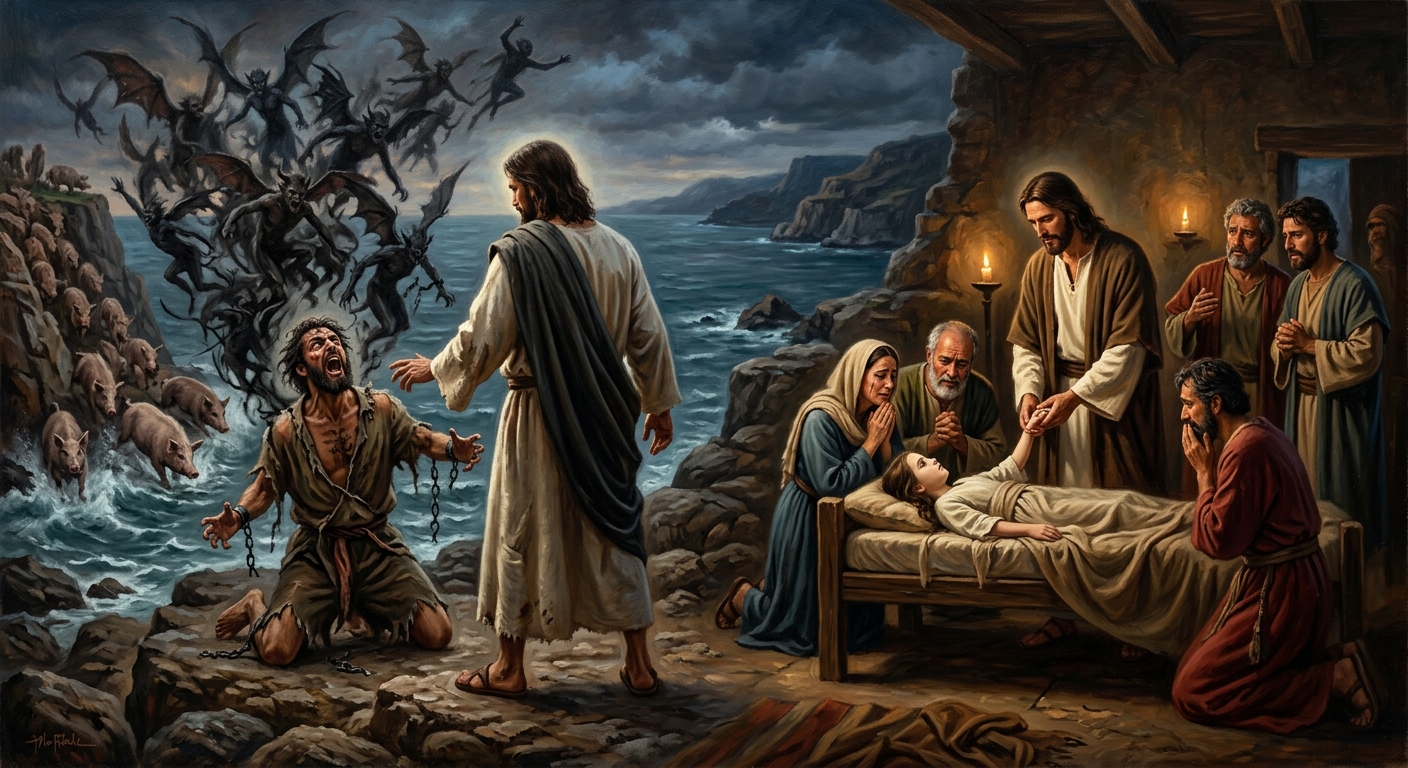
Illustration: Dramatic cinematic biblical illustration for Mark Chapter 5 showing Power over Demons and Death, photorealistic oil painting style.
🔊
Listen to Chapter
Grace Notes Journey Audio Narration
Author
John Mark
Written
~AD 55-70
Key Theme
Power over Demons and Death
Setting
Gadarenes, Sea of Galilee
Key Verse
Mark 5:9
Total Verses
43
Chapter Introduction
*In this chapter we witness the tender compassion of Christ as He meets a tormented soul, liberating him from chains that had bound his flesh and spirit. The man's desperate cries echo the yearning of every heart longing for freedom, and Jesus' gentle command brings a new dawn of peace. As He restores the man to his home, we too are called to share this grace with those around us. Let this story remind you that no darkness is too deep for the Light of Christ.*
Mark — Chapter 5 — KJV
1
And they came over unto the other side of the sea, into the country of the Gadarenes.
Simply PutThe disciples have crossed the sea and entered a new region, the country of the Gadarenes. This “other side” marks a step into unfamiliar territory—much like stepping out of our comfort zone into the unknown where God might be waiting.
2
And when he was come out of the ship, immediately there met him out of the tombs a man with an unclean spirit,
Simply PutAs soon as Jesus steps onto land, a man tormented by an “unclean spirit” (Greek: ἀκάθαρτος) confronts Him. The immediacy of this encounter reminds us that when we seek Jesus, the broken parts of our life will often meet Him first.
3
Who had his dwelling among the tombs; and no man could bind him, no, not with chains:
Simply PutThis man lives among tombs, a place of death, and no one can bind him with “chains” (Greek: δεσμοί). It shows how deep despair can feel like a prison that even the strongest human measures cannot lock down.
4
Because that he had been often bound with fetters and chains, and the chains had been plucked asunder by him, and the fetters broken in pieces: neither could any man tame him.
Simply PutThough he has been bound many times, the “fetters” (Greek: ζυγός) break in his hands and no one can tame him. The verse paints a picture of a soul so restless that human effort alone cannot bring peace.
5
And always, night and day, he was in the mountains, and in the tombs, crying, and cutting himself with stones.
Simply PutDay and night he wanders the mountains and tombs, crying and cutting himself with stones. This relentless grief mirrors how those who are deeply wounded can feel trapped in a cycle of self-harm and hopelessness.
6
But when he saw Jesus afar off, he ran and worshipped him,
Simply PutWhen the man finally sees Jesus from a distance, he runs to Him and bows down in worship (Greek: πρόσκυπτω). In our own brokenness, we often find the first spark of faith when we recognize something greater than ourselves.
7
And cried with a loud voice, and said, What have I to do with thee, Jesus, thou Son of the most high God? I adjure thee by God, that thou torment me not.
Simply PutWith a loud voice, he asks Jesus what He wants from him and swears by God not to be tormented. Even in his terror, he acknowledges the “most high God,” showing that even the most haunted hearts can glimpse divine authority.
8
For he said unto him, Come out of the man, thou unclean spirit.
Simply PutJesus commands, “Come out of the man,” using the Greek word ἔξελθε (to go out). It’s a simple, powerful invitation that says the presence of Christ can force out what has been holding us captive.
9
And he asked him, What is thy name? And he answered, saying, My name is Legion: for we are many.
Simply PutThe demons reveal their name as “Legion,” a Roman term for a thousand. It indicates that the man’s torment was not just one broken thought but many layers of darkness working together.
10
And he besought him much that he would not send them away out of the country.
Simply PutThe demons beg Jesus not to send them away from the region, pleading for a place to remain. Their desperation reminds us that the forces of evil are eager to stay close, even in seemingly empty places.
11
Now there was there nigh unto the mountains a great herd of swine feeding.
Simply PutNear the mountains there is a large herd of swine feeding—an ordinary, noisy backdrop to an extraordinary encounter. The pigs become a stage where God’s power is dramatically displayed.
12
And all the devils besought him, saying, Send us into the swine, that we may enter into them.
Simply PutAll the demons ask to be sent into the swine, showing a willingness to possess anything they can. Their request highlights how spiritual forces seek any foothold, even the most lowly creatures.
13
And forthwith Jesus gave them leave. And the unclean spirits went out, and entered into the swine: and the herd ran violently down a steep place into the sea, (they were about two thousand;) and were choked in the sea.
Simply PutJesus grants them permission (Greek: ἐξουσίαν, authority), and the swine rush down a steep bank into the sea, drowning about two thousand. The sudden chaos underscores that when demons are driven out, they can cause a dramatic ripple in the surrounding world.
14
And they that fed the swine fled, and told it in the city, and in the country. And they went out to see what it was that was done.
Simply PutThe shepherds flee to tell the town and countryside what happened. Their panic reflects how those who witness a miracle can be overwhelmed by its power, yet they also become messengers of the event.
15
And they come to Jesus, and see him that was possessed with the devil, and had the legion, sitting, and clothed, and in his right mind: and they were afraid.
Simply PutThe townspeople come to see the man who was possessed, now sitting clothed and in his right mind (Greek: νοῦς). His transformation from chaos to calm reminds us that Christ can bring order and sanity back into a life once ruled by fear.
16
And they that saw it told them how it befell to him that was possessed with the devil, and also concerning the swine.
Simply PutThe townspeople who witnessed Jesus' miracle spread the story of how He freed a man from demonic oppression and also drove away the herd of swine. The Greek phrase "ἐν δαιμονίᾳ" (G1673) shows the man's deep spiritual bondage, and the sheer number of pigs that fled underscores the chaos Jesus quelled. For anyone in turmoil, this verse reminds us that God's power can break even the most entrenched chains.
17
And they began to pray him to depart out of their coasts.
Simply PutThe people begged Jesus to leave their region—"παρασχέας" (G3848) meaning the borders or coasts of their town—and to go elsewhere. Their fear was not for themselves but for the loss of their livelihood after the swine were destroyed. In moments of doubt, we see how fear can follow even when we've witnessed God's work.
18
And when he was come into the ship, he that had been possessed with the devil prayed him that he might be with him.
Simply PutThe healed man, once tormented by demons, "invited" (παρεκάλεσεν, G3895) Jesus into his boat, pleading that the Savior stay with him. This shows a trembling gratitude and a desire for continued companionship. For those yearning for more of God, it demonstrates that true transformation leads to a longing for His presence.
19
Howbeit Jesus suffered him not, but saith unto him, Go home to thy friends, and tell them how great things the Lord hath done for thee, and hath had compassion on thee.
Simply PutJesus "allowed" (ἐπέτρεψεν, G1991) the man to go home and testify about God's "compassion" (ἐσπλαγχνίσθη, G5625). He didn't keep him for a show of power but sent him to share the love that rescued him. When you're hurting, this verse tells you that God wants you to be a living witness of His care.
20
And he departed, and began to publish in Decapolis how great things Jesus had done for him: and all men did marvel.
Simply PutThe man went throughout Decapolis, "proclaiming" (ἀνέγγειλεν, G317) the miracles Jesus performed for him. Everyone was "astonished" (κατέλαβον, G2576) by the transformation. For those seeking hope, it shows that personal testimony can inspire awe in a whole region.
21
And when Jesus was passed over again by ship unto the other side, much people gathered unto him: and he was nigh unto the sea.
Simply PutAs Jesus crossed to the other side, "many people gathered" (ἐπισυναγωγὲν, G1848) around Him near the sea. The crowd's eagerness to see Jesus again reflects a deep hunger for His teaching and presence. In our own lives, this reminds us that there is always a waiting heart for Christ.
22
And, behold, there cometh one of the rulers of the synagogue, Jairus by name; and when he saw him, he fell at his feet,
Simply PutJairus, an important synagogue leader (ἀρχιερεὺς, G641), fell at Jesus' feet upon seeing Him. This act of falling (προσεκύνησεν, G4338) reflects deep reverence and desperation for help. When we're desperate, we too can find comfort in humbly turning to Jesus.
23
And besought him greatly, saying, My little daughter lieth at the point of death: I pray thee, come and lay thy hands on her, that she may be healed; and she shall live.
Simply PutJairus "begged" (ἠξίωσεν, G167) earnestly for Jesus to touch his dying daughter, pleading that she might be healed and live. The plea underscores a father's fear of loss and his trust in Jesus' power to restore life. In our moments of crisis, this verse models a heartfelt plea for divine intervention.
24
And Jesus went with him; and much people followed him, and thronged him.
Simply PutJesus went with Jairus, and many "throngs" (ὁρμώμενοι, G5615) pressed around Him. The crowd's size shows how people naturally gather where the Master walks. For those feeling isolated, this reminds us that we're never alone in following Jesus.
25
And a certain woman, which had an issue of blood twelve years,
Simply PutA woman who had been bleeding for twelve years—a chronic "issue of blood" (ῥοῦς, G4472)—approached the crowd. Twelve years of suffering had left her socially marginalized and physically exhausted. In our own infirmities, this verse reflects long-term pain that often goes unnoticed.
26
And had suffered many things of many physicians, and had spent all that she had, and was nothing bettered, but rather grew worse,
Simply PutShe had endured countless treatments from physicians, spent all her resources, yet grew worse—not "bettered" (G1978) but deteriorated. The Greek term for worsening, "πονηρὸν" (G4170), emphasizes how human solutions had failed her. For those in despair, this verse validates the frustration of exhausting every earthly avenue.
27
When she had heard of Jesus, came in the press behind, and touched his garment.
Simply PutHearing about Jesus, she slipped into the crowd "by force" (ὁρμῇ, G5615) and touched His garment. She believed that even a brush with His "clothing" (ῥάβδον, G4539) could bring healing. This demonstrates a faith that seeks the smallest contact with Christ for restoration.
28
For she said, If I may touch but his clothes, I shall be whole.
Simply PutBelieving that touching even His clothes would make her "whole" (ὁλόκληρος, G3749), she whispered a prayer of faith. Her conviction that "I shall be whole" reflects a desperate hope for wholeness amidst chronic illness. For those yearning for completeness, this verse shows the power of a simple yet profound belief.
29
And straightway the fountain of her blood was dried up; and she felt in her body that she was healed of that plague.
Simply PutImmediately, her bleeding was stopped—"the fountain of blood was dried up" (G2192)—and she felt her body healed from the "plague." The Greek phrase for immediate healing, "εὐθὺς" (G215), underscores God's swift response. In moments of crisis, this verse assures us that divine healing can happen instantly.
30
And Jesus, immediately knowing in himself that virtue had gone out of him, turned him about in the press, and said, Who touched my clothes?
Simply PutJesus sensed in His spirit that power had gone out and turned to the crowd, asking, "Who touched My clothes?" The Greek word for power, "δύναμις" (G1414), indicates the divine authority that left Him. Even amid a throng, He is attuned to each individual's act of faith.
31
And his disciples said unto him, Thou seest the multitude thronging thee, and sayest thou, Who touched me?
Simply PutIn the thick crowd—Greek "plethos" (G4189) for a packed multitude—Jesus asks, “Who touched me?” His question pulls the hidden faith of that lone woman into the light.
32
And he looked round about to see her that had done this thing.
Simply PutHe scans the crowd with intent—Greek "blepo" (G965) meaning to look carefully—to find the one who dared to touch Him in secret.
33
But the woman fearing and trembling, knowing what was done in her, came and fell down before him, and told him all the truth.
Simply PutThe woman, trembling with fear—Greek "phobos" (G531)—approaches Him, confessing everything she has experienced, because only He truly knows what was done to her.
34
And he said unto her, Daughter, thy faith hath made thee whole; go in peace, and be whole of thy plague.
Simply Put“Faith” (Greek "pistis" G4102) is the catalyst that makes her whole; He tells her to go in peace, confirming that genuine belief brings restoration and calm.
35
While he yet spake, there came from the ruler of the synagogue’s house certain which said, Thy daughter is dead: why troublest thou the Master any further?
Simply PutThough the crowd declares her “dead” (Greek "nekros" G1435), Jesus sees beyond their panic, recognizing that the situation is still in God’s hands.
36
As soon as Jesus heard the word that was spoken, he saith unto the ruler of the synagogue, Be not afraid, only believe.
Simply Put“Be not afraid” (Greek "phobeo" G531); “only believe” (Greek "pisteuo" G4100). His invitation is to trade fear for trust, promising that belief can move the impossible.
37
And he suffered no man to follow him, save Peter, and James, and John the brother of James.
Simply PutHe allows only three to follow—Greek "akoloutheō" (G31) for “to follow”—showing that true discipleship is a deep, intimate journey with the Master.
38
And he cometh to the house of the ruler of the synagogue, and seeth the tumult, and them that wept and wailed greatly.
Simply PutHe enters the house and sees the tumult of grief—people weeping and wailing—knowing that He is stepping into their deepest sorrow.
39
And when he was come in, he saith unto them, Why make ye this ado, and weep? the damsel is not dead, but sleepeth.
Simply PutHe tells them, “Why make this ado? The girl is not dead, but sleeping.” His words (Greek "koimas" G2885 for “sleep”) calm their panic, showing that He has authority over life and death.
40
And they laughed him to scorn. But when he had put them all out, he taketh the father and the mother of the damsel, and them that were with him, and entereth in where the damsel was lying.
Simply PutAs they laugh at Him, He pushes them out, insisting on privacy. The miracle is meant to be a personal encounter with the Messiah, not a public spectacle.
41
And he took the damsel by the hand, and said unto her, Talitha cumi; which is, being interpreted, Damsel, I say unto thee, arise.
Simply PutHe calls her by name in Aramaic—“Talitha cumi”—and lifts her up, using Greek "egeirō" (G1081) meaning “to raise.” His voice alone restores her to life.
42
And straightway the damsel arose, and walked; for she was of the age of twelve years. And they were astonished with a great astonishment.
Simply PutAt twelve years old, she rises and walks. The disciples are struck with a great “astonishment” (Greek "thauma" G2732), witnessing the power of God’s word.
43
And he charged them straitly that no man should know it; and commanded that something should be given her to eat.
Simply PutHe commands them strictly—Greek "entellomai" (G2098)—that no one should know it, ensuring that the miracle leads to humility and gratitude rather than pride.
Matthew 8:28-34This passage recounts the same demoniac in Gadarenes, confirming Mark's account and emphasizing Jesus' authority over unclean spirits.
Luke 8:26-39The parallel narrative in Luke provides additional details, such as the man's name "Legion," enriching the understanding of Mark 5's demon‑possessed man.
Mark 1:23-26This earlier miracle shows Jesus' consistent power to command unclean spirits, establishing a pattern that culminates in the
Reflect
When you face a crisis that feels beyond your control, how does Jairus' act of falling at Jesus' feet invite you to set aside pride and seek help from someone greater than yourself?