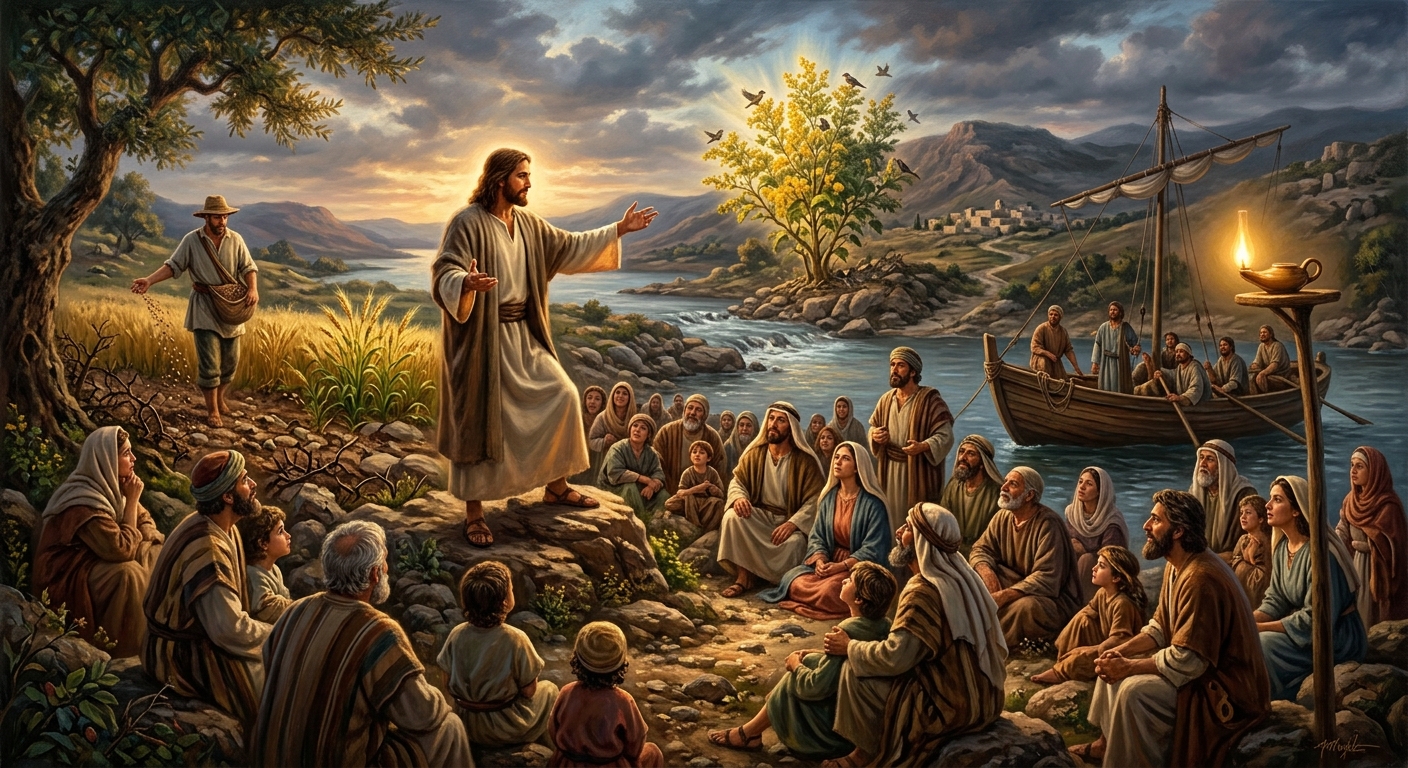
Illustration: Dramatic cinematic biblical illustration for Mark Chapter 4 showing Kingdom of God revealed through parables, photorealistic oil painting style.
🔊
Listen to Chapter
Grace Notes Journey Audio Narration
Author
John the Evangelist (Mark)
Written
~65-70 AD
Key Theme
Kingdom of God revealed through parables
Setting
Galilean Sea Shore
Key Verse
Mark 4:39
Total Verses
40
Chapter Introduction
*In the quiet hush of Galilee's shore, Jesus gathers a great multitude to teach with simple stories that speak directly to the heart. He shares the tale of a sower, urging each listener to reflect on the condition of their own spirit. As the wind rages and then is stilled by His command, we see that He can calm the storms within us. May these words remind you of God's patient invitation to nurture and grow in faith.*
Mark — Chapter 4 — KJV
1
And he began again to teach by the sea side: and there was gathered unto him a great multitude, so that he entered into a ship, and sat in the sea; and the whole multitude was by the sea on the land.
Simply PutJesus began teaching again by the sea, where a massive crowd gathered. The word “great multitude” (Greek: plethos, G4169) reflects how many hearts were drawn to hear Him. He stepped onto a boat and spoke, while the people pressed on the shore—showing that God meets us wherever we are, even in noisy places.
2
And he taught them many things by parables, and said unto them in his doctrine,
Simply PutHe taught them “many things by parables,” using simple stories to reveal profound truths. The Greek word for “parables” (parabolē, G3881) literally means a comparison or illustration. For those in pain or doubt, these stories become mirrors that help us see God’s kingdom in everyday life.
3
Hearken; Behold, there went out a sower to sow:
Simply Put“Hearken; Behold, there went out a sower to sow.” The command “hearken” (Greek: akouō, G119) means more than just listening—it’s an invitation to truly understand. It reminds us that God is calling us to pay close attention, especially when we feel lost.
4
And it came to pass, as he sowed, some fell by the way side, and the fowls of the air came and devoured it up.
Simply PutSome seeds fell “by the way side,” and birds devoured them. The “way side” (Greek: hēmeros, G2215) is the hard road where nothing sticks. The birds (Greek: tôrnos, G5069) symbolize the devil’s quick snatching of our faith if it isn’t rooted. Even when we’re already in trouble, the enemy can strike fast.
5
And some fell on stony ground, where it had not much earth; and immediately it sprang up, because it had no depth of earth:
Simply PutSome seeds fell on “stony ground,” where there was little earth, and sprouted quickly. The phrase “stony ground” (Greek: petra, G4082) shows how shallow faith can rise fast but lacks depth. It warns that without a firm foundation, our trust in God won’t survive the sun’s heat.
6
But when the sun was up, it was scorched; and because it had no root, it withered away.
Simply PutYet when the sun rose, it scorched, and because there were no roots, the plants withered. The “sun” (Greek: hēlios, G2199) represents trials that test our faith. If we haven’t planted deep roots in God’s love, those tests can burn us out.
7
And some fell among thorns, and the thorns grew up, and choked it, and it yielded no fruit.
Simply PutSome seeds fell among thorns; the thorns grew up, choked them, and they yielded no fruit. The “thorns” (Greek: thōn, G5045) represent the worries of life and the deceptive wealth that can strangle our spiritual growth. It reminds us to keep God first, not let distractions smother the seed.
8
And other fell on good ground, and did yield fruit that sprang up and increased; and brought forth, some thirty, and some sixty, and some an hundred.
Simply PutSome fell on good ground and bore fruit—some thirty, some sixty, some a hundred. The “good ground” (Greek: kalos, G2594) is the heart that receives God’s word and nurtures it. When we open ourselves fully, our faith can multiply abundantly.
9
And he said unto them, He that hath ears to hear, let him hear.
Simply Put“He that hath ears to hear, let him hear.” The Greek phrase (G2815) emphasizes that hearing isn’t just about ears—it’s a heart response. It invites us to truly listen and apply the word, not just hear it passively.
10
And when he was alone, they that were about him with the twelve asked of him the parable.
Simply PutWhen He was alone with the twelve, they asked about the parable. The “twelve” (Greek: dōdekatos, G1416) represent the core disciples. Their curiosity shows that true followers seek deeper understanding rather than staying at surface level.
11
And he said unto them, Unto you it is given to know the mystery of the kingdom of God: but unto them that are without, all these things are done in parables:
Simply Put“Unto you it is given to know the mystery of the kingdom of God; but unto them that are without, all these things are done in parables.” The word “mystery” (Greek: mystērion, G3469) refers to truths hidden until revealed. This verse shows that God sometimes speaks in stories so the truth is clear for those seeking, yet remains hidden from those who ignore it.
12
That seeing they may see, and not perceive; and hearing they may hear, and not understand; lest at any time they should be converted, and their sins should be forgiven them.
Simply Put“Seeing they may see, and not perceive; hearing they may hear, and not understand.” The words “see” (Greek: horaō, G3745) and “hear” (Greek: akouō, G119) indicate that God’s truth can be recognized but not grasped by those who are spiritually blinded. This warns us that merely hearing God’s voice isn’t enough—we must truly comprehend.
13
And he said unto them, Know ye not this parable? and how then will ye know all parables?
Simply Put“Know ye not this parable? and how then will ye know all parables?” The question (Greek: οὗτος, G376) challenges the disciples to recognize this specific story’s meaning. It shows that understanding one truth opens our eyes to all of God’s wisdom.
14
The sower soweth the word.
Simply Put“The sower soweth the word.” The “sower” (Greek: speirō, G4709) is Christ Himself, and the “word” (Greek: logos, G3056) includes every truth He speaks. It reminds us that God’s message is planted in our hearts by His own hand.
15
And these are they by the way side, where the word is sown; but when they have heard, Satan cometh immediately, and taketh away the word that was sown in their hearts.
Simply Put“And these are they by the way side... Satan cometh immediately, and taketh away the word.” “Satan” (Greek: satanas, G4585) is the accuser who steals our newly sown faith. This verse warns that if we don’t anchor God’s word, the enemy will snatch it away right away.
16
And these are they likewise which are sown on stony ground; who, when they have heard the word, immediately receive it with gladness;
Simply PutThe word here is "stony ground" (Greek petra, G4084), meaning a hard, shallow place that cannot hold water. Those who hear the message with gladness are like stones—quick to accept but lacking depth. When the pressure of life comes, they have nowhere to cling.
17
And have no root in themselves, and so endure but for a time: afterward, when affliction or persecution ariseth for the word’s sake, immediately they are offended.
Simply PutThe key word is "root" (Greek rhiza, G1079), the deep part of a plant that anchors it. Without this inner root, believers endure only for a short season. When affliction or persecution (Greek penthos, G3980) arises because of the word, they stumble and fall away.
18
And these are they which are sown among thorns; such as hear the word,
Simply PutThe Greek word "spina" (G4995) means thorns, which are sharp obstacles that choke growth. Even though these hear the word, the thorns of worry and sin entangle them.
19
And the cares of this world, and the deceitfulness of riches, and the lusts of other things entering in, choke the word, and it becometh unfruitful.
Simply PutThe "cares of this world" (Greek epithymia, G5415) and the deceitfulness of riches (Greek dolos, G1412) are inordinate desires that choke the word. The result is a life that bears no fruit because it lacks focus on God.
20
And these are they which are sown on good ground; such as hear the word, and receive it, and bring forth fruit, some thirtyfold, some sixty, and some an hundred.
Simply Put"Good ground" (Greek agathos, G4) is a heart that receives the word and lets it grow. Such soil yields abundant fruit—thirty, sixty, or a hundredfold—showing the reward of perseverance.
21
And he said unto them, Is a candle brought to be put under a bushel, or under a bed? and not to be set on a candlestick?
Simply PutThe lamp (Greek pharos, G5376) is meant to shine on a candlestick, not hidden under a bushel. Its purpose is clear: the light of truth must be displayed for all to see.
22
For there is nothing hid, which shall not be manifested; neither was any thing kept secret, but that it should come abroad.
Simply PutNothing hidden (Greek kryptos, G2845) will stay concealed; everything will be revealed (Greek phaino, G5447). Secrets become visible in God's perfect time.
23
If any man have ears to hear, let him hear.
Simply PutIf anyone has ears (Greek ous, G3688) to hear, let them listen. This is an invitation for those who are truly seeking truth.
24
And he said unto them, Take heed what ye hear: with what measure ye mete, it shall be measured to you: and unto you that hear shall more be given.
Simply PutBe careful how you measure others; the same amount will be measured back to you. Generosity and fairness are not optional—they affect how much is given.
25
For he that hath, to him shall be given: and he that hath not, from him shall be taken even that which he hath.
Simply PutTo the one who has, more will be added; to the one who lacks, even what they have will be taken away. This principle warns against complacency.
26
And he said, So is the kingdom of God, as if a man should cast seed into the ground;
Simply PutThe kingdom of God is like a seed planted in the ground. Though it seems tiny, its growth will be far greater than we can imagine.
27
And should sleep, and rise night and day, and the seed should spring and grow up, he knoweth not how.
Simply PutThe farmer sleeps and wakes, while the seed springs up without his knowledge. God works in mysterious ways that we cannot fully comprehend.
28
For the earth bringeth forth fruit of herself; first the blade, then the ear, after that the full corn in the ear.
Simply PutThe earth naturally brings forth fruit of itself—the blade, the ear, and then the full grain. This shows how creation follows God's divine order.
29
But when the fruit is brought forth, immediately he putteth in the sickle, because the harvest is come.
Simply PutWhen the fruit ripens, it is time to reap. The sickle is ready because the harvest has come.
30
And he said, Whereunto shall we liken the kingdom of God? or with what comparison shall we compare it?
Simply PutWe must find a picture to compare the kingdom of God. There is no adequate comparison—yet we continue searching for understanding.
31
It is like a grain of mustard seed, which, when it is sown in the earth, is less than all the seeds that be in the earth:
Simply PutThe mustard seed, Greek "mostas" (G4481), is so tiny that it seems insignificant. Yet when it's planted, it bursts forth into a bush bigger than any herb in the garden. For anyone feeling like their faith is too small, this verse reminds us that God can take a little seed of belief and make it grow beyond what we ever imagined.
32
But when it is sown, it groweth up, and becometh greater than all herbs, and shooteth out great branches; so that the fowls of the air may lodge under the shadow of it.
Simply PutAs the mustard plant grows, its branches spread wide and provide shade for birds to rest. This image shows that the Kingdom of God, though it begins in humble soil, will become a refuge for those who are weary. When life feels exposed and scorching, we can trust that God's kingdom will stretch out a shelter of peace over us.
33
And with many such parables spake he the word unto them, as they were able to hear it.
Simply PutJesus spoke to the crowds in "parabolē" (G3982)—simple, vivid illustrations that matched their everyday life. He used these stories so the people could grasp divine truths in a language they already understood. If your heart is hungry for meaning, remember that God meets you where you are and speaks truth in pictures that click.
34
But without a parable spake he not unto them: and when they were alone, he expounded all things to his disciples.
Simply PutWhen the crowd left, Jesus turned to His close friends and "explanare" (G1803) all the mysteries of the Kingdom. He didn't waste any pearl of insight; He shared it with those willing to listen deeply. This shows that while Jesus is patient with the masses, He also builds a deep foundation for those who walk closely with Him.
35
And the same day, when the even was come, he saith unto them, Let us pass over unto the other side.
Simply PutAs the evening fell, Jesus said, "Let us go over to the other side." The Greek verb "poreomai" (G4160) suggests moving beyond familiar shores. He invited His disciples to leave the crowd behind and experience a new, quieter setting—a chance for deeper communion.
36
And when they had sent away the multitude, they took him even as he was in the ship. And there were also with him other little ships.
Simply PutThe disciples followed Him onto the boat, and there were also other small vessels around. The word "echō" (G2192) shows that He was in their midst, physically present. Even among many boats, they set out together into the waiting night, trusting that His presence would guide them.
37
And there arose a great storm of wind, and the waves beat into the ship, so that it was now full.
Simply PutSuddenly a great storm rose, with wind and waves beating into the boat until it was filled. This is the Greek "kataras" (G2672) of being tossed about, a picture of life's sudden turmoil. In those moments when we feel overwhelmed, we can see that even the strongest vessels are tested.
38
And he was in the hinder part of the ship, asleep on a pillow: and they awake him, and say unto him, Master, carest thou not that we perish?
Simply PutJesus was sleeping on a pillow at the back of the boat. The Greek "hypnopō" (G560) shows He rested peacefully even while chaos raged around Him. When the disciples cried out, "Do you not care that we are perishing?" they discovered that Jesus' calm was rooted in divine confidence.
39
And he arose, and rebuked the wind, and said unto the sea, Peace, be still. And the wind ceased, and there was a great calm.
Simply PutHe rose, rebuked the wind, and spoke to the sea, "Peace, be still." The Greek verb "sigeō" (G5629) commands calmness. Instantly, the wind stopped and a great stillness settled over the waters—proof that Jesus' word has authority over nature.
40
And he said unto them, Why are ye so fearful? how is it that ye have no faith?
41
And they feared exceedingly, and said one to another, What manner of man is this, that even the wind and the sea obey him?
Simply PutThey were filled with awe and asked, "What kind of man is this that even the wind and the sea obey Him?" Their fear turned into wonder as they recognized His divine power. In moments of crisis, such encounters remind us that God is in control of the very forces that surround us.
Matthew 13:3The parallel account of the Parable of the Sower in Mark 4, emphasizing the same seed-sowing imagery and varied reception.
Luke 8:5Another synoptic parallel that recounts the Parable of the Sower, reinforcing its thematic focus on hearing and fruitfulness.
Isaiah 55:10A prophetic illustration of seed sown and water that returns to the earth, thematically linking the law of sowing in Mark 4 with divine purpose.
John 12:24Jesus' grain-of-wheat analogy of death and fruitfulness, echoing the growth and yield themes found in Mark 4's sower parable.
Reflect
What bright gift or purpose in your life are you currently keeping hidden under a bushel, and what simple step could you take this week to set it on a candlestick for others to see?