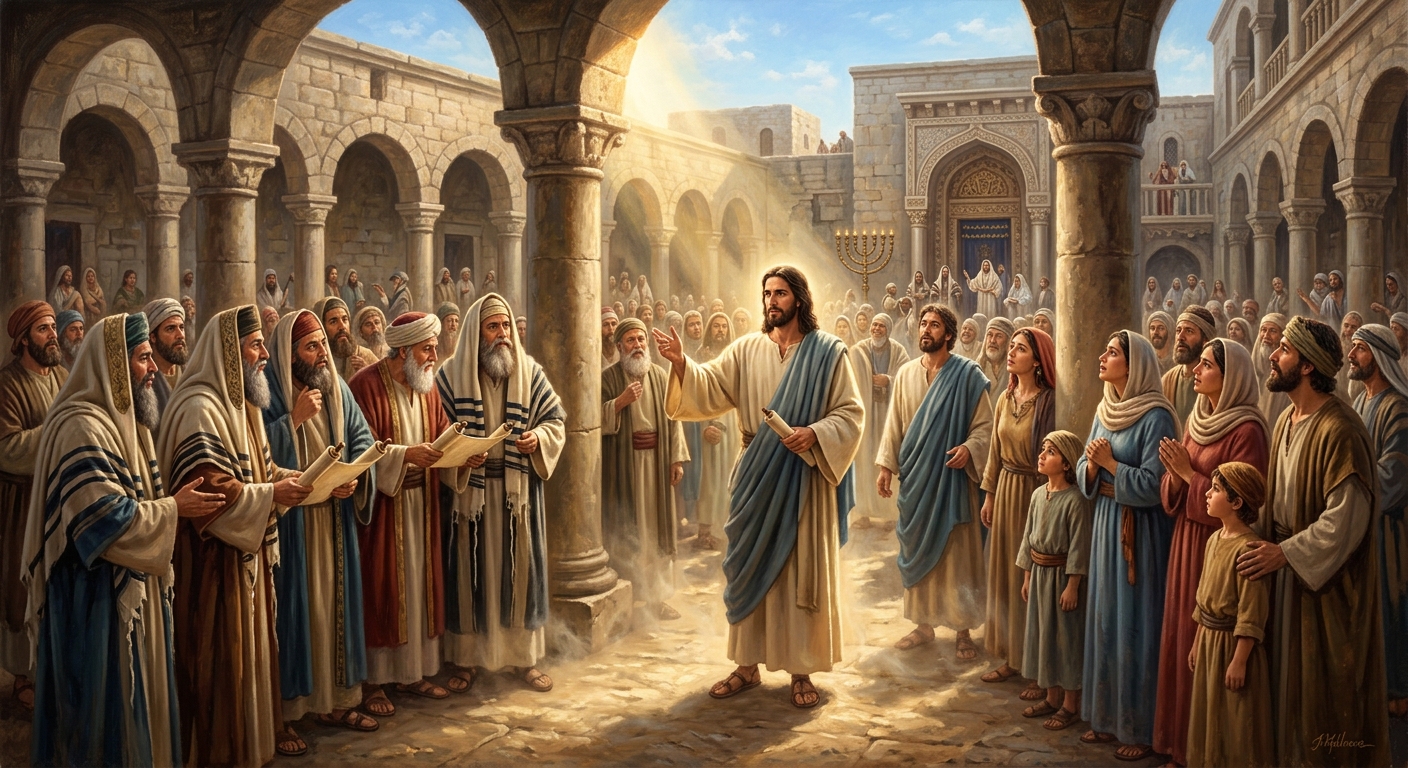
Illustration: A sweeping, photorealistic oil painting of Jesus standing among the ancient stone pillars of a bustling synagogue courtyard on a sunny Sabbath, surrounded by curious scribes and townspeople in flowing linen robes, the dust of the ground swirling as He gestures with authority over the law; dramatic golden sunlight streams through high arches, casting luminous rays that illuminate Christ’s serene yet commanding expression while the crowd's faces reflect awe, confusion, and reverence in a cinematic, high-contrast atmosphere.
🔊
Listen to Chapter
Grace Notes Journey Audio Narration
Author
John Mark (companion of Peter)
Written
~65-70 AD
Key Theme
Authority of Christ over Sabbath and Law
Setting
Capernaum synagogue, Sabbath day
Key Verse
Mark 3:4
Total Verses
35
Chapter Introduction
*When Jesus entered the synagogue, He saw a man whose hand was withered. With gentle authority, He called him to stand and healed him, revealing that the Sabbath is a day for mercy. In this simple miracle, we see God's grace breaking through human hardness and legalism. May our hearts be softened to receive the same love that restores us.*
Mark — Chapter 3 — KJV
1
And he entered again into the synagogue; and there was a man there which had a withered hand.
Simply PutIn this scene, the man’s hand is described as “asthenōs,” a Greek term (G553) meaning weak or lacking strength. Picture someone whose very ability to work, to help his family, is crippled—his whole life feels withered. Jesus sees that loss and steps into the synagogue, not just to perform a miracle but to restore hope to a weary soul.
2
And they watched him, whether he would heal him on the sabbath day; that they might accuse him.
Simply PutThe Pharisees “watched” (Greek, parakolouein G3918) the miracle carefully, not out of curiosity but to find a reason to accuse. Their hearts were set on finding fault rather than celebrating faith, turning the Sabbath into a courtroom of judgment. This reminds us that some people watch our struggles with hidden intentions, hoping we’ll stumble.
3
And he saith unto the man which had the withered hand, Stand forth.
Simply PutJesus commands the man to “stand forth,” using the Greek verb egeirō (G1124), which means to arise or lift up. It’s not just a physical command but an invitation to step out of the shadows of disability into the light of new life. Even when we feel broken, God calls us to rise and be seen.
4
And he saith unto them, Is it lawful to do good on the sabbath days, or to do evil? to save life, or to kill? But they held their peace.
Simply PutHe asks a simple yet profound question about what is “lawful” (Greek, dikaios G1345) on the Sabbath—whether it’s right to do good or evil. The Greek word for “good” (agathos) and “evil” (kakos) underlines that the Sabbath was meant for mercy, not restriction. In our daily grind, we must ask ourselves: is my day spent in love and healing or in legalistic rigidity?
5
And when he had looked round about on them with anger, being grieved for the hardness of their hearts, he saith unto the man, Stretch forth thine hand. And he stretched it out: and his hand was restored whole as the other.
Simply PutJesus looks around “with anger,” the Greek term sklerosis (G4649) indicating a hardened, stubborn heart. He then says “stretch forth thine hand,” using ektíneō (G1767), meaning to extend or unfold. The man’s hand becomes “whole” (holos G5605), fully restored, showing that God can soften even the toughest hearts and bring complete healing.
6
And the Pharisees went forth, and straightway took counsel with the Herodians against him, how they might destroy him.
Simply PutThe Pharisees “took counsel” (synergeō G4915) with the Herodians—a political alliance to plot their destruction. Their whispered plans reveal how fear can drive people to conspire against the good. It reminds us that even in the midst of miracles, there can be hidden threats seeking to snuff out hope.
7
But Jesus withdrew himself with his disciples to the sea: and a great multitude from Galilee followed him, and from Judaea,
Simply PutJesus “withdraws” (exēlthen) with his disciples to the sea, seeking a place of calm amidst growing crowds. He goes from the temple’s noise to the shore’s quiet, showing that sometimes we need to step back and find space for renewal. The multitude follows from Galilee, Judea, Jerusalem—people hungry for what He offers.
8
And from Jerusalem, and from Idumaea, and from beyond Jordan; and they about Tyre and Sidon, a great multitude, when they had heard what great things he did, came unto him.
Simply PutA “great multitude” (Greek, polis G4185) from regions far and near—Idumaea, beyond the Jordan, Tyre, Sidon—hear of His deeds and come. Their diverse backgrounds show that the message of Christ transcends borders, reaching those with “plagues” (pestilē G4167) and sorrows. It’s a reminder that real need is everywhere, drawing people toward the Savior.
9
And he spake to his disciples, that a small ship should wait on him because of the multitude, lest they should throng him.
Simply PutHe tells his disciples to have a “small ship” (nekton G3525) ready for Him, lest the crowd “throng” them. The image of a tiny boat amidst a massive wave teaches us to stay ready and humble, even when overwhelming forces press against us. It’s about staying grounded so the flood of people doesn’t overwhelm His purpose.
10
For he had healed many; insomuch that they pressed upon him for to touch him, as many as had plagues.
Simply PutHe had healed many, so “they pressed upon Him” (Greek, phylax G5345) to touch Him. Those who were “plagued” (pestilē G4167) sought physical and spiritual relief, believing that a touch could bring salvation. Their desperation mirrors our own longing for divine healing in the most desperate moments.
11
And unclean spirits, when they saw him, fell down before him, and cried, saying, Thou art the Son of God.
Simply Put“Unclean spirits” (pneuma akatharton G4151) fell before Him, proclaiming, “You are the Son of God.” Even the spiritual realm recognizes His authority. Their confession shows that true power is recognized not just by crowds but also by the unseen forces of darkness.
12
And he straitly charged them that they should not make him known.
Simply PutHe “straitly” (sphēro G4732) commands them not to reveal Him. The Greek “apokalypto” (to make known) shows that even divine messengers can be instructed to keep it hidden. Sometimes God’s work unfolds quietly before He steps into the light.
13
And he goeth up into a mountain, and calleth unto him whom he would: and they came unto him.
Simply PutHe “goes up” into a mountain and “calls” (kaleō G2541) those He wants. The Greek word for “call” is an invitation, a personal summons—like hearing your name across the wind. It’s a reminder that God beckons each of us individually, regardless of how many stand before Him.
14
And he ordained twelve, that they should be with him, and that he might send them forth to preach,
Simply PutHe “ordains” (appoints) twelve to be with Him, preparing them for a mission. The number twelve represents completeness—the fullness of God’s people. It shows that Jesus doesn’t work alone; He equips a community to carry on His message.
15
And to have power to heal sicknesses, and to cast out devils:
Simply PutTheir “power” (exousia G2145) to heal sicknesses and cast out devils points to true authority, not just ability. The Greek “ekpiptō” (to throw down) signifies a decisive, forceful act against evil. This verse reminds us that divine power is meant for love—healing the broken and freeing the oppressed.
16
And Simon he surnamed Peter;
Simply PutSimon’s new name, Peter (Greek petros G4075), literally means “rock.” Jesus gave him this name to show that Simon would become a firm foundation for the church, someone others could rely on in times of trouble.
17
And James the son of Zebedee, and John the brother of James; and he surnamed them Boanerges, which is, The sons of thunder:
Simply PutJames and John were called Boanerges (Greek boanerges G922), which means “sons of thunder.” Their fiery zeal and bold preaching made them stand out among the twelve, ready to speak truth even when it shakes people’s hearts.
18
And Andrew, and Philip, and Bartholomew, and Matthew, and Thomas, and James the son of Alphaeus, and Thaddaeus, and Simon the Canaanite,
Simply PutThis gathering of disciples—Andrew, Philip, Bartholomew, Matthew, Thomas, James the son of Alphaeus, Thaddaeus, and Simon the Canaanite (Greek kananeos G2545)—shows that Jesus called ordinary men from different walks of life to follow Him. No matter who you are, He invites you into His work.
19
And Judas Iscariot, which also betrayed him: and they went into an house.
Simply PutJudas Iscariot “betrayed” (Greek paradidomi G3956) Jesus, a painful act that foreshadowed the very real threat of disloyalty. Even when betrayal looms, we must remember that Jesus still chose to share a house with His followers.
20
And the multitude cometh together again, so that they could not so much as eat bread.
Simply PutThe “multitude” (Greek plethos G4229) pressed in so tightly they couldn’t even eat bread. Their physical hunger mirrored their deep spiritual longing for the true sustenance only Jesus could provide.
21
And when his friends heard of it, they went out to lay hold on him: for they said, He is beside himself.
Simply PutWhen “friends” (Greek philoi G5369) heard of the crowd, they went out to “lay hold on” Him because He seemed “beside himself.” Their concern reflects the human tendency to doubt when we can’t see clear purpose, yet it also shows their love for Jesus.
22
And the scribes which came down from Jerusalem said, He hath Beelzebub, and by the prince of the devils casteth he out devils.
Simply PutThe scribes from Jerusalem accused Him of having Beelzebub (Greek beelzeboul G965), the chief demon, and claimed He cast out devils by the “prince of devils.” Their words reveal how easily people can label God’s work as evil when they don’t understand His power.
23
And he called them unto him, and said unto them in parables, How can Satan cast out Satan?
Simply PutJesus answered in parables (Greek parabole G3886), asking, “How can Satan cast out Satan?” The question challenges us to think that a divided source cannot produce true good; only God’s power can defeat evil.
24
And if a kingdom be divided against itself, that kingdom cannot stand.
Simply Put“If a kingdom be divided against itself, that kingdom cannot stand.” When we’re torn between our faith and worldly pressures, the strength of God’s reign in us weakens.
25
And if a house be divided against itself, that house cannot stand.
Simply Put“If a house be divided against itself, that house cannot stand.” A family or community fractured by doubt and conflict loses the stability it needs to thrive.
26
And if Satan rise up against himself, and be divided, he cannot stand, but hath an end.
Simply Put“If Satan rise up against himself, and be divided, he cannot stand, but hath an end.” Even the strongest spiritual adversary falls when he turns on himself; God’s authority surpasses all division.
27
No man can enter into a strong man’s house, and spoil his goods, except he will first bind the strong man; and then he will spoil his house.
Simply Put“No man can enter into a strong man's house and spoil his goods, except he will first bind the strong man.” The Greek word for “strong” (isoikos G2375) describes a powerful adversary. To overcome our deepest struggles, we must first bind the source of those struggles—often sin or fear.
28
Verily I say unto you, All sins shall be forgiven unto the sons of men, and blasphemies wherewith soever they shall blaspheme:
Simply Put“All sins shall be forgiven unto the sons of men, and blasphemes wherewithsoever they shall blaspheme.” The Greek word for “blasphemy” (blasphēmeō G2759) refers to speaking against God’s authority. Jesus assures us that every sin can be covered, except for one serious rejection.
29
But he that shall blaspheme against the Holy Ghost hath never forgiveness, but is in danger of eternal damnation:
Simply Put“He that shall blaspheme against the Holy Ghost hath never forgiveness.” The Holy Ghost (hagios pneuma G40 + G4150) is God’s presence within us. To deny this gift forever is to close the heart against the only source of true renewal.
30
Because they said, He hath an unclean spirit.
Simply Put“Because they said, He hath an unclean spirit.” Their claim that Jesus possessed a “unclean spirit” (Greek akatharsē) shows their inability to recognize His pure, divine nature. When we’re surrounded by misunderstanding, we must trust that He is wholly good.
31
There came then his brethren and his mother, and, standing without, sent unto him, calling him.
Simply PutHis family stood outside, sending a message to him. The Greek word for "brother" (G80) and "mother" (G1135) point to blood ties, but they were on the fringe of his life, unable to see how deep his work went. It reminds us that even our closest loved ones can sometimes be outside the circle of understanding His purpose for us.
32
And the multitude sat about him, and they said unto him, Behold, thy mother and thy brethren without seek for thee.
Simply PutThe crowd pointed out, "Look, your mother and brothers are outside looking for you." The word "outside" (G3624) shows a clear boundary between the family and the growing crowd waiting for Jesus. For those in doubt, it shows how even loved ones can be oblivious to the divine call that’s breaking through their lives.
33
And he answered them, saying, Who is my mother, or my brethren?
Simply PutHe turned and asked, "Who is my mother or my brothers?" The Greek question (G80) asks not about blood, but about who truly shares his life. It challenges anyone wrestling with identity to look beyond family labels toward the deeper bond of purpose.
34
And he looked round about on them which sat about him, and said, Behold my mother and my brethren!
Simply PutHe looked around at those sitting with him and said, "Here are my mother and brothers!" By turning his head (G3624) to those gathered, Jesus shows that true kinship is found in the shared walk of faith. It tells us that when we gather around Him, we become his family.
35
For whosoever shall do the will of God, the same is my brother, and my sister, and mother.
Simply Put"Whoever does the will of God is my brother, sister, and mother." The Greek word for "will" (G865) means the purpose or desire of God. It reminds us that obedience to His will creates a family bound not by blood, but by shared devotion and love.
When you consider Jesus gathering a group of ordinary men from different walks of life, who in your own circle feels like someone you could invest in more deeply today?