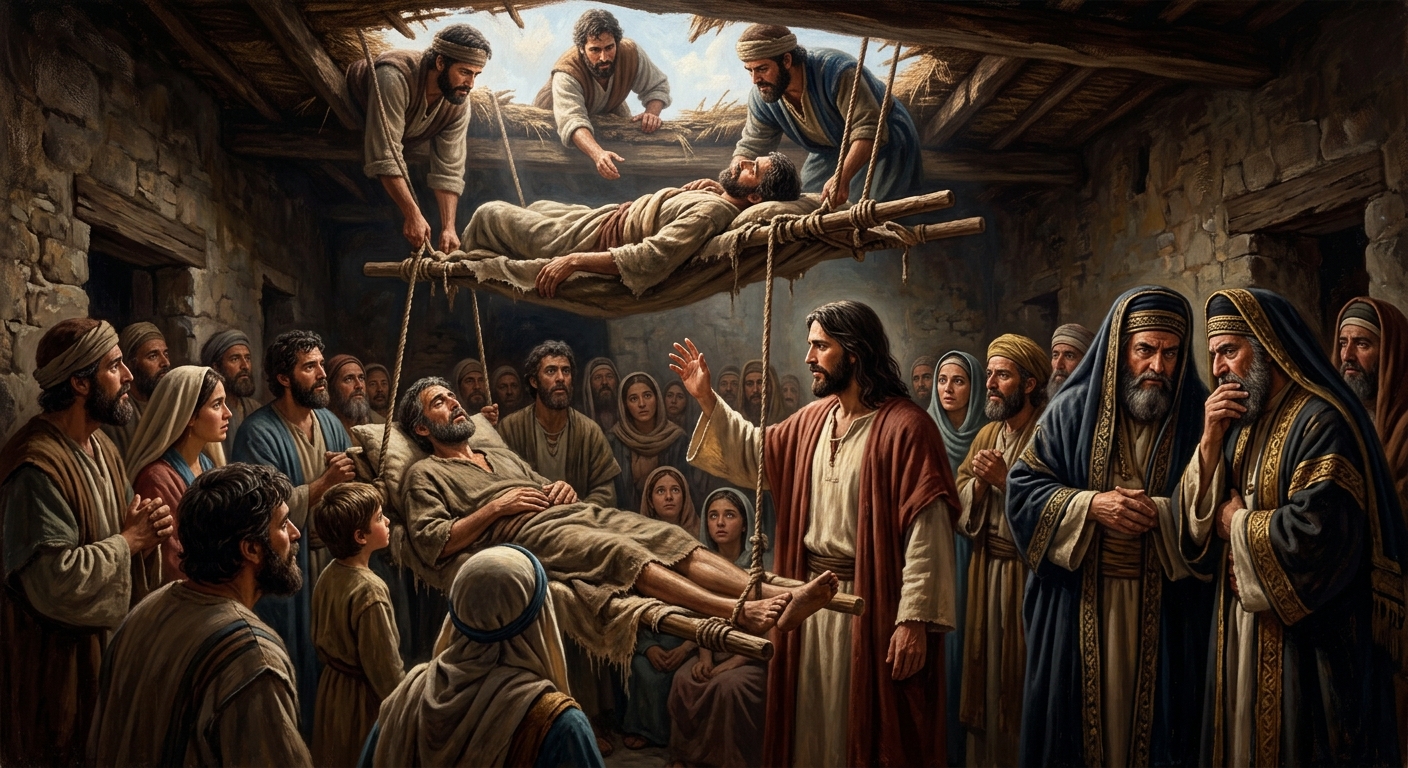
Illustration: Dramatic cinematic biblical illustration for Mark Chapter 2 showing Faith and Forgiveness, photorealistic oil painting style.
🔊
Listen to Chapter
Grace Notes Journey Audio Narration
Author
John Mark
Written
~55-60 AD
Key Theme
Faith and Forgiveness
Setting
Capernaum - House of Prayer
Key Verse
Mark 2:5
Total Verses
28
Chapter Introduction
*In the humble town of Capernaum, Jesus gathers a crowd so eager that there is no room left. Four friends lift their beloved onto the roof with great effort, driven by a deep faith that He can heal. When Jesus sees their devotion, He declares forgiveness before healing the body—a reminder that our sins are first forgiven in Christ. May we bring our burdens to Him, trusting He sees and cares for both spirit and flesh.*
Mark — Chapter 2 — KJV
1
And again he entered into Capernaum after some days; and it was noised that he was in the house.
Simply PutJesus entered Capernaum again, and the news of his presence spread quickly. The Greek word for "entered" (eisēlthen, G1519) implies a purposeful stepping into a place. For anyone longing for hope, his return signals that the same loving Savior is still coming to where they are.
2
And straightway many were gathered together, insomuch that there was no room to receive them, no, not so much as about the door: and he preached the word unto them.
Simply PutSo many people gathered that there wasn't even room at the doorway. Their pressing in shows a deep hunger for his teaching, the "word" of God. When we feel crowded by life's worries, this verse reminds us that Jesus welcomes the overflow of our hearts.
3
And they come unto him, bringing one sick of the palsy, which was borne of four.
Simply PutThey brought a man crippled by palsy, literally paralysed from the waist down. The Greek term "paralytos" (G3952) means "to be laid aside or taken out of the world." For anyone feeling stuck, this shows that no matter how severe our limitations, they can be brought before Jesus.
4
And when they could not come nigh unto him for the press, they uncovered the roof where he was: and when they had broken it up, they let down the bed wherein the sick of the palsy lay.
Simply PutBecause of the crowd, his friends made a hole in the roof and lowered the man's mat down to him. Their determination reflects a love that goes beyond inconvenience. When we face obstacles, this verse encourages us to find creative ways to bring our burdens to Christ.
5
When Jesus saw their faith, he said unto the sick of the palsy, Son, thy sins be forgiven thee.
Simply PutSeeing their faith (Greek pistis, G4102), Jesus declared the man's sins forgiven. Faith isn't just belief; it's trust that God cares enough to intervene. For those doubting their worth, this shows that Jesus values the heart behind our actions.
6
But there were certain of the scribes sitting there, and reasoning in their hearts,
Simply PutSome scribes sat there, quietly questioning in their minds. The Greek "scribas" (G4585) refers to scholars of the law, often skeptical of miracles. Their inner doubts remind us that even those well-versed in Scripture can miss the point of God's power.
7
Why doth this man thus speak blasphemies? who can forgive sins but God only?
Simply Put"Who can forgive sins but God alone?" they muttered, thinking Jesus was blaspheming. The word "blasphemy" (Greek blaspheian, G967) means an irreverent claim against God. This reveals how our doubt can turn into accusations when we don't recognize the divine authority present.
8
And immediately when Jesus perceived in his spirit that they so reasoned within themselves, he said unto them, Why reason ye these things in your hearts?
Simply PutJesus, knowing their thoughts, asked why they were reasoning in their hearts. The Greek "spirit" (pneuma, G4153) indicates his deep insight into human motives. For anyone wrestling with inner doubts, it shows that Jesus sees and addresses the root of our skepticism.
9
Whether is it easier to say to the sick of the palsy, Thy sins be forgiven thee; or to say, Arise, and take up thy bed, and walk?
Simply PutHe challenged them, asking which is easier—to declare forgiveness or to command the man to rise and walk. The question forces them to consider whether words alone save, or if they must be backed by visible power. It invites us to see that true forgiveness is demonstrated through action.
10
But that ye may know that the Son of man hath power on earth to forgive sins, (he saith to the sick of the palsy,)
Simply PutHe said the "Son of man" (Greek huios tou anthrōpou, G5202) has authority on earth to forgive sins. This title emphasizes his humanity and divine mission. For those yearning for a Savior who truly understands us, this assures that Christ possesses both earthly reach and heavenly authority.
11
I say unto thee, Arise, and take up thy bed, and go thy way into thine house.
Simply Put"Arise," he said, commanding the paralytic to stand, take his mat, and go home. The Greek "anistēmi" (G540) means to stand up or awaken. It tells us that Jesus not only forgives but also restores, inviting even the most broken to step forward in new life.
12
And immediately he arose, took up the bed, and went forth before them all; insomuch that they were all amazed, and glorified God, saying, We never saw it on this fashion.
Simply PutThe man rose immediately, walked out before everyone, and they were amazed. The Greek "ekchala" (G2749) describes being struck with awe. Their amazement leads them to glorify God, showing that a genuine miracle turns observers into worshippers.
13
And he went forth again by the sea side; and all the multitude resorted unto him, and he taught them.
Simply PutJesus went along the sea shore, and a great crowd gathered to hear his teaching. The setting of water often symbolizes life’s vastness, reminding us that Jesus’ message reaches all corners. Those seeking guidance find comfort in his willingness to be present wherever they are.
14
And as he passed by, he saw Levi the son of Alphaeus sitting at the receipt of custom, and said unto him, Follow me. And he arose and followed him.
Simply PutHe saw Levi, a tax collector, and simply said, "Follow me." The Greek "akolouthē" (G331) means to follow closely or be a disciple. This offers hope that anyone, regardless of past profession or reputation, can become part of Jesus' inner circle.
15
And it came to pass, that, as Jesus sat at meat in his house, many publicans and sinners sat also together with Jesus and his disciples: for there were many, and they followed him.
Simply PutAs Jesus dined at home, many publicans and sinners sat with him and his disciples. The inclusion of those considered outsiders shows that the kingdom is open to all who seek it. For anyone feeling outcast, this verse assures them that Jesus welcomes and embraces the brokenhearted.
16
And when the scribes and Pharisees saw him eat with publicans and sinners, they said unto his disciples, How is it that he eateth and drinketh with publicans and sinners?
Simply PutThe scribes and Pharisees saw Jesus sharing a meal with tax‑collectors (Greek: leptairoi, Strong’s G3040) and sinners, and they whispered to the disciples, “Why does He eat and drink with such people?” In those days, a meal was a sign of fellowship, and the religious elite saw no room for “the lowly” in God’s table. Jesus was showing that the love of God (agape) breaks all human barriers.
17
When Jesus heard it, he saith unto them, They that are whole have no need of the physician, but they that are sick: I came not to call the righteous, but sinners to repentance.
Simply PutWhen Jesus heard their murmurs, He replied, “Those who are whole don’t need a physician (Greek: iatros, Strong’s G2399), but those who are sick do.” He wasn’t calling anyone “righteous” or “sinner”; He was urging a heart‑change, repentance (Greek: metanoia, Strong’s G3361), which is the cure for a soul in need of healing.
18
And the disciples of John and of the Pharisees used to fast: and they come and say unto him, Why do the disciples of John and of the Pharisees fast, but thy disciples fast not?
Simply PutThe disciples of John and the Pharisees kept up a tradition of fasting. When they asked Jesus why His disciples didn’t fast, He was gently reminding them that the outward act of not eating is meaningless without a heart ready for God’s touch.
19
And Jesus said unto them, Can the children of the bridechamber fast, while the bridegroom is with them? as long as they have the bridegroom with them, they cannot fast.
Simply PutJesus answered, “Can the children of the bridechamber (Greek: neophytos, Strong’s G3515) fast while the bridegroom is with them?” Think of a wedding celebration—no one would deny food in the middle of the feast. The presence of Christ is a time to rejoice, not to mourn.
20
But the days will come, when the bridegroom shall be taken away from them, and then shall they fast in those days.
Simply Put“But there will come days,” He said, “when the bridegroom is taken away from them.” Those are the moments of loss and sorrow, when we turn our hearts back to God in humble fasting.
21
No man also seweth a piece of new cloth on an old garment: else the new piece that filled it up taketh away from the old, and the rent is made worse.
Simply PutJesus warned that you can’t stitch a patch of new cloth onto an old garment. The Greek word “kainos” (new) means fresh and lively; if you force it onto a worn-out piece, the tear only gets bigger. The new life we receive from Christ needs fresh, whole clothing.
22
And no man putteth new wine into old bottles: else the new wine doth burst the bottles, and the wine is spilled, and the bottles will be marred: but new wine must be put into new bottles.
Simply PutHe said the same about wine—new wine (Greek: kainos) must be poured into new bottles (Greek: pithos). Old jars would burst under the pressure of the fresh wine, spilling it everywhere. Our new faith must be housed in a heart that’s ready to receive and contain it.
23
And it came to pass, that he went through the corn fields on the sabbath day; and his disciples began, as they went, to pluck the ears of corn.
Simply PutOn the Sabbath, He walked through the grain fields with His disciples. As they passed, they began to pluck ears of corn—just as one would gather food in a field.
24
And the Pharisees said unto him, Behold, why do they on the sabbath day that which is not lawful?
Simply PutThe Pharisees, ever watchful of the law, asked Him, “Why are they doing what isn’t lawful on the Sabbath?” They saw the act of plucking as a violation of tradition.
25
And he said unto them, Have ye never read what David did, when he had need, and was an hungred, he, and they that were with him?
Simply PutJesus replied, “Did you not read what David did in his time of need?” He reminded them that when hunger struck, even the king didn’t wait for Sabbath rules.
26
How he went into the house of God in the days of Abiathar the high priest, and did eat the shewbread, which is not lawful to eat but for the priests, and gave also to them which were with him?
Simply PutHe spoke of David entering the house of God during Abiathar’s priesthood, eating the shewbread—bread meant only for priests—and sharing it with his companions. This was a reminder that human need can surpass ceremonial law.
27
And he said unto them, The sabbath was made for man, and not man for the sabbath:
Simply Put“The Sabbath was made for man,” Jesus declared, “not man for the Sabbath.” The purpose of the day is to serve humanity’s well‑being, not to become a burdensome rule.
28
Therefore the Son of man is Lord also of the sabbath.
Simply PutHe concluded with authority, “Therefore the Son of Man (Greek: huios tou anthrōpos, Strong’s G5203) is Lord also of the Sabbath.” As the divine Son, He has the right to define what truly honors God on that day.
Matthew 9:1-8This passage provides the parallel Synoptic account of Jesus healing a paralytic and declaring his sins forgiven, confirming Mark 2's narrative.
Luke 5:17-26This parallel account emphasizes the faith of those who bring the paralytic to Jesus and underscores his authority to forgive sins, mirroring Mark 2.
Isaiah 53:4-5This prophetic passage predicts the Messiah bearing our infirmities and being wounded for our transgressions, thematically linking to Jesus' healing and forgiveness in Mark 2.
Psalm 103:3This psalm declares that God forgives all our sins and heals all our diseases, providing a theological backdrop for Jesus' proclamation in Mark 2.
Reflect
When you gather for a meal or event, who among your guests feels like they might not belong to the usual circle you keep?