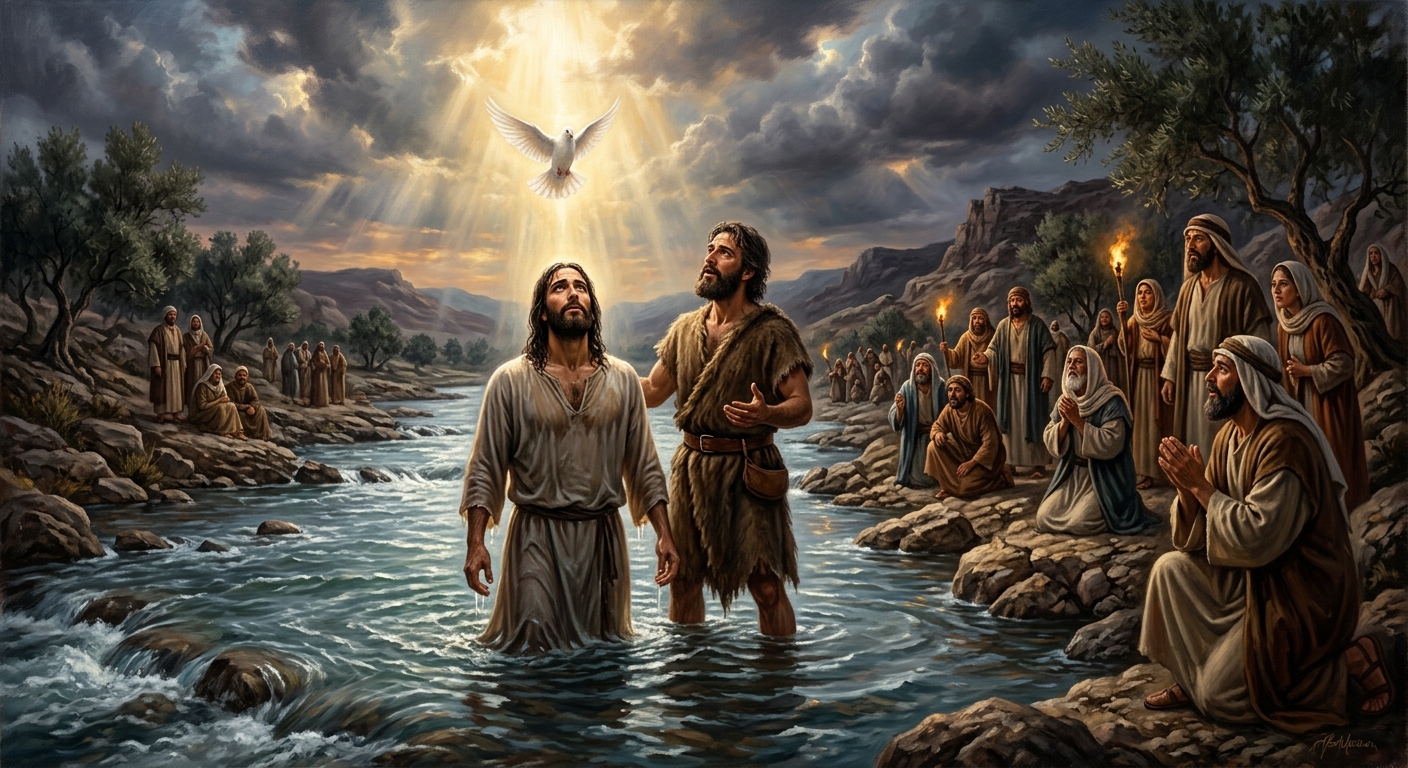
Illustration: Dramatic cinematic biblical illustration for Mark Chapter 1 showing Inauguration of Jesus' ministry, photorealistic oil painting style.
🔊
Listen to Chapter
Grace Notes Journey Audio Narration
Author
John Mark
Written
~57 AD
Key Theme
Inauguration of Jesus' ministry
Setting
Wilderness of Judea, John’s baptism
Key Verse
Mark 1:15
Total Verses
45
Chapter Introduction
*The first chapter of Mark opens the story of our Savior with a gentle invitation to behold His arrival. In the quiet desert, John the Baptist prepares hearts for the One who brings forgiveness and new life. As we read this beginning, let us feel the tender love that calls us from our wilderness into the light of Christ. May this passage remind us that God's grace is ever ready to meet us where we are.*
Mark — Chapter 1 — KJV
1
The beginning of the gospel of Jesus Christ, the Son of God;
Simply PutThe Greek word for gospel, euangelion (G112), means "good news." This chapter opens with the declaration that Jesus, the Christ (G5547) – God's anointed One – is the source of that news. For anyone pressed by pain, it reminds us that there is a beginning to God's story of rescue, and that story starts with Jesus entering our brokenness.
2
As it is written in the prophets, Behold, I send my messenger before thy face, which shall prepare thy way before thee.
Simply PutThe "messenger" here is the Greek angelos (G32), literally one who goes ahead to announce. The verb "prepare" is etoimō (G2095), meaning to make ready or set straight. This verse tells those in doubt that God Himself sends a forerunner to smooth the path, so we can meet Him without stumbling.
3
The voice of one crying in the wilderness, Prepare ye the way of the Lord, make his paths straight.
Simply PutThe "voice" is a cry (G1249) from the wilderness, erēmos (G1902), a place of desolation. To "prepare the way" is to make it straight and smooth (G2095). For those yearning for God, this picture shows that even in our emptiest places He calls us to make room for His presence.
4
John did baptize in the wilderness, and preach the baptism of repentance for the remission of sins.
Simply PutJohn baptizes with water (baptizo, G907), but the true cleansing comes through repentance – metanoia (G3369) – a radical change of heart. This "remission of sins" points to God's mercy (G1004). In our deepest guilt, this verse offers the promise that turning away from sin opens us to God's forgiveness.
5
And there went out unto him all the land of Judaea, and they of Jerusalem, and were all baptized of him in the river of Jordan, confessing their sins.
Simply PutThe people of Judah and Jerusalem come to John, confessing (homologeo, G3717) their sins as they are baptized in the Jordan. Their public acknowledgment shows that true repentance involves both heart and action. For anyone wrestling with hidden shame, it reminds us that honesty before God is the first step toward freedom.
6
And John was clothed with camel’s hair, and with a girdle of a skin about his loins; and he did eat locusts and wild honey;
Simply PutJohn wears camel's hair and a leather belt, living simply on locusts and honey. This humble appearance symbolizes his message: true spirituality doesn't require luxury, just a heart set on God. For those feeling burdened by life's complexities, John shows that simplicity can be a conduit for divine power.
7
And preached, saying, There cometh one mightier than I after me, the latchet of whose shoes I am not worthy to stoop down and unloose.
Simply PutHe proclaims, "There comes one mightier than I," using the Greek dunamenos (G1412), meaning powerful or able. The humility of John—unworthy to even untie the sandals of his successor—highlights Jesus' supreme authority. When we feel powerless, this verse assures us that the One who follows is far greater than any earthly obstacle.
8
I indeed have baptized you with water: but he shall baptize you with the Holy Ghost.
Simply PutJohn says, "I have baptized you with water; He will baptize you with the Holy Spirit (pneuma, G4152)." Water is a symbol of outward cleansing; the Spirit is an inward transformation. For those hungry for lasting change, this promise points to a divine presence that fills us from within.
9
And it came to pass in those days, that Jesus came from Nazareth of Galilee, and was baptized of John in Jordan.
Simply PutJesus comes from Nazareth, the small town of Galilee, to be baptized by John in Jordan. The act of a Son being baptized emphasizes His humility and identification with humanity. If you ever feel overlooked, remember that even the Son of God entered into ordinary life to be with us.
10
And straightway coming up out of the water, he saw the heavens opened, and the Spirit like a dove descending upon him:
Simply PutAs He rises from the water, the heavens "open" (horizō, G1650), and the Spirit descends like a dove. The opening sky symbolizes divine approval and revelation, while the dove represents peace and purity. For those seeking signs of God's love, this moment declares that God is present, affirming Jesus as His beloved Son.
11
And there came a voice from heaven, saying, Thou art my beloved Son, in whom I am well pleased.
Simply PutA voice from heaven declares, "You are my beloved Son (agapētos, G26), in whom I am well pleased." The Greek agapētos conveys deep, cherished love. In moments of self-doubt, this voice reminds us that we are deeply loved and valued by our Heavenly Father.
12
And immediately the Spirit driveth him into the wilderness.
Simply PutImmediately, the Spirit drives (ekporeuomai, G1832) Jesus into the wilderness. The rapid movement signifies God's intentional testing and preparation of His servant. For those feeling pushed into hardships, this verse shows that the Spirit uses wilderness experiences to strengthen and refine us.
13
And he was there in the wilderness forty days, tempted of Satan; and was with the wild beasts; and the angels ministered unto him.
Simply PutIn the desert for forty days, Jesus is tempted by Satan (peirazō, G3999). He lives among wild beasts while angels minister to Him. In our own trials and temptations, this passage assures us that God provides both the challenge to grow and the divine assistance to endure.
14
Now after that John was put in prison, Jesus came into Galilee, preaching the gospel of the kingdom of God,
Simply PutAfter John’s imprisonment, Jesus moves into Galilee and begins proclaiming the kingdom of God (basileia, G932). The "kingdom" represents God's reign breaking into human history. For those longing for a better world, this verse reveals that the promise of God's reign is now actively unfolding.
15
And saying, The time is fulfilled, and the kingdom of God is at hand: repent ye, and believe the gospel.
Simply PutJesus declares, "The time is fulfilled (plērōma, G5603), the kingdom of God is near; repent (metanoeō, G3369) and believe." The fulfillment of time signals God's perfect timing. For anyone feeling impatient or weary, this invitation offers a fresh start: turn your heart toward God and trust in the gospel that brings new life.
16
Now as he walked by the sea of Galilee, he saw Simon and Andrew his brother casting a net into the sea: for they were fishers.
Simply PutAs Jesus walked along the familiar shores of Galilee, He saw Simon and his brother Andrew busy casting nets into a sea that was their daily bread. The Greek word for fisherman, halieus (G1245), tells us they were simply doing what they knew best—working, providing for family. In this quiet scene, God meets us right where we are, in the midst of ordinary labor, to call us into something greater.
17
And Jesus said unto them, Come ye after me, and I will make you to become fishers of men.
Simply PutJesus turned to them and said, "Come after me, and I will make you fishers of men." The Greek phrase after me (opisō mou) invites us into a new kind of pursuit—catching souls instead of fish. If you’re feeling empty or searching, this promise points to a purpose beyond your own plans: a life that draws others into the love of God.
18
And straightway they forsook their nets, and followed him.
Simply PutRight away they left their nets and followed Him. The word straightway (eutheōs, G2196) shows their immediate trust—no hesitation. When you’re weighed down by worry, this moment reminds us that the call of Christ often requires a single step that changes everything.
19
And when he had gone a little farther thence, he saw James the son of Zebedee, and John his brother, who also were in the ship mending their nets.
Simply PutHe went on a little farther and saw James and John mending their nets in the boat. The Greek verb katenōnēse (G2801) means to repair, indicating they were finishing their work before the call. Even when we’re in the middle of a task, God can pause everything to bring us into His story.
20
And straightway he called them: and they left their father Zebedee in the ship with the hired servants, and went after him.
Simply PutHe called them at once, and they left their father Zebedee in the boat with the hired men. The word called (eklelei, G1761) is a personal invitation—God’s voice reaching out specifically to you. Leaving a familiar life for an unknown future can be terrifying, but this verse shows the promise of belonging to Him outweighs any comfort left behind.
21
And they went into Capernaum; and straightway on the sabbath day he entered into the synagogue, and taught.
Simply PutThey entered Capernaum, and on the Sabbath He went into the synagogue and taught. The Sabbath (sabbaton) was a day of rest, yet Jesus brought fresh life into it. If you feel spiritually stagnant on your "day of rest," this reminds us that true worship is a living conversation with the Savior.
22
And they were astonished at his doctrine: for he taught them as one that had authority, and not as the scribes.
Simply PutThe people were amazed at His teaching, because He spoke with authority—not as the scribes. Authority (exousia, G1842) implies a power that comes from within, not merely learned words. In moments of doubt about the Bible’s relevance, this verse points us to a Teacher who lives His truth, not just writes it.
23
And there was in their synagogue a man with an unclean spirit; and he cried out,
Simply PutIn the synagogue there was a man with an unclean spirit who cried out. The phrase "unclean spirit" (pneuma akatharton, G432) shows an inner turmoil that reaches out beyond the physical. If you’re wrestling with anxiety or hidden pain, this is a reminder that Jesus can confront the unseen forces within you.
24
Saying, Let us alone; what have we to do with thee, thou Jesus of Nazareth? art thou come to destroy us? I know thee who thou art, the Holy One of God.
Simply Put"Leave us alone! What have we to do with you, Jesus of Nazareth? Are you here to destroy us? I know who you are—the Holy One of God." The word "Holy One" (hagios, G40) signifies divine purity. When life feels chaotic and hostile, remember that the One who knows you intimately is also the Most Holy—greater than any force trying to break you.
25
And Jesus rebuked him, saying, Hold thy peace, and come out of him.
Simply PutJesus rebuked him, saying, "Be quiet! Come out of the man." To rebuke (ephre, G1841) is a firm command from authority. Even in moments of deep inner conflict, the power of Christ’s word can silence and release us from what binds us.
26
And when the unclean spirit had torn him, and cried with a loud voice, he came out of him.
Simply PutThe unclean spirit tore the man, cried out loudly, and then left him. The verb "torn" (ekyrō, G2700) shows a violent struggle before release. If you’ve ever felt trapped in mental or emotional distress, this picture shows that God’s power can break through even the loudest cries for help.
27
And they were all amazed, insomuch that they questioned among themselves, saying, What thing is this? what new doctrine is this? for with authority commandeth he even the unclean spirits, and they do obey him.
Simply PutAll were amazed and whispered among themselves, "What is this? A new teaching! He commands even unclean spirits with authority." The term "new teaching" (kainē didaskalia, G1491) signals a fresh revelation that surpasses old traditions. When you’re hungry for something more than ritual, this verse promises a living, powerful move of God that meets your deepest needs.
28
And immediately his fame spread abroad throughout all the region round about Galilee.
Simply PutImmediately His fame spread throughout the whole region around Galilee. The word "fame" (doxa, G1415) here indicates a reputation that draws people to the truth. In times of loneliness or being overlooked, know that God’s work does not stay hidden—it reaches out, touching hearts far beyond the immediate setting.
29
And forthwith, when they were come out of the synagogue, they entered into the house of Simon and Andrew, with James and John.
Simply PutStraight away they left the synagogue and entered Simon's house with James and John. The phrase "straightaway" (eutheōs, G2196) underscores their urgency to share the miracle. When you experience a life-changing encounter with God, there’s an instinctive drive to bring it home—to the family and friends who need hope.
30
But Simon’s wife’s mother lay sick of a fever, and anon they tell him of her.
Simply PutSimon's wife's mother was lying with a fever, and they told Jesus about her at once. The mention of "fever" (tēlē, G5040) shows a pressing need for healing. If you or someone you love is in sickness or distress, this verse assures that the same Jesus who teaches with authority also cares deeply for our physical ailments.
31
And he came and took her by the hand, and lifted her up; and immediately the fever left her, and she ministered unto them.
Simply PutHe took her by the hand, raised her up, and instantly the fever left. Then she ministered to them—serving as a testimony that Jesus’ touch (the Greek verb hēgeisō, “to bring up”) brings not just health but a new purpose.
32
And at even, when the sun did set, they brought unto him all that were diseased, and them that were possessed with devils.
Simply PutWhen evening fell, the sick and demon-possessed were brought to Him. “Even” (Greek Hespéras) signifies the day's end, a time when hope wanes—yet they came in crowds, trusting that He could heal both body and spirit.
33
And all the city was gathered together at the door.
Simply PutThe whole city gathered at the gates. The Greek word polis, “city,” conveys a community that had heard of His miracles and was eager to witness the Savior’s power for themselves.
34
And he healed many that were sick of divers diseases, and cast out many devils; and suffered not the devils to speak, because they knew him.
Simply PutHe healed many of diverse diseases and cast out devils, silencing the demons because they recognized Him. The act of “casting out” (Greek ekballō, “to throw out”) shows that Jesus’ authority over evil is as real and immediate as His healing.
35
And in the morning, rising up a great while before day, he went out, and departed into a solitary place, and there prayed.
Simply PutAt dawn, He rose early, went to a solitary place, and prayed. “Solitary” (Greek monē) reflects the deep need for communion with God—a reminder that even He sought quiet to hear the Father’s voice.
36
And Simon and they that were with him followed after him.
Simply PutSimon and his companions followed Him. Their following is a simple act of obedience, showing that true discipleship begins with walking behind the One who leads.
37
And when they had found him, they said unto him, All men seek for thee.
Simply PutThey reported, “All men seek for thee.” The crowd’s search reveals a universal longing for truth and healing—a hunger that only the Messiah can satisfy.
38
And he said unto them, Let us go into the next towns, that I may preach there also: for therefore came I forth.
Simply PutHe replied, “Let us go into the next towns.” Jesus’ purpose was to preach everywhere (Greek erchomai, “to go forth”), fulfilling the mission He came for—to bring salvation to all.
39
And he preached in their synagogues throughout all Galilee, and cast out devils.
Simply PutHe preached in synagogues throughout Galilee and cast out devils. The synagogue was the heart of Jewish worship, where His words and power were made known to the faithful.
40
And there came a leper to him, beseeching him, and kneeling down to him, and saying unto him, If thou wilt, thou canst make me clean.
Simply PutA leper approached, kneeling, and begged, “If thou wilt, thou canst make me clean.” His humble plea (Greek begoumai, “to beseech”) reflects a heart that trusts in God’s mercy.
41
And Jesus, moved with compassion, put forth his hand, and touched him, and saith unto him, I will; be thou clean.
Simply PutMoved with compassion, Jesus touched him and said, “I will; be thou clean.” The Greek word for compassion (splagchnizomai) means “to be moved in the inner parts,” showing that Jesus’ care for us is heartfelt and personal.
42
And as soon as he had spoken, immediately the leprosy departed from him, and he was cleansed.
Simply PutAs soon as He spoke, the leprosy left. His word alone (Greek legeō, “to say”) brings immediate transformation—proof that divine authority is swift and definitive.
43
And he straitly charged him, and forthwith sent him away;
Simply PutHe strictly charged him. Jesus gave clear instructions, emphasizing the importance of obedience after receiving His grace.
44
And saith unto him, See thou say nothing to any man: but go thy way, shew thyself to the priest, and offer for thy cleansing those things which Moses commanded, for a testimony unto them.
Simply PutHe told him to tell no one, but to show himself to the priest and offer what Moses commanded—providing a testimony for the people. This compliance fulfilled Old Testament law, confirming his cleansing before the community.
45
But he went out, and began to publish it much, and to blaze abroad the matter, insomuch that Jesus could no more openly enter into the city, but was without in desert places: and they came to him from every quarter.
Simply PutThe man spread the news so widely that Jesus couldn’t enter towns openly; He stayed in desert places. The spreading of the miracle (Greek kephalein, “to blaze”) shows how the Gospel’s impact can overflow beyond human control.
Isaiah 40:3This prophetic verse directly supplies the Old Testament source for Mark 1:2‑3, announcing a voice in the wilderness preparing the Lord's way.
Matthew 3:4The parallel description of John’s attire and diet underscores the shared Gospel tradition of his ascetic ministry in the wilderness.
John 1:23John's own testimony of being "the voice of one crying in the wilderness" mirrors Mark 1:7 and highlights his role as the forerunner to Christ.
Luke 3:16This passage parallels John’s proclamation in Mark 1:8, contrasting water baptism with the forthcoming baptism of the Holy Ghost by a mightier one.
Reflect
When an unsettling feeling (like anxiety, fear, or frustration) rises within you and cries for attention, how do you choose to respond and what source of peace or help do you invite into that moment?