Born AgainNicodemusJohn 3:16Holy SpiritEternal LifeLight & DarknessJohn the Baptist
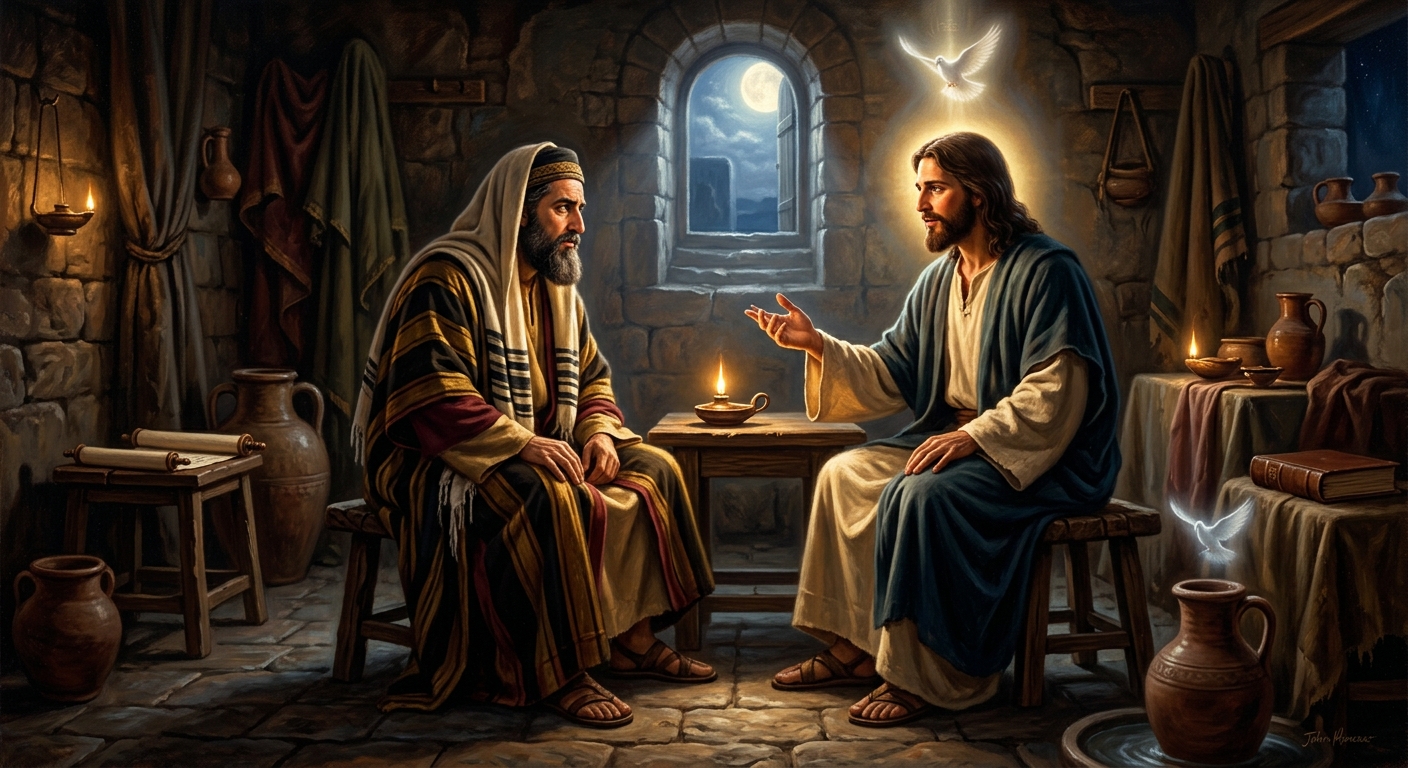
Illustration: Dramatic cinematic biblical illustration for John Chapter 3 showing The New Birth, photorealistic oil painting style.
🔊
Listen to Chapter
Grace Notes Journey Audio Narration
Author
John the Apostle
Written
~85–90 AD, Ephesus
Key Theme
The New Birth
Setting
Jerusalem — at night
Key Verse
John 3:16
Total Verses
34
Chapter Introduction
Nicodemus had religion. He had education. He had position on the highest council in all of Israel. And Jesus looked at him and said: you have to start over. Not improve — start over. Born again. The Greek word Jesus used was anothen — a word that means both "again" and "from above." Nicodemus heard one meaning. Jesus meant both. What follows is the most theologically dense, most personally urgent conversation in all of Scripture. And it ends with a verse so simple a child can hold it, so deep a scholar can spend a lifetime in it.
Nicodemus Comes by Night
1
There was a man of the Pharisees, named Nicodemus, a ruler of the Jews:
Simply PutA very important religious leader named Nicodemus — someone who had spent his whole life studying God's law — came to talk to Jesus.
2
The same came to Jesus by night, and said unto him, Rabbi, we know that thou art a teacher come from God: for no man can do these miracles that thou doest, except God be with him.
Simply PutHe came at night — possibly afraid to be seen — and opened with a compliment: "We know God sent you." He was trying to start a respectful conversation. Jesus skipped the small talk.
3
Jesus answered and said unto him, Verily, verily, I say unto thee, Except a man be born again, he cannot see the kingdom of God.
Simply PutJesus didn't respond to the compliment. He went straight to the thing Nicodemus needed most: "You must be born a second time — not physically, but spiritually. Without it, you can't even begin to see what God is doing."
4
Nicodemus saith unto him, How can a man be born when he is old? can he enter the second time into his mother's womb, and be born?
Simply PutNicodemus was confused — he took Jesus literally. "That's impossible. No grown man can be physically reborn." This is how religious thinking often misses the point: it processes spiritual truth with natural logic.
5
Jesus answered, Verily, verily, I say unto thee, Except a man be born of water and of the Spirit, he cannot enter into the kingdom of God.
Simply PutJesus clarified: there are two births — one physical (water), one spiritual (the Spirit of God). The first one gets you into this world. The second one gets you into God's kingdom.
6
That which is born of the flesh is flesh; and that which is born of the Spirit is spirit.
Simply PutPhysical birth makes you physical. Spiritual birth makes you spiritual. You can't get to the second kind by trying harder at the first kind. That's why religion alone never works.
7
Marvel not that I said unto thee, Ye must be born again.
Simply PutJesus knew this was hard to hear. So He said it again — gently, but without backing down. There is no path to God that bypasses the new birth. This is not negotiable.
8
The wind bloweth where it listeth, and thou hearest the sound thereof, but canst not tell whence it cometh, and whither it goeth: so is every one that is born of the Spirit.
Simply PutThe same Greek word — pneuma — means both wind AND Spirit. Jesus used this on purpose. You can't see the wind, but you see what it does. You can't see the Spirit, but you see the lives it changes. The evidence is undeniable, even if the source is invisible.
9
Nicodemus answered and said unto him, How can these things be?
Simply PutThe most educated man in Jerusalem — a master of Israel's law — had no answer. "How?" is the honest response when human knowledge hits the edge of what it can understand on its own.
10
Jesus answered and said unto him, Art thou a master of Israel, and knowest not these things?
Simply PutThis is not a rebuke — it's a question that strips away credentials. "You've spent your life studying God's Word, and this is new to you?" Jesus is showing Nicodemus that knowledge of Scripture and knowledge of God are not the same thing.
11
Verily, verily, I say unto thee, We speak that we do know, and testify that we have seen; and ye receive not our witness.
Simply PutJesus speaks in "we" — the Father, Son, and Spirit testify together. Nicodemus is representing a whole system of religious leadership that has heard the testimony of heaven and still refuses to receive it. Unbelief is not always about lack of evidence.
12
If I have told you earthly things, and ye believe not, how shall ye believe, if I tell you of heavenly things?
Simply PutJesus challenges the logic: "You won't even accept what you can observe — wind, water, new life — how will you receive the deeper mysteries of heaven?" Faith always precedes full understanding.
The Son of Man Lifted Up
13
And no man hath ascended up to heaven, but he that came down from heaven, even the Son of man which is in heaven.
Simply PutJesus makes an extraordinary claim: He alone has come from heaven, and He alone can speak of heavenly things with firsthand authority. Every prophet pointed upward. Jesus came down. That changes everything about the nature of His words.
14
And as Moses lifted up the serpent in the wilderness, even so must the Son of man be lifted up:
Simply PutIn Numbers 21, dying Israelites were healed simply by looking at a bronze serpent Moses lifted up on a pole. Jesus says: in the same way, He will be lifted up on a cross — and everyone who looks to Him in faith will be saved from death. This is a direct prophecy of the crucifixion.
15
That whosoever believeth in him should not perish, but have eternallife.
Simply PutThe pattern is set before verse 16: look to Him, trust Him, and death does not have the final word. "Whosoever" is the widest possible word of inclusion. Nobody is excluded from that invitation.
16
For God so loved the world, that he gave his only begotten Son, that whosoever believeth in him should not perish, but have everlastinglife.
Simply PutThe most famous sentence in all of human history. God's love is not just warm feelings — it cost Him His Son. "The world" means everyone, without exception. "Believeth" means trusting with your whole being, not just agreeing with a fact. And "everlasting life" is not just heaven later — it begins the moment you believe. This verse is the entire Gospel in one sentence.
For God sent not his Son into the world to condemn the world; but that the world through him might be saved.
Simply PutThe mission of Jesus was not judgment — it was rescue. He didn't come to catch you doing wrong. He came to get you out. If you feel condemnation, it does not come from Jesus.
18
He that believeth on him is not condemned: but he that believeth not is condemned already, because he hath not believed in the name of the only begotten Son of God.
Simply PutThe verdict is not waiting for some future day — it happens now, in this moment of response. To believe is to pass from judgment into life. To reject is to remain under the weight of a verdict already given. The choice could not be more urgent.
Light Has Come Into the World
19
And this is the condemnation, that light is come into the world, and men loved darkness rather than light, because their deeds were evil.
Simply PutPeople don't just stumble away from God — they prefer the dark. Not because the light isn't real, but because the light reveals what we'd rather keep hidden. The problem is not lack of evidence. It's love of secrecy.
20
For every one that doeth evil hateth the light, neither cometh to the light, lest his deeds should be reproved.
Simply PutSin's first instinct is to hide. Nobody wants their secrets exposed. This is why people resist the light of Jesus — not because they do not understand it, but because they understand it perfectly. The light reveals. That is exactly what we fear most.
21
But he that doeth truth cometh to the light, that his deeds may be made manifest, that they are wrought in God.
Simply PutTruth-living is not just right doctrine — it is a life that can stand fully in the light. When you walk in truth, you have nothing to hide. You actually want to be seen, because what God sees in you is His own work.
John the Baptist's Final Testimony
22
After these things came Jesus and his disciples into the land of Judaea; and there he tarried with them, and baptized.
Simply PutJesus moves from the theological moment with Nicodemus into real ministry — baptizing, teaching, being with people. The Word made flesh did not stay in conference rooms. He went to where people were.
23
And John also was baptizing in Aenon near to Salim, because there was much water there: and they came, and were baptized.
Simply PutJohn the Baptist was still preaching and baptizing — his work was not yet finished. "Much water" — simple geography, but it tells us John was faithful to the last. He showed up, every day, and did what God called him to do.
24
For John was not yet cast into prison.
Simply PutA detail that anchors this in real history. John was not yet imprisoned. This is still the early season of Jesus's ministry. The narrator is reminding us: this all happened. These were real people, real days, real events.
25
Then there arose a question between some of John's disciples and the Jews about purifying.
Simply PutReligious competition rises up even among disciples. The question about purification was really a question about which leader, which movement, which baptism was legitimate. Status anxiety is as old as religion itself.
26
And they came unto John, and said unto him, Rabbi, he that was with thee beyond Jordan, to whom thou barest witness, behold, the same baptizeth, and all men come to him.
Simply PutNotice what they say: "all men come to him." They expected John to be threatened. What comes next is one of the most stunning responses to rivalry ever recorded.
27
John answered and said, A man can receive nothing, except it be given him from heaven.
Simply PutJohn the Baptist shuts down any jealousy with one line: everything comes from God. There is no competition when you understand the source of every gift.
28
Ye yourselves bear me witness, that I said, I am not the Christ, but that I am sent before him.
Simply PutJohn reminds his own followers of what he already told them — "I am not the Christ." There is no identity crisis here. John knew exactly who he was and exactly who he wasn't. Clarity about your calling kills comparison.
29
He that hath the bride is the bridegroom: but the friend of the bridegroom, which standeth and heareth him, rejoiceth greatly because of the bridegroom's voice: this my joy therefore is fulfilled.
Simply PutJohn compares himself to the best man at a wedding — not the groom. His joy is complete when Jesus receives the glory. This is the picture of true servanthood: thrilled to point to someone greater than yourself.
"He must increase, but I must decrease."
— John the Baptist · John 3:30
Simply PutEight words. One of the greatest statements ever made by a human being. John understood his role perfectly — not to be remembered, but to make Jesus unforgettable. This is the posture of every true follower of Christ.
31
He that cometh from above is above all: he that is of the earth is earthly, and speaketh of the earth: he that cometh from heaven is above all.
Simply PutJohn draws a sharp contrast: the one from the earth can only speak from earthly experience. The one from heaven speaks with a different kind of authority altogether — not learned, not studied, but known firsthand. Jesus does not have a theology of heaven. He has the memory of it.
32
And what he hath seen and heard, that he testifieth; and no man receiveth his testimony.
Simply PutJesus testified to what He had seen and heard directly from the Father. And still — most did not receive it. The greatest eyewitness account in history, and the world looked away. This should humble every preacher who wonders why truth does not always land.
33
He that hath received his testimony hath set to his seal that God is true.
Simply PutTo receive His testimony is to set your seal — your signature, your full agreement — on the fact that God is true. To believe Jesus is not just a religious choice. It is an alignment with reality itself.
34
For he whom God hath sent speaketh the words of God: for God giveth not the Spirit by measure unto him.
Simply PutThe Spirit is not measured out to Jesus in limited portions as with the prophets. The fullness of the Spirit rested on Him without limit. When Jesus speaks, He speaks from the full counsel of God — not a portion of it.
35
The Father loveth the Son, and hath given all things into his hand.
Simply PutThe Father's love for the Son is the foundation of everything. The authority Jesus carries is not seized — it is given, freely, out of love. All things. Not some things. The scope of this gift is total.
36
He that believeth on the Son hath everlasting life: and he that believeth not the Son shall not see life; but the wrath of God abideth on him.
Simply PutThe chapter ends with two paths made crystal clear. There is no third option, no middle ground. Eternal life belongs to those who trust the Son. This is not cruelty — it is the most urgent love imaginable. The door is open. Walk through it.
Titus 3:5This verse explicitly links the concepts of water ("washing") and the Spirit ("renewing of the Holy Ghost") to regeneration, echoing Jesus' teaching that one must be born of water and the Spirit.
Romans 8:16It states that the Holy Spirit testifies with our spirit that we are God's children, illustrating the spiritual rebirth Jesus describes as being born of the Spirit.
Matthew 3:11John the Baptist foretells a baptism with the Holy Ghost and fire, prefiguring the new birth through water and Spirit that Jesus outlines in John 3.
John 4:24This verse emphasizes that God is spirit, reinforcing the distinction Jesus makes between flesh-born and Spirit-born life.
Reflect
When was the last time you chose the comfort of a familiar habit over a new truth that challenged your behavior, and how did that choice feel?