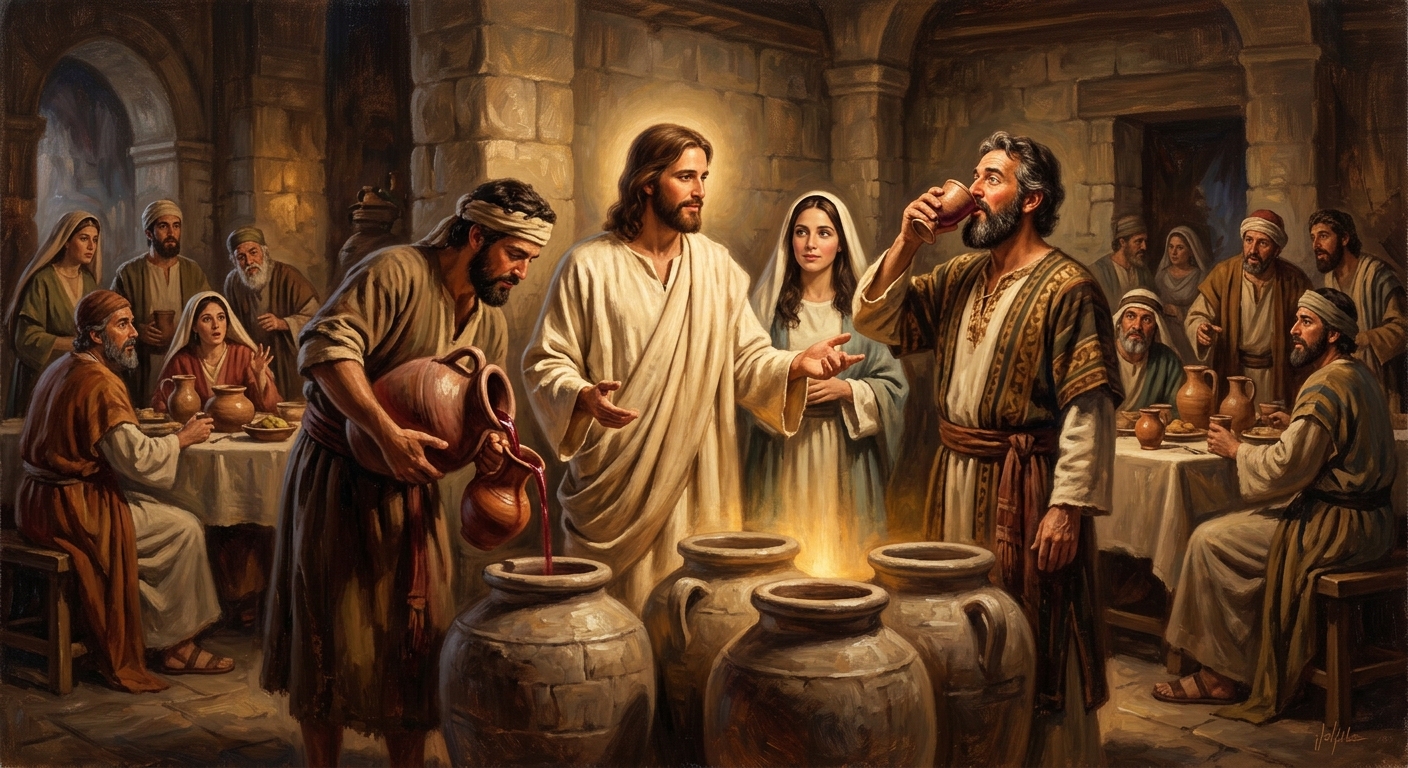
Illustration: Dramatic cinematic biblical illustration for John Chapter 2 showing Christ's Glory Revealed, photorealistic oil painting style.
🔊
Listen to Chapter
Grace Notes Journey Audio Narration
Author
John the Apostle
Written
~90-95 AD
Key Theme
Christ's Glory Revealed
Setting
Cana Wedding - Galilee
Key Verse
John 2:11
Total Verses
25
Chapter Introduction
*In the quiet of a humble wedding, Jesus steps into our ordinary moments. He listens to his mother's gentle concern and, with a word, turns scarcity into abundance. This miracle reminds us that God's grace overflows where we need it most, turning the plain into the precious. As we celebrate with Him, we glimpse the promise of a greater feast to come.*
John — Chapter 2 — KJV
1
And the third day there was a marriage in Cana of Galilee; and the mother of Jesus was there:
Simply PutIn Cana, a wedding—a covenant of love—was in full swing. The presence of Jesus’ mother hints that this humble household was a cradle for faith, ready for what God would do through them.
2
And both Jesus was called, and his disciples, to the marriage.
Simply PutJesus and His disciples were invited (Greek kalleo, G2617) to this celebration. Their attendance shows that they were already part of the story, about to witness something that would define their lives.
3
And when they wanted wine, the mother of Jesus saith unto him, They have no wine.
Simply PutThe guests ran out of wine, a vital part of the feast. In the moment of crisis, the mother’s simple request reflects real human need—“We have no wine”—a plea that God still hears.
4
Jesus saith unto her, Woman, what have I to do with thee? mine hour is not yet come.
Simply PutJesus replies, “Woman, what have I to do with thee? My hour is not yet come.” The Greek word for “hour” (G2295) points to God’s perfect timing, reminding us that even in desperation He works on a divine schedule.
5
His mother saith unto the servants, Whatsoever he saith unto you, do it.
Simply PutMary tells the servants, “Whatever He says to you, do it.” This is a call to trust and act on God’s word—no matter how strange the instruction may seem.
6
And there were set there six waterpots of stone, after the manner of the purifying of the Jews, containing two or three firkins apiece.
Simply PutSix stone waterpots, used for Jewish purification (Greek nympha, G3524), were set there. Their completeness and purpose hint that God’s cleansing was about to be displayed in a new, surprising way.
7
Jesus saith unto them, Fill the waterpots with water. And they filled them up to the brim.
Simply PutJesus commands them to fill the pots. Their obedience—filling them “to the brim”—sets the stage for God’s miracle, showing that faithful action paves the way for divine work.
8
And he saith unto them, Draw out now, and bear unto the governor of the feast. And they bare it.
Simply Put“Draw out now, and bear unto the governor of the feast.” The servants obey, bringing the water to the head of the celebration. Their service becomes the conduit through which God’s power flows into the hearts of those present.
9
When the ruler of the feast had tasted the water that was made wine, and knew not whence it was: (but the servants which drew the water knew;) the governor of the feast called the bridegroom,
Simply PutThe governor tastes the wine, unaware of its origin. This moment of surprise shows how God’s blessings can spring from the most ordinary places, catching even the authorities off guard.
10
And saith unto him, Every man at the beginning doth set forth good wine; and when men have well drunk, then that which is worse: but thou hast kept the good wine until now.
Simply PutThe governor declares that usually only good wine is served first, with the worse left for later. Yet Jesus has kept “the good wine until now,” a metaphor for how God preserves the best of Himself for those who wait on Him.
11
This beginning of miracles did Jesus in Cana of Galilee, and manifested forth his glory; and his disciples believed on him.
Simply PutThis first miracle in Cana revealed Jesus’ glory. It wasn’t just a party trick; it was a sign that God’s power had entered the world, and His disciples began to truly believe in Him.
12
After this he went down to Capernaum, he, and his mother, and his brethren, and his disciples: and they continued there not many days.
Simply PutAfter this event, Jesus travels with his family and disciples to Capernaum. Their stay is brief—yet every moment together deepens their understanding of who He is.
13
And the Jews’ passover was at hand, and Jesus went up to Jerusalem,
Simply PutAs the Jewish Passover approaches, Jesus heads to Jerusalem. This pilgrimage points toward a greater purpose—His own sacrifice that would fulfill the Passover’s promise.
14
And found in the temple those that sold oxen and sheep and doves, and the changers of money sitting:
Simply PutIn the temple, He finds traders selling animals and money changers. Their presence in a holy place reveals how commercial activity had polluted worship.
15
And when he had made a scourge of small cords, he drove them all out of the temple, and the sheep, and the oxen; and poured out the changers’ money, and overthrew the tables;
Simply PutWith cords, Jesus drives them out—overturning tables and spilling money. This act of cleansing symbolizes how God’s kingdom must be pure, free from the clutter that hinders genuine worship.
16
And said unto them that sold doves, Take these things hence; make not my Father’s house an house of merchandise.
Simply PutThis verse warns that the Father’s house should be a place of worship, not a marketplace. The Greek word “house” (oikē G4755) denotes the intimate dwelling of God, while “merchandise” (kras G2882) suggests profit and greed. When life feels noisy and commercial, remember that God’s house invites quiet reverence, not bargaining over His love.
17
And his disciples remembered that it was written, The zeal of thine house hath eaten me up.
Simply Put“Zeal” (zēlos G2224) is a burning passion that consumes the believer. The disciples recall Psalm 69:9, where zeal eats the psalmist up—a desperate longing for God’s presence. In moments of deep yearning or emptiness, this verse reminds us that such fervent desire is the very fuel for spiritual revival.
18
Then answered the Jews and said unto him, What sign shewest thou unto us, seeing that thou doest these things?
Simply PutThe Jews ask, “What sign do you show us?” The Greek term for sign (sēma G4585) is a visible proof of divine power. When doubts crowd our hearts, this question reflects the human need for evidence; yet true faith often moves beyond signs to trust in what God has already revealed.
19
Jesus answered and said unto them, Destroy this temple, and in three days I will raise it up.
Simply PutJesus says, “Destroy this temple and in three days I will raise it up.” The Greek word for destroy (apokopto G623) indicates a complete dismantling, while “raise up” (anastēso G423) points to new creation. For those who feel shattered, this promise offers hope that from total ruin, God can rebuild something greater.
20
Then said the Jews, Forty and six years was this temple in building, and wilt thou rear it up in three days?
Simply PutThe Jews reply, “Forty-six years this temple was built—can you raise it in three days?” Their focus on the physical stone temple highlights human reliance on visible structures. In times of impatience, we learn that God’s timing often works beyond our measured expectations.
21
But he spake of the temple of his body.
Simply Put“He spake of the temple of his body.” Here, “temple” (teikhos G5141) shifts from a building to the very flesh of Jesus. For those hurting, it means that God’s dwelling place is not distant; He lives within us, inviting personal intimacy.
22
When therefore he was risen from the dead, his disciples remembered that he had said this unto them; and they believed the scripture, and the word which Jesus had said.
Simply Put“When he was risen from the dead… they believed.” The Greek word for resurrect (exanastēsen G1779) emphasizes a new, life-giving power. In moments of loss or grief, this resurrection assures us that death is not the final word; new life awaits.
23
Now when he was in Jerusalem at the passover, in the feast day, many believed in his name, when they saw the miracles which he did.
Simply Put“Many believed in his name, seeing the miracles.” The Greek term for miracles (dunamia G1413) signifies divine power at work. For those in need, witnessing God’s wonders rekindles hope that He can intervene in everyday challenges.
24
But Jesus did not commit himself unto them, because he knew all men,
Simply Put“Jesus did not commit himself unto them, because he knew all men.” The word “commit” (paradidomi G3885) reflects a choice to entrust Himself; yet Jesus’ awareness of every heart shows He doesn't need our validation. In times of self-doubt, this reminds us that God’s love is steadfast regardless of our performance.
25
And needed not that any should testify of man: for he knew what was in man.
Simply Put“Needed not any testimony of man; for he knew what was in man.” The Greek word for testifies (mēmiō G3329) and “knew” (gnōthi G1096) reveal that God’s insight into our deepest thoughts surpasses any human witness. For those feeling judged, this assures us that God’s judgment is based on truth, not outward appearances.
Genesis 1:6–7This passage parallels the miracle of separating water from wine, echoing the creation's division of waters.
1 Samuel 13:19The mention of stone vessels for purification mirrors the six stone waterpots used at Cana.
Isaiah 25:6This prophetic banquet foretells a feast where wine flows abundantly, foreshadowing the wedding miracle.
Revelation 5:9The new song praising Christ as worthy to receive the wine of his blood connects to the transformation from water to wine.
Reflect
When a significant event or deadline pulls you toward a new direction, how do you balance your responsibilities at home while honoring the call to step out in faith?