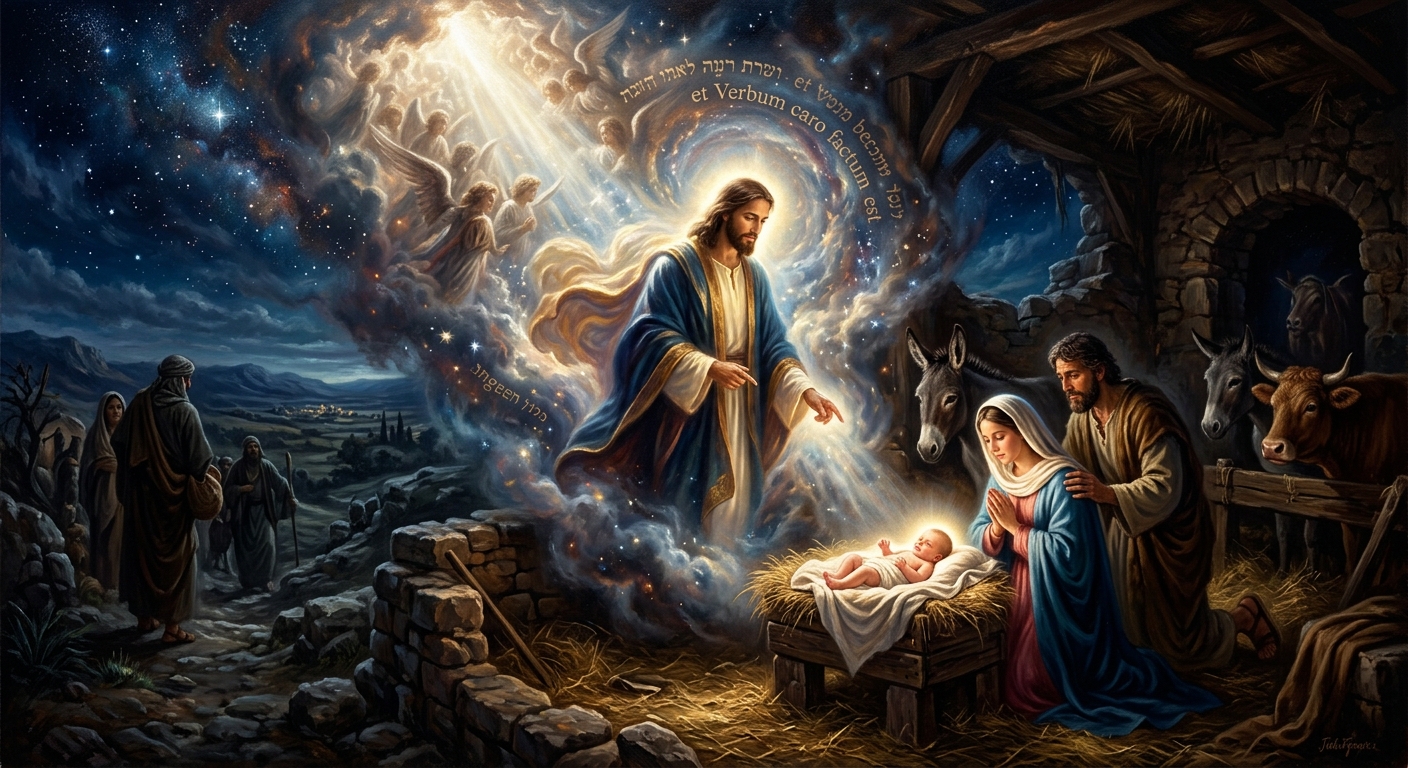
Illustration: Dramatic cinematic biblical illustration for John Chapter 1 showing Incarnation of the Divine Word, photorealistic oil painting style.
🔊
Listen to Chapter
Grace Notes Journey Audio Narration
Author
John the Apostle
Written
~90 AD
Key Theme
Incarnation of the Divine Word
Setting
Early Christian Jerusalem, post-Temple period
Key Verse
John 1:1
Total Verses
51
Chapter Introduction
*In the beginning, God chose to step into our world as a tender Light. The Word was not only with God but truly God, and He came to bring life that shines in the darkness. Though we may stumble in night, His Light never fades, inviting us into a deeper relationship with Him. Let this truth fill your heart with hope and grace as you read on.*
John — Chapter 1 — KJV
1
In the beginning was the Word, and the Word was with God, and the Word was God.
Simply PutIn the beginning was the Word—Logos (G3056), the divine self-expression of God. He existed before anything else, was in perfect fellowship with God, and was fully divine Himself. It tells us that Jesus is not a later invention; He is the eternal source of all life and love.
Key Verse
2
The same was in the beginning with God.
Simply PutThe same was in the beginning with God. Here “same” (autos) emphasizes that this Word is not a separate entity but the very presence of God Himself. It reassures us that before the world began, there was a perfect communion where God and His Word were one.
3
All things were made by him; and without him was not any thing made that was made.
Simply PutAll things were made by him—poieo (G4160) means to bring forth purposefully. Nothing came into being apart from His creative power. When you feel overwhelmed by the world, remember that the same One who created it is intimately involved in every detail of your life.
4
In him was life; and the life was the light of men.
Simply PutIn him was life—zoe (G2222) refers to the fullness of divine vitality, not just mere existence. That life is the light for humanity, guiding us out of spiritual darkness. Even when you feel empty inside, His life offers a radiant source that never dims.
5
And the light shineth in darkness; and the darkness comprehended it not.
Simply PutThe light shines in darkness—skotos (G4679) is the deep, all-encompassing void that separates us from God. The word comprehended (symnoeo, G4845) means to receive or admit. Though darkness may not grasp the light’s brilliance, He continues to illuminate us, inviting us to open our hearts.
6
There was a man sent from God, whose name was John.
Simply PutThere was a man sent from God—anthropos (G444) simply means a human being, chosen for a purpose. John the Baptist was that man, serving as a bridge between heaven and earth. His life shows us that ordinary people can be vessels for extraordinary divine messages.
7
The same came for a witness, to bear witness of the Light, that all men through him might believe.
Simply PutThe same came for a witness—to bear witness of the Light—martureo (G3145) means to testify or attest. He was sent so that everyone might believe in the Light’s promise of salvation. His example reminds us that we are called to testify to God’s truth in our own lives.
8
He was not that Light, but was sent to bear witness of that Light.
Simply PutHe was not that Light, but sent to bear witness of that Light. John understood his role as a messenger rather than the source itself, pointing us toward Jesus. It teaches us humility: we can shine by reflecting the Light rather than trying to be it.
9
That was the true Light, which lighteth every man that cometh into the world.
Simply PutThat was the true Light—phos alēthinos (G545)—the authentic, unblemished illumination that pierces every darkness. It lights every man who steps into the world, offering a path out of spiritual blindness. Even when we wander in confusion, this Light remains steadfast and true.
10
He was in the world, and the world was made by him, and the world knew him not.
Simply PutHe was in the world that He made, yet the world knew Him not. The Greek word for “world” (kosmos) represents the entire created order, which often fails to recognize its creator. It shows us that even those closest to us may miss the One who dwells among them.
11
He came unto his own, and his own received him not.
Simply PutHe came unto His own—His people, the Jews—and they did not receive Him. This rejection reflects a hardened heart that missed the Messiah’s presence. In our own lives, we may overlook God’s gifts until we open our hearts.
12
But as many as received him, to them gave he power to become the sons of God, even to them that believe on his name:
Simply PutBut as many as received Him, He gave them power—exousia (G2192)—the right or privilege—to become children of God. To those who believe in His name, He grants a new identity and purpose. Your faith is the doorway to a divine heritage.
13
Which were born, not of blood, nor of the will of the flesh, nor of the will of man, but of God.
Simply PutThey were born not of blood or flesh, but of God. Spiritual birth is a work of the Holy Spirit, independent of human lineage or desire. It reminds us that we belong to God through His power alone.
14
And the Word was made flesh, and dwelt among us, (and we beheld his glory, the glory as of the only begotten of the Father,) full of grace and truth.
Simply PutAnd the Word was made flesh—sarx (G4562)—He took on human form, walking among us. We saw His glory as the unique Son of the Father, full of grace and truth. In Christ, divine love becomes tangible, reaching us in every circumstance.
15
John bare witness of him, and cried, saying, This was he of whom I spake, He that cometh after me is preferred before me: for he was before me.
Simply PutJohn bore witness of Him, saying He is greater than himself—prochoō (G4286) means to be ahead of. Though John came first in time, the One after Him existed before. This underscores Jesus’ eternal supremacy over all creation and humanity.
16
And of his fulness have all we received, and grace for grace.
Simply PutWe have received all that belongs to Him—His entire being, His life, His love. The Greek word for "fulness," plēroma (G4174), means the complete, overflowing presence of Christ. And He continues to shower us with grace upon grace, never leaving a single need unmet.
17
For the law was given by Moses, but grace and truth came by Jesus Christ.
Simply PutThe old law was given through Moses, but the new covenant is built on grace and truth that come from Jesus Himself. "Grace" (charis, G5485) is God's unmerited favor that restores us, and "truth" (alētheia, G846) is the firm reality of His promises. For the doubting heart, this means we are saved not by our own works but by His loving kindness.
18
No man hath seen God at any time; the only begotten Son, which is in the bosom of the Father, he hath declared him.
Simply PutNo one has ever seen God directly, yet the only begotten Son—Jesus, who dwells in the Father's heart (kardia, G2588)—has revealed Him to us. The term "only begotten Son" (monogenēs huios, G3439+G5200) tells us that Jesus is uniquely qualified to make God known. In our yearning for the divine, we can trust that through His life and words we truly encounter God.
19
And this is the record of John, when the Jews sent priests and Levites from Jerusalem to ask him, Who art thou?
Simply PutThis is the testimony (marturion, G3142) of John the Baptist. The Jews sent priests and Levites from Jerusalem to ask, "Who are you?" They wanted a clear answer for those who had sent them. The question reveals the deep desire to understand God's plan and the identity of His messenger.
20
And he confessed, and denied not; but confessed, I am not the Christ.
Simply PutJohn answered honestly, saying, "I am not the Christ." He did not hide or pretend—he confessed (exēgēs, G1651) his true role. For anyone wrestling with identity, John's humility reminds us that we are called to witness truth, not to be the center of attention.
21
And they asked him, What then? Art thou Elias? And he saith, I am not. Art thou that prophet? And he answered, No.
Simply PutThey pressed further—"Are you Elijah?" "Are you that prophet?" John replied, "No." He clarified that he was not the Old Testament figure returning. This shows that while we may be searching for familiar signs, God often works through new and unexpected channels.
22
Then said they unto him, Who art thou? that we may give an answer to them that sent us. What sayest thou of thyself?
Simply PutThe questioners asked again, "Who are you?" so they could report back to those who sent them. Their repeated inquiry highlights a genuine hunger for understanding and a need for a reliable answer.
23
He said, I am the voice of one crying in the wilderness, Make straight the way of the Lord, as said the prophet Esaias.
Simply PutJohn said, "I am the voice (phōnē, G5401) of one crying out in the wilderness." He echoed the words of the prophet Isaiah, urging people to prepare a straight path for the Lord. His humble declaration invites us to listen closely and make room for God's coming work.
24
And they which were sent were of the Pharisees.
Simply PutThe men who were sent came from the Pharisees, a group focused on strict religious observance. Their presence underscores how even those steeped in ritual were seeking deeper insight into the Messiah.
25
And they asked him, and said unto him, Why baptizest thou then, if thou be not that Christ, nor Elias, neither that prophet?
Simply PutThey asked, "Why do you baptize if you're not the Christ, nor Elijah, nor that prophet?" Their doubts reflect a common struggle—how can someone be significant without being the expected figure? The question pushes us to look beyond titles and see true impact.
26
John answered them, saying, I baptize with water: but there standeth one among you, whom ye know not;
Simply PutJohn replied, "I baptize with water. Yet among you stands one you do not know." He points beyond his own work to the One who would bring a greater revelation. This encourages us, even in our doubts, to recognize that there is a divine plan larger than what we see.
27
He it is, who coming after me is preferred before me, whose shoe’s latchet I am not worthy to unloose.
Simply PutHe declared, "He comes after me and is far greater than I am; I am not worthy to untie his sandal strap." The humble mention of the shoe's latchet (botru, G977) shows John's reverence for the One who would follow. For those feeling unworthy, this reminds us that God's greatness surpasses our own abilities.
28
These things were done in Bethabara beyond Jordan, where John was baptizing.
Simply PutThese events took place at Bethabara, beyond the Jordan River, where John was baptizing.
29
The next day John seeth Jesus coming unto him, and saith, Behold the Lamb of God, which taketh away the sin of the world.
Simply PutThe next day, John saw Jesus coming toward him and said, "Look! The Lamb (arnion, G396) of God who takes away the sin of the world." John identifies Jesus as the perfect sacrifice whose purpose is to cleanse us from all guilt. This offers hope that our sins are not permanent but can be removed by the Lamb.
30
This is he of whom I said, After me cometh a man which is preferred before me: for he was before me.
Simply PutJohn said, "This is the One I spoke of—after me comes a man who is greater than I am because he existed before me." This statement (proēgēs, G4272) affirms Jesus' pre-existence and supreme authority. It reminds us that Christ's presence is timeless, offering eternal security to those who trust Him.
31
And I knew him not: but that he should be made manifest to Israel, therefore am I come baptizing with water.
Simply PutJohn admits he didn’t know Jesus personally before his ministry began; instead, God sent him to baptize with water so that the Messiah would be revealed—“manifest” (Greek phaneroō, G5470) means to make clear or visible.
32
And John bare record, saying, I saw the Spirit descending from heaven like a dove, and it abode upon him.
Simply PutJohn testifies that he saw the Holy Spirit (Greek πνεῦμα, G4151) descend from heaven like a dove (ὄρνις, G3628), confirming Jesus’ divine anointing.
33
And I knew him not: but he that sent me to baptize with water, the same said unto me, Upon whom thou shalt see the Spirit descending, and remaining on him, the same is he which baptizeth with the Holy Ghost.
Simply PutJohn explains that God told him the one upon whom the Spirit rests is the one who will baptize with the Holy Ghost (Greek πνεῦμα, G4151), pointing to Jesus as the source of spiritual renewal.
34
And I saw, and bare record that this is the Son of God.
Simply PutJohn confidently declares that he has seen and recorded Jesus as the Son of God (Greek υἱός, G5205), affirming his identity as the promised Messiah.
35
Again the next day after John stood, and two of his disciples;
Simply PutAfter John’s testimony, two of his own disciples decide to follow Jesus, marking the beginning of a new group of followers.
36
And looking upon Jesus as he walked, he saith, Behold the Lamb of God!
Simply PutJohn points out to the two disciples that Jesus is “the Lamb of God,” a perfect sacrifice who takes away sin—“Lamb” (Greek ἀμνός, G358) symbolizes innocence and redemption.
37
And the two disciples heard him speak, and they followed Jesus.
Simply PutHearing John’s proclamation, the two disciples immediately follow Jesus, showing their readiness to seek truth.
38
Then Jesus turned, and saw them following, and saith unto them, What seek ye? They said unto him, Rabbi, (which is to say, being interpreted, Master,) where dwellest thou?
Simply PutWhen Jesus turns and sees them following, He asks what they’re looking for; they respectfully call Him “Rabbi” (Greek διδάσκαλος, G1321) and ask where He lives (“dwellest”—G5620), seeking a deeper connection.
39
He saith unto them, Come and see. They came and saw where he dwelt, and abode with him that day: for it was about the tenth hour.
Simply PutJesus invites them to see where He lives, and they spend the day with Him (“abided”—Greek μένω, G3326), learning and resting in His presence.
40
One of the two which heard John speak, and followed him, was Andrew, Simon Peter’s brother.
Simply PutOne of the two who heard John and followed Jesus was Andrew, Simon Peter’s brother—signifying that even in a small family circle, the call of Christ spreads.
41
He first findeth his own brother Simon, and saith unto him, We have found the Messias, which is, being interpreted, the Christ.
Simply PutAndrew finds his brother Simon and excitedly tells him they have found the Messiah (Greek χριστός, G5547), the Anointed One promised in Scripture.
42
And he brought him to Jesus. And when Jesus beheld him, he said, Thou art Simon the son of Jona: thou shalt be called Cephas, which is by interpretation, A stone.
Simply PutPeter is brought to Jesus, who looks at him and gives him the name Cephas (Greek Κηφᾶς, G2812), meaning “rock,” indicating Peter’s future role as a firm foundation of the church.
43
The day following Jesus would go forth into Galilee, and findeth Philip, and saith unto him, Follow me.
Simply PutThe next day, Jesus goes to Galilee and calls Philip, saying “Follow me,” inviting him into a life of discipleship.
44
Now Philip was of Bethsaida, the city of Andrew and Peter.
Simply PutPhilip is from Bethsaida, the same hometown as Andrew and Peter, showing how the early followers are closely connected.
45
Philip findeth Nathanael, and saith unto him, We have found him, of whom Moses in the law, and the prophets, did write, Jesus of Nazareth, the son of Joseph.
Simply PutPhilip finds Nathanael and tells him that they have found the one Moses and the prophets wrote about—Jesus of Nazareth.
46
And Nathanael said unto him, Can there any good thing come out of Nazareth? Philip saith unto him, Come and see.
Simply PutNathanael doubts the worth of Nazareth, asking if any good thing—Greek agathos (G26), meaning truly beneficial or noble—could come from such a humble place. Philip simply says, “Come and see,” inviting him to witness rather than decide by reputation alone.
47
Jesus saw Nathanael coming to him, and saith of him, Behold an Israelite indeed, in whom is no guile!
Simply PutJesus calls Nathanael “an Israelite indeed, in whom there is no guile”—Greek apate (G613), which implies deceit or hidden sin. This declares that Nathanael’s heart is sincere, a rare quality that anyone bearing deep pain or hidden doubts craves: being truly seen without pretense.
48
Nathanael saith unto him, Whence knowest thou me? Jesus answered and said unto him, Before that Philip called thee, when thou wast under the fig tree, I saw thee.
Simply PutNathanael asks how Jesus knows him, and Jesus replies that He saw him under the fig tree—Greek syke (G4940), a place of contemplation in ancient Israel. This intimate knowledge shows that God sees the quiet moments of our lives, offering hope to those who feel unseen or overlooked.
49
Nathanael answered and saith unto him, Rabbi, thou art the Son of God; thou art the King of Israel.
Simply PutUpon hearing this, Nathanael declares, “Rabbi (rabbí, G4505), you are the Son of God and the King of Israel.” He recognizes both the divine nature—Greek huios tou theou (G5209)—and the messianic authority, a bold confession that gives hungry seekers a glimpse of true identity.
50
Jesus answered and said unto him, Because I said unto thee, I saw thee under the fig tree, believest thou? thou shalt see greater things than these.
Simply PutJesus asks if Nathanael believes Him because He saw him under the fig tree, using the Greek word pisteuo (G4100) for trust. He promises that believers will witness “greater things” than this, encouraging those in doubt to look beyond the present and anticipate deeper revelations.
51
And he saith unto him, Verily, verily, I say unto you, Hereafter ye shall see heaven open, and the angels of God ascending and descending upon the Son of man.
Simply PutJesus says, “Verily, verily (amen amen, G395), you will see heaven opened and the angels of God descending and ascending upon the Son of man.” This promise of a new, visible reality—Greek huios tou anthrōpou (G5205)—offers hope to those longing for a tangible encounter with God’s kingdom.
Genesis 1:1This verse mirrors John 1:1's "In the beginning," linking the Word to God's original act of creation.
Genesis 1:3"And God said, Let there be light," directly parallels John 1:5's description of Light shining in darkness.
Colossians 1:16"For by him were all things created," confirms John 1:3's statement that the Word made all things.
Isaiah 40:3"Prepare ye the way of the LORD," illuminates John 1:23's portrayal of John the Baptist as the voice crying in the wilderness.
Reflect
Reflecting on John’s statement that there is someone among you whom you do not know, can you identify a person or situation in your life right now that might be quietly pointing you toward something deeper?