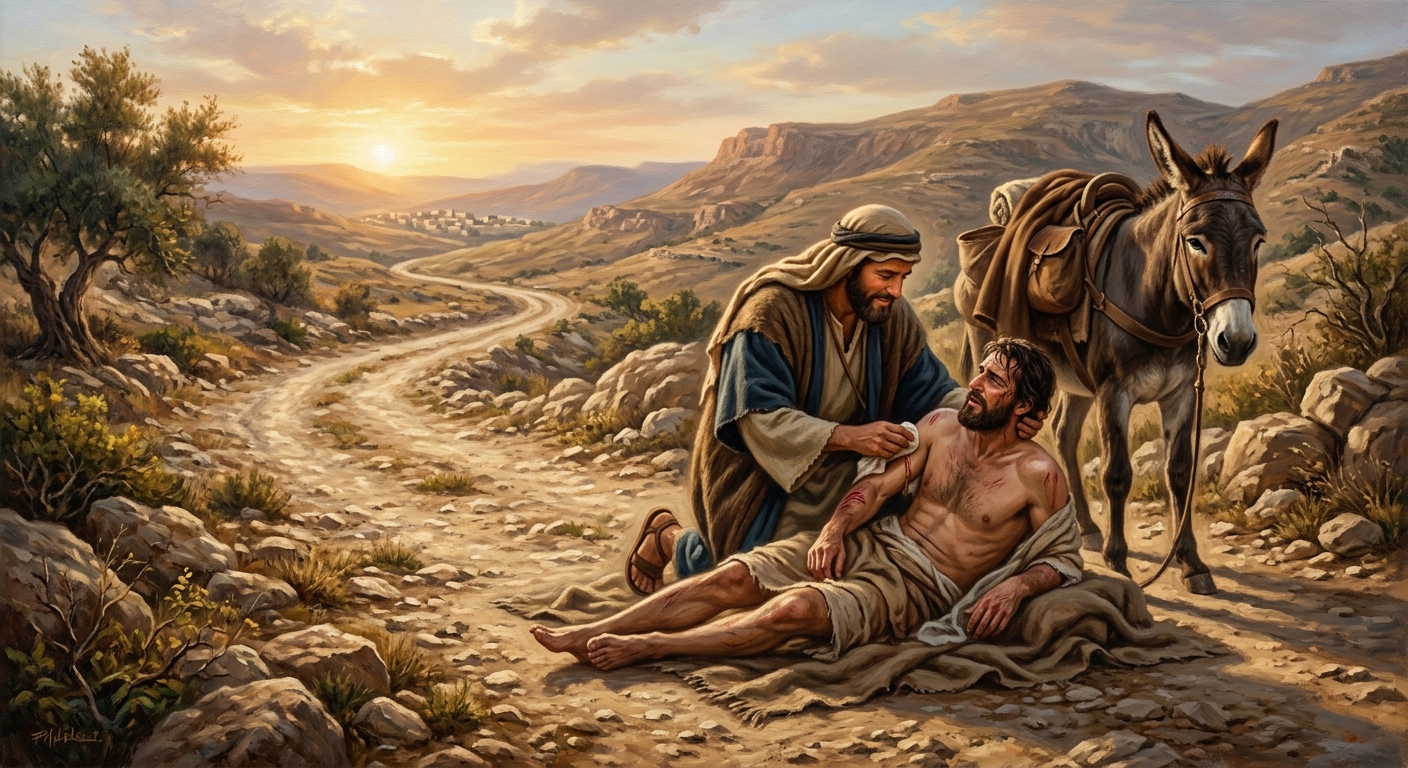
Illustration: A photorealistic oil painting of the Samaritan
🔊
Listen to Chapter
Grace Notes Journey Audio Narration
Author
John the Apostle
Written
~90-95 AD
Key Theme
Living Water and True Worship
Setting
Samaria, Jacob's Well
Key Verse
John 4:13
Total Verses
54
Chapter Introduction
*In this gentle encounter, the Savior reaches across centuries and cultures to offer an invitation that transcends geography. He meets a weary woman at the well, not merely to quench her thirst but to reveal the source of everlasting life. The story reminds us that true worship is not bound by place but by spirit and truth, flowing from a heart renewed by grace. May we, like the Samaritan woman, step forward in faith and share this living water with those around us.*
John — Chapter 4 — KJV
1
When therefore the LORD knew how the Pharisees had heard that Jesus made and baptized more disciples than John,
Simply PutThe Greek word “Lord” (kyrios, G2962) tells us that God is fully aware of every plot and rumor. Even the Pharisees' whispering about Jesus’ growing following didn’t escape His notice. This reminds us that our doubts and gossip are never hidden from God’s all-seeing eye.
2
(Though Jesus himself baptized not, but his disciples,)
Simply PutThe term “baptized” (baptizo, G907) here isn’t about a ritual but about being immersed in Jesus’ authority. Though Christ Himself didn’t perform the baptisms, He empowered His disciples to do so. It shows that God works through ordinary people when they are filled with His Spirit.
3
He left Judaea, and departed again into Galilee.
Simply Put“Departed” (exodidomi, G1843) means He left the familiar and went out into new lands. Leaving Judea for Galilee, Jesus stepped beyond the Jewish heartland to meet people where they lived. He teaches us that following God often means leaving our comfort zones.
4
And he must needs go through Samaria.
Simply PutThe phrase “must needs” (dei, G1165) signals a divine necessity—Jesus could not avoid Samaria. He crossed the cultural divide that Jews and Samaritans kept for centuries. This reminds us that God’s purpose often leads us through places we might otherwise avoid.
5
Then cometh he to a city of Samaria, which is called Sychar, near to the parcel of ground that Jacob gave to his son Joseph.
Simply Put“Jacob” (Iakobos, G2473) is a key patriarch whose land holds deep history. The well at Sychar sits on the very ground Jacob gave to his son Joseph, a place steeped in covenant. Jesus chooses to meet humanity amidst the weight of ancient promises.
6
Now Jacob’s well was there. Jesus therefore, being wearied with his journey, sat thus on the well: and it was about the sixth hour.
Simply Put“Wearied” (kinouron, G2805) shows Jesus was physically tired from the journey. He rests at Jacob’s well at about noon, the “sixth hour.” Even the Son of God needed a pause—God invites us to find rest in Him amid our busy lives.
7
There cometh a woman of Samaria to draw water: Jesus saith unto her, Give me to drink.
Simply PutThe woman comes to “draw water,” a daily task of fetching sustenance. Jesus asks her for a drink, flipping the cultural script—He, a man, asks a woman of Samaria. He meets us in our ordinary routines and invites deeper conversation.
8
(For his disciples were gone away unto the city to buy meat.)
Simply PutThe disciples had gone into town to “buy meat,” showing that Jesus’ ministry includes ordinary human needs like food. While they were away, He stayed with the woman—spending time where others won’t.
9
Then saith the woman of Samaria unto him, How is it that thou, being a Jew, askest drink of me, which am a woman of Samaria? for the Jews have no dealings with the Samaritans.
Simply PutThe woman wonders why a Jew would ask her for water, as “Jews” (Ioudaios, G2450) and Samaritans never mixed. Her question reveals deep cultural barriers that Jesus is about to break down. He shows that God’s love crosses all human borders.
10
Jesus answered and said unto her, If thou knewest the gift of God, and who it is that saith to thee, Give me to drink; thou wouldest have asked of him, and he would have given thee living water.
Simply PutJesus speaks of the “gift” (dorea, G1406) and “living water” (hydor zōn, G5615). If she knew this gift, she would have asked God for it and received eternal sustenance. He offers a deeper satisfaction that quenches the soul, not just the body.
11
The woman saith unto him, Sir, thou hast nothing to draw with, and the well is deep: from whence then hast thou that living water?
Simply PutThe woman points out that there’s “nothing to draw with,” and the well is deep—she doubts He can provide water without a bucket. Her skepticism reflects our own doubts about how the Spirit works in us.
12
Art thou greater than our father Jacob, which gave us the well, and drank thereof himself, and his children, and his cattle?
Simply PutShe asks if He is “greater than our father Jacob,” the one who gave them the well. By comparing Him to a revered ancestor, she seeks evidence of His power. Jesus shows that true greatness lies not in earthly titles but in spiritual provision.
13
Jesus answered and said unto her, Whosoever drinketh of this water shall thirst again:
Simply Put“Drinketh” (pieō, G4182) is used to illustrate that the water He offers now will never satisfy. If you drink it once, your thirst won’t return—It’s an everlasting source that fills the deepest longing.
14
But whosoever drinketh of the water that I shall give him shall never thirst; but the water that I shall give him shall be in him a well of water springing up into everlasting life.
Simply PutThe “everlasting” (aiōnios, G165) water becomes a spring inside each believer that continuously flows. This “well of water” leads to an eternal life that never runs dry, a promise that our thirst will be forever quenched.
15
The woman saith unto him, Sir, give me this water, that I thirst not, neither come hither to draw.
Simply PutThe woman asks for this water, yearning that she never has to come back and draw again. Her request shows a deep desire for a lasting fulfillment that only God can provide, leaving behind the endless cycle of searching.
16
Jesus saith unto her, Go, call thy husband, and come hither.
Simply PutJesus gently tells her, “Go, call your husband and come here.” The Greek word for husband, anēr (G132), means a man, the male partner in marriage. He knows her situation and calls her out into his presence, showing that even the deepest brokenness can be met by God's love.
17
The woman answered and said, I have no husband. Jesus said unto her, Thou hast well said, I have no husband:
Simply PutShe answers, “I have no husband,” and Jesus replies, “You’ve spoken truly; I also have no husband.” The Greek word for “no,” ou (G3760), emphasizes a total lack. In the midst of her shame, Jesus affirms her honesty—God cares for those who are honest about their pain.
18
For thou hast had five husbands; and he whom thou now hast is not thy husband: in that saidst thou truly.
Simply Put“You have had five husbands, and the one you now have is not your husband,” He says. The Greek word alēthēs (G260) means “truly” or “in truth.” By revealing her history, He shows that true intimacy with God begins when we stop hiding our deepest hurts.
19
The woman saith unto him, Sir, I perceive that thou art a prophet.
Simply Put“Sir, I realize you are a prophet,” she says. The word prophetic, prophētēs (G4384), means “one who speaks God’s truth.” Even a Samaritan woman, dismissed by many, perceives that Jesus carries divine insight.
20
Our fathers worshipped in this mountain; and ye say, that in Jerusalem is the place where men ought to worship.
Simply Put“Our fathers worshipped on this mountain, but you say Jerusalem is the proper place to worship.” The Greek word latreō (G2986) means “to serve or worship.” This debate shows how people can be split over rituals, yet miss the heart of true worship.
21
Jesus saith unto her, Woman, believe me, the hour cometh, when ye shall neither in this mountain, nor yet at Jerusalem, worship the Father.
Simply Put“Believe me,” Jesus says, “the hour is coming when worship will no longer be tied to a mountain or Jerusalem.” The Greek word hora (G5612) means “a specific, appointed time.” He points to a future where worship is not about location but about a personal relationship with the Father.
22
Ye worship ye know not what: we know what we worship: for salvation is of the Jews.
Simply Put“You worship what you don’t know; we do know what we worship, for salvation comes from the Jews.” The word soteria (G4982) means “salvation.” He acknowledges that the Jews held the key to God’s promise, yet true worship transcends ethnicity.
23
But the hour cometh, and now is, when the true worshippers shall worship the Father in spirit and in truth: for the Father seeketh such to worship him.
Simply Put“The hour is now when the true worshippers will worship God in spirit and truth.” The Greek pneuma (G4151) means “spirit,” and alēthēs (G260) means “truth.” True worship is an inner, sincere devotion, not merely outward formalities.
24
God is a Spirit: and they that worship him must worship him in spirit and in truth.
Simply Put“God is spirit; those who worship must do so in spirit and truth.” The word pneuma (G4151) emphasizes that God’s nature is non-physical. Worshiping Him requires a heartfelt, authentic connection beyond rituals.
25
The woman saith unto him, I know that Messias cometh, which is called Christ: when he is come, he will tell us all things.
Simply Put“I know the Messiah is coming—called Christ—who will tell us everything.” The Greek messiā (G3217) means “anointed one,” and Christos (G5547) also means “the anointed.” She looks forward to a future Savior who will bring clarity and hope.
26
Jesus saith unto her, I that speak unto thee am he.
Simply Put“I am the one speaking to you.” The Greek legei (G3004) means “to say” or “to speak.” Jesus declares His identity, confirming that the promised Messiah is right there with her.
27
And upon this came his disciples, and marvelled that he talked with the woman: yet no man said, What seekest thou? or, Why talkest thou with her?
Simply PutThe disciples were surprised that He was talking to a woman; no one asked Him why. The Greek word thaumazō (G2325) means “to marvel.” This shows that Jesus breaks social barriers, showing love to all.
28
The woman then left her waterpot, and went her way into the city, and saith to the men,
Simply PutShe leaves her waterpot and goes into the city. The Greek loutōrion (G3060) means “water jar.” In leaving the ordinary daily task, she chooses to share her encounter with others.
29
Come, see a man, which told me all things that ever I did: is not this the Christ?
Simply Put“Come, see a man who told me everything I ever did. Is this not the Christ?” She brings her citymen to meet Jesus. The word Christos (G5547) signifies the anointed Savior she believes He is.
30
Then they went out of the city, and came unto him.
Simply PutThey leave their city and come to Him. The Greek polis (G1566) means “city.” Her testimony compels others to step out of their routines and encounter the living God.
31
In the mean while his disciples prayed him, saying, Master, eat.
Simply PutThe disciples, seeing Jesus tired from the long journey, felt a deep concern for His physical needs. In Greek, ζητεῖν (G2219) means to ask earnestly for something essential. Their request, “Master, eat,” reflects a heartfelt desire to care for someone they love.
32
But he said unto them, I have meat to eat that ye know not of.
Simply PutJesus replies, “I have meat to eat that ye know not of.” The Greek word σάρξ (G4560) isn’t just food; it’s the very essence of life. He’s pointing to a deeper sustenance that satisfies the soul, beyond any earthly meal.
33
Therefore said the disciples one to another, Hath any man brought him ought to eat?
Simply PutThe disciples whisper among themselves, “Hath any man brought him ought to eat?” The Greek verb φέρω (G535) means “to bring.” Their doubt reveals a worry that He might lack the resources to fulfill His divine mission.
34
Jesus saith unto them, My meat is to do the will of him that sent me, and to finish his work.
Simply PutJesus tells them, “My meat is to do the will of him that sent me, and to finish his work.” The word σάρξ (G4560) again signals the vital nourishment of spiritual purpose. “Will” (βούλημα, G970) is His Father’s plan; the true food for Jesus is obedience and completion of God’s design.
35
Say not ye, There are yet four months, and then cometh harvest? behold, I say unto you, Lift up your eyes, and look on the fields; for they are white already to harvest.
Simply PutHe warns, “Don’t say there are still four months until the harvest.” The Greek word συγκομίζω (G5186) means “to gather in.” He urges them to lift their eyes now and see the fields already white, reminding us that God’s timing is often sooner than we expect.
36
And he that reapeth receiveth wages, and gathereth fruit unto life eternal: that both he that soweth and he that reapeth may rejoice together.
Simply Put“He who reaps receives wages and gathers fruit for eternal life.” The Greek μισθός (G3394) is the reward earned. This verse shows that both sowers and reapers can rejoice together, as each labor contributes to a harvest that lasts forever.
37
And herein is that saying true, One soweth, and another reapeth.
Simply Put“One sows and another reaps.” The Greek σπείρω (G4925) refers to planting seed. It highlights the truth that in God’s kingdom, different people fulfill different roles, and each labor is valued.
38
I sent you to reap that whereon ye bestowed no labour: other men laboured, and ye are entered into their labours.
Simply Put“I sent you to reap where you did not sow.” The Greek συγκομίζω (G5186) again emphasizes gathering. Jesus tells His disciples they are entering into the harvest that others have already worked on, showing how we can be blessed by joining in someone else’s ministry.
39
And many of the Samaritans of that city believed on him for the saying of the woman, which testified, He told me all that ever I did.
Simply Put“Many Samaritans believed because of the woman’s testimony.” The Greek πιστεύω (G4100) means to trust or have confidence. Her personal story of Jesus revealing her life’s details sparked a ripple of faith throughout the town.
40
So when the Samaritans were come unto him, they besought him that he would tarry with them: and he abode there two days.
Simply Put“The Samaritans asked Him to stay.” The Greek αἰτέω (G151) means to request or plead. Their earnest invitation shows a deep hunger for His presence, and He responded by staying two days.
41
And many more believed because of his own word;
Simply Put“Many more believed because of His own word.” The Greek λόγος (G3056) is the spoken message, powerfully persuasive. His own teachings carried weight and drew even more people into belief.
42
And said unto the woman, Now we believe, not because of thy saying: for we have heard him ourselves, and know that this is indeed the Christ, the Saviour of the world.
Simply Put“We believe not because of your words, but because we have heard Him ourselves.” The Greek Χριστός (G5547) identifies Jesus as the Anointed One, the Savior of the world. Their confession reflects a personal encounter that confirmed His divine role.
43
Now after two days he departed thence, and went into Galilee.
Simply Put“After two days, He left and went into Galilee.” This simple transition shows the continuity of His mission—moving from one place to another, always on purpose.
44
For Jesus himself testified, that a prophet hath no honour in his own country.
Simply Put“A prophet has no honor in his own country.” The Greek προφήτης (G4429) denotes a messenger from God. This truth points to the familiar reality that those closest to us often overlook our gifts.
45
Then when he was come into Galilee, the Galilaeans received him, having seen all the things that he did at Jerusalem at the feast: for they also went unto the feast.
Simply Put“The Galilaeans welcomed Him, having seen His miracles at the feast.” The Greek ἀποδέχομαι (G540) means to receive willingly. Their recognition of His works in Jerusalem reinforces how authentic signs and deeds draw people closer to Him.
46
So Jesus came again into Cana of Galilee, where he made the water wine. And there was a certain nobleman, whose son was sick at Capernaum.
47
When he heard that Jesus was come out of Judaea into Galilee, he went unto him, and besought him that he would come down, and heal his son: for he was at the point of death.
48
Then said Jesus unto him, Except ye see signs and wonders, ye will not believe.
49
The nobleman saith unto him, Sir, come down ere my child die.
50
Jesus saith unto him, Go thy way; thy son liveth. And the man believed the word that Jesus had spoken unto him, and he went his way.
51
And as he was now going down, his servants met him, and told him, saying, Thy son liveth.
52
Then enquired he of them the hour when he began to amend. And they said unto him, Yesterday at the seventh hour the fever left him.
53
So the father knew that it was at the same hour, in the which Jesus said unto him, Thy son liveth: and himself believed, and his whole house.
54
This is again the second miracle that Jesus did, when he was come out of Judaea into Galilee.
John 3:22This verse situates Jesus' journey through Judaea and Samaria after the baptism of John, illuminating the context of v1‑v4.
Genesis 29:1Jacob's encounter at a well in Haran mirrors the Samaritan woman's meeting with Jesus at Jacob’s well, highlighting the narrative parallel.
Isaiah 12:3The promise to "draw water out of the wells of salvation" prefigures Jesus' offer of living water to the Samaritan woman.
Jeremiah 2:13The prophetic image of God as "the fountain of living waters" underscores the woman's yearning for spiritual fulfillment in v7‑v8.
Reflect
What recent encounter or insight has moved you to leave your familiar routine and share its significance with the people in your daily life?