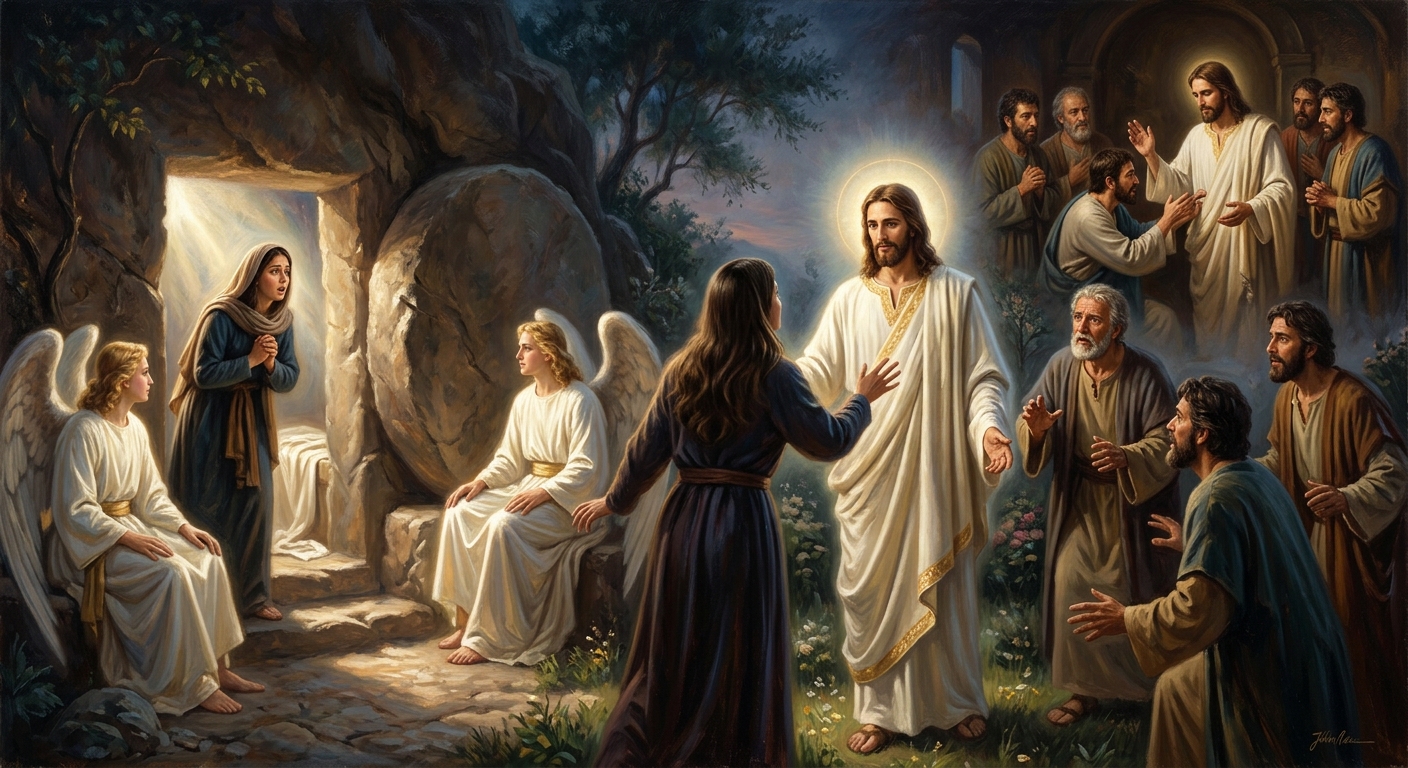
Illustration: Dramatic cinematic biblical illustration for John Chapter 20 showing Resurrection and the risen Christ's appearances, photorealistic oil painting style.
🔊
Listen to Chapter
Grace Notes Journey Audio Narration
Author
John the Apostle
Written
~90-95 AD
Key Theme
Resurrection and the risen Christ's appearances
Setting
Jerusalem - early morning after crucifixion
Key Verse
John 20:28
Total Verses
31
Chapter Introduction
*In the quiet hush before dawn, Mary Magdalene's devotion led her to the empty tomb. As she runs to share this miracle with Peter and the beloved disciple, the stone is rolled away, revealing that death has been conquered. The risen Christ appears to His friends, breathing peace into their fear and doubt. He invites them into the light of new life, calling us to believe and be transformed.*
John — Chapter 20 — KJV
1
The first day of the week cometh Mary Magdalene early, when it was yet dark, unto the sepulchre, and seeth the stone taken away from the sepulchre.
Simply PutMary Magdalene went to the tomb early on the first day of the week, while it was still dark. The Greek word for “first” (mia, G3170) marks the very beginning of a new week—just as we start fresh each Monday. Even in the deep darkness (skotos, G4569), she was seeking her Lord’s body.
2
Then she runneth, and cometh to Simon Peter, and to the other disciple, whom Jesus loved, and saith unto them, They have taken away the LORD out of the sepulchre, and we know not where they have laid him.
Simply PutShe runs to tell Peter and the other disciple, saying “They have taken away the Lord from the tomb.” The word “Lord” (kyrios, G2962) isn’t just a title; it’s the deep personal relationship she had with Jesus. Her panic shows how real loss can feel like something has been stolen from us.
3
Peter therefore went forth, and that other disciple, and came to the sepulchre.
Simply PutPeter and the other disciple set out together to the tomb. Their haste reflects a desperate need for truth—when something is missing, we’re driven to find the answer.
4
So they ran both together: and the other disciple did outrun Peter, and came first to the sepulchre.
Simply PutBoth ran; the other disciple outran Peter and reached the tomb first. In moments of crisis, we often find that someone else may arrive sooner, but all are drawn to the same hope.
5
And he stooping down, and looking in, saw the linen clothes lying; yet went he not in.
Simply PutHe stooped down and looked inside, seeing the linen cloths lying there, yet he didn’t go in. The word “stooped” (krousō, G2914) suggests reverence—he was humbled before what could be a holy place.
6
Then cometh Simon Peter following him, and went into the sepulchre, and seeth the linen clothes lie,
Simply PutThen Simon Peter went in after him and saw the linen cloths lying. This simple act of entering shows that sometimes we need to step into uncertainty to see the evidence.
7
And the napkin, that was about his head, not lying with the linen clothes, but wrapped together in a place by itself.
Simply PutThe napkin, which had been around his head, was lying separate from the linen cloths. In Greek law (G3760), burial linens were laid out in a specific order; the separate napkin hints at something intentionally left untouched.
8
Then went in also that other disciple, which came first to the sepulchre, and he saw, and believed.
Simply PutThe other disciple, who had arrived first, went in and saw, and he believed. “Believed” (pisteusō, G4100) isn’t just an intellectual assent; it’s a heart trust that says “I know this is true.”
9
For as yet they knew not the scripture, that he must rise again from the dead.
Simply PutFor they had not yet understood the Scripture (graphe, G1123) that He must rise again from the dead. The early believers were still learning that the Old Testament promised a new life beyond the grave.
10
Then the disciples went away again unto their own home.
Simply PutThe disciples went back home again. Even after seeing something miraculous, they returned to their ordinary lives—reminding us that faith often coexists with daily routine.
11
But Mary stood without at the sepulchre weeping: and as she wept, she stooped down, and looked into the sepulchre,
Simply PutMary stayed outside the tomb weeping, and as she wept, she stooped down to look in. Her tears (klērou, G2817) are a raw expression of loss that anyone in grief can relate to.
12
And seeth two angels in white sitting, the one at the head, and the other at the feet, where the body of Jesus had lain.
Simply PutShe sees two angels dressed in white sitting at the head and feet of where Jesus had lain. White (leukos, G567) symbolizes purity; the angels’ presence signals that God’s message is being delivered.
13
And they say unto her, Woman, why weepest thou? She saith unto them, Because they have taken away my LORD, and I know not where they have laid him.
Simply PutThey ask her why she weeps; she answers because they have taken away her Lord and she doesn’t know where He was laid. Her confusion mirrors our own when life’s plans seem to be torn apart.
14
And when she had thus said, she turned herself back, and saw Jesus standing, and knew not that it was Jesus.
Simply PutAs she turned back, she saw Jesus standing but didn’t recognize Him. The failure to see Him immediately reminds us that we often miss the presence of God when we’re focused on our own pain.
15
Jesus saith unto her, Woman, why weepest thou? whom seekest thou? She, supposing him to be the gardener, saith unto him, Sir, if thou have borne him hence, tell me where thou hast laid him, and I will take him away.
Simply PutJesus asks her why she weeps and whom she seeks. Thinking He’s the gardener, she says “Sir, if you have moved Him away, tell me where to find Him.” Even in confusion, she reaches out for answers—showing a relentless desire to know where her love has gone.
16
Jesus saith unto her, Mary. She turned herself, and saith unto him, Rabboni; which is to say, Master.
Simply PutMary turned around and heard Jesus call her by name. The Greek word for “Rabboni” (G4520) means “my Teacher or Master.” In that simple greeting, she’s reminded of a personal relationship—Jesus knows her by name and calls her his beloved disciple.
17
Jesus saith unto her, Touch me not; for I am not yet ascended to my Father: but go to my brethren, and say unto them, I ascend unto my Father, and your Father; and to my God, and your God.
Simply PutJesus tells Mary, “Touch me not; for I am not yet ascended to my Father.” The word “ascended” (Greek: anabaino, G376) signifies his future return to heaven. He also says he ascends “to my Father and your Father, to my God and your God,” showing that the Christian relationship with God is a shared family bond.
18
Mary Magdalene came and told the disciples that she had seen the LORD, and that he had spoken these things unto her.
Simply PutMary Magdalene ran to tell the disciples what she had seen. Her words carried weight because she was the first witness of the risen Christ, and her testimony anchored their hope in the reality that Jesus is alive.
19
Then the same day at evening, being the first day of the week, when the doors were shut where the disciples were assembled for fear of the Jews, came Jesus and stood in the midst, and saith unto them, Peace be unto you.
Simply PutOn the evening of the first day of the week, the doors were shut because the disciples feared the Jews. Jesus entered and said “Peace be unto you.” The Greek word “peace” (eirēnē, G1519) isn’t just calmness; it is a deep wholeness that comes from being reconciled with God through Christ’s victory over death.
20
And when he had so said, he shewed unto them his hands and his side. Then were the disciples glad, when they saw the LORD.
Simply PutJesus showed his hands and side to the disciples. The physical proof of his wounds reminded them that he truly suffered for them, and seeing the risen Lord filled their hearts with gladness—a joy that replaces fear and doubt.
21
Then said Jesus to them again, Peace be unto you: as my Father hath sent me, even so send I you.
Simply PutJesus repeated “Peace be unto you” and said, “As my Father hath sent me, even so send I you.” The word “send” (Greek: apostello, G652) indicates a commission. He’s calling them out into the world to share his peace and truth, just as he was sent by God.
22
And when he had said this, he breathed on them, and saith unto them, Receive ye the Holy Ghost:
Simply PutAfter speaking, Jesus breathed on them and said, “Receive ye the Holy Ghost.” The Greek word for “Holy Ghost” (Pneuma, G4151) means the breath of God. This breathing in signifies a fresh outpouring of divine life and empowerment for their mission.
23
Whose soever sins ye remit, they are remitted unto them; and whose soever sins ye retain, they are retained.
Simply Put“Whose soever sins ye remit, they are remitted unto them; and whose soever sins ye retain, they are retained.” The Greek word for “remit” (aphiēmi, G632) means to release or forgive. Jesus is telling them that they have the authority to bind and loose—granting forgiveness as they stand in his power.
24
But Thomas, one of the twelve, called Didymus, was not with them when Jesus came.
Simply PutThomas, called Didymus, was not present when Jesus first appeared. His absence sets the stage for a deeper lesson about belief versus seeing.
25
The other disciples therefore said unto him, We have seen the LORD. But he said unto them, Except I shall see in his hands the print of the nails, and put my finger into the print of the nails, and thrust my hand into his side, I will not believe.
Simply PutThe other disciples told Thomas they had seen Jesus, but he demanded proof. He wanted to feel the “print of the nails” (Greek: stigma, G5195) in Jesus’s hands and side. Thomas’ craving for tangible evidence reflects a natural human desire to see before believing.
26
And after eight days again his disciples were within, and Thomas with them: then came Jesus, the doors being shut, and stood in the midst, and said, Peace be unto you.
Simply PutEight days later, Thomas was there when the doors were shut. Jesus appeared again and said, “Peace be unto you.” The repeated greeting reassures Thomas that his doubts are being met with grace, not judgment.
27
Then saith he to Thomas, Reach hither thy finger, and behold my hands; and reach hither thy hand, and thrust it into my side: and be not faithless, but believing.
Simply PutJesus invited Thomas to “Reach hither thy finger…and thrust thy hand into my side.” He said, “be not faithless, but believing.” The word “faithless” (Greek: apistos, G862) means lacking belief. Jesus gently pushes Thomas from doubt to trust.
28
And Thomas answered and said unto him, My LORD and my God.
Simply PutThomas declared, “My Lord and my God.” The Greek phrase here, “Kyrios kai Theos,” (G2962 + G2316) affirms Jesus’s divine authority. Thomas’ confession is a heartfelt acknowledgment that the risen Christ is both his master and his deity.
29
Jesus saith unto him, Thomas, because thou hast seen me, thou hast believed: blessed are they that have not seen, and yet have believed.
Simply PutJesus tells Thomas, “Because thou hast seen me, thou hast believed; blessed are they that have not seen and yet have believed.” The word “blessed” (G1340) means happy or favored. He emphasizes that faith without sight is a treasured gift, encouraging all believers who walk by trust alone.
30
And many other signs truly did Jesus in the presence of his disciples, which are not written in this book:
Simply PutJesus says many other signs were performed in the presence of his disciples that are not recorded. This reminds us that the gospel story we have is just a glimpse of the fullness of Christ’s work and power, inviting us to seek deeper experiences with Him.
31
But these are written, that ye might believe that Jesus is the Christ, the Son of God; and that believing ye might have life through his name.
Simply PutThis verse tells us that these written words are not just stories, but a lifeline. The Greek word for "Christ" (χριστός, G5547) means the one anointed by God—Jesus as He was set apart to save us. When we truly believe in Him, the word "life" (ζωή, G2222) is not just future hope but a present reality that flows from His name into our hearts today. In the midst of doubt or sorrow, this promise invites us to trust in Jesus as the living Son of God and receive life that transforms our everyday existence.
Genesis 1:5The phrase “the first day of the week” in John 20:1 echoes God’s creation of light on the first day, underscoring a new beginning with Christ’s resurrection.
Mark 16:1Mary Magdalene’s early visit to the sepulchre parallels Mark’s account of women finding the stone rolled away, confirming the shared resurrection narrative.
Luke 24:12Peter’s rush to the tomb and discovery of the linen cloths in Luke mirrors John 20:3‑6, providing a parallel eyewitness testimony of the empty tomb.
John 19:23The mention of a “napkin” and linen clothes in John 20:7‑8 connects back to the burial garments placed on Jesus, highlighting their purposeful arrangement after His resurrection.
Reflect
When have you caught a glimpse of who God truly sees you as, beyond the roles and routines that define your day?