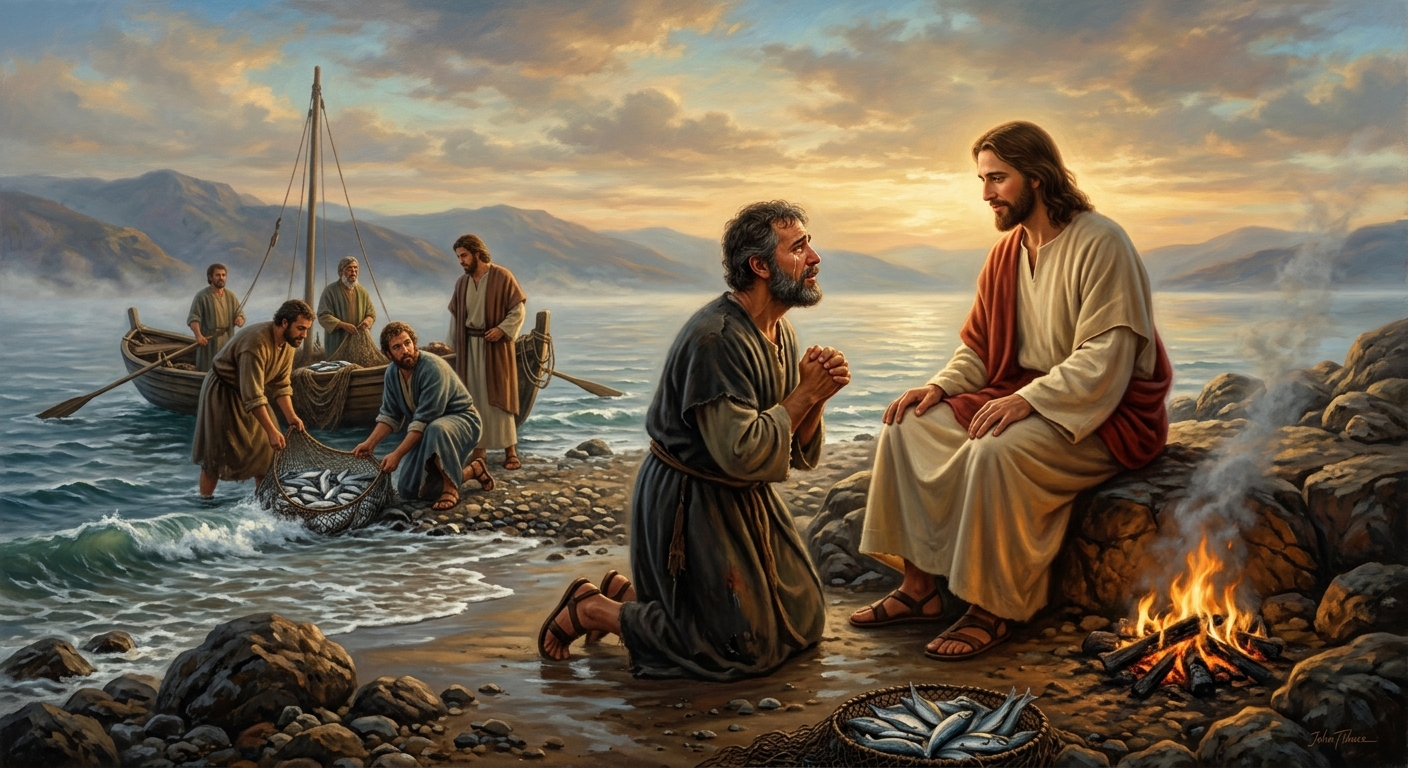
Illustration: Dramatic cinematic biblical illustration for John Chapter 21 showing Restoration of Peter's love for Christ, photorealistic oil painting style.
🔊
Listen to Chapter
Grace Notes Journey Audio Narration
Author
John the Apostle
Written
~90-95 AD
Key Theme
Restoration of Peter's love for Christ
Setting
Sea of Tiberias, early morning
Key Verse
John 21:15
Total Verses
25
Chapter Introduction
*In the quiet hush of dawn, we find our Teacher waiting on the shore. He calls His beloved disciples "Children," inviting them not just to a meal, but to the fullness of their fellowship. Here Peter learns that love for Christ is measured not by words alone, but by the willingness to follow Him again. May this tender scene remind us that grace restores our broken hearts, calling us back to the love we once promised.*
John — Chapter 21 — KJV
1
After these things Jesus shewed himself again to the disciples at the sea of Tiberias; and on this wise shewed he himself.
Simply PutThis marks a fresh appearance of Jesus after His resurrection. The Greek word "deiknumi" (G3776) means to make Himself known, showing that He is still present in familiar places. Like a trusted friend reappearing after a long absence, He reassures the broken-hearted that He continues to walk with them.
2
There were together Simon Peter, and Thomas called Didymus, and Nathanael of Cana in Galilee, and the sons of Zebedee, and two other of his disciples.
Simply PutThe verse lists familiar friends—Peter, Thomas (Didymus), Nathanael, the sons of Zebedee. The Greek term "huios" (G5201) literally means children or offspring, underscoring that they are not just disciples but a family of believers. Even in their confusion and doubt, Jesus gathers them together as His beloved children.
3
Simon Peter saith unto them, I go a fishing. They say unto him, We also go with thee. They went forth, and entered into a ship immediately; and that night they caught nothing.
Simply PutPeter declares his intention to fish, and the others eagerly join him. The Greek verb "poreuomai" (G3325) means to go forth, reflecting human effort. Yet the night ends empty, echoing how we often labor hard only to return with nothing, preparing our hearts for a deeper divine work.
4
But when the morning was now come, Jesus stood on the shore: but the disciples knew not that it was Jesus.
Simply PutAt dawn, Jesus stands on the shore unseen by the disciples. The Greek verb "histemi" (G5605) means to stand upright, a posture of authority and presence. This reminds us that God can be right before our eyes, but we must open our hearts to recognize Him.
5
Then Jesus saith unto them, Children, have ye any meat? They answered him, No.
Simply PutJesus asks the simple question, "Children, have ye any meat?" The Greek word for children (paidi, G5201) can mean beloved ones or dear friends. He shows tender concern for their basic needs, offering comfort to those who are hungry and weary.
6
And he said unto them, Cast the net on the right side of the ship, and ye shall find. They cast therefore, and now they were not able to draw it for the multitude of fishes.
Simply PutHe instructs them to cast the net on the right side of the ship. The Greek verb "ballein" (G2756) means to throw or cast, and "dexios" (G2965) signifies the right side—symbolic of the correct direction. Their obedience results in a miraculous catch overflowing beyond their capacity.
7
Therefore that disciple whom Jesus loved saith unto Peter, It is the Lord. Now when Simon Peter heard that it was the Lord, he girt his fisher’s coat unto him, (for he was naked,) and did cast himself into the sea.
Simply PutUpon realizing it is the Lord, Peter hurriedly girds his fisher's coat (zēnō, G5500) and leaps into the sea. His urgency reflects a heart yearning for intimacy with Jesus, even if he acts clumsily and naked. This deep longing mirrors our desire to be close to God despite our imperfections.
8
And the other disciples came in a little ship; (for they were not far from land, but as it were two hundred cubits,) dragging the net with fishes.
Simply PutThe other disciples row in a small boat, dragging the net of fish (trugō, G3080). Their teamwork demonstrates how believers can work together in following Christ. Even from a short distance, they bring the bounty to shore.
9
As soon then as they were come to land, they saw a fire of coals there, and fish laid thereon, and bread.
Simply PutWhen they reach land, they see a fire of coals and fish laid upon it. This scene is reminiscent of hospitality and provision, showing that after long labor, God prepares a welcoming table for His people.
10
Jesus saith unto them, Bring of the fish which ye have now caught.
Simply PutJesus tells them to bring the fish they have caught (phero, G2985). This invitation is a call to bring our work and life into His presence, trusting that He will transform it.
11
Simon Peter went up, and drew the net to land full of great fishes, an hundred and fifty and three: and for all there were so many, yet was not the net broken.
Simply PutPeter's net fills with a great number of fish—one hundred and fifty-three. The Greek word "ephos" (G1490) means to be filled, a picture of abundant provision. The net remains unbroken despite holding enough fish for everyone.
12
Jesus saith unto them, Come and dine. And none of the disciples durst ask him, Who art thou? knowing that it was the Lord.
Simply PutJesus invites them to dine, and none of the disciples dare ask Him who He is. Their reverence reflects awe at encountering God in the flesh, highlighting the deep respect and humility that true believers hold.
13
Jesus then cometh, and taketh bread, and giveth them, and fish likewise.
Simply PutJesus takes bread and fish, giving them to the disciples. This act reflects God's generous provision for both physical sustenance and spiritual nourishment.
14
This is now the third time that Jesus shewed himself to his disciples, after that he was risen from the dead.
Simply PutThis is the third time Jesus has shown Himself after rising from the dead. The word "deiknumi" (G3776) emphasizes that He is alive and continues to guide His followers, reinforcing the reality of His resurrection.
15
So when they had dined, Jesus saith to Simon Peter, Simon, son of Jonas, lovest thou me more than these? He saith unto him, Yea, Lord; thou knowest that I love thee. He saith unto him, Feed my lambs.
Simply PutJesus asks Peter if he loves Him more than the others. The Greek word "agape" (G26) denotes selfless, divine love. He then instructs Peter to "Feed my lambs," entrusting him with the pastoral care of Christ's flock.
16
He saith to him again the second time, Simon, son of Jonas, lovest thou me? He saith unto him, Yea, Lord; thou knowest that I love thee. He saith unto him, Feed my sheep.
Simply PutWhen Jesus asks Peter again, “Do you love me?” He’s using the Greek word agape (G26), which speaks of deep, selfless love. Peter’s answer, “Yes, Lord,” confirms that Jesus knows his heart. The command to “Feed my sheep” is a call to care for God’s people, not just any flock.
17
He saith unto him the third time, Simon, son of Jonas, lovest thou me? Peter was grieved because he said unto him the third time, Lovest thou me? And he said unto him, Lord, thou knowest all things; thou knowest that I love thee. Jesus saith unto him, Feed my sheep.
Simply PutJesus asks Peter a third time because the simple “Yes” wasn’t enough for his heart. The Greek word for grief, penthos (G4009), shows how Peter was hurting from his earlier denial. Yet Jesus repeats the loving command, assuring Peter that even with doubt, he must still shepherd the believers.
18
Verily, verily, I say unto thee, When thou wast young, thou girdedst thyself, and walkedst whither thou wouldest: but when thou shalt be old, thou shalt stretch forth thy hands, and another shall gird thee, and carry thee whither thou wouldest not.
Simply PutJesus tells Peter about his future in vivid terms. The word “girded” (Greek perizomai, G4059) means to prepare yourself for action. When Peter grows old, he’ll “stretch forth his hands” — a picture of death and being carried by another. It’s a gentle reminder that our own plans will be reshaped by God’s purpose.
19
This spake he, signifying by what death he should glorify God. And when he had spoken this, he saith unto him, Follow me.
Simply PutThis statement points to the way Peter would glorify God through his death. The Greek word for “glorify” (G437) means to bring honor and testimony to God. After speaking this, Jesus simply says, “Follow me,” shifting the focus back to Peter’s present walk with Him.
20
Then Peter, turning about, seeth the disciple whom Jesus loved following; which also leaned on his breast at supper, and said, Lord, which is he that betrayeth thee?
Simply PutPeter turns and sees that beloved disciple of Jesus, the one who leaned on His chest at supper. This figure is seen as a trusted witness of Jesus’ life, and his presence brings comfort to Peter in this moment.
21
Peter seeing him saith to Jesus, Lord, and what shall this man do?
Simply PutPeter asks, “Lord, what will this man do?” He wants to know if there’s a new role for that disciple. But the focus isn’t on the other yet, it’s still on Peter’s own calling.
22
Jesus saith unto him, If I will that he tarry till I come, what is that to thee? follow thou me.
Simply PutJesus replies, “If I want him to stay until I come back, what does that have to do with you? Follow me.” The word “tarry” (Greek menei, G3323) points to remaining in place. Peter is reminded that his own path isn’t dependent on anyone else’s.
23
Then went this saying abroad among the brethren, that that disciple should not die: yet Jesus said not unto him, He shall not die; but, If I will that he tarry till I come, what is that to thee?
Simply PutThis rumor spreads among the brothers that the beloved disciple would not die. Yet Jesus never says “He shall not die”; He simply says that if He wishes him to stay, it’s not for Peter’s concern. The misunderstanding shows how the early church tried to protect their leader.
24
This is the disciple which testifieth of these things, and wrote these things: and we know that his testimony is true.
Simply PutThis is a testimony from that beloved disciple, likely John. The Greek word “witness” (marturia, G3110) means he has seen and recorded the truth. The author affirms that his account is trustworthy.
25
And there are also many other things which Jesus did, the which, if they should be written every one, I suppose that even the world itself could not contain the books that should be written. Amen.
Simply PutThe writer notes that Jesus did so many other things that if we tried to write them all, the world itself could not hold the pages. This underscores how rich and expansive Jesus’ life was, far beyond what any single book could capture.
John 20:19-26This passage parallels the disciples' initial failure to recognize Jesus on the shore, highlighting their gradual transition from confusion to recognition.
Luke 5:4-7The miraculous catch after following Jesus' command mirrors the net on the right side, underscoring obedience leading to abundance.
Matthew 4:18-22The call of Simon Peter as a fisherman foreshadows his later restoration and the commission to "fish for men" in John 21.
John 13:34-35The beloved disciple's role in confirming Jesus' identity connects to the love command and the relational dynamics among the disciples.
Reflect
What simple, everyday moment today feels like Jesus' “bread and fish,” reminding you that He is still present in the ordinary details of your life?