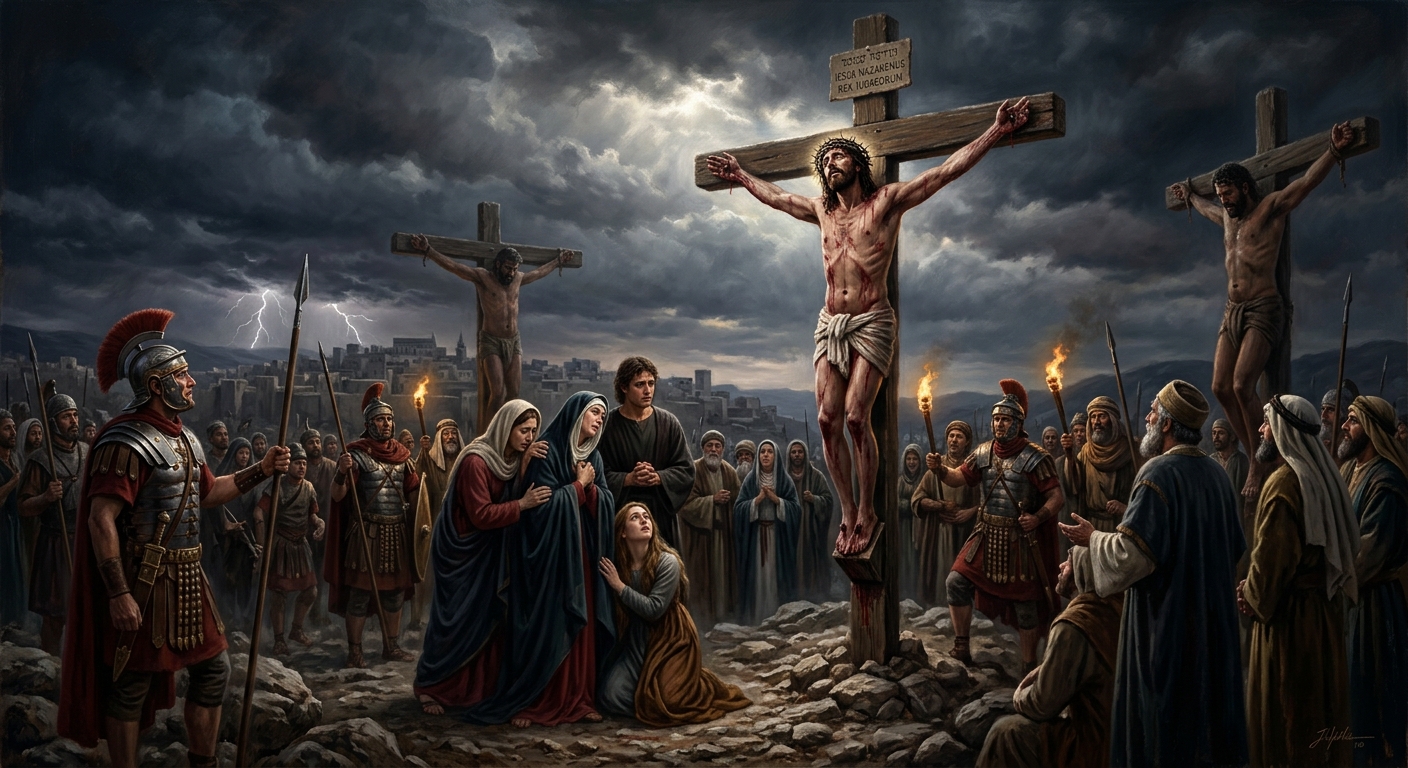
Illustration: Dramatic cinematic biblical illustration for John Chapter 19 showing Christ's sacrificial death, photorealistic oil painting style.
🔊
Listen to Chapter
Grace Notes Journey Audio Narration
Author
John the Apostle
Written
~90-95 AD
Key Theme
Christ's sacrificial death
Setting
Jerusalem - Golgotha, early morning
Key Verse
John 19:30
Total Verses
42
Chapter Introduction
In the quiet hush of that early morning, we see our Savior wrapped in a crown of thorns and a purple robe, bearing the weight of every sin. He stands before Pilate not as a condemned criminal, but as the Lamb who takes away the sins of the world. His words, "It is finished," echo through eternity, reminding us that the price of our redemption has already been paid. Let this chapter draw you into the depth of His love, and may your heart be renewed by His grace.
John — Chapter 19 — KJV
1
Then Pilate therefore took Jesus, and scourged him.
Simply PutPilate’s act of scourging—using the Greek word bastazo (G982), which means to beat hard with a whip—was a brutal punishment meant to break the body and spirit. Think of it as a harsh reminder that even the innocent can be mercilessly beaten, yet Christ stood firm through every strike.
2
And the soldiers platted a crown of thorns, and put it on his head, and they put on him a purple robe,
Simply PutThe soldiers placed a crown of thorns (stefanos, G4712) on Jesus’s head and wrapped him in a purple robe (porphyra, G5435), the finest dye reserved for royalty. They mocked Him with symbols of honor while inflicting painful wounds, showing how the world can dress Christ in splendor yet turn Him into a suffering fool.
3
And said, Hail, King of the Jews! and they smote him with their hands.
Simply Put“Hail, King of the Jews!”—the Greek chairete (G5580) means “rejoice”—was shouted by those who thought they were honoring Him, yet they struck Him with their hands. Their applause was a cruel mockery that echoed the heartache of those who pretend to worship while hurting Christ in reality.
4
Pilate therefore went forth again, and saith unto them, Behold, I bring him forth to you, that ye may know that I find no fault in him.
Simply PutPilate says he finds no fault (adikēma, G22) in Jesus, meaning He bears no guilt. Yet he still brings Him forward, revealing how political powers can wash their hands clean while turning the innocent over to a crowd hungry for blood.
5
Then came Jesus forth, wearing the crown of thorns, and the purple robe. And Pilate saith unto them, Behold the man!
Simply PutJesus emerges wearing the crown of thorns and purple robe, a painful mixture of humiliation and false glory. Pilate’s words “Behold the man!” (ide ton anthrōpon, G444) force us to see Christ’s suffering nakedly, not as a ruler but as the One who bears our sin.
6
When the chief priests therefore and officers saw him, they cried out, saying, Crucify him, crucify him. Pilate saith unto them, Take ye him, and crucify him: for I find no fault in him.
Simply PutThe chief priests and officers demand, “Crucify Him!”—the Greek word stauroō (G4742) describes the method of nailing to a cross. Pilate’s reluctant “Take Him and crucify Him” shows how the true guilt lies in the hearts of those who call for death, not in the one being crucified.
7
The Jews answered him, We have a law, and by our law he ought to die, because he made himself the Son of God.
Simply PutThe Jews claim “He made himself the Son of God” (huios tou theou, G520) and demand His death. The law (nomos, G3545) they invoke is twisted; it becomes a weapon to silence the one who truly reveals God’s love.
8
When Pilate therefore heard that saying, he was the more afraid;
Simply PutPilate’s fear (phobēomai, G527) grows as he realizes the depth of what’s being demanded. He sees that even authority can be shaken by the weight of a single act of injustice.
9
And went again into the judgment hall, and saith unto Jesus, Whence art thou? But Jesus gave him no answer.
Simply PutPilate asks, “Where are you from?” (pothen ei), but Jesus remains silent. His silence invites us to ask ourselves where we come from and whether our answers can withstand the weight of truth.
10
Then saith Pilate unto him, Speakest thou not unto me? knowest thou not that I have power to crucify thee, and have power to release thee?
Simply PutPilate reminds Jesus that he has power (exousia, G1845) to crucify or release Him. He’s trying to manipulate the situation, yet the real power is beyond the Roman governor’s reach—it lies in God’s hand.
11
Jesus answered, Thou couldest have no power at all against me, except it were given thee from above: therefore he that delivered me unto thee hath the greater sin.
Simply PutJesus replies that Pilate’s power (dunamis, G1414) is given “from above” (anōthen, G398). He points out that the one who handed Him over—Judas and the religious leaders—carries a deeper sin, showing how human betrayal is rooted in divine allowance.
12
And from thenceforth Pilate sought to release him: but the Jews cried out, saying, If thou let this man go, thou art not Caesar’s friend: whosoever maketh himself a king speaketh against Caesar.
Simply PutThe Jews warn Pilate that letting the man go would make him “not a friend of Caesar.” Their words reveal how political pressure can force people to betray the One who is truly sovereign.
13
When Pilate therefore heard that saying, he brought Jesus forth, and sat down in the judgment seat in a place that is called the Pavement, but in the Hebrew, Gabbatha.
14
And it was the preparation of the passover, and about the sixth hour: and he saith unto the Jews, Behold your King!
Simply PutOn the day of preparation for Passover, around the sixth hour (noon), Pilate says “Behold your King!”—yet He knows this is a mockery. It shows how even divine timing can be twisted into humiliation when human hearts are set against the Messiah.
15
But they cried out, Away with him, away with him, crucify him. Pilate saith unto them, Shall I crucify your King? The chief priests answered, We have no king but Caesar.
Simply PutThe crowd demands, “Crucify Him!”—the chief priests demand that there be no king but Caesar. Their clamor reflects the human tendency to reject God’s kingship in favor of worldly power, leaving us to choose whom we serve.
16
Then delivered he him therefore unto them to be crucified. And they took Jesus, and led him away.
Simply PutJesus was handed over to the soldiers, and they led Him away to die on a cross. The Greek word for "crucified" (stauroo, G2240) tells us that He was not just carried to a death place but actually nailed there for us.
17
And he bearing his cross went forth into a place called the place of a skull, which is called in the Hebrew Golgotha:
Simply PutJesus took His own cross and walked to the hill called Golgotha (Greek: G1113), meaning "the place of a skull." He embraced the weight of it, stepping into the very spot where humanity meets its deepest pain.
18
Where they crucified him, and two other with him, on either side one, and Jesus in the midst.
Simply PutHe was nailed between two criminals, showing that He is never alone in suffering. Even at the center of this tragic scene, He remains the focus of God's love.
19
And Pilate wrote a title, and put it on the cross. And the writing was, JESUS OF NAZARETH THE KING OF THE JEWS.
Simply PutPilate placed a sign on the cross that read, "JESUS OF NAZARETH THE KING OF THE JEWS." The Greek word for "title" (titlos, G5081) points to a royal proclamation that declares Jesus' true authority over all nations.
20
This title then read many of the Jews: for the place where Jesus was crucified was nigh to the city: and it was written in Hebrew, and Greek, and Latin.
Simply PutThe inscription was written in Hebrew, Greek, and Latin so everyone could read it. This universality shows that the message of Jesus' kingship is meant for all peoples, regardless of language.
21
Then said the chief priests of the Jews to Pilate, Write not, The King of the Jews; but that he said, I am King of the Jews.
Simply PutThe chief priests tried to change the wording from a title into a claim, fearing political trouble. Their effort highlights how they wanted to control the story of Jesus while He Himself stood for truth.
22
Pilate answered, What I have written I have written.
Simply PutPilate replied, "What I have written, I have written." His stubbornness ensures that the title remains, serving as a lasting testimony to Jesus' identity.
23
Then the soldiers, when they had crucified Jesus, took his garments, and made four parts, to every soldier a part; and also his coat: now the coat was without seam, woven from the top throughout.
Simply PutThe soldiers divided Jesus' garments among themselves, but they left His seamless tunic (Greek: chiton, G5529) untouched. This unbroken cloth symbolizes that all believers will one day be united as a single body.
24
They said therefore among themselves, Let us not rend it, but cast lots for it, whose it shall be: that the scripture might be fulfilled, which saith, They parted my raiment among them, and for my vesture they did cast lots. These things therefore the soldiers did.
Simply PutThey cast lots for the seamless tunic, fulfilling Isaiah's prophecy (Greek: graphe, G1126). God's plan was already set into motion, and even the soldiers' actions served that divine purpose.
25
Now there stood by the cross of Jesus his mother, and his mother’s sister, Mary the wife of Cleophas, and Mary Magdalene.
Simply PutAt the foot of the cross stood Jesus' mother, her sister's husband, and Mary Magdalene. Their presence reminds us that even in His deepest agony, Jesus kept close those He loved.
26
When Jesus therefore saw his mother, and the disciple standing by, whom he loved, he saith unto his mother, Woman, behold thy son!
Simply PutSeeing His mother and the beloved disciple, Jesus said to her, "Woman, behold thy son!" The Greek word for "woman" (gynaika, G1115) reflects a respectful address that acknowledges their bond even in death.
27
Then saith he to the disciple, Behold thy mother! And from that hour that disciple took her unto his own home.
Simply PutHe then told the disciple, "Behold thy mother!" From that moment the disciple took care of her. This shows how followers should look after one another as family.
28
After this, Jesus knowing that all things were now accomplished, that the scripture might be fulfilled, saith, I thirst.
Simply PutKnowing His mission was complete, Jesus said, "I thirst." Even in this final hour, He expressed a simple human need, showing His solidarity with our suffering.
29
Now there was set a vessel full of vinegar: and they filled a spunge with vinegar, and put it upon hyssop, and put it to his mouth.
Simply PutThey offered Him sour vinegar on a hyssop reed, fulfilling another prophetic detail. This bitter drink reflects the bitterness of Christ's sacrifice for humanity.
30
When Jesus therefore had received the vinegar, he said, It is finished: and he bowed his head, and gave up the ghost.
Simply PutAfter drinking the vinegar, Jesus declared, "It is finished" (Greek: tetelēma, G5045), bowed His head, and gave up His spirit. With these words He announced that the work of redemption was fully accomplished.
31
The Jews therefore, because it was the preparation, that the bodies should not remain upon the cross on the sabbath day, (for that sabbath day was an high day,) besought Pilate that their legs might be broken, and that they might be taken away.
Simply PutThe Jews asked Pilate to have the legs of those on the cross broken because it was the day of preparation (Greek: παρασκευά, Strong's G3875), meaning the day before the Sabbath. They wanted the bodies removed early so they wouldn't linger on the holy day.
32
Then came the soldiers, and brake the legs of the first, and of the other which was crucified with him.
Simply PutThe soldiers came and broke the legs of the first man taken down from the cross, and then of the second man who was crucified alongside him. The Greek word for break (κάμνος, Strong's G2590) shows they were cracking the bones to hasten death.
33
But when they came to Jesus, and saw that he was dead already, they brake not his legs:
Simply PutWhen they reached Jesus, they saw He was already dead (Greek: νεκρός, Strong's G3588), so they didn’t break His legs. This fulfilled the prophecy that none of His bones would be broken.
34
But one of the soldiers with a spear pierced his side, and forthwith came there out blood and water.
Simply PutOne soldier thrust a spear into Jesus’ side (Greek: λόγχη, Strong's G3050), and blood and water flowed out. These fluids represent the fullness of His sacrifice—His life (blood) pouring out, and His spirit (water) flowing forth.
35
And he that saw it bare record, and his record is true: and he knoweth that he saith true, that ye might believe.
Simply PutThe man who saw this testified (Greek: μαρτυρία, Strong's G3145), and his witness is trustworthy. He knows he’s telling the truth so that you might believe what truly happened.
36
For these things were done, that the scripture should be fulfilled, A bone of him shall not be broken.
Simply PutThese events were done to fulfill Scripture (Greek: γραφή, Strong's G1126). Psalm 34 says a bone of the Messiah shall not be broken (Greek: ὀστέον, Strong's G3685), and that prophecy is fulfilled here.
37
And again another scripture saith, They shall look on him whom they pierced.
Simply PutAnother Scripture says, “They shall look on Him whom they pierced.” This refers to the prophecy in Zechariah that the Messiah would be pierced (Greek: λόγχη, Strong's G3050).
38
And after this Joseph of Arimathaea, being a disciple of Jesus, but secretly for fear of the Jews, besought Pilate that he might take away the body of Jesus: and Pilate gave him leave. He came therefore, and took the body of Jesus.
Simply PutJoseph of Arimathaea, a secret disciple (Greek: μαθητής, Strong's G310) because he feared the Jews, begged Pilate for Jesus’ body and was granted permission. He showed true devotion by taking the body away for burial.
39
And there came also Nicodemus, which at the first came to Jesus by night, and brought a mixture of myrrh and aloes, about an hundred pound weight.
Simply PutNicodemus, who first came to Jesus at night (Greek: νύξ, Strong's G3687), brought a large amount of myrrh (Greek: σμόδα, Strong's G4759) and aloes (Greek: λάδον, Strong's G3022), showing reverence and love for the One who had died.
40
Then took they the body of Jesus, and wound it in linen clothes with the spices, as the manner of the Jews is to bury.
Simply PutThey wrapped Jesus’ body in linen cloths (Greek: λινὸν, Strong's G3009) and anointed it with spices (Greek: μυρόν, Strong's G3465), following Jewish burial customs. This careful preparation honored Him even after death.
41
Now in the place where he was crucified there was a garden; and in the garden a new sepulchre, wherein was never man yet laid.
Simply PutNear the place of crucifixion, there was a garden and in it a new tomb (Greek: μνῆμα, Strong's G3360) where no one had yet been laid to rest. This fresh sepulchre would become the place of Jesus’ resurrection.
42
There laid they Jesus therefore because of the Jews’ preparation day; for the sepulchre was nigh at hand.
Simply PutThey laid Jesus in this tomb because it was still the day of preparation (Greek: παρασκευά, Strong's G3875), and the tomb was nearby. They ensured He was buried before the Sabbath began.
Isaiah 53:5This prophecy of the suffering servant foretells Jesus' scourging and bearing of our sins, illuminating John 19:1.
Psalm 22:16-18The psalmist's depiction of being pierced and the casting of lots over garments parallels Jesus' crucifixion in John 19:6-7.
Mark 15:16-20This passage recounts the same soldiers' actions of crowning Jesus with thorns and dressing Him in purple, providing a parallel account to John 19:2-5.
Matthew 27:11-14Pilate's questioning and the chief priests' accusation of Jesus claiming to be Son of God mirror the dialogue in John 19:4-7.
Reflect
What is a decision or promise you have made that feels as fixed as Pilate's inscription, and how does it shape the way you move forward today?