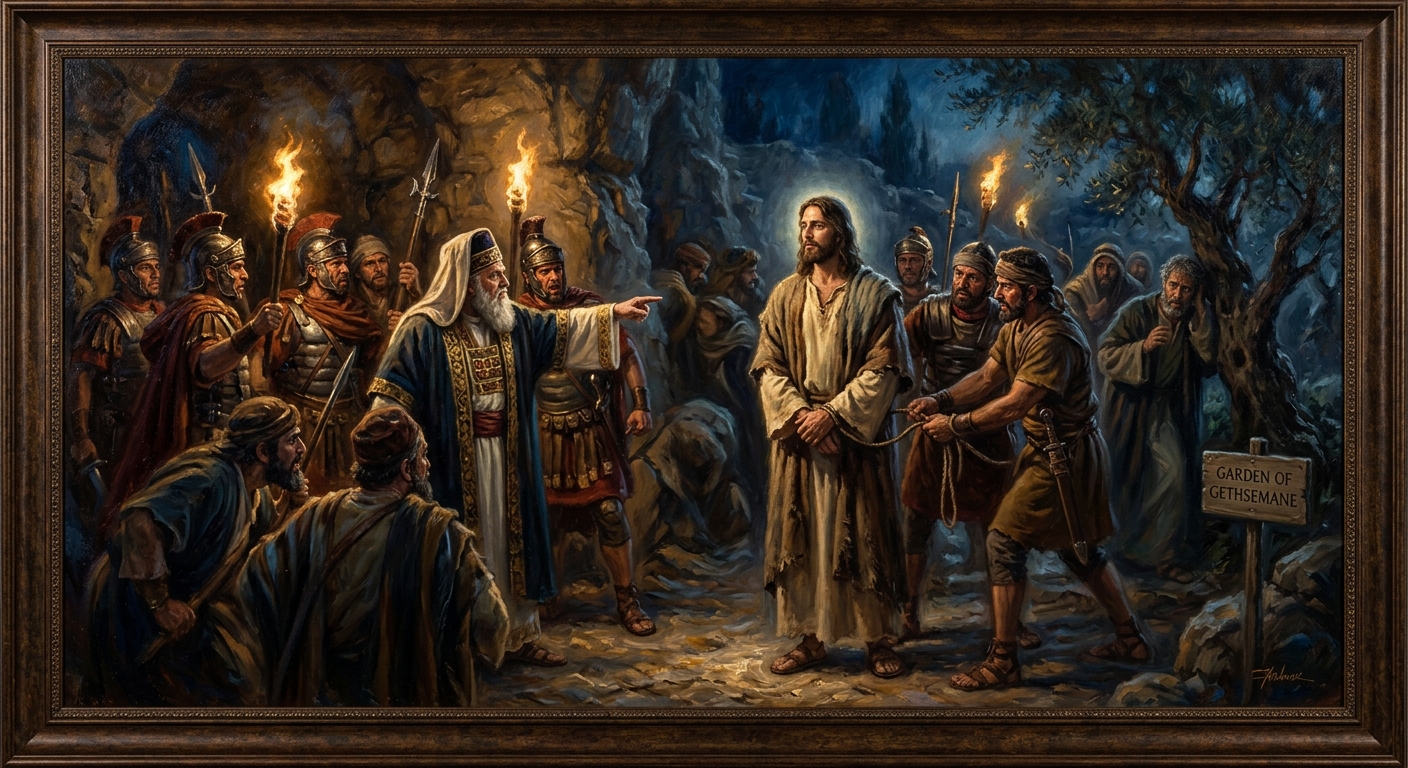
Illustration: Dramatic cinematic biblical illustration for John Chapter 18 showing Jesus' fulfillment of divine purpose, photorealistic oil painting style.
🔊
Listen to Chapter
Grace Notes Journey Audio Narration
Author
John the Apostle
Written
~90-95 AD
Key Theme
Jesus' fulfillment of divine purpose
Setting
Gethsemane, Jerusalem - night
Key Verse
John 18:37
Total Verses
40
Chapter Introduction
*In this quiet hour, the Master walks toward His destiny with calm assurance. He knows every step that will be taken and embraces it for the love of the world. Even as betrayal unfolds, He offers Himself openly, saying, “I am He.” Let this remind us that God’s plan is perfect and our trust rests in His sovereign grace.*
John — Chapter 18 — KJV
1
When Jesus had spoken these words, he went forth with his disciples over the brook Cedron, where was a garden, into the which he entered, and his disciples.
Simply PutJesus walked out of the garden where He often spent time with His disciples. The Greek word "kēdon" (G1485) refers to a watercourse, reminding us that even in places of peace He moves toward the heavy things He must do. For you in pain, remember that God never stays put; He moves toward your need.
2
And Judas also, which betrayed him, knew the place: for Jesus ofttimes resorted thither with his disciples.
Simply PutJudas, who would betray Him, knew the spot because Jesus often went there with His friends. The Greek verb "poreuomai" (G4161) means to go away, indicating that Jesus often sought solitude in the garden. Even when you feel betrayed, know that God’s presence is constant and familiar.
3
Judas then, having received a band of men and officers from the chief priests and Pharisees, cometh thither with lanterns and torches and weapons.
Simply PutJudas brought a band of soldiers, officers, and lanterns to the garden. The Greek "phylax" (G5409) means a guard, showing that the world’s power and weapons came against Him. In your doubts, you see that earthly force can’t stop the divine purpose.
4
Jesus therefore, knowing all things that should come upon him, went forth, and said unto them, Whom seek ye?
Simply PutJesus, knowing everything that would happen to Him, stepped forward and asked, “Whom are you looking for?” The Greek "ginomai" (G1492) means to become or happen, reflecting His divine foreknowledge. When you’re in real hunger for God, trust that He knows the path ahead.
5
They answered him, Jesus of Nazareth. Jesus saith unto them, I am he. And Judas also, which betrayed him, stood with them.
Simply PutThey replied “Jesus of Nazareth.” Jesus said, “I am He,” and Judas stood among them. The Greek "ego eimi" (G225) is a powerful declaration of identity, the same as “I am the way, the truth.” In pain, know that He stands with you, even when betrayal is near.
6
As soon then as he had said unto them, I am he, they went backward, and fell to the ground.
Simply PutAs soon as Jesus said the words “I am He,” they fell back and hit the ground. The Greek "piptō" (G4325) means to fall, showing their shock and fear. Even in darkness, Jesus’ words can bring you down to the ground for a fresh start.
7
Then asked he them again, Whom seek ye? And they said, Jesus of Nazareth.
Simply PutHe asked again, “Whom are you looking for?” They answered, “Jesus of Nazareth.” The repetition shows that the human heart can be indecisive. In doubt, ask yourself: who are you truly seeking?
8
Jesus answered, I have told you that I am he: if therefore ye seek me, let these go their way:
Simply PutJesus said, “If you want to find me, let these men go.” The Greek "aphistēmi" (G530) means to send away, showing that He would not let His friends be harmed. In hunger for God, understand that He protects those He loves.
9
That the saying might be fulfilled, which he spake, Of them which thou gavest me have I lost none.
Simply PutThis fulfilled the prophecy that none of those given to Him would be lost. The Greek "apollumi" (G663) means “to destroy or lose,” showing that the plan was perfect. Even when you feel lost, God’s purpose is unchanging.
10
Then Simon Peter having a sword drew it, and smote the high priest’s servant, and cut off his right ear. The servant’s name was Malchus.
Simply PutSimon Peter drew his sword and cut off the servant’s right ear, named Malchus (meaning “king”). The name reminds us that even a servant of the king was wounded. In anger, remember that violence cuts only flesh; it heals no soul.
11
Then said Jesus unto Peter, Put up thy sword into the sheath: the cup which my Father hath given me, shall I not drink it?
Simply PutJesus told Peter to put away his sword, saying He “has not yet drunk the cup” His Father gave Him. The Greek "phialē" (G2591) means a cup of suffering. In pain, surrender your weapons and trust that God’s plan will be fulfilled.
12
Then the band and the captain and officers of the Jews took Jesus, and bound him,
Simply PutThe soldiers took Jesus, bound Him. The Greek "dianomai" (G1493) means to bind or imprison. Even in bondage, the One who is bound is free.
13
And led him away to Annas first; for he was father in law to Caiaphas, which was the high priest that same year.
Simply PutThey led Him first to Annas, father-in-law to Caiaphas. The family ties show how the religious leaders were connected. In doubt, see that even powerful families are subject to divine will.
14
Now Caiaphas was he, which gave counsel to the Jews, that it was expedient that one man should die for the people.
Simply PutCaiaphas told the people it was good for one man to die for them. The Greek "epithumia" (G1415) means “it is fitting,” pointing to the necessity of substitution. In hunger, know that Jesus took on the penalty you should have paid.
15
And Simon Peter followed Jesus, and so did another disciple: that disciple was known unto the high priest, and went in with Jesus into the palace of the high priest.
Simply PutSimon Peter followed Jesus, and another disciple who knew the high priest went with Him into the palace. The Greek "akoloutheō" (G539) means to follow closely, showing loyalty. Even when the night is dark, true disciples walk with Him.
16
But Peter stood at the door without. Then went out that other disciple, which was known unto the high priest, and spake unto her that kept the door, and brought in Peter.
Simply PutPeter was waiting just outside the high priest’s courtyard, feeling the weight of his fear. The Greek word for “high priest” (ἀρχιερεύς) means the chief religious leader, the one who decides if a man is clean or guilty. That other disciple was known to him and opened the inner door, showing how even in moments of crisis God can provide a quiet opening for us.
17
Then saith the damsel that kept the door unto Peter, Art not thou also one of this man’s disciples? He saith, I am not.
Simply PutThe girl at the door asked Peter if he was one of Jesus’ followers, and he replied “I am not.” The Greek word for “one” (εἷς) emphasizes his need to blend in, to be just a single face among many. In our own moments of doubt we sometimes deny the very love that has shaped us, hoping to hide from a painful truth.
18
And the servants and officers stood there, who had made a fire of coals; for it was cold: and they warmed themselves: and Peter stood with them, and warmed himself.
Simply PutPeter stood by the fire of coals, warming his hands because it was cold. The Greek word “θερμόν” (thermon) speaks of physical warmth, yet it also hints at a deeper longing for spiritual heat. Even when we stand in the shadows of guilt, there is still a place where we can feel a small comfort—a reminder that God’s presence never fully leaves us.
19
The high priest then asked Jesus of his disciples, and of his doctrine.
Simply PutThe high priest asked Jesus about his disciples and his teaching. In the Greek, “διδασκαλία” (didaskalia) means the body of instruction or doctrine. For a soul in need, this question is about identity: Who am I following? What truth do I hold onto amid the chaos?
20
Jesus answered him, I spake openly to the world; I ever taught in the synagogue, and in the temple, whither the Jews always resort; and in secret have I said nothing.
Simply PutJesus replied that He had always spoken openly to everyone, in synagogues and the temple—places where Jews gathered. The Greek word “ἀποκάλυψις” (apokalypsis) means a full revelation or uncovering. In moments of fear, we are reminded that God’s truth is not hidden; it has always been offered to those who seek Him.
21
Why askest thou me? ask them which heard me, what I have said unto them: behold, they know what I said.
Simply PutJesus asked the high priest to ask his own followers what He had taught. The Greek “ἔρωτα” (erota) means to ask or inquire. When we feel doubted, this verse invites us to let the witness of those who have heard God’s voice confirm His love for us.
22
And when he had thus spoken, one of the officers which stood by struck Jesus with the palm of his hand, saying, Answerest thou the high priest so?
Simply PutOne of the officers slapped Jesus with his hand, asking if He answered the high priest truly. The Greek word “πάλμα” (palm) signifies a sharp, sudden strike. Even in our deepest pain, we may be met with harshness; yet God’s answer remains steady and measured.
23
Jesus answered him, If I have spoken evil, bear witness of the evil: but if well, why smitest thou me?
Simply PutJesus responded, “If I have spoken evil, bear witness of the evil; but if well, why smite me?” The Greek “πονηρία” (poneria) means wickedness or evil. In our doubts, we can ask: If God’s words are true, why does He seem to be striking us? The answer lies in the trustworthiness of His testimony.
24
Now Annas had sent him bound unto Caiaphas the high priest.
Simply PutAnnas sent Jesus, bound, to Caiaphas the high priest. The Greek “δεσμευμένος” (desmeumenos) means bound or restrained. In the midst of our own chains—whether fear, sin, or doubt—we are reminded that God is still moving through us, even when we feel constrained.
25
And Simon Peter stood and warmed himself. They said therefore unto him, Art not thou also one of his disciples? He denied it, and said, I am not.
Simply PutPeter stood and warmed himself again; they asked if he was a disciple, and he denied it. The word “denied” (ἄρτιος) shows an urgent attempt to disassociate. In our hunger for God, we may sometimes deny Him to protect ourselves, yet the truth remains that He sees our heart.
26
One of the servants of the high priest, being his kinsman whose ear Peter cut off, saith, Did not I see thee in the garden with him?
Simply PutA servant of the high priest, a relative whose ear Peter had cut off, said, “Did I not see you in the garden with Him?” The Greek “συγγενής” (syngenes) means kinsman or relative. Even our smallest actions—cutting off an ear—can be noticed by God, and they become part of the story He weaves for us.
27
Peter then denied again: and immediately the cock crew.
Simply PutPeter denied again, and immediately the rooster crowed. The Greek “ὀρνίς” (ornis) means a bird, specifically the rooster. In moments of fear, this reminds us that God’s timing is precise; He knows when we will stand or fall.
28
Then led they Jesus from Caiaphas unto the hall of judgment: and it was early; and they themselves went not into the judgment hall, lest they should be defiled; but that they might eat the passover.
Simply PutThey led Jesus from Caiaphas to the judgment hall early in the morning, and they themselves did not go inside so as not to become defiled; they went to eat the Passover. The Greek “αἰών” (aion) can refer to a period or age, here the hall of judgment. Even when we are called away from holy places for practical reasons, God’s work continues.
29
Pilate then went out unto them, and said, What accusation bring ye against this man?
Simply PutPilate went out to them and asked what accusation they brought against this man. The Greek “κατηγορία” (katigoria) means a formal charge or accusation. In our doubts, we must ask: What is the real charge against us? Is it sin, fear, or misunderstanding?
30
They answered and said unto him, If he were not a malefactor, we would not have delivered him up unto thee.
Simply PutThey replied that if He were not a malefactor, they would not have delivered Him to Pilate. The Greek “ποιητής” (poietes) means a doer or maker of deeds. When we feel wrongly accused, this verse reminds us that God knows the truth behind every claim, and He sees who truly carries out deeds of love.
31
Then said Pilate unto them, Take ye him, and judge him according to your law. The Jews therefore said unto him, It is not lawful for us to put any man to death:
Simply PutPilate hands over Jesus to the Jewish leaders, saying “Take ye him and judge him according to your law.” The Greek word for “law” (nomos, G3555) points to the whole system of rules they claimed to uphold. For anyone feeling judged or abandoned, this reminds us that earthly judgments can be passed around without finding the heart of truth.
32
That the saying of Jesus might be fulfilled, which he spake, signifying what death he should die.
Simply Put“It is not lawful for us to put any man to death,” the Jews reply, showing they didn’t have authority over life and death. The Greek word for “death” (thanatos, G2329) is the very fate that Jesus had already spoken about. In moments of doubt, we can see that even the most painful events may be part of a divine purpose beyond our sight.
33
Then Pilate entered into the judgment hall again, and called Jesus, and said unto him, Art thou the King of the Jews?
Simply PutPilate asks Jesus, “Art thou the King of the Jews?” The word “King” (basileus, G932) carries weight—it means a ruler with divine authority. When you’re wrestling with who truly leads you, this question invites us to consider a kingdom that doesn’t rely on earthly power but on something deeper.
34
Jesus answered him, Sayest thou this thing of thyself, or did others tell it thee of me?
Simply PutJesus replies, “Sayest thou this thing of thyself, or did others tell it thee of me?” The Greek word “rhema” (G7465) means a spoken utterance or truth. It shows that Jesus was not just playing with words; He wanted to know whether Pilate’s claim came from his own heart or was merely gossip. For those in real pain, it speaks to the need for genuine honesty about what we truly believe.
35
Pilate answered, Am I a Jew? Thine own nation and the chief priests have delivered thee unto me: what hast thou done?
Simply PutPilate, feeling no authority, says, “Am I a Jew?” He points to the “nation” (ethnos, G1766) and its leaders who handed Jesus over. This highlights how political divisions can blind people to truth. In your own hunger for God, notice that sometimes the real issue isn’t about ethnicity or politics, but about who truly stands before the truth.
36
Jesus answered, My kingdom is not of this world: if my kingdom were of this world, then would my servants fight, that I should not be delivered to the Jews: but now is my kingdom not from hence.
Simply PutJesus answers, “My kingdom is not of this world.” The Greek word “kingdom” (basileia, G932) reveals a realm of spiritual power, not earthly clamor. He explains that if it were worldly, his servants would fight to keep him from being handed over. When you’re feeling the world’s pressures, remember that His kingdom offers peace beyond any battlefield.
37
Pilate therefore said unto him, Art thou a king then? Jesus answered, Thou sayest that I am a king. To this end was I born, and for this cause came I into the world, that I should bear witness unto the truth. Every one that is of the truth heareth my voice.
Simply PutPilate asks again, “Art thou a king then?” Jesus says, “Thou sayest that I am a king. To this end was I born…” The word for “truth” (alētheia, G265) underlies this moment. Jesus came to bear witness to the truth that sets hearts free, and anyone who loves truth hears His voice. In moments of doubt, cling to the promise that truth will always be heard.
38
Pilate saith unto him, What is truth? And when he had said this, he went out again unto the Jews, and saith unto them, I find in him no fault at all.
Simply Put“What is truth?” Pilate asks, then steps back. The Greek word for “truth” (alētheia) again surfaces as a deep question that still haunts us today. His curiosity shows how people can be so close to truth yet never grasp it. If you’re seeking meaning, know that the search is a journey toward the everlasting reality He offers.
39
But ye have a custom, that I should release unto you one at the passover: will ye therefore that I release unto you the King of the Jews?
Simply PutPilate tells the Jews that he can release one prisoner at Passover, asking if they’d like “the King of the Jews.” The custom of releasing a prisoner was meant to bring hope during the holy feast. Yet here, it becomes a choice between hope and fear—an image for anyone who feels torn between trusting God’s plan or following the crowd.
40
Then cried they all again, saying, Not this man, but Barabbas. Now Barabbas was a robber.
Simply PutThe crowd shouts for Barabbas, a robber. “Barabbas” means “son of the father,” an ironic title for a thief. The choice to free a sinner over Christ highlights how easy it is for us to choose the familiar wrong path. In real hunger, this reminds you that God offers a better way, even when the world pulls you in the opposite direction.
When a friend or colleague asks for your honest opinion on an important matter, how does the confidence of those who heard Jesus' words in John 18:37 influence your willingness to speak truthfully?