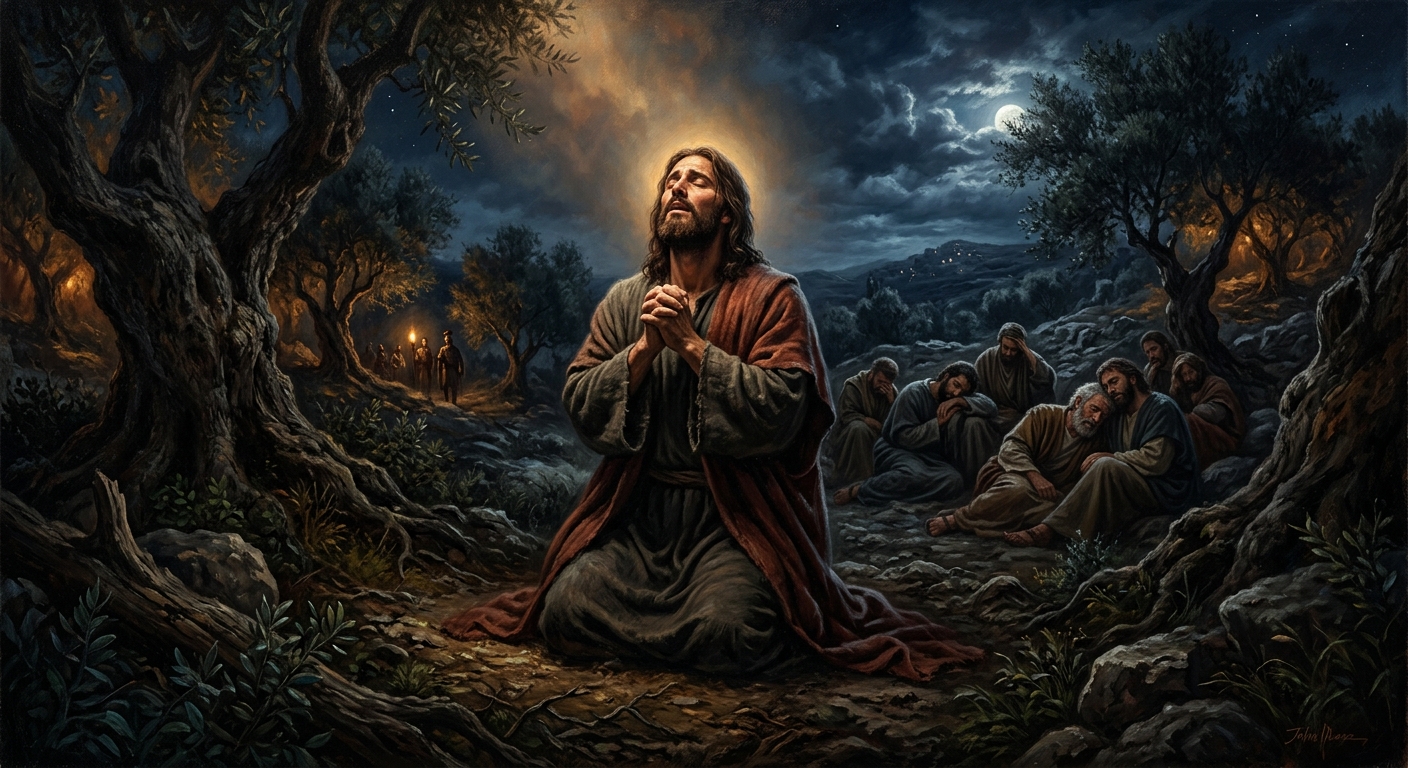
Illustration: Dramatic cinematic biblical illustration for John Chapter 17 showing Christ's High Priestly Prayer, photorealistic oil painting style.
Author
John the Apostle
Written
~90 AD
Key Theme
Christ's High Priestly Prayer
Setting
Upper Room, Jerusalem
Key Verse
John 17:3
Total Verses
26
Chapter Introduction
*In this sacred moment, the Son lifts His eyes to the Father and pours out a prayer that bridges heaven and earth. He speaks of the hour of glory, not for Himself alone, but for all who will believe. The promise He offers—eternal life—is a deep invitation to know the true God and His Son intimately. As He completes the work given Him, we are reminded that our own calling is to share in this divine communion and love.*
John — Chapter 17 — KJV
1
These words spake Jesus, and lifted up his eyes to heaven, and said, Father, the hour is come; glorify thy Son, that thy Son also may glorify thee:
Simply PutJesus lifts His eyes to heaven and says, “Father, the hour is come.” The Greek word for “hour” (hora, G2249) means a divinely appointed moment. Here Jesus is telling the Father that His time to shine forth and complete the work of salvation has arrived. He asks God to glorify Him (doxa, G1391) so that the Son can bring glory back to the Father.
2
As thou hast given him power over all flesh, that he should give eternal life to as many as thou hast given him.
Simply PutThe “power” (exousia, G1765) given to the Son means authority over all flesh. This power is used to give “eternal life” (zoe aionios, G2222) to those the Father has placed in His care. It’s not just a future promise; it’s a present, living relationship that begins now and lasts forever.
3
And this is life eternal, that they might know thee the only true God, and Jesus Christ, whom thou hast sent.
Simply Put“Life eternal” is defined here as knowing the “only true God” (the Greek ginōskō, G1093, means to truly know). It’s a personal relationship with the Father and His Son, Jesus Christ. If you hunger for certainty, this verse tells you that true life comes from knowing God intimately.
4
I have glorified thee on the earth: I have finished the work which thou gavest me to do.
Simply PutJesus declares He has “glorified” the Father on earth and finished the work (ergon, G2040) He was given. The task is complete—He has revealed God’s love through His life, death, and resurrection. Anyone feeling the weight of unfinished business can rest in the fact that this divine mission is fully accomplished.
5
And now, O Father, glorify thou me with thine own self with the glory which I had with thee before the world was.
Simply PutJesus now asks the Father to “glorify” Him with the glory He shared before creation (doxa, G1391). The pre‑world relationship means that the Son’s identity is rooted in God’s eternal nature. In moments of doubt, remember that you are part of a divine story that started before the world began.
6
I have manifested thy name unto the men which thou gavest me out of the world: thine they were, and thou gavest them me; and they have kept thy word.
Simply PutJesus has “manifested” (phaenō, G5393) the Father’s name to those who were given Him out of the world. To “manifest” is to make visible, to shine forth. Those who have kept His word are living testimonies of God’s presence in a world that often forgets Him.
7
Now they have known that all things whatsoever thou hast given me are of thee.
Simply PutThe disciples now “know” (ginōskō, G1093) that all the gifts they received come from the Father. Knowledge here is experiential—it's a lived reality, not just an intellectual idea. If you’re wrestling with uncertainty, this verse reminds you that the reality of God’s love is evident in His giving.
8
For I have given unto them the words which thou gavest me; and they have received them, and have known surely that I came out from thee, and they have believed that thou didst send me.
Simply PutJesus gave them the words (rhema) He received from the Father, and they “received” (lambanō, G2980) them, confirming He came from the Father. Their belief (pisteuō, G4102) was a trust that He was sent. In moments of hunger for truth, this shows that the Holy Spirit makes God’s words alive within us.
9
I pray for them: I pray not for the world, but for them which thou hast given me; for they are thine.
Simply PutJesus “prays” (proseuchō, G4395) for His disciples—not for the world, but for those given to Him. Prayer here is a deep intercession, showing that Jesus cares personally for each believer’s well‑being. If you feel alone in pain, know the Savior is constantly praying for your specific needs.
10
And all mine are thine, and thine are mine; and I am glorified in them.
Simply PutAll that belongs to Jesus belongs to the Father, and He is glorified in them. Their unity reflects divine glory. In times of division or loneliness, this verse urges us to see ourselves as part of a larger family that shares in God’s glory.
11
And now I am no more in the world, but these are in the world, and I come to thee. Holy Father, keep through thine own name those whom thou hast given me, that they may be one, as we are.
Simply PutJesus, now no longer “in the world,” asks the Father to keep His disciples through His name so they may be one as He and the Father are. The word “keep” (phulō, G5383) means to protect and preserve. If you fear being scattered, this prayer assures that God’s covenant binds believers together.
12
While I was with them in the world, I kept them in thy name: those that thou gavest me I have kept, and none of them is lost, but the son of perdition; that the scripture might be fulfilled.
Simply PutWhile with His disciples, Jesus kept them in the Father’s name; none were lost except “the son of perdition” (apoleia, G2773). This refers to the one who chose rejection. The Scripture was fulfilled, showing that God’s plan includes both rescue and warning.
13
And now come I to thee; and these things I speak in the world, that they might have my joy fulfilled in themselves.
Simply PutJesus comes to the Father, speaking now so His disciples may have His joy (chara, G5485) fulfilled in themselves. “Joy” here is deep delight and peace that comes from the Spirit’s presence. In moments of emptiness, this promises a joy that fills the heart.
14
I have given them thy word; and the world hath hated them, because they are not of the world, even as I am not of the world.
Simply PutHe gave them the Father’s word, and the world “hated” them (misos, G3395) because they weren’t of this world—just as He isn’t. The Greek “world” (kosmos, G2889) represents the system that opposes God. If you feel alienated, this shows that being set apart is a sign of belonging to Christ.
15
I pray not that thou shouldest take them out of the world, but that thou shouldest keep them from the evil.
Simply PutJesus prays not for removal from the world, but that they be kept “from the evil” (ponēros, G4056). The focus is on protection from harmful influences rather than isolation. In a world full of temptation, this prayer asks God to shield His children from the snares that would harm them.
16
They are not of the world, even as I am not of the world.
Simply PutEven though they walk on this earth, their hearts belong to another kingdom. The Greek word for “world” (kosmos) refers to the system of values and priorities that pulls people away from God. Jesus reminds us that He, too, was never truly part of this fleeting system.
17
Sanctify them through thy truth: thy word is truth.
Simply Put“Sanctify them through thy truth” – the verb sanctify (hágiosō) means to set apart as holy and pure. Jesus is saying, “Let My Word be the light that cleanses you.” In our deepest need for peace, we can trust that God’s truth makes us whole.
18
As thou hast sent me into the world, even so have I also sent them into the world.
Simply Put“As thou hast sent me into the world, even so have I also sent them.” The verb sent (apostellō) means to commission or launch into a mission. Jesus is telling us that He has placed His followers in the world with a purpose—to shine His love wherever they go.
19
And for their sakes I sanctify myself, that they also might be sanctified through the truth.
Simply Put“And for their sakes I sanctify myself, that they also might be sanctified through the truth.” Here again is sanctify (hágiosō). Jesus shows that His own obedience to God’s will paves the way for us to be truly set apart. When He walks in truth, we can follow and become holy too.
20
Neither pray I for these alone, but for them also which shall believe on me through their word;
Simply Put“Neither pray I for these alone, but for them also which shall believe on me through their word.” The Greek word for “believe” (pisteuo) means to trust with the whole heart. Jesus prays for all future believers, knowing that faith spreads from one heart to another.
21
That they all may be one; as thou, Father, art in me, and I in thee, that they also may be one in us: that the world may believe that thou hast sent me.
Simply Put“That they all may be one; as thou, Father, art in me, and I in thee.” The word “one” (hen) speaks of deep unity—a shared life. Jesus desires that we share the same love and purpose He shares with the Father, so the world can see God’s plan.
22
And the glory which thou gavest me I have given them; that they may be one, even as we are one:
Simply Put“And the glory which thou gavest me I have given them; that they may be one, even as we are one.” Glory (doxa) is the radiant presence of God. Jesus shares this divine light with His disciples, inviting them into a fellowship that mirrors the perfect unity of Father and Son.
23
I in them, and thou in me, that they may be made perfect in one; and that the world may know that thou hast sent me, and hast loved them, as thou hast loved me.
Simply Put“I in them, and thou in me, that they may be made perfect in one.” The Greek word “perfect” (teleios) means fully mature and complete. Jesus seeks to bring us into a wholeness that reflects God’s love, so the world can recognize His sending.
24
Father, I will that they also, whom thou hast given me, be with me where I am; that they may behold my glory, which thou hast given me: for thou lovedst me before the foundation of the world.
Simply Put“Father, I will that they also, whom thou hast given me, be with me where I am; that they may behold my glory.” The word “foundation” (archē) points to the beginning of all things. Jesus longs for believers to be with Him and see His eternal glory, a love that existed before anything else.
25
O righteous Father, the world hath not known thee: but I have known thee, and these have known that thou hast sent me.
Simply Put“O righteous Father, the world hath not known thee; but I have known thee.” Righteous (dikaios) captures God’s perfect justice and love. While the world is blind to Him, Jesus invites us into a personal relationship where we truly know our Father.
26
And I have declared unto them thy name, and will declare it: that the love wherewith thou hast loved me may be in them, and I in them.
Simply Put“And I have declared unto them thy name, and will declare it; that the love wherewith thou hast loved me may be in them.” Love (agape) is the selfless, unconditional affection that God poured into Jesus. By sharing His name, Jesus spreads this divine love so it can fill every heart that receives it.
John 3:16This verse reveals the Father's gift of eternal life through belief in Jesus, directly illuminating John 17:2‑3’s promise of everlasting life to those given by the Father.
John 5:19Here Jesus declares that He works as the Father does, receiving authority over all flesh from Him, which parallels John 17:2’s statement of the Father's power granted to the Son.
1 John 5:20This passage emphasizes that knowing the only true God and Jesus Christ is essential for salvation, echoing John 17:3’s definition of eternal life.
Philippians 2:9The apostle declares that God has glorified Jesus and bestowed upon Him the name above every name, aligning with Jesus’ prayer in John 17:5 to be glorified with the Father.
Reflect
How does carrying God's word in your everyday life—at work, school, or home—shape the way you respond when those around you seem indifferent or even hostile to your faith?